The Moment
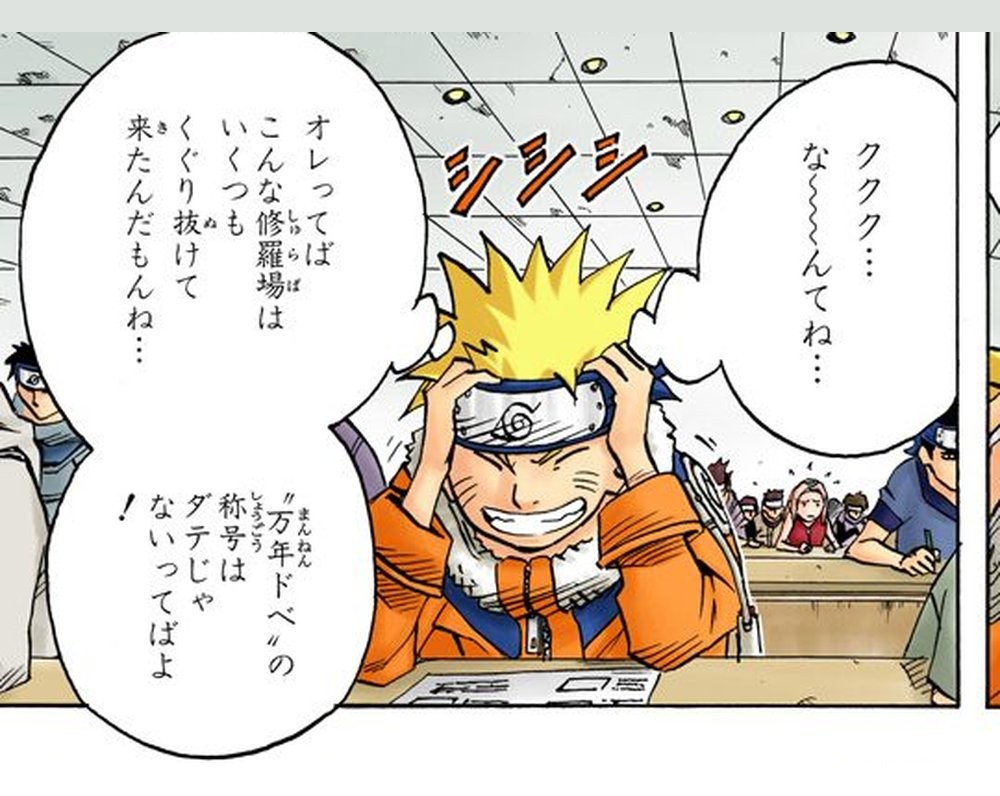
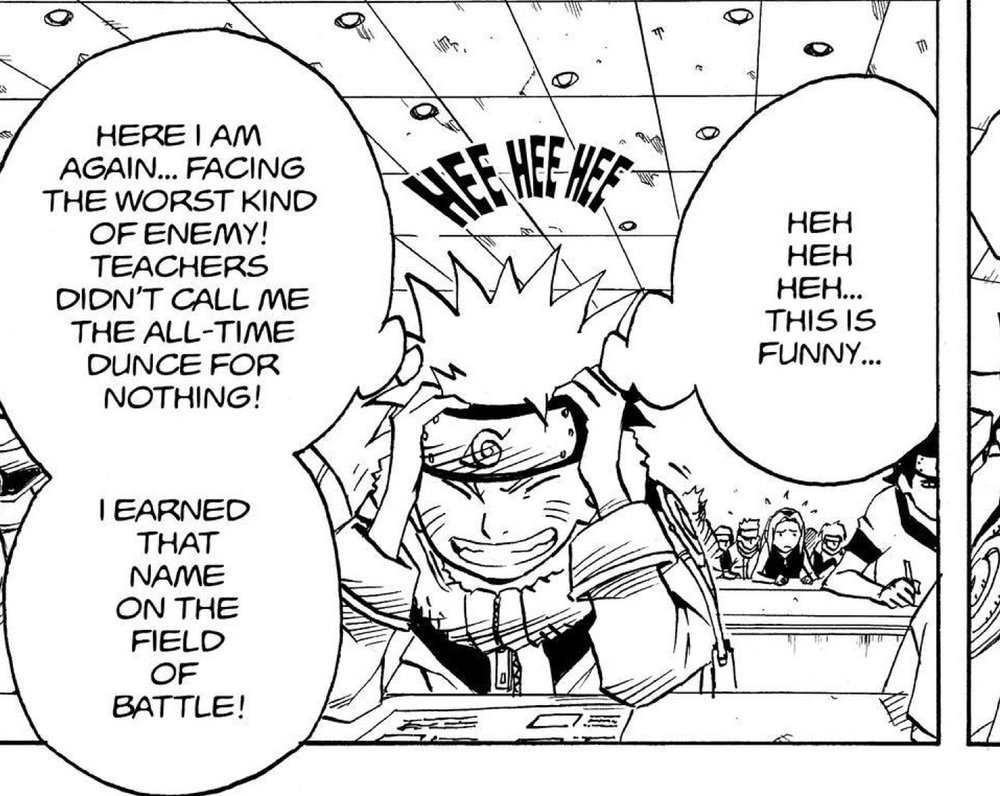
Volume 5. The Chunin Selection Exam has just begun, and its first stage is the one thing nobody trained for: a written test. The page itself shows the paper — 中忍選抜〝第一の試験〟, "CHŪNIN JOURNEYMAN NINJA SELECTION EXAM PART ONE… QUESTION NO. 1: DECODE THE FOLLOWING CIPHER AND SUMMARIZE ITS MEANING." Naruto — the academy's proudest academic disaster — takes one look, shudders, forces out a strangled chuckle and a な~んてね (the Japanese verbal shrug for "…just kidding"; VIZ hears genuine amusement: "HEH HEH HEH... THIS IS FUNNY..."), and then clamps both hands on his head, grins like a maniac, and delivers this:
「オレってばこんな修羅場はいくつもくぐり抜けて来たんだもんね…」
Ore tteba konna shuraba wa ikutsu mo kugurinukete kita n da mon ne…
VIZ's English edition prints: "HERE I AM AGAIN... FACING THE WORST KIND OF ENEMY! TEACHERS DIDN'T CALL ME THE ALL-TIME DUNCE FOR NOTHING!" (Vol. 5, p.87).
Grant the rendering its due, because there is real craft in it. Naruto's speech here runs across two linked bubbles, and VIZ reflowed them as one continuous joke: the second half of that first bubble ("TEACHERS DIDN'T CALL ME THE ALL-TIME DUNCE...") is actually VIZ's version of the next bubble's content — 「〝万年ドベ〟の称号はダテじゃないってばよ!」, "the title 'all-time dead-last' isn't just for show!" — pulled forward, while the second bubble gets a punchline VIZ wrote fresh: "I EARNED THAT NAME ON THE FIELD OF BATTLE!" The dunce joke is genuinely there in the Japanese, and the reflow reads beautifully. Two panels later Sasuke supplies the reaction shot — ナルトの奴いきなりビビッてんじゃねーだろうな… ("don't tell me that idiot's already panicking…"; VIZ: "NARUTO IS AN IDIOT... I JUST HOPE HE DOESN'T PANIC.").
But look at what happened to the sentence that started it all. The Japanese is a boast about the past. The English is a report of a present emergency. And the word that made the boast funny — 修羅場 — has vanished entirely.
The Original
Take 修羅場 (shuraba) apart, because there is a whole cosmology folded inside it.
修羅 (shura) is the clipped form of 阿修羅 (ashura) — and here the kanji mean nothing at all. They are ateji, pure phonetics spelling out the Sanskrit asura: the demigods of Buddhist cosmology, beings of pride and jealousy condemned to wage endless, unwinnable war against the deva king 帝釈天 (Taishakuten — Indra). Their home, 修羅道, is one of the six realms of rebirth (六道): an entire plane of existence made of nothing but combat.
場 (ba) is "place; scene" — the same 場 as in 場所 (place) and 場面 (scene of a play).
So 修羅場 is literally the Asura's battlefield — the ground where that war never stops. Medieval Japanese theater made the word a stage direction: Noh has a whole category of warrior-ghost plays, 修羅物 (shura-mono), about slain samurai suffering in the Asura realm, and in jōruri and kabuki the battle scenes are the 修羅場. From the stage it walked into the street, where modern Japanese uses it for any scene of carnage or hellish ordeal — including, famously, the domestic kind: walk in on a spouse, a lover, and airborne crockery, and any Japanese speaker will name the scene a 修羅場.
Then there is the verb Naruto bolts onto it. 修羅場をくぐり抜ける — くぐる is to duck under and through, 抜ける is to come out the other side — is the set phrase of survivors, and with 〜て来た ("have come through, up to now") it is a perfect of experience: not "I am surviving" but "I have survived, many times, and here I stand." It is a badge. Yakuza-movie elders wear it; ER nurses wear it; salarymen in deadline hell wear it ironically. 場数を踏む ("to have stood on many stages") is its mild-mannered cousin.
And the grammar around the badge is pure Naruto: オレってば ("yours truly here") runs on the same emphatic ってば as his signature だってばよ, and the closing もんね is a kid's self-satisfied "so there." A twelve-year-old flunky, in the most childish grammar available, claiming the war-veteran's badge phrase — about a paper test. That collision is the joke. And the joke has a real spine: as the academy's 万年ドベ, the all-time dead-last, every exam of Naruto's life genuinely has been a life-or-death scrape. His shuraba credentials are in order. The one battlefield that still terrifies him is made of paper. (Vocabulary note: 修羅場 is solid JLPT N1 material; everything around it is N4–N3.)
VIZ's Choice
修羅場 itself appears once in the volumes we have on file — but the word inside it, 修羅, is load-bearing in this series. Here is the whole family, side by side with the official English:
| Vol. / p. | Speaker & scene | Japanese | VIZ English |
|---|---|---|---|
| 5 / 87 | Naruto, written exam | オレってばこんな修羅場はいくつもくぐり抜けて来たんだもんね… | HERE I AM AGAIN... FACING THE WORST KIND OF ENEMY! TEACHERS DIDN'T CALL ME THE ALL-TIME DUNCE FOR NOTHING! |
| 7 / 96 | Gaara's blood-poem, Forest of Death | 死者の血涙は漠漠たる流砂に混じり――さらなる力を修羅に与ふ | BITTER, CRIMSON TEARS FLOW FROM LIFELESS EYES AND MINGLE WITH THE ENDLESS SANDS... BESTOWING EVER-GREATER POWER UPON THE DEMON GOD. |
| 15 / 94 | Yashamaru, on Gaara's name 我愛羅 | この子の名は我愛羅…我を愛する修羅… | "THIS CHILD'S NAME SHALL BE GAARA... A SHURA, A DEMON, WHO SHALL LOVE ONLY HIMSELF..." |
Three appearances, three unrelated solutions: an enemy, a demon god, and — when the translator finally has no exit, because Gaara's name 我愛羅 literally spells "me-love-asura" — a transliterated SHURA with "A DEMON" bolted on as a gloss. That Vol. 15 line is the tell: VIZ knew the word was untranslatable enough to smuggle in romaji. A Japanese reader hears the class clown in Vol. 5 casually invoking the same Buddhist war-realm that will name the saga's first true monster. The English reader hears a classroom gag, a poem, and a naming ceremony that share no vocabulary at all.
And within the exam line itself, the choice is stranger than a miss: VIZ deleted the battlefield from the bubble that had one (修羅場 → "THE WORST KIND OF ENEMY") and then wrote a battlefield into the bubble that didn't (ダテじゃない → "I EARNED THAT NAME ON THE FIELD OF BATTLE!"). The props survived the translation; they just ended up on the wrong lines.
The Gap
The survivor's tense flips into the victim's. くぐり抜けて来た is a track record — "I have slipped through plenty of these." Retrospective, credentialed, smug. "HERE I AM AGAIN... FACING THE WORST KIND OF ENEMY!" is a present progressive predicament: the ordeal is happening to him, now. The Japanese panel grins over the panic; the English panel is the panic. Subtext gets promoted to text, and the bravado — the thing the artwork is drawing, that manic hands-on-head grin — loses its script.
A place becomes an opponent. 修羅場 is ground: a scene you are in, wade through, crawl out of — which is why it takes the verb くぐり抜ける. "THE WORST KIND OF ENEMY" is a facing relation: something you square off against. Japanese stages crisis as terrain; this English line personifies it. With the terrain goes the mock-epic hyperbole — a cipher quiz called an Asura's battlefield — which was the engine of the gag.
The word family snaps. The 修羅 that Naruto wields as comic exaggeration is the same 修羅 that Gaara's poem and Gaara's own name carry in deadly earnest — the series quietly runs one Buddhist noun from farce to horror. VIZ's three unrelated renderings ("enemy," "demon god," "Shura, a demon") cut the thread, so the rhyme between the dead-last's exam and the demon's name is inaudible in English.
The fingerprint grammar washes off. オレってば and もんね are Naruto's role language — the childish, self-certain voice that makes the veteran's badge phrase absurd in his mouth. English has no seat for either particle, and the reflowed joke, funny as it is, speaks in VIZ's comic timing rather than Naruto's.
What If
No rendering is free; here is the menu and its prices.
- "Heh... I've crawled out of way worse bloodbaths than this, y'know..." — keeps the carnage hyperbole and the survivor's past tense. Cost: "bloodbath" is louder and gorier than 修羅場's worn-in idiom; the theatrical wink coarsens into splatter.
- "This ain't my first war zone, y'know!" — compact, swaggering, badge intact. Cost: "war zone" swaps Buddhist cosmology for the evening news, and the epic exaggeration shrinks to mere toughness.
- "I've been through hell and back plenty of times, y'know." — English's own religious geography, perfect tense preserved. Cost: hell is a punishment you are sent to; a shuraba is a fight you wade through. The agency reverses, and the veteran's badge dulls into a sigh.
- Keep VIZ's dunce logic, restore the vector: "A dead-last like me has scraped through scarier exams than this!" — Cost: no carnage at all; the mock-epic collapses into plain self-deprecation, and the panel's manic grin is left over-acting for its line.
Notice the common tax: English can buy the past tense or the battlefield, but the full price of both — a child claiming an Asura's war record over a sheet of paper — needs the one word English never minted.
Take-away
修羅場 is what happens when a cosmology becomes a cliché: the Asura's eternal battlefield, shrunk to fit an exam room, a deadline, a lovers' showdown — while never quite losing the smell of the war-realm it came from. Naruto's line works because the word is too big for the room, and he knows it.
Three rules of thumb to carry off this page:
- When you hear 修羅場をくぐる, look for the past tense. The set phrase is a badge of experience, not a distress call — translate the track record, not the crisis.
- Japanese stages crisis as a place. 修羅場, 土壇場 (the execution ground → the last minute), 正念場 (the scene of true resolve → the make-or-break moment): three ordeals, three 場. English tends to personify a crisis as an enemy to face; Japanese gives you ground to stand on — keep the terrain if you can.
- When a Buddhist proper noun hides inside daily vocabulary, check who else in the story owns it. In Naruto, 修羅 is a gag in Vol. 5 and a monster's name in Vol. 15 — a thread worth keeping whole.
This is the first entry in the Naruto translation notes index. For another Buddhist word English keeps splitting into pieces — the karmic tie 因縁 that VIZ rendered five different ways across One Piece — see our One Piece piece on innen.
Every Japanese and English line quoted above is a byte-exact capture from the cited editions — NARUTO―ナルト― Vol. 5, 7 and 15 (Japanese) and Naruto (VIZ Media) at the corresponding panels — via our bilingual page database; see Sources below.