The Moment
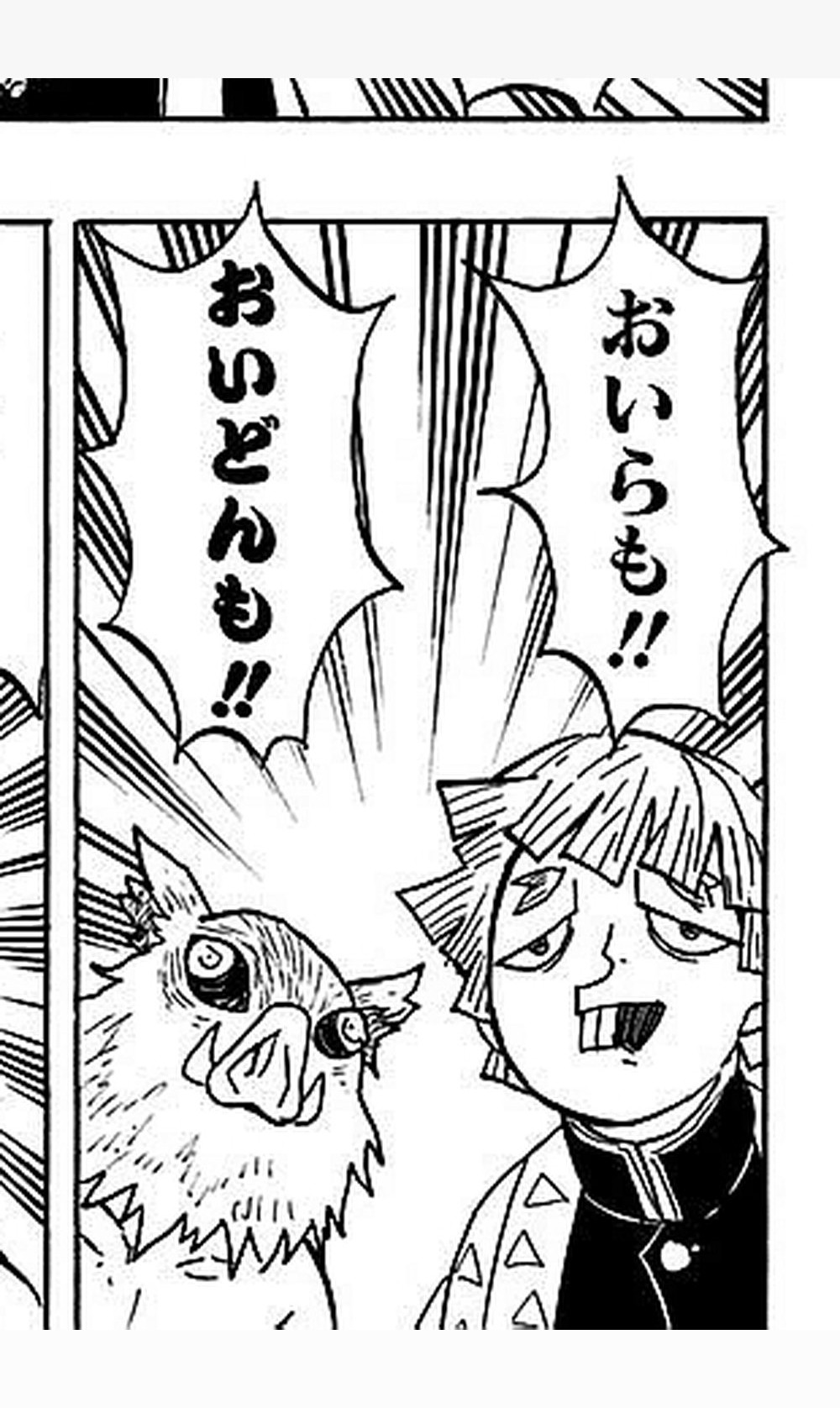
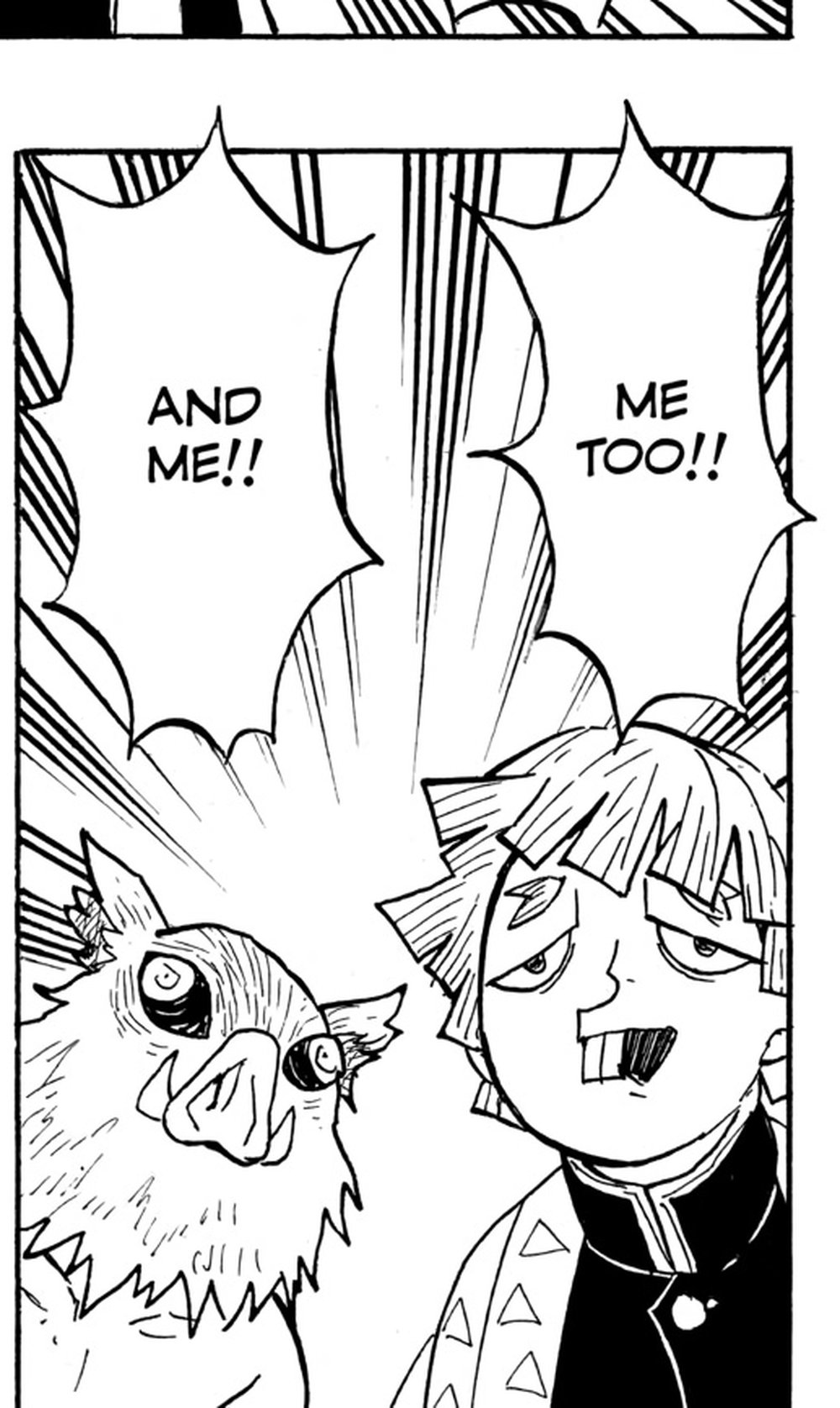
Volume 7. A train car, ordinary passengers dozing on the benches — until a swordsman named Kyojuro Rengoku strides down the aisle and, without breaking stride, kicks a stranger's bare foot off the seat with a single crack of sound. The car erupts. Boys who watched the whole thing go starstruck on the spot; by the time Rengoku promises the crowd, fist at his chest, 「みんなまとめて面倒みてやる!!」 — "I'LL LOOK AFTER YOU ALL TOGETHER!!" — two of them are already shouting their way into his flock. The first begs to become his disciple. The second adds his own 「おいらも!!」 — "ME TOO!!" And then a third voice, from a boy drawn with an odd, hawkish, beaked face tucked in among the ordinary crowd, tops them both:
「おいどんも!!」
Oidon mo!!
VIZ's English edition prints: "AND ME!!" (Vol. 7, p.45).
Grant the rendering its due first: "AND ME!!" is snappy, it varies the phrasing so the panel doesn't repeat "ME TOO" twice in a row, and it keeps the comic momentum of a crowd scene moving. Nothing about it is wrong as an exclamation. What it can't preserve is the fact that this third boy isn't just repeating his neighbor with different words — he's reaching for a different dialect entirely. Two boys say おいら. This one says おいどん, and any Japanese reader's ear catches the shift instantly, the way an English ear catches a sudden drop into a Scots burr in the middle of an otherwise unaccented sentence.
The Original
おいどん (oidon) carries no kanji at all — pure kana, and its shape is usually traced to two pieces: おい, a Kyushu-dialect variant sitting in the same first-person family as おれ (ore), fused with どん, the Satsuma-dialect familiar-honorific suffix cognate with 殿 (dono). That second piece is not obscure trivia — it's the exact suffix NHK borrowed for the title of its 2018 taiga drama about Saigō Takamori, 西郷どん (Segodon, roughly "our dear Saigō"), a folksy elevation of the man's name parallel to how standard Japanese might attach ~さん.
Here is the detail worth sitting with: standard Japanese does not ordinarily suffix an honorific onto its own first-person pronoun. Nobody says 私どの. おいどん borrows the grammar of respectfully addressing someone else and turns it back on the speaker — a small, self-contained oddity that marks the word as dialect the moment a trained ear hears it, independent of any accent in the surrounding sentence. Grammatically, once you accept the pronoun, nothing else is unusual: おいどんも takes も exactly the way おれも or ぼくも would; every particle behaves like clockwork. All of the word's charge sits in those four kana, not in any special syntax around them.
This is 役割語 (yakuwarigo, "role language") at its most geographically specific. This hub has already built a small wardrobe of first-person pronouns doing this kind of work in 鬼滅の刃: おいら marks a speaker as rustic and unpolished, without naming a place; 儂・わし marks a speaker as old; 拙者, one work over in Naruto, marks a speaker as archaic and martial. おいどん is the one pronoun in that wardrobe that pins a map coordinate — not class, not age, not era, but a specific corner of Kyushu, and by extension a whole cluster of associations (bluff, blunt, provincial, proud) that ride along with it for free. It doesn't appear on any JLPT list; treat it as N1-adjacent cultural-recognition vocabulary — nothing a textbook drills, but something every reader of samurai fiction or period drama absorbs by osmosis.
VIZ's Choice
Only one confirmed occurrence of おいどん turns up in the volumes on file, so there is no scatter table to build the way there is for a word like 因縁. But the single occurrence sits inside a three-way chorus worth setting side by side, because the comparison IS the finding:
| Speaker | Japanese | VIZ English |
|---|---|---|
| First boy (generic rustic おいら) | おいらを弟子にしてくだせぇ!! | PLEASE, MAKE ME YOUR APPRENTICE!! |
| Second boy (generic rustic おいら) | おいらも!! | ME TOO!! |
| Third boy (Satsuma/Kyushu おいどん) | おいどんも!! | AND ME!! |
Read down the Japanese column and the pattern is obvious: two boys share a dialect, a third boy doesn't. Read down the English column and that pattern is gone; "PLEASE, MAKE ME YOUR APPRENTICE!!," "ME TOO!!," and "AND ME!!" read as three sentences varied for style, not three speakers varied by hometown. VIZ's choice for our headline line specifically — "AND ME!!" — is a perfectly good English exclamation on its own terms. It just happens to be doing a completely different job than おいどんも was doing: keeping a three-line panel from repeating itself, rather than marking the third boy as the odd one out.
The Gap
English has no dialect-coded pronoun, full stop. English marks regional accent through spelling of the words around a pronoun — dropped g's, "ain't," eye-dialect — never through the pronoun itself. "I" is "I" whether the speaker is from Kagoshima's fictional counterpart or the capital. おいどん achieves its entire regional pin in a single word, before the sentence has said anything else, which is a trick the English pronoun system has no mechanism to reproduce.
The specific geography evaporates, not just "rural" in general. おいら already signals unpolished and rustic; おいどん goes a full step further and says Satsuma specifically — a place carrying its own outsized historical charge as the staging ground of the Meiji Restoration. "AND ME!!" carries no place at all. The boy could be from anywhere in the story's Japan, or nowhere.
A three-way chorus collapses into two-way variety. Two おいらも plus one おいどんも in one breath is a compact joke: three fans, two dialects, one panel. "ME TOO!!" beside "AND ME!!" reads as a translator's ordinary instinct not to repeat a phrase — which is exactly what makes the loss so quiet. A reader has no signal that would let them distinguish stylistic variation from an actual dialect switch; both look identical in English.
What If
No option here is free — the menu and its costs:
- "AND ME, ALL THE WAY FROM KAGOSHIMA!!" — spells the geography out directly, so no reader could possibly miss it. Cost: a one-beat comic aside turns into a footnote; nobody shouts their home prefecture mid-cheer, so the line stops sounding spontaneous and starts sounding explained.
- "ME AN' ALL, THAT I AM!!" — a vague dialect flavor at least signals "this one talks differently" from the boys beside him. Cost: imports a specific, wrong-country regionalism — a reader hears Ireland or the English West Country, not Kyushu, not Japan at all.
- "AN' ME, Y'HEAR!!" — light eye-dialect spelling keeps the joke's pace and cheaply marks roughness. Cost: still generic "rural," not regionally pinned — indistinguishable from any all-purpose dialect stand-in, including the two おいらも boys standing right beside him, which erases exactly the contrast the Japanese draws.
- Keep VIZ's clean "AND ME!!" as printed. Cost: an honest concession, not a fix — English's pronoun system has no drawer for regional accent at all, and the only real remedy lives outside the sentence, in a translator's note, not inside the dialogue bubble.
Take-away
おいどん spends four kana doing what an entire paragraph of scene-setting would otherwise need to do: telling a Japanese reader precisely where a nameless extra is from, and what that origin implies about him, before he's said anything else. English's one general-purpose "I" has no comparable trick in its pocket — the geography has to be rebuilt from outside the pronoun, if it survives at all.
Three rules of thumb to carry off this page:
- A kana-only pronoun is worth a second look. 俺, 僕, 私 all carry kanji or a neutral default spelling; おいら, おいどん, and their cousins skip kanji entirely and skip standard-Japanese neutrality just as completely.
- When a crowd chorus repeats "me too" in Japanese, check whether the pronoun repeats too. A scene can stage several different first-person forms back to back specifically so that a reader hears several different kinds of people — collapsing them all into the same English phrase erases that staging.
- A dialect-suffix pronoun like おいどん often hides a real place name. どん specifically gestures at Satsuma; other regions build their own first-person forms the same way. Treat an unfamiliar kana-only "I" as a geography clue worth chasing down, not just a flavor word.
For this same panel's plainer, unregional cousin — the two boys standing right beside this one — see A Trainful of Country Boys: おいら. For this hub's age-coded "I," see One Pronoun, Every Old Man: 儂・わし, and for its bookish, self-effacing opposite number, see This Insignificant Self's Prey: 小生. おいどん's era-coded cousin lives one work over: Naruto's ninja dog Pakkun growls 拙者, the archaic samurai's humble "I," out of the same yakuwarigo wardrobe pointed at a different axis entirely. Or browse the Demon Slayer translation notes index.
Every Japanese and English line quoted above is a byte-exact capture from the cited editions — 鬼滅の刃 Vol. 7 (Japanese) and Demon Slayer: Kimetsu no Yaiba Vol. 7 (VIZ Media) at the corresponding panel — via our bilingual page database; see Sources below.