The Moment
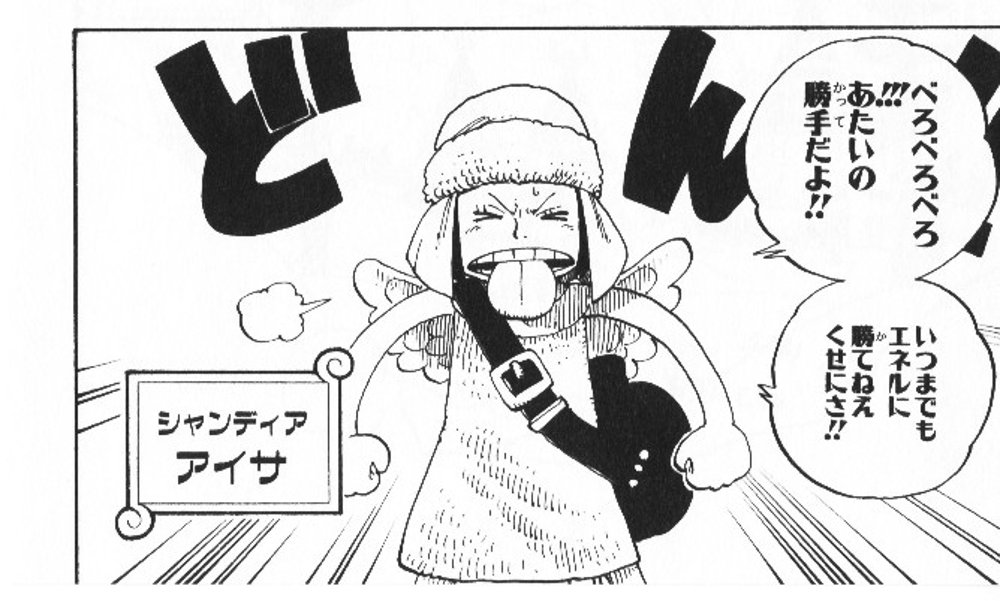
Skypiea, the ruins above the Milky Way — a place of gold, gods, and a warrior people hiding in plain sight. A young girl in a fur hood is caught red-handed with a bag of stolen goods by an adult warrior, Kamakiri, who's clearly used to this. He half-scolds her — 「バッグの中身は“ヴァース”だろ...程々にしとけ」, “YOU HAVE VARSE IN YOUR BAG, DON'T YOU? YOU SHOULD BE CAREFUL.” — and she answers the only way she knows how: with a raspberry and a shout.
「べろべろべろ!!あたいの勝手だよ!!!」
Berobero!! Atai no katte da yo!!!
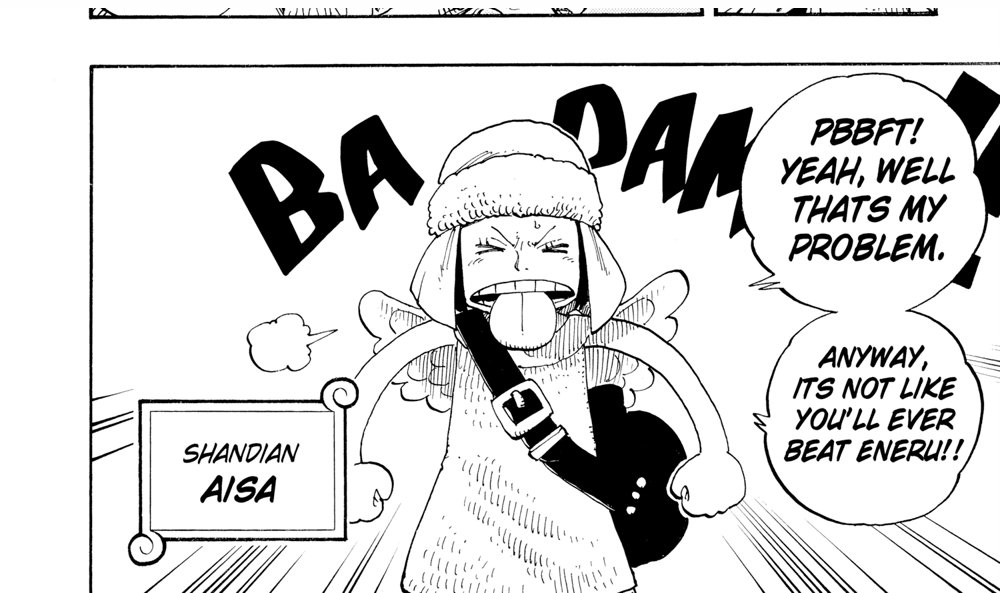
VIZ's English edition prints: “PBBFT! YEAH, WELL THAT'S MY PROBLEM.” (Vol. 27, p.52).
Grant the rendering its due first: it's funny, it's exactly the right amount of bratty, and “PBBFT!” is a genuinely good onomatopoeia for べろべろべろ. The scene reads perfectly well in English — a kid mouthing off to an authority figure. But notice what the panel is doing that the sentence, in English, isn't: right below her, a caption box formally introduces her — 「シャンディア/アイサ」, “SHANDIAN AISA” — as if Oda knows this is the character's real debut and wants the name on record. In Japanese, her very first line has already told us who she is: あたい, not あたし, not 私. Rough, working-class, a fighter. The caption confirms what the pronoun already said. In English, the caption is doing all the introducing alone.
The Original
あたい carries no kanji — it is pure kana, and for a first-person pronoun that bareness is itself a signal. Trace the family it belongs to: わたくし (formal, humble) contracts to わたし (the neutral standard everyone learns first), which contracts again to あたし (casual, feminine, still perfectly respectable), which contracts once more to あたい, where the final し softens into い. Each step sheds a degree of formality; Japanese listeners hear that slide the way English speakers hear “going to” slur into “gonna” — automatic, unconscious, and read instantly as lower register. This site's sister article on Boodle's わし traces the same chain from the other end (わたくし→わたし→あたし→あたい, four different social “I”s sharing one root); あたい is where the chain runs out of formality to lose.
あたい is documented real speech, not an invention for manga: it began in Edo-period shitamachi (下町, “downtown”) Tokyo — the everyday “I” of craftsmen's daughters, market kids, geisha, the working city as opposed to the samurai uptown. In modern Japanese it survives mostly in fiction, where it has narrowed into a costume: say あたい, and a reader pictures a scrappy, unrefined, often poor girl, frequently a child, often fighting somebody. That casting effect has a name — 役割語 (yakuwarigo, “role language”), coined by linguist Kinsui Satoshi for exactly this phenomenon: fictional speech patterns that cast a character type before the plot does any work at all. Grammatically あたい is inert, dropping into any slot a normal pronoun fills; socially, it's doing more work in one syllable than most narration manages in a paragraph. None of this is JLPT-tested — pronoun register isn't examinable grammar — but learners typically run into あたい around N3–N2, in manga dialogue, well before anyone explains what the word is flagging.
VIZ's Choice
Every occurrence of あたい in Aisa's dialogue across the volumes on file, side by side with VIZ's English:
| Vol. / p. | Japanese | VIZ English |
|---|---|---|
| 27 / 54 | ベろベろべろ!!あたいの勝手だよ!!! | PBBFT! YEAH, WELL THATS MY PROBLEM. |
| 27 / 59 | な...何だよ......!!別にあたい神の島”になんか... | W-WHAT?! IT'S NOT LIKE I WENT TO UPPER YARD... |
| 27 / 91 | イ...イヤだよ!!イヤがこれはあたいの秘密のバッグで出来て中に宝が | N-NO!! NO WAY!!! THIS IS MY SECRET BAG!! I KEEP MY TREASURE INSIDE. |
| 28 / 165 | あたいはシャンドラの戦士だ!!! | I AM A WARRIOR OF SHANDORA!! |
| 29 / 11 | 多くても2人組..4人で動いてる奴らがいたらわかるもんあたい! | TWO'S THE MOST. IF THERE WERE A GROUP OF FOUR, I'D KNOW! |
| 29 / 11 | 生まれつき使えるんだあたいは!! | I WAS BORN WITH IT! |
| 29 / 50 | あたいは戦士だ!! | I'M A WARRIOR! |
| 29 / 177 | みんな外へ脱出したよ!!あたい違、取り残されたっ!!! | EVERYONE ELSE GOT OUT! WE GOT LEFT BEHIND!! |
| 29 / 177 | だからあたいだってイヤだそれは!!! | I TOLD YOU, NO WAY! |
| 30 / 40 | ...あたい達の故郷.....? | ...OUR HOME- LAND? |
| 30 / 45 | .....あ...あたい達の村も!!? | M-MY VILLAGE TOO?! |
| 30 / 47 | あたいわかる!!! | I CAN TELL! |
| 30 / 113 | ううん!!だめだよあたい達が行ったら邪魔になる!! | NO, IT'S NO USE. IF WE GO UP WE'LL JUST BE IN THE WAY! |
| 30 / 162 | ごめんねあたいをかばって...!!! | I'M SORRY YOU HAD TO PROTECT ME...!!! |
| 32 / 120 | あたいもあんな風になりたい!! | I WANNA BE LIKE HIM WHEN I GROW UP. |
| 32 / 120 | あたいが~~~? | ME? |
Sixteen lines, four volumes, one boy-shy confession about mantra powers, one grief-choked apology, one incredulous “me?” at being called cute — and the English column never varies: I, my, me, I'm, our. Compare this to the scatter this site tracked in 因縁, where one Japanese word fractured into five unrelated English ones. Here it's the mirror image: total convergence. Every single あたい, regardless of what Aisa is feeling — bravado, fear, secrecy, tenderness, mortification — becomes the one pronoun English has. The emotional range is enormous; the translated pronoun is a flat line.
That flat line isn't a translator's failure so much as a structural ceiling. English genuinely has nowhere else to put “she's rough and poor and eleven” except into the surrounding words — which VIZ does do, well, elsewhere (“PBBFT!”, clipped exclamations, “you can't scare me with that look”). But the running thread — the fact that the word for “I” itself is Aisa's tell, over and over, independent of what she's saying — has nowhere to land. It has to be rebuilt scene by scene instead of ringing once, structurally, in the pronoun.
The Gap
All Japanese first-person pronouns collapse into one. Nami says あたし. Robin says わたくし. Aisa says あたい. Three completely different social registers — casual-feminine, hyper-formal, rough-and-poor — and in English all three characters say “I.” A reader fluent only in the English edition has no linguistic signal, ever, that these three women would sound utterly different reading their lines aloud in Japanese.
The corruption is a performance English can't restage on the pronoun. あたい isn't a fancier or plainer synonym for あたし — it's あたし audibly roughened, the same move as slurring a vowel to sound tougher. English has no equivalent operation that corrupts a pronoun the same way; “I” cannot be “slurred” into a class marker. Whatever compensates has to live somewhere else in the sentence, disconnected from the one word that, in Japanese, is doing the actual work.
The leitmotif disappears. Eighteen times across four volumes, あたい quietly re-confirms who Aisa is — whether she's boasting 「あたいは戦士だ!!」 (“I'M A WARRIOR!”) or breaking down 「ごめんねあたいをかばって...!!!」 (“I'M SORRY YOU HAD TO PROTECT ME...!!!”). In Japanese this is a running vocal fingerprint independent of content. In English, “I” never varies, so the fingerprint is invisible — an English reader reconstructs Aisa's character entirely from plot and art, with the prose offering no help.
The one scene where it should hurt the most goes quiet. Post-Skypiea, an older Shandia woman tells Aisa — warrior, treasure-thief, raspberry-blower — to grow her hair out: 「女の子なんだからかわいくしなくちゃ!」 (“YOU'RE A GIRL, SO WE SHOULD MAKE YOU CUTE!”). Aisa's stunned reply is 「あたいが~~~?」 — VIZ's “ME?”. In Japanese, the joke and the ache both land on the same word: the girl whose entire textual identity has been built out of a rough, un-cute pronoun is being told, for the first time, to be soft. “ME?” preserves the surprise. It can't preserve the irony that the surprised word and the identity-defining word are, in Japanese, the same one.
What If
No option here is free — the menu and its prices:
- Sustain a consistent non-standard voice for her — dropped g's, “ain't,” clipped syntax (“Ain't none o' your business”). Merit: recreates the register signal somewhere in the sentence, every time she talks. Cost: risks reading as a specific American regional accent rather than “tomboy warrior,” and must be sustained flawlessly for four volumes or it collapses.
- Keep “I,” compensate with blunt sentence shapes (“Not your business. Back off.”) every time she speaks. Merit: doesn't import a foreign dialect marker. Cost: the pronoun — exactly where Japanese puts the signal — stays invisible; this treats the symptom, not the word.
- Front the pronoun for emphasis (“Me, I don't care what you think”), importing a rough, vernacular cadence. Merit: at least foregrounds “I” the way あたい foregrounds itself. Cost: reads as affected or oddly formal — the opposite of Aisa's bluntness.
- A translator's note early, once, explaining あたい's register. Merit: attentive readers get the full picture. Cost: not standard VIZ shonen practice, and it still doesn't restore the running signal to every one of Aisa's eighteen lines.
The deeper point: every fix pays for itself by spending effort elsewhere in the sentence, because English has no pronoun slot that can corrupt the way あたい corrupts. Japanese gets the characterization for free, once, in the smallest word in the language. English has to earn it back, line by line, for four volumes.
Take-away
あたい isn't a synonym for “I” — it's あたし worn down one more step, and that wearing-down is the whole point: a rough, working-class, often-tomboyish first-person pronoun that casts a character before she's done anything. English's one-size “I” can't hear the difference between Aisa, Nami, and Robin; Japanese hears it in the first syllable, every time.
Three rules of thumb to carry off this page:
- Collect Japan's first-person pronouns as a cast list, not a grammar point. わたくし, わたし, あたし, あたい, おれ, ぼく, わし, 拙者 — each one is a costume a character puts on, and the costume is doing narrative work no English pronoun can.
- Watch for corruption chains. あたし→あたい is a phonological “toughening” Japanese performs on its own pronouns; when a word looks like a worn-down cousin of a more formal one, the wear itself is the meaning.
- A repeated pronoun is a running character beat, not filler. Eighteen uses of あたい across four volumes are eighteen quiet reminders of who's talking — count them, and you're tracking characterization the English text can't show you.
For the elder-male end of the same first-person role-language system — and the わたくし→わたし→あたし→あたい chain in full — see わし and the Old Man's ‘I’. For another translation pitfall from this same Skypiea arc, see 108 Desires, 108 Pounds, on the bilingual pun packed into Zoro's own battle cry — or browse the One Piece translation notes index.
Every Japanese and English line quoted above is a byte-exact capture from the cited editions — ONE PIECE Vol. 27–32 (Japanese) and One Piece (VIZ Media) at the corresponding panels — via our bilingual page database; see Sources below.