The Moment
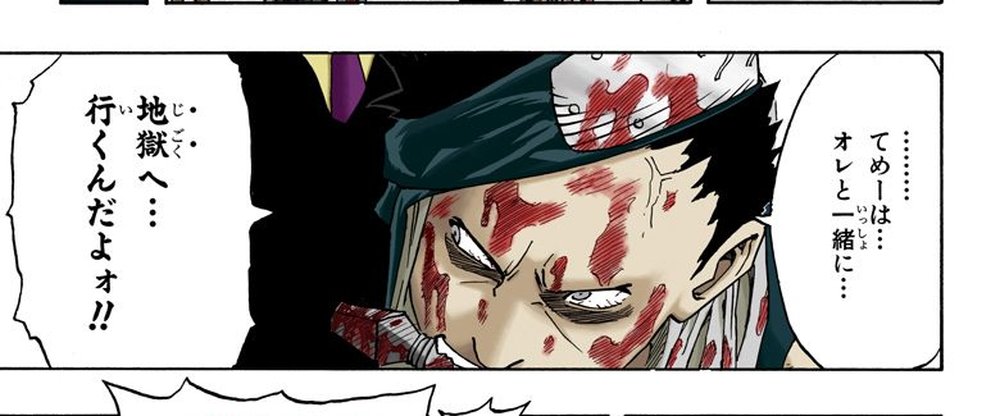
The Land of Waves. Zabuza Momochi — the Demon of the Hidden Mist — has just watched Haku, the boy who lived only for him and killed only for him, die in his place under Kakashi's Chidori. Riddled with the throwing knives of Gato's hired muscle, bleeding out on a half-built bridge, Zabuza refuses an easy ending: 「あいにくだが…オレは…白と同じ…ところへ行くつもりはねぇ…」 — "I have no intention of going to the same place as Haku." Instead he turns on the nearest of Gato's men and decides to take company:
「てめーは...オレと一緒に...」
Temē wa… ore to issho ni…
「地獄へ...行くんだよォ!!」
Jigoku e… ikun da yo-o!!
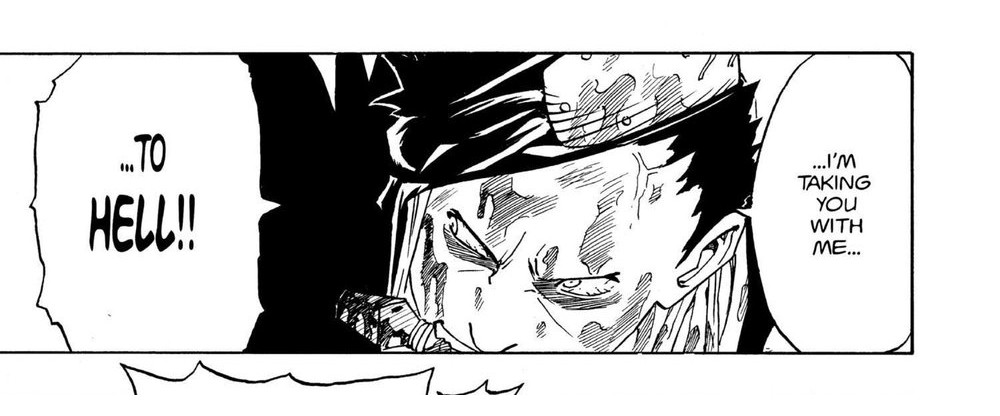
VIZ's English edition prints: "...I'M TAKING YOU WITH ME... ...TO HELL!!" (Vol. 4, p.99).
Grant it its due — this is a strong two-panel death threat. The line break lands exactly where Zabuza's breath runs out; "HELL!!" gets its own giant panel, bold and alone, exactly the kind of English a dying swordsman deserves. Whatever else this article argues, VIZ did not flinch on this page.
Then, still bleeding, Zabuza turns his contempt on the man himself:
「大したことねェ...霧隠れの鬼人も...」
Taishita koto nē… Kirigakure no kijin mo…
「死んで地獄なら本物の鬼になれるぜ...」
Shinde jigoku nara honmono no oni ni nareru ze…
VIZ: "EVEN AN OGRE IN NAME ONLY... A WASHOUT FROM KIRIGAKURE VILLAGE... CAN BECOME A REAL DEMON IN HOW HE MEETS HIS DEATH."
Look closely at that second line and a seam shows. 死んで地獄なら本物の鬼になれるぜ is built directly on 地獄 — "if dying means hell, [then facing it right] can make even you a real demon" — and VIZ's English never says the word. "In how he meets his death" is a graceful paraphrase of the sentiment, but the specific Buddhist logic underneath it — that where you go after dying depends on how you die — has quietly evaporated. One panel prints HELL in capital letters. The very next panel, built on the identical kanji, says nothing about it at all.
Zabuza isn't finished. Wounded, he adds one more line before the kill:
「楽しみにしとけ!小鬼ちゃんかどうか地獄でたっぷり確かめさせてやるよォ!!!」
Tanoshimi ni shitoke! Ko-oni-chan ka dō ka jigoku de tappuri tashikamesasete yaru yo-o!!!
VIZ: "ONCE WE'RE IN HELL, I CAN TAKE MY TIME, AND SHOW YOU OVER... AND OVER... WHO IS, OR IS NOT, 'A BABY DEMON'!"
(小鬼ちゃん, "little ogre" or "baby demon," was the mercenary's own mocking nickname for Haku, thrown back in his face — Zabuza defending a dead boy's memory with his last breaths.)
Three lines. Three uses of 地獄. Two say HELL; one says nothing at all. That contradiction is the whole article, compressed onto a single page.
The Original
地獄 (jigoku) splits into 地 (chi/ji), "earth, ground" — the same 地 as 地面 (jimen, "ground") and 地図 (chizu, "map") — and 獄 (goku), "prison," the same 獄 as 脱獄 (datsugoku, "prison break") and 監獄 (kangoku, "jail"). Together: an earth-prison — the standard Sino-Japanese rendering of Naraka, the underground hell-realms of Buddhist cosmology.
Doctrine doesn't give you one hell; it gives you eight — 八大地獄 (hachidai jigoku, "the Eight Great Hells") — stacked from 等活地獄 (Tōkatsu, "Reviving Hell," where the dead are cut down and revived only to be cut down again) down to 阿鼻地獄 (Abi — Sanskrit Avīci, "Hell Without Interval"), reserved for the deadliest sins in the canon. Each hell is matched to a class of crime, its own torment for its own sin. And critically, every sentence is finite: once the karma that sent a soul there is spent, it is reborn elsewhere on the wheel of the six realms (六道, rokudō) — hell (地獄道) is only one address among six, with the fighting spirits' realm (修羅道, the subject of this hub's companion article on 修羅場) sitting right next door on the same wheel.
Zabuza's own line never touches this vocabulary directly — grammatically it's the plainest structure Japanese owns, [PLACE へ行く], "go to [place]." But that plainness is exactly the point: 地獄 doesn't need decoration to carry its full cosmology into a sentence. The destination he names for a man he's about to kill is not a vague curse word. It is a specific, structured underworld, doctrinally distinct from every other possible rebirth — and, crucially, one with an exit built into its own theology.
VIZ's Choice
Six representative appearances of 地獄, sampled from the eleven times our corpus catches this word in Naruto's dialogue — one of which turns out to be a garbled OCR match on a table-of-contents page, not a real line of dialogue at all, and gets thrown out. That leaves ten genuine occurrences; here are six of them, spanning four volumes and three very different kinds of scene:
| Vol. / p. | Speaker → context | Japanese | VIZ English |
|---|---|---|---|
| 4 / 99 | Zabuza, dying, dragging a mercenary down with him | 地獄へ...行くんだよォ!! | ...TO HELL!! |
| 4 / 99 | Zabuza, same breath, taunting the same man | 死んで地獄なら本物の鬼になれるぜ... | CAN BECOME A REAL DEMON IN HOW HE MEETS HIS DEATH. |
| 15 / 116 | Naruto, inner monologue, remembering his own childhood | ...あの苦しみはハンパじゃない...真っ暗な地獄だ | ...THAT PAIN WASN'T JUST ANYTHING... IT WAS JUST PITCH BLACK. |
| 16 / 64 | Naruto, lying wounded beside Gaara after their fight | 一人ぼっちのあの地獄から救ってくれた... | THEY SAVED ME FROM MY PIT OF LONELINESS... |
| 35 / 89 | Hidan, warning Kakuzu before the Fire Temple raid | そんなのでボウズを殺ると地獄へ落ちるぜ | KILLING A MONK FOR WORLDLY GAIN IS A TICKET STRAIGHT TO DAMNATION!* |
| 35 / 89 | Kakuzu, retorting with the old proverb | 地獄の沙汰も金次第だ** | AND THEY SAY MONEY TALKS... |
*Our bilingual corpus records this line's English as "KILLING A MONK FOR MONEY WOULD ONLY GAIN IS A TICKET STRAIGHT TO DAMNATION!" — a garbled OCR pass that has fused "WORLDLY GAIN" with a stray "MONEY WOULD ONLY." Reading the printed VIZ page directly shows the actual wording is "KILLING A MONK FOR WORLDLY GAIN IS A TICKET STRAIGHT TO DAM-NATION!", which is what appears in the table above; the byte-exact corpus string is preserved in this article's Sources/References for traceability. **Likewise, the corpus transcribes this proverb's kanji as 金沢第 (an OCR misread — "Kanazawa-dai" is not a word); the page image confirms the actual print is the standard idiom 金次第, used in the table and body text above.
Read down the right-hand column and the pattern runs backward from what a "famous" word usually does. A companion article on this hub's sister franchise, covering Demon Slayer's identical 地獄, found convergence: across roughly forty appearances, VIZ reaches for "HELL" almost every single time, flattening eight tiers of doctrine into one undifferentiated English pit. Naruto's corpus does the opposite — scatter away from "hell" entirely. Of ten genuine occurrences, only two ever print the word, and both come from the same dying breath on the same page. The rest reach for "torture," "pitch black," "a pit," "damnation," or a secularized proverb that keeps none of the underworld at all.
And the two clusters aren't random. Rows one and two are Zabuza mid-kill, one panel apart, one word translated two irreconcilable ways. Rows three and four are Naruto, in two separate scenes, reaching for the identical noun to describe his own childhood loneliness — once dropped entirely ("pitch black"), once softened into a spatial metaphor ("pit of loneliness") that could just as easily describe a bad mood as a Buddhist hell-realm. Rows five and six are Hidan and Kakuzu — the Akatsuki's resident zealot and its resident mercenary — trading the word like a coin: Hidan invokes actual damnation as a warning against killing for money, and Kakuzu, unbothered, tosses back 地獄の沙汰も金次第だ, the folk proverb that even hell's own courtroom can be bribed. Four speakers, three completely different registers, one Japanese word running underneath all of it — and English never lets the reader notice.
The Gap
Gradation disappears first. Zabuza's taunt about becoming "a real demon" depending on how a man dies only makes sense if hell has tiers to earn — a coward's death and a warrior's death lead to different addresses within 地獄's own architecture. VIZ's paraphrase ("CAN BECOME A REAL DEMON IN HOW HE MEETS HIS DEATH") keeps the taunt but drops the graded cosmology it's built on, along with the word itself.
Permanence sneaks in where the Japanese never put it. "HELL" in English default-loads finality — a one-way trip. 地獄 does not; it's a sentence, not a verdict, which is exactly why Zabuza can talk about taking his time "once we're in hell," as though it were a place with a floor you could stand on and an errand you could still run. The Christian shelf hands English no comparably temporary hell to borrow.
The thread between a death threat and a child's grief snaps. Zabuza's killing floor and Naruto's private memory of solitude use the same word, several volumes apart, and a Japanese reader who has followed both scenes hears the rhyme. Scattered into "HELL," "the torture called solitude," "pitch black," and "my pit of loneliness," the rhyme goes silent — four unrelated-sounding phrases standing in for one recurring idea about what it means to be trapped somewhere with no way out.
Idiom erasure swallows the theology whole. 地獄の沙汰も金次第 literally invokes hell's own courtroom — even the judges down there, the proverb claims, can be bought. "AND THEY SAY MONEY TALKS..." keeps Kakuzu's cynicism but discards the specific image of a corrupt afterlife bureaucracy, which is the entire joke. The idiom survives as an attitude; the underworld it's making fun of does not survive at all.
What If
For the headline line, the menu and its prices:
- "DOWN TO THE PIT WITH YOU!!" — keeps Zabuza's grim intimacy (you're coming with me) without smuggling in Christian eternity. Cost: loses the one-word punch of "HELL!!" that makes VIZ's line land so hard.
- "STRAIGHT TO NARAKA — BOTH OF US!!" — names the actual doctrinal address. Cost: a first-time reader has no idea what Naraka is, and a dying man's last line is the worst place to introduce a vocabulary term.
- "WE'RE GOING DOWN TOGETHER!!" — keeps the pairing and the direction, generic enough to survive without theology. Cost: loses the specific underworld threat; could describe drowning as easily as damnation.
- Keep "HELL," spend the setup line instead: "...I'M TAKING YOU WHERE I'M GOING... ...TO HELL!!" — Cost: still only names one hell where doctrine names eight, but at least keeps the destination shared between speaker and victim rather than generic.
Take-away
地獄 looks like the one word in this series that translates itself — everyone already knows what "hell" means — and that's exactly why it scatters instead of landing. Naruto's hell is graded, temporary, and shared with the living metaphorically as often as it's invoked literally; when a translation gives you "HELL" for a death threat and "pitch black" for a childhood memory, the underlying word is real, it's just been sanded down to fit whichever sentence it landed in.
Three rules of thumb to carry off this page:
- Watch whether 地獄 is being used literally or as an emotional metaphor — Naruto's corpus leans metaphorical far more often than cosmological, and English tends to translate the metaphor while erasing the word that ties it back to the doctrine.
- A hell you can "take your time" in is not eternal. Any English rendering that implies permanence — "damned," "forever," a flat "REST IN PEACE"-style closure — is quietly importing Christian finality onto a karmic sentence with an exit.
- When a word converges in one series and scatters in another, both are diagnostic. Convergence erases gradation by flattening everything to one term; scatter erases the connections between scenes that share a word. Ask which failure mode you're looking at before you trust the translation's confidence.
For the neighboring realm on the same six-fold wheel, see this hub's piece on 修羅場 and the veteran's boast VIZ flipped into present-tense panic, and for the Buddhist word for "this mundane world" that 地獄 stands opposite, see 娑婆 and the ex-con's first breath VIZ files under fresh air — or browse the full Naruto translation notes index. For the same word explored in far greater doctrinal depth — the Eight Great Hells named and mapped in full — a Demon Slayer article on this identical expression, 地獄, is part of the same publishing run as this piece; look for it on that franchise's own translation-notes hub.
Every Japanese and English line quoted above is a byte-exact capture from the cited editions — NARUTO―ナルト― Vol. 4, 15, 16 & 35 (Japanese) and Naruto (VIZ Media) at the corresponding panels — via our bilingual page database; see Sources below. Two lines on Vol. 35, p.89 carry a correction: the corpus records this page's English and Japanese text with OCR errors ("MONEY WOULD ONLY GAIN" for "WORLDLY GAIN"; 金沢第 for 金次第); both page images were checked directly, and the confirmed printed wording is used in this article's table and body text, while the corpus's byte-exact strings are preserved in Sources/References.