The Moment
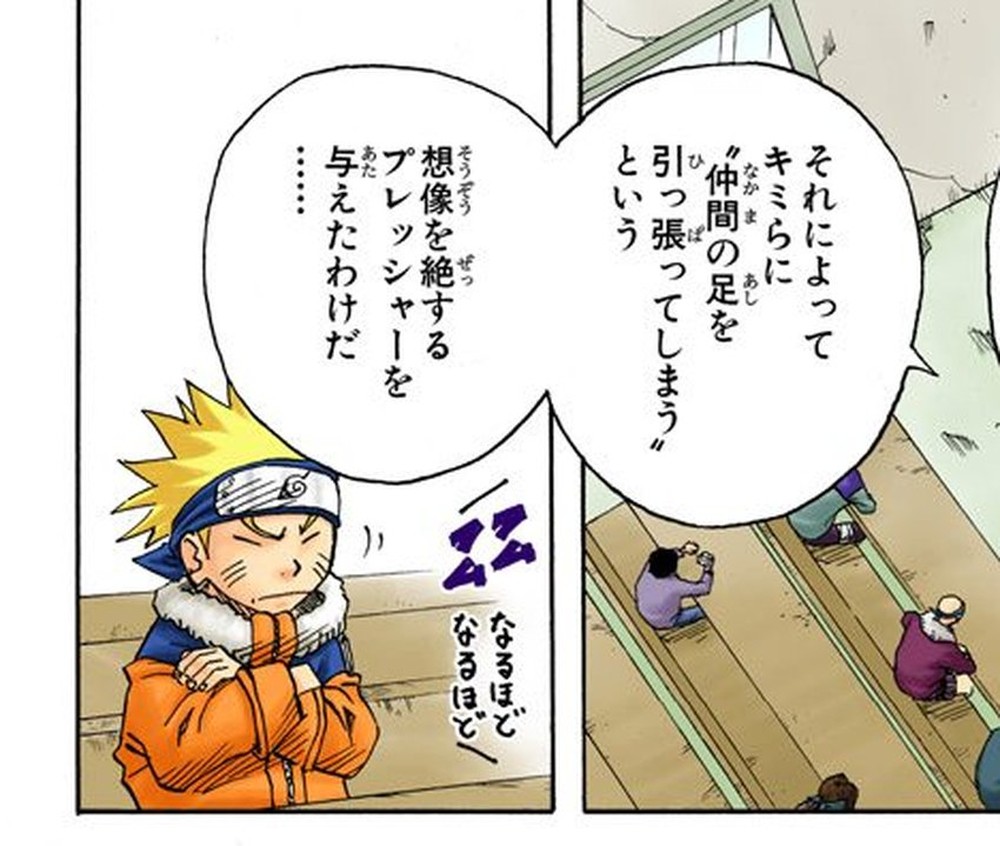
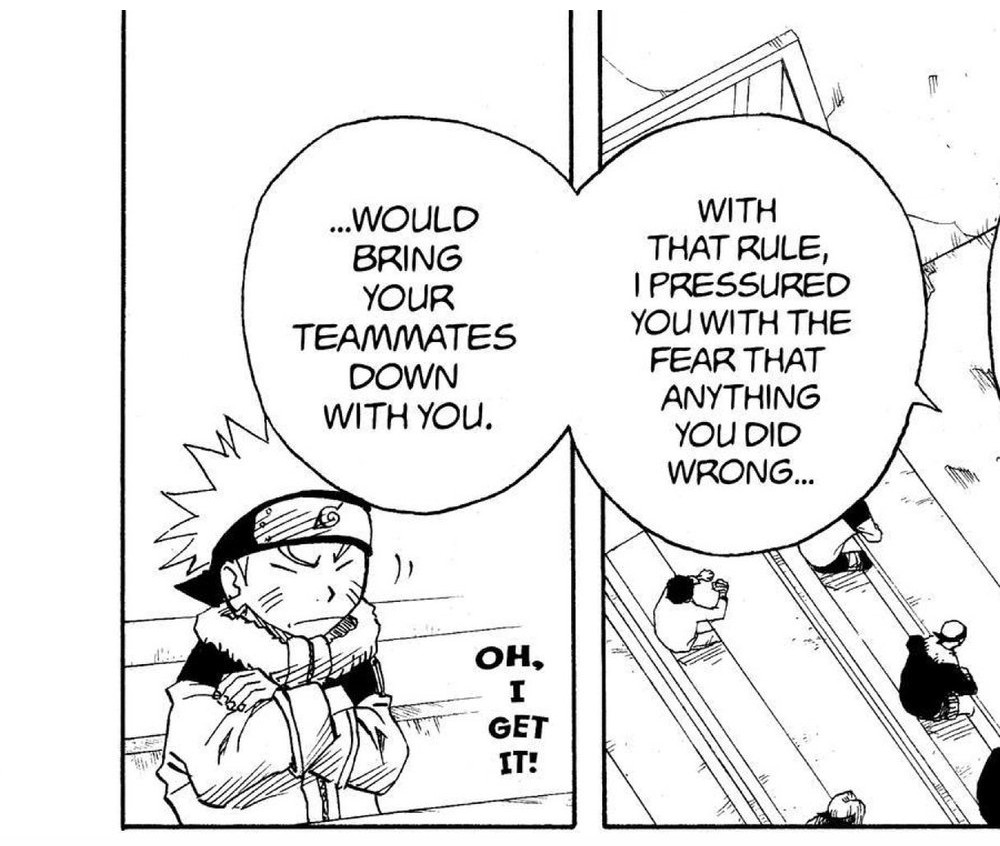
The Chunin Exam's first test — a written exam that isn't really about the questions. Every genin in the hall is sweating over problems built for jonin, half of them one point away from disqualifying their whole cell, when the black-clad proctor Ibiki Morino finally explains what the test was actually testing. Two panels earlier he's already laid the trap bare: 〝常に三人一組で合否を判定する〟というシステムにある — "YOU PASS OR FAIL AS PART OF A THREE-MAN CELL." Then he closes the loop:
「それによってキミらに〝仲間の足を引っ張ってしまう!!〟という想像を絶するプレッシャーを与えたわけだ…?」
Sore ni yotte kimira ni "nakama no ashi o hippatte shimau!!" to iu sōzō o zessuru puresshā o ataeta wake da…?
VIZ's English edition prints, across the same two joined speech bubbles: "WITH THAT RULE, I PRESSURED YOU WITH THE FEAR THAT ANYTHING YOU DID WRONG... ...WOULD BRING YOUR TEAMMATES DOWN WITH YOU." (Vol. 5, p.146.)
Grant the rendering its due before picking it apart: it is clean, it is dramatically legible, and "bring your teammates down with you" genuinely lands the threat. Notice, too, what the panel is doing visually while this plays out — Ibiki himself is barely drawn, a tiny silhouette in an aerial shot of the exam hall in the panel beside this one. The bubbles carrying his voice float instead over a close-up of Naruto, arms crossed, eyes shut, working it out in real time. A beat later he gets it: 「なるほどなるほど」— "OH, I GET IT!" — followed by a flat 「うそつけ!」from a nearby classmate, "YOU ARE SO FULL OF IT!" — because of course Naruto immediately claims he'd already figured out the whole scheme himself.
Now look at what the two Japanese bubbles actually do with their word order, because VIZ's translation quietly reshuffles it. The Japanese saves the payload for last: that's why I gave you the unimaginable pressure of the fear that you'd 仲間の足を引っ張ってしまう [pull your comrades' legs] — isn't that so? The idiom itself sits in the first of the two bubbles, wrapped in quotation marks 〝 〟 as if Ibiki is citing the exact dread his students felt, and the general description — "unimaginable pressure," "that's the reason" — trails afterward, capped with a taunting …?. English runs the clauses in the opposite order: the general frame ("I pressured you with the fear that...") comes first, and the idiom's actual content ("...would bring your teammates down with you") lands second. Both versions are faithful to the sentence — nothing is invented or dropped — but a reader skimming only the first English bubble, the one that lines up with the Japanese bubble actually containing 足を引っ張ってしまう, would see nothing about teammates at all. The idiom's translation is real; it's just one bubble over from where the idiom itself sits.
The Original
足を引っ張る breaks into 足 (ashi), "foot/leg" — Japanese doesn't split the limb into "foot" and "leg" the way English does; one word covers ankle to hip in ordinary speech — plus 引っ張る (hipparu), "to pull hard, to tug, to drag." 引っ張る is itself two verbs fused into one forceful action by the small っ: 引く (hiku, "to pull," one of the first verbs any learner meets, N5) plus 張る (haru, "to stretch taut," N4) — the same fusion pattern behind 引っ越す (hikkosu, "to move house," literally "to pull up and go") and 引っ掛かる (hikkakaru, "to get snagged on something"). Put the two halves back together and the idiom pictures something almost cartoonishly physical: a line of people advancing together, and a hand reaching back to close around an ally's leg and yank it backward mid-stride — not necessarily malicious, just enough to make the whole formation stumble. From that single image, the idiom generalized to cover any drag on a group's forward motion: slowness, incompetence, a mistake, an injury, a subordinate having an off day — anything that turns one member of a team into ballast the others have to haul along. It's common enough to sit on most N3 idiom lists, even though every kanji in it (足, 引, 張) is taught by N5 — a fixed expression built entirely out of beginner vocabulary, which is exactly the kind of word a learner can mistranslate with total grammatical confidence.
And here is the trap the whole article is built around. English owns an idiom that looks like a mirror translation of 足を引っ張る, kanji for word: "to pull someone's leg." Set the two phrases side by side and the resemblance is uncanny — same limb, same verb, same grammatical shape, PERSON's leg getting pulled either way. But "pull someone's leg" means to tease them, to make a harmless joke at their expense, to fool them for fun. It carries none of the sabotage, none of the burden, none of the dead weight the Japanese idiom names. A translator working fast, or a learner leaning on the literal image, could see 仲間の足を引っ張ってしまう and write something like "you'd end up pulling your teammates' legs" — grammatically defensible, tonally catastrophic. Ibiki's line is a proctor coldly confessing to engineered psychological warfare; "pulling their legs" turns that confession into a joke about practical pranks. This is a false friend in the purest sense: not two words that merely sound alike, but a whole idiom, image and all, pointing in the wrong direction.
Grammar is where the two occurrences in this article diverge. Ibiki's line ends in わけだ (wake da), "the reason/upshot is that…" — an explanatory construction (N3) that frames the whole sentence as a calm accounting of cause and effect, reinforced by 想像を絶する (sōzō o zessuru), "to defy imagination," a formal, faintly literary phrase for pressure so extreme it can't be pictured. Orochimaru's line, met below, runs on the opposite register entirely: casual, unfinished, trailing into か… rather than closing on a verdict. Same idiom, same core image, two completely different postures toward it — one a system's architect explaining his own design, the other a boss idly grading his subordinates.
VIZ's Choice
Both occurrences of 足を引っ張る in the volumes on file, matched to their actual VIZ panels:
| Vol. / p. | Speaker | Japanese | VIZ English |
|---|---|---|---|
| 5 / 146 | Ibiki Morino, addressing the Chunin Exam hall | それによってキミらに〝仲間の足を引っ張ってしまう!!〟という想像を絶するプレッシャーを与えたわけだ…? | WITH THAT RULE, I PRESSURED YOU WITH THE FEAR THAT ANYTHING YOU DID WRONG... ...WOULD BRING YOUR TEAMMATES DOWN WITH YOU. |
| 23 / 62 | Orochimaru, appraising the Sound Four's pace | まあ足を引っぱってるのはすぐ腹が減る次郎坊か… | WELL, THE ONE WHO'S SLOWING THEM DOWN IS EITHER THE PERPETUALLY HUNGRY JIROBO OR... |
(The corpus's OCR renders the second speaker's name as 次郎あか — almost certainly a misread of 次郎坊, Jirobo's actual name, whose 坊 can visually blur into あか at low scan resolution. The rawCapture above preserves the corpus text byte-for-byte, as required; the character is Jirobo either way.)
Eighteen volumes apart, two completely different speakers, two completely different relationships to the idiom — a proctor confessing what fear he engineered into his own exam, and a master casually auditing which of his subordinates is dragging — and VIZ lands on the same family of fix both times: "bring/hold... down/back." "BRING YOUR TEAMMATES DOWN WITH YOU" and "THE ONE WHO'S SLOWING THEM DOWN" are built from different verbs ("bring down" vs. "slow down"), so they don't read as twins on the page the way the Japanese pair obviously are — but both solve the same underlying problem the same way: describe the outcome of 足を引っ張る (a group getting held back) rather than its mechanism (someone's hand on someone's leg). Neither translator reached for the false friend, not even once, despite the idiom offering it up on a plate twice, eighteen volumes and two entirely different scenes apart.
Look, too, at what each rendering keeps of its speaker's voice. Ibiki's version stays inside a formal, complete clause — "pressured you with the fear that... would bring your teammates down with you" — preserving some of わけだ's after-the-fact, lecture-hall composure. Orochimaru's version stays a loose, trailing musing — "the one who's slowing them down is either... or..." — preserving the shrugging, unfinished か of the original. The idiom itself flattens into one shared formula in translation, but the sentence architecture around it still tracks each speaker's very different relationship to the burden they're describing.
The Gap
The false friend was sitting right there, twice, and nobody took it. "To pull someone's leg" is close enough to 足を引っ張る in form that a rushed or literal-minded translation could reach for it by accident — and the result wouldn't be a subtle mistranslation, it would be scene-breaking. Imagine Ibiki's calculated confession rendered as "the fear that you'd pull your teammates' legs," or Orochimaru's cold appraisal as "the one pulling everybody's leg": both read as jokes about pranks, in scenes built respectively on institutional dread and clinical menace. VIZ's real choice deserves credit precisely because the failure mode it dodged is this bad — twice, in two unrelated arcs, with two unrelated translators.
Even the correct fix drops the leg. "Bring/hold... down/back" is accurate and idiomatic, but nothing in either phrase pictures a leg, a hand, or a grip. 足を引っ張る's entire rhetorical force comes from a specific, almost cartoonish image — fingers closing around an ally's ankle mid-stride — and English's safe idioms describe the same outcome (restraint, impediment) through a bodiless mechanism instead: someone holding, someone bringing down, nobody's legs involved at all. The reader gets the meaning without ever seeing the picture the word is named for.
The idiom's two directions collapse into unrelated-sounding English. In Japanese, the exact same fixed phrase serves Ibiki's self-directed fear and Orochimaru's third-party judgment — a reader fluent in the original would recognize instantly that these are the same idiom, deployed from opposite vantage points, eighteen volumes apart. "Bring your teammates down with you" and "the one who's slowing them down" share no vocabulary in English. The rhyme that exists in Japanese — one recurring idiom threading two very different scenes — is invisible on the English side.
What If
No rendering is free; here is the menu and its prices.
- "...meant putting unbearable pressure on you: the fear you'd drag your own comrades down with you." — keeps the drag-image explicit ("drag... down") while staying nowhere near "pull someone's leg." Cost: longer and less clipped than Ibiki's actual cadence, which prefers short, declarative beats.
- "...so that any slip of yours would sink your whole team." — trades the leg-grab for a different but still physical, still visceral image. Cost: no anatomical echo of 足 survives, and "sink" imports a nautical catastrophe bigger than the everyday drag 足を引っ張る usually names.
- "...so you'd dread becoming the weak link holding the other two back." — "weak link" is genuinely idiomatic English for exactly this team-liability anxiety. Cost: "weak link" names a role or a person, not an ongoing action — it flattens 引っ張る's active verb into a static label.
- For the Sound Four line, tried as a thought experiment: "the one who's got a grip on their ankles." — the closest any English sentence gets to the actual Japanese picture. Cost: unnatural, over-literal English no native speaker would say about a teammate; it demonstrates exactly why VIZ didn't attempt it.
Notice the shared shape of every trade-off: the closer an option gets to the leg-image, the more it risks sounding invented, imported, or dangerously close to the false friend's own territory; the safer options — VIZ's own "bring/hold down/back" among them — buy naturalness by giving the picture up entirely. There may not be an English phrase that keeps both at once, and that gap is itself the lesson.
Take-away
足を引っ張る is a word where the danger isn't obscurity, it's false confidence. Every piece of it is beginner vocabulary; the idiom it forms is common enough to appear in sports recaps and office small talk; and English happens to have already built a trap shaped exactly like it, sharing its limb and its verb. The idiom doesn't need a dictionary. It needs a translator who knows to distrust the resemblance.
Three rules of thumb to carry off this page:
- When a Japanese idiom has an English "twin," check the twin's meaning before you trust its shape. 足を引っ張る and "pull someone's leg" share a limb and a verb and mean close to opposite things — the resemblance is the danger, not the reassurance.
- A split-bubble sentence can carry an idiom's grammar in one balloon and its translation in the next. Ibiki's Japanese puts 足を引っ張ってしまう in the first bubble and the general "pressure" frame in the second; VIZ's English reverses the order. Read across bubble boundaries before deciding what a single panel "says."
- 足を引っ張る has two faces — confession and verdict — and English often can't tell you which one you're reading. The same idiom names a fear you carry about yourself and a judgment you pass on someone else; only context, not the words themselves, tells you which.
This isn't a Naruto-only trap, either. Demon Slayer's own translators dodge the identical false friend twice over — once when the wounded Genya Shinazugawa fears becoming dead weight on the Stone Hashira mid-battle, and again when Mitsuri Kanroji vows 今度は足を引っ張らないようにするから after being struck down — and VIZ lands on the same solution family there too: "hold... back." Same idiom, same trap dodged, two unrelated franchises, one shared blind spot in English.
For the noun-form of this same fear — the label this hub's own Sakura dreads earning in the Forest of Death — see 足手まとい and the burden VIZ keeps calling "in the way". For another body idiom whose literal image evaporates the moment English gets hold of it, see 骨が折れる and the bones VIZ never turns into a metaphor. Or browse the full Naruto translation notes index.
Every Japanese and English line quoted above is a byte-exact capture from the cited editions — NARUTO―ナルト― Vol. 5 & 23 (Japanese) and Naruto (VIZ Media) at the corresponding panels — via our bilingual page database; see Sources below.