The Moment
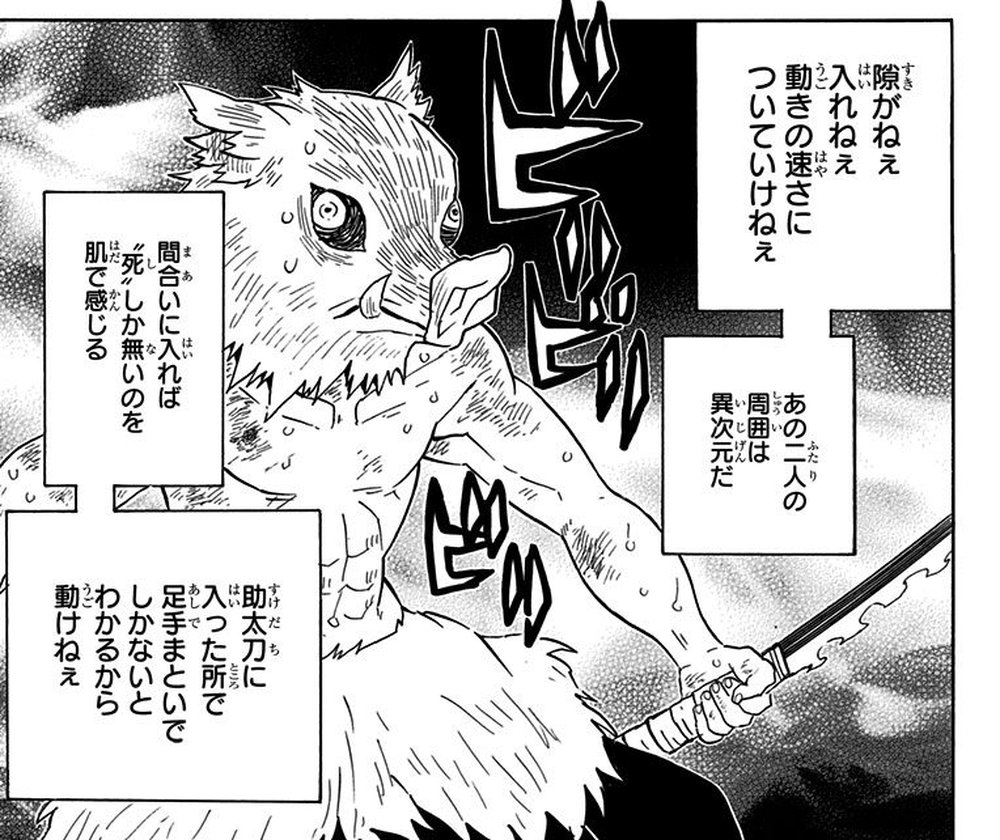
The Mugen Train arc has reached the fight nobody in the audience wants to watch. Kyojuro Rengoku, the Flame Hashira, is dueling the Upper Rank demon Akaza at a speed that has stopped looking like swordsmanship and started looking like weather. Tanjiro is down. Inosuke Hashibira — boar mask, twin blades, usually the loudest thing in any room — is still standing, and still can't move. His thoughts come out in fragments, one clause per panel-box, like a boast that keeps losing its nerve:
「隙がねぇ入れねぇ動きの速さについていけねぇ」
Suki ga nee irenee ugoki no hayasa ni tsuiteikenee
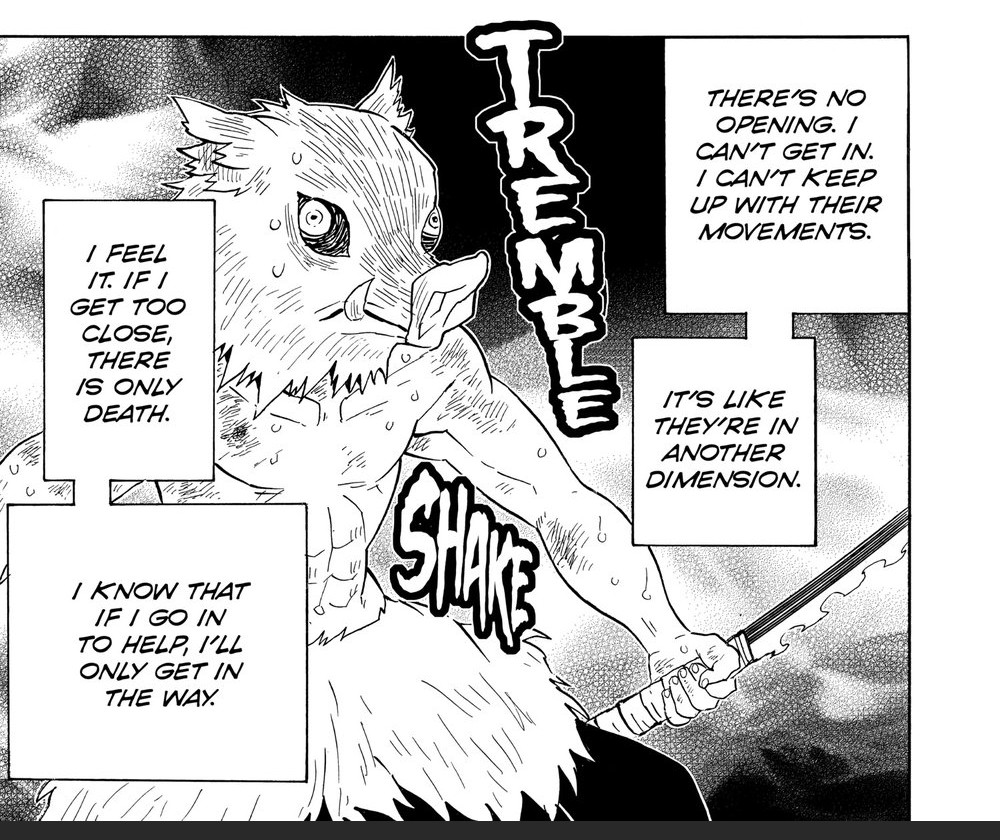
VIZ: "THERE'S NO OPENING. I CAN'T GET IN. I CAN'T KEEP UP WITH THEIR MOVEMENTS."
Then, across three more stacked boxes, the confession this article is about:
「助太刀に入った所で足手まといでしかないとわかるから動けねぇ」
Sukedachi ni haitta tokoro de ashidematoi de shika nai to wakaru kara ugokenē
VIZ's English edition prints all three boxes as one sentence: "I KNOW THAT IF I GO IN TO HELP, I'LL ONLY GET IN THE WAY." (Vol. 8, p.51.)
Grant the rendering its due first: it's accurate, it fits the layout, and "get in the way" is a completely reasonable English idiom for the moment. What it can't show is the shape of the original. Japanese gives Inosuke's realization to the reader in three separate breaths — even if I went in to help / I'd only be ashidematoi / I know it, so I can't move — each one its own panel, its own pause, its own flinch. English, needing one grammatically complete sentence to fill the merged balloon, smooths the stammer into a single confident clause. The boy who never has a moment's doubt about anything is, for one page, doubting himself three separate times, and the translation only shows the finished thought.
The Original
Take 足手まとい apart, because the pieces are all beginner vocabulary and the sum is worth owning.
足手 (ashide) fuses 足 (ashi, "foot, leg") and 手 (te, "hand, arm") into one compound for "the limbs" — 手 voicing to で by rendaku, the same sound-shift Japanese compounding runs constantly. Both kanji are first-year vocabulary; nothing exotic yet.
まとい is the noun form of 纏う (matou), "to wind [something] around, to wrap, to drape" — the verb behind 身に纏う ("draped on the body," said of clothes or an aura) and 纏わりつく ("to cling, to coil around," said of vines, smoke, or a clingy little sibling).
Put the two halves back together and 足手まとい pictures exactly what it says: something wound around your own hands and feet. Not weight on your back, not baggage in your arms — a tangle at the exact four points a body uses to move. A person who is 足手まとい isn't just heavy to have around; they're rope on the ankles, the reason a stride breaks.
One spelling note sets this article apart from its sister pieces on Naruto and One Piece, where the same idiom turns up spelled almost exclusively in hiragana. 纏 sits outside the Jōyō kanji list Japan teaches through high school, so the headline line here follows that pattern — Inosuke's version prints 足手まといで, no kanji for 纏 at all. But two of this article's other three sightings spell it out in full: 足手纏いだった, 足手纏いになるな, 足手纏いの厄介者 — kanji and all, three times out of four. Kimetsu no Yaiba's lettering leans on the rarer, more literate spelling noticeably more than its two shonen siblings do, a small but genuine difference in house style between mangaka.
The grammar wrapped around the headline line is worth a second look, too. 助太刀に入った所で uses 〜たところで, a concessive built from 所 ("place, point") that has drifted entirely away from its literal meaning of location into pure hypothetical concession — "even if I did X." And 助太刀 (sukedachi) is an old word for battlefield reinforcement, the backup a fighter calls in when they're losing — exactly the role Inosuke is talking himself out of filling. As vocabulary, 足手まとい carries no official JLPT rating; by working frequency, call it N2-territory, two N5 kanji wrapped around a reading most learners never see spelled with its own kanji.
VIZ's Choice
Every confirmed sighting of 足手まとい on file, speaker included:
| Vol. / p. | Speaker | Register | Japanese | VIZ English |
|---|---|---|---|---|
| 8 / 51 | Inosuke, of himself | fearful confession | 助太刀に入った所で足手まといでしかないとわかるから動けねぇ | I KNOW THAT IF I GO IN TO HELP, I'LL ONLY GET IN THE WAY. |
| 12 / 19 | Muzan, of the dead Daki | cold verdict | 妓夫太郎は負けると思っていた.案の定堕姫が足手纏いだった | I SUSPECTED GYUTARO WOULD LOSE. AS I THOUGHT, DAKI WAS A HINDRANCE. |
| 21 / 80 | unconfirmed, likely Tanjiro self-addressing amid the final battle | urgent command | 足手纏いになるな!! | DON'T BE A HINDRANCE!! |
(A fourth sighting turned up while widening the search past this article's assigned needles: Vol. 21, p.85, 足手纏いの厄介者 — Obanai Iguro, snake draped around his neck, ordering Mitsuri Kanroji to withdraw during the same final battle. The corpus page-pairing breaks down here — the note attached to the record reads "JP page 85 does not match EN page 85; EN page 85 corresponds to JP page 84" — so no verified official English line could be located for it, and it isn't quoted as a translation choice above. The Japanese text itself is confirmed directly against the printed page.)
Three confirmed sightings, and English lands on "hindrance" twice and "in the way" once — real convergence, tighter than this idiom gets in either Naruto (nine sightings, eight different English strings) or One Piece (two sightings, two different verb phrases, no noun at all). "Hindrance" is a genuinely good all-purpose fit for the word's meaning. But look at what it's being asked to carry: Muzan's "A HINDRANCE" is a closed case filed in a demon lord's ledger about a subordinate who just died for him. The final-battle "DON'T BE A HINDRANCE!!" is a shouted order between allies mid-fight, life or death, right now. Same English noun, same exclamation-free/exclamation-heavy contrast lost, two completely different stakes. Meanwhile Inosuke's fear — arguably the most emotionally loaded of the three, a boastful character admitting real limits for the first time — gets the one rendering that doesn't share a word with the other two, so nothing in the English text signals that all three scenes are the same idiom at all.
The Gap
The limbs disappear in all three. 足手まとい pictures rope wound around hands and feet; "in the way" and "a hindrance" are pure abstractions, verdicts with no body attached. Every rendering here is locally correct. None of them shows a single hand or foot.
The stammer gets smoothed into a sentence. Japanese splits Inosuke's realization across three separate panel-boxes, each one a fresh beat of hesitation. English needs one grammatical sentence to fill the merged balloon, so "I KNOW THAT IF I GO IN TO HELP, I'LL ONLY GET IN THE WAY" reads as a finished thought — confident, almost composed — where the original reads as someone talking himself down in real time, one clause at a time.
Convergence erases the difference between contempt and command. Muzan's flat, declarative "A HINDRANCE" and the battlefield's urgent "DON'T BE A HINDRANCE!!" are opposite acts of speech — one closing a file, one trying to keep someone alive — wearing the identical English noun. A reader who notices the echo has no way to know whether it's meaningful or coincidental, because Japanese's echo (the same word, three totally different deliveries: confession, verdict, order) simply isn't visible in the translation at all.
What If
For Inosuke's line, the menu and its prices:
- "I know — if I jump in, I'm nothing but rope around their ankles." — keeps the tangled-limb picture explicit. Cost: an invented metaphor with no English precedent; the reader has to build the image mid-panel, in a scene that needs to land fast.
- "Even if I went in to help... I'd only tangle their feet... I know it, so I can't move." — split into three clauses like the three original boxes, preserving the stammer. Cost: the staccato em-dashes read as affected in a single block of English prose, where three separate manga panels made the same pause feel natural.
- "...Nothing but dead weight if I stepped in." — plain, idiomatic, and close to how the sentence would actually get said out loud. Cost: "dead weight" is inert mass, not limbs that trip a stride — the tangle becomes a lump.
- Keep VIZ's line, restore the fragments: "If I go in to help... I know... I'll only be in the way." — Cost: recovers the panel-by-panel hesitation VIZ's version smooths away, but the body is still gone; this fixes the rhythm, not the picture.
Take-away
足手まとい is what Japanese reaches for instead of "burden" or "hindrance" when it wants the listener to feel the rope, not just register the inconvenience. Three speakers use the identical word across this manga's darkest arcs — a fighter confessing fear to himself, a demon lord filing a death as a clerical loss, an ally shouting a lifeline mid-battle — and English answers with two words that erase the difference between all three.
Three rules of thumb to carry off this page:
- When Japanese splits a thought across several small panel-boxes, the fragmentation is part of the meaning. A translation that merges them into one clean sentence may stay accurate and still lose the hesitation the layout was built to show.
- A recurring idiom spoken by wildly different characters is worth tracking as one thread, not three unrelated lines. Fear, contempt, and command sharing a single word is a real pattern in how this manga uses 足手まとい — visible in Japanese, invisible once English scatters its vocabulary.
- Watch which kanji a series chooses to spell out. Naruto and One Piece nearly always leave 纏 in hiragana; Kimetsu no Yaiba prints it in kanji more often than not — a small, checkable fingerprint of house lettering style, not a difference in meaning.
This hub tracks the same missing anatomy elsewhere on this site: a coward's hips give out behind 腰抜け, courage and terror get graded by liver and hip in 肝が据わる・腰を抜かす, and Tanjiro's own nose does the work English makes him claim credit for in 鼻が利く. For the leg-pulling half of this same body-idiom family, see Genya's 足を引っ張る — a near-miss false friend with the English idiom that looks identical and means almost the opposite. Naruto's sister site runs the identical two kanji across nine speakers in a companion piece also titled around "Tied Hand and Foot," and One Piece runs it through Marine Captain Hina's habit of never saying "I" — worth reading alongside this one for how differently the same idiom scatters from manga to manga. For the rest of what gets lost in translation on this hub, browse the Demon Slayer translation notes index.
Every Japanese and English line quoted above is a byte-exact capture from the cited editions — 鬼滅の刃 Vol. 8, 12 & 21 (Japanese) and Demon Slayer: Kimetsu no Yaiba (VIZ Media) at the corresponding panels — via our bilingual page database; see Sources below.