The Moment
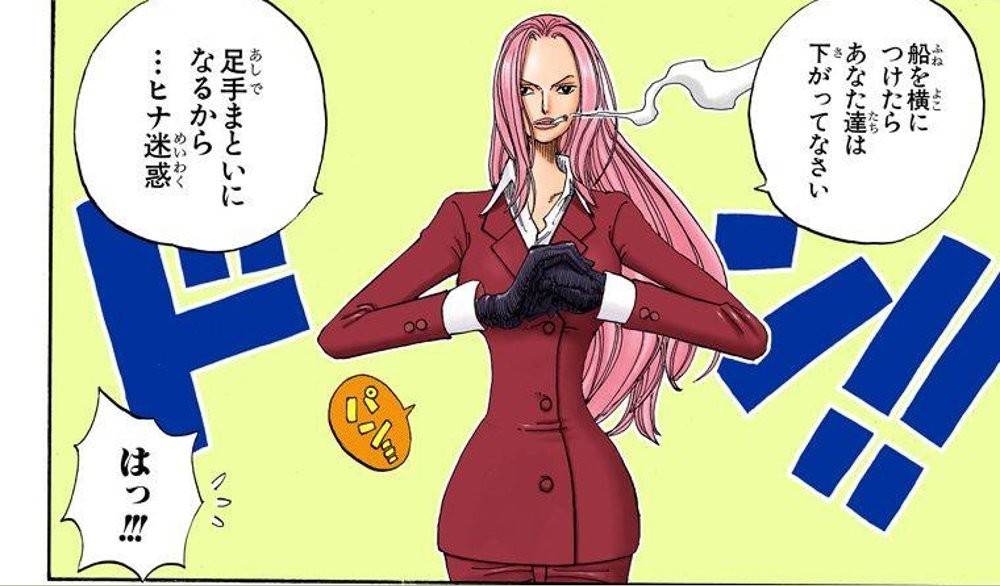
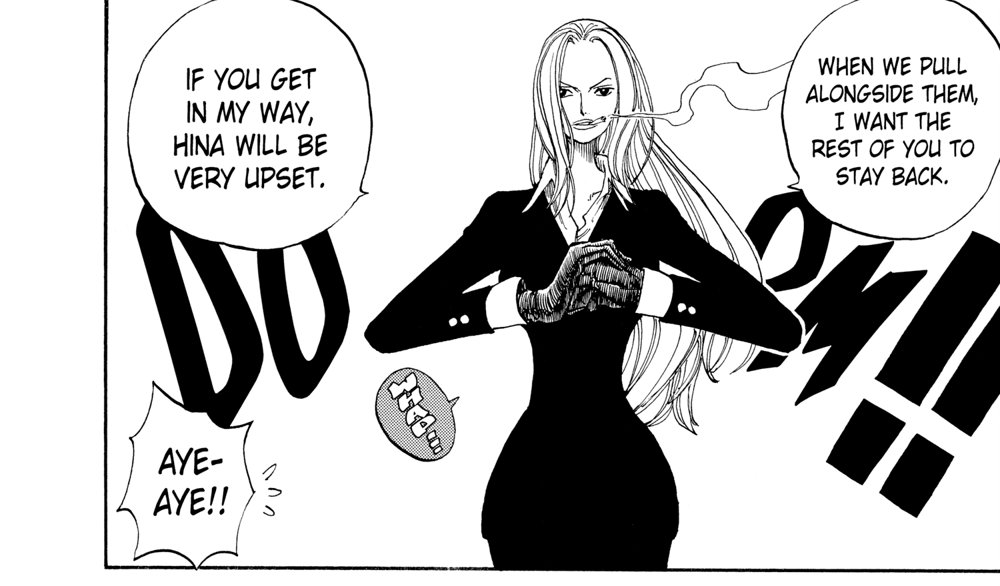
Volume 23 opens on the tail end of the Alabasta arc. Marine Captain Hina's fleet — three warships, hers flying its own banner — has cornered a fleeing, badly damaged pirate ship in open water. A subordinate reports on the bombardment already dealt: 「我らの“黒ヤリの陣”で落とせぬ船はありません」 — "NO VESSEL EXISTS THAT MY BLACK SPEAR FORMATION CAN'T DESTROY." Hina isn't finished. She orders her ship pulled alongside the wreck, then turns to her own crew with an instruction before she wades in personally: 「船を横につけたらあなた達は下がってなさい」 — "WHEN WE PULL ALONGSIDE THEM, I WANT THE REST OF YOU TO STAY BACK." — and follows it with the reason:
「足手まといになるから...ヒナ迷惑」
Ashidematoi ni naru kara… Hina meiwaku
VIZ's English edition prints: "IF YOU GET IN MY WAY, HINA WILL BE VERY UPSET." (Vol. 23, p.198 — the English edition runs five pages ahead of the Japanese here, which sits at p.193 in the original; the corpus pairs the two correctly, but it's worth flagging the offset before citing either page number on its own.)
Grant the rendering its due: it's a clean, punchy line that fits its balloon, and "Hina will be very upset" preserves the single strangest thing about how this character talks — she never calls herself "I." Now watch the sentence work. The Japanese never breaks from third person: 足手まといになるから has no stated subject at all (ordinary for Japanese), and the only name anywhere in the line is ヒナ, referring to herself. VIZ needed a grammatical subject for the English verb phrase it invented — "get in ___ way" — and reached for "my." So the translation opens in first person and closes in third person, a switch the Japanese line never makes even once.
The Original
Take 足手まとい apart, because the pieces are all beginner vocabulary and the sum is worth owning.
足手 (ashide) fuses 足 (ashi, "foot, leg") and 手 (te, "hand, arm") into one compound for "the limbs" — 手 voicing to で by rendaku, the same sound-shift Japanese compounding runs constantly. Both kanji are first-year vocabulary; nothing exotic yet.
まとい is the noun form of 纏う (matou), "to wind around, to wrap, to drape" — the verb behind 身に纏う ("draped on the body," said of clothes or an aura) and 纏わりつく ("to cling, to coil around," said of vines, smoke, or a clingy little sibling).
Put the two halves back together and 足手まとい pictures exactly what it says: something wound around your hands and feet. Not weight on your back, not baggage in your arms — a tangle at the exact four points a body uses to move. A person who is 足手まとい isn't just heavy to have around; they're rope on the ankles, the reason a stride breaks.
Both occurrences quoted in this article use the identical grammatical frame — 足手まといになる, "[for someone] to become ashidematoi" — down to the になる. Hina's order and the reply three volumes later share the construction word for word, even though the speakers, the stakes, and the register couldn't be more different. One spelling note worth keeping: 纏 sits outside the Jōyō kanji list Japan teaches through high school, so the word is almost never typeset 足手纏い — both headline occurrences here print it 足手 in kanji plus まとい in hiragana, with furigana あしで confirming the reading. A third hit turned up while widening the search net past this article's assigned needles: Vol. 21, p.59 spells the same idiom 足でまとい — で written out in plain hiragana standing in for 手 — which only works because the true reading really is あしで, not あして. It's the same word, spelled phonetically instead of with its usual kanji, and it happens to be Zoro growling about Nami — 足でまとい以外の何物でもねェぞあのバカ女っ!!!, "THAT STUPID GIRL IS NOTHING BUT A NUISANCE!!" — five volumes before this article's second occurrence, in a scene where he's the confirmed, on-panel speaker.
As vocabulary, 足手まとい carries no official JLPT rating; by working frequency across shonen manga, treat it as N2-territory, built from two N5 kanji wrapped around a reading most learners never see spelled with its own kanji at all.
VIZ's Choice
Both occurrences of 足手まといになる on file, side by side with the official English:
| Vol. / p. | Speaker | Japanese | VIZ English |
|---|---|---|---|
| 23 / 193 (EN p.198) | Marine Captain Hina, to her own fleet | 足手まといになるから...ヒナ迷惑 | IF YOU GET IN MY WAY, HINA WILL BE VERY UPSET. |
| 26 / 169 | unconfirmed — likely Zoro, answering a shipmate's request to tag along (Skypiea) | あァ!?いいが足手まといになるなよ | HUH?! SURE, AS LONG AS YOU DON'T SLOW ME DOWN. |
Two appearances, two English sentences, and neither one is a noun. That's the real finding here, and it cuts a different way than this hub's Naruto companion piece, where 足手まとい mostly freezes into nouns — "burden," "liability," "nuisance" — English nouns standing in for a Japanese noun. Both occurrences on file in One Piece dodge the noun shape entirely and reach for an active-verb warning instead: "get in my way," "slow me down." The menace survives both times. The picture — someone tangled at the hands and feet — survives neither.
One footnote the table can't hold: Vol. 21's 足でまとい (see above) isn't a third row here because it doesn't match this article's exact needles — but it is the same idiom, spelled out phonetically, and it's spoken by the same character (Zoro) about the same target (Nami) that this article's second, unconfirmed occurrence most likely also involves. If that identification is right, the two lines are five volumes apart and the same running joke: Zoro, muttering the identical warning about the identical crewmate, twice.
The Gap
The noun becomes a verb, and the body disappears with it. 足手まといになる names a state someone is about to enter — becoming a tangle. "Get in my way" and "slow me down" name an action someone might take. The shift from noun to verb is subtle in English and total in what it drops: nobody in the translated text is ever called an entanglement, only an inconvenience.
Hina's third person survives exactly halfway. "IF YOU GET IN MY WAY, HINA WILL BE VERY UPSET" opens with an implied "you're in my way" (first person "my") and closes with her own name (third person "Hina"). The Japanese never makes that switch — it stays in third person, subjectless, from 足手まといになるから straight through to ヒナ迷惑. English's need for an explicit grammatical subject in the first clause is what forces the split; Japanese never needed one.
The shared frame vanishes. 足手まといになる is the exact phrase in both quoted lines — same verb, same conjugation pattern, spoken three volumes apart by (probably) two completely different characters in two completely different registers. A reader of the Japanese can feel that rhyme. A reader of the English, routed through "get in my way" in one panel and "slow me down" in another, has no way to notice the two speakers ever said the same words.
What If
For Hina's line, the menu and its prices:
- "If you tangle Hina's hands and feet, Hina won't be pleased…" — keeps the literal binding image and the third-person voice from start to finish. Cost: needs a beat to land as a threat in English.
- "You'll only be rope on my ankles… and Hina doesn't forgive that." — vivid, and keeps the name. Cost: an invented metaphor English has no ready idiom for.
- "Stay out from underfoot — Hina won't stand for it." — natural English idiom, still foot-adjacent. Cost: "underfoot" is a much smaller threat than rope wound around all four limbs.
- Keep VIZ's clause, restore the name throughout: "If you get in Hina's way, Hina will be very upset." — Cost: repeating the name reads oddly by English style, but it's the only option here that never lets Hina slip into "I."
Every option that keeps the body image has to either invent an English metaphor from scratch or accept an odd-sounding sentence; every option that sounds natural in English quietly drops the rope.
Take-away
足手まとい is what Japanese says instead of "burden" or "in the way" when it wants the listener to picture the tangle, not just register the inconvenience. Both occurrences on file here answer that picture with a warning about future behavior instead — accurate in effect, silent on the anatomy.
Three rules of thumb to carry off this page:
- When 足手まとい shows up as 〜になる, expect English to convert the "becoming" into a "doing." The noun names a state; most fixes translate it as an action instead, which is often the more natural English sentence and always the one that drops the limbs.
- Watch what happens to a character's grammar, not just their vocabulary. Hina's total avoidance of first-person pronouns is a running trait across her appearances, and it can survive translation only in fragments unless a translator builds the whole sentence around preserving it.
- A recurring construction is evidence of a running bit, even across unrelated scenes. The identical frame, 足手まといになる, tying a Marine captain's fleet order to a pirate's dockside permission-slip three volumes later, is exactly the kind of echo that a scatter of different English verbs erases without meaning to.
This hub tracks the same missing anatomy elsewhere in the story: the hands and feet that won't come out in 手も足も出ない, the hips that give out behind 腰抜け, and the downward glance at a traveler's feet in 足元を見る — three more places where Japanese reaches for a body part and English reaches for an abstraction instead. This hub's Naruto sister site runs the identical two kanji, 足手まとい, across nine speakers and nine different English words, in a companion piece titled "Tied Hand and Foot" — worth reading alongside this one for how differently the same idiom scatters in a different series' hands. For the rest of what English relocates out of the body on this hub, browse the One Piece translation notes index.
Every Japanese and English line quoted above is a byte-exact capture from the cited editions — ONE PIECE Vol. 21, 23 & 26 (Japanese) and One Piece (VIZ Media) at the corresponding panels — via our bilingual page database; see Sources below.