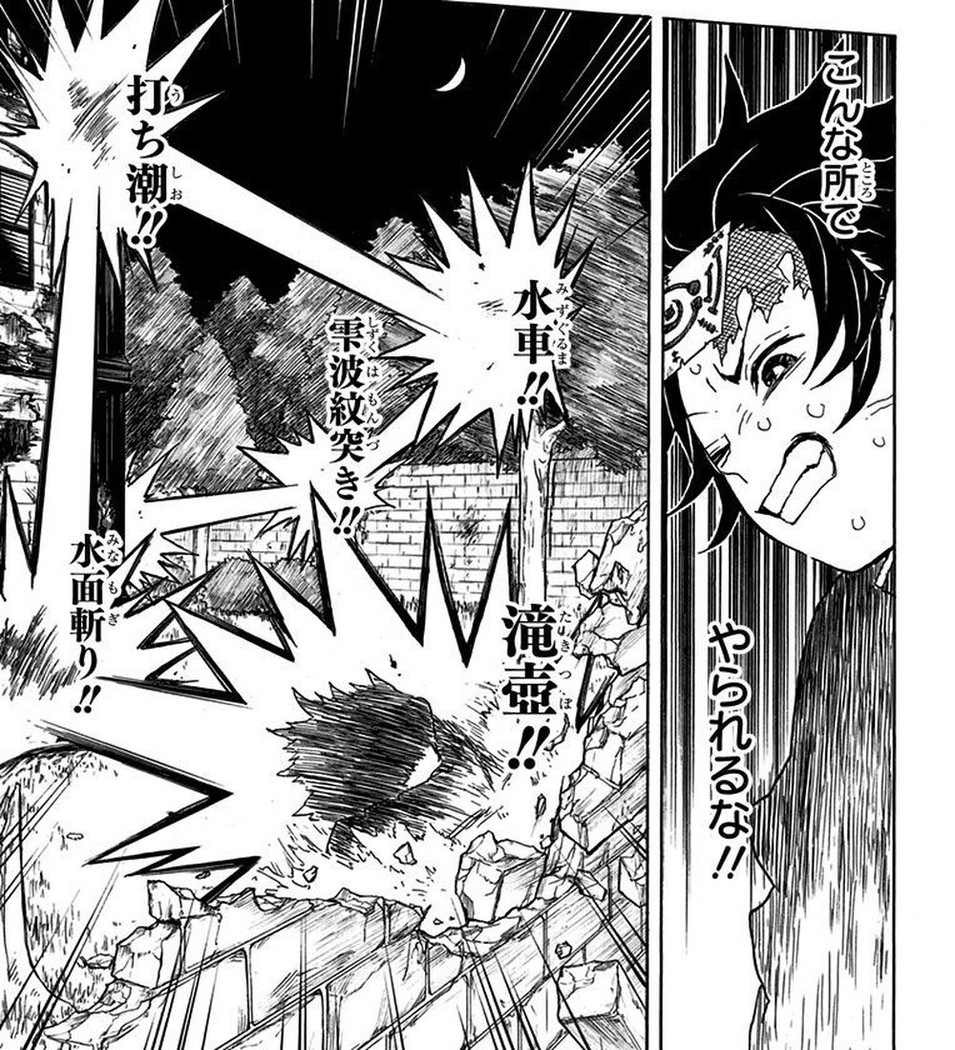
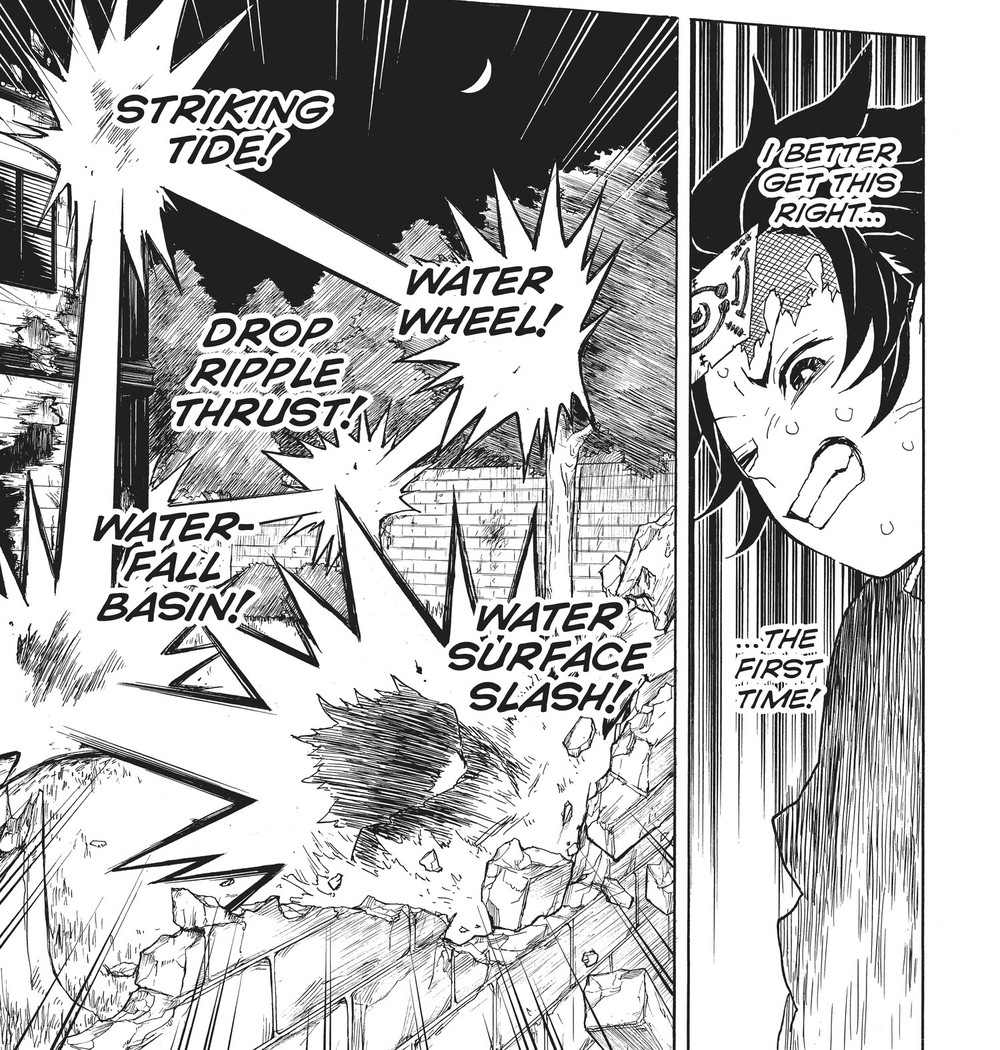
VIZ keeps the geometry of the name intact — "surface" and "slash" both survive the translation untouched, which is unusual restraint for a series where later forms lean into freer imagery. That's likely because 水面斬り is the entry point: as the first numbered form Tanjiro is shown performing, it needs to read as a plain, teachable technique rather than a flourish. The flat clause structure ("first form, then verb") sets the template every later form riffs against.
The corpus never shows 水面斬り taught in isolation — its only two named appearances (Vol. 3 p.31, Vol. 16 p.133) are both mid-battle, fired as the closing beat of a rapid technique chain rather than a standalone showcase. That placement is itself informative: by the time Tanjiro reaches for Form One again in Vol. 16 (the Swordsmith Village arc, against Upper Rank Gyokko), it isn't a beginner's move anymore — it's muscle memory he falls back on when he needs speed over spectacle, book-ending roughly thirteen volumes of growth with the same four syllables.
Structurally, "water surface" is doing quiet technical work: a slash that treats the blade's path like it's skimming a pond implies a flat, level cut with minimal upward or downward arc — useful precisely because it's unglamorous. Compare that to Form Five's explicit poetry (skipped in this dictionary — it never surfaces by name in the corpus) or Form Ten's Buddhist echo (生生流転), and Form One reads almost deliberately plain: the technique you learn before you learn taste.