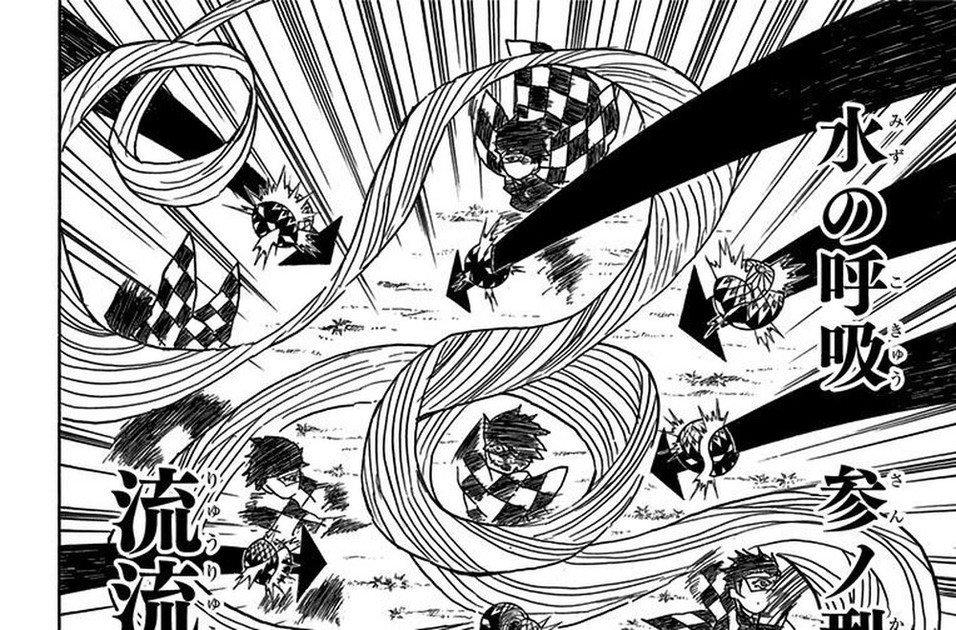
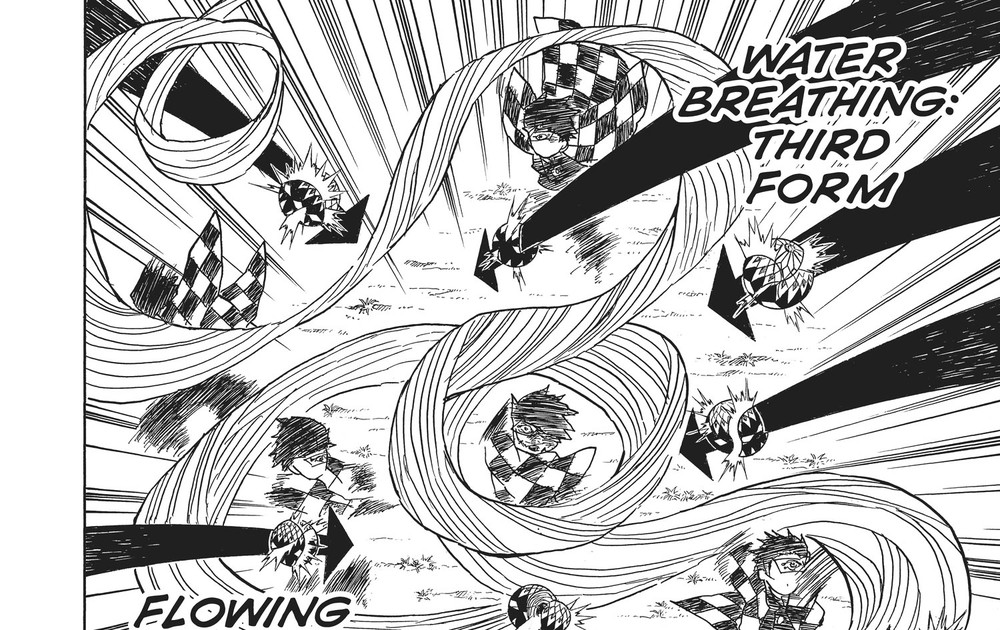
"Flowing Dance" is a rare case in this style where VIZ drops the reduplication entirely rather than trying to preserve it. The Japanese 流流 (ryuuryuu) doubles the character for "flow" for rhythmic and semantic emphasis — a common pattern in Japanese vocabulary (布ボロボロ, 光キラキラ) that has no clean one-word English equivalent. VIZ's "Flowing Dance" captures the movement but sacrifices the doubling; an alternate literal rendering closer to the Japanese would read "Flowing-Flowing Dance" or "Ever-Flowing Dance," which is clunkier in English but truer to the insistence baked into the name.
Unlike the combo-strike forms (One, Four, Seven, Eight) that all describe a single committed attack, Flowing Dance is explicitly about movement and repositioning — Vol. 3's narration literally cites "the footwork of Form Three" as a technique component separate from the cutting forms it's paired with, confirming that 舞い (mai, "dance") is doing real descriptive work here, not just decoration. That's consistent with its recurring role across the corpus: it shows up in high-mobility fights (against the thread-wielding Yahaba in Vol. 2, against the speed-obsessed Akaza in Vol. 11) rather than fights that reward a single overwhelming blow.
The Mugen Train appearance (Vol. 11, p.60) is a small piece of series trivia worth flagging: the same page pairs Tanjiro's Water Breathing Third Form with Zenitsu Agatsuma's Thunder Breathing First Form (雷の呼吸 壱ノ型 霹靂一閃・八連, "Thunderclap and Flash: Eightfold") fired in the same beat — a rare moment where the corpus captures two demon slayers' named techniques back-to-back in a single scanned exchange.