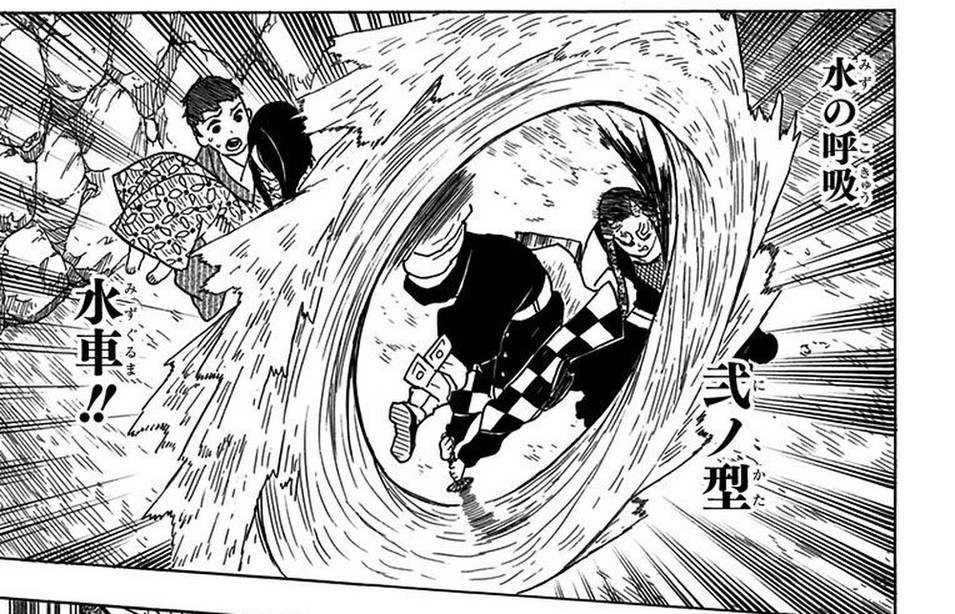
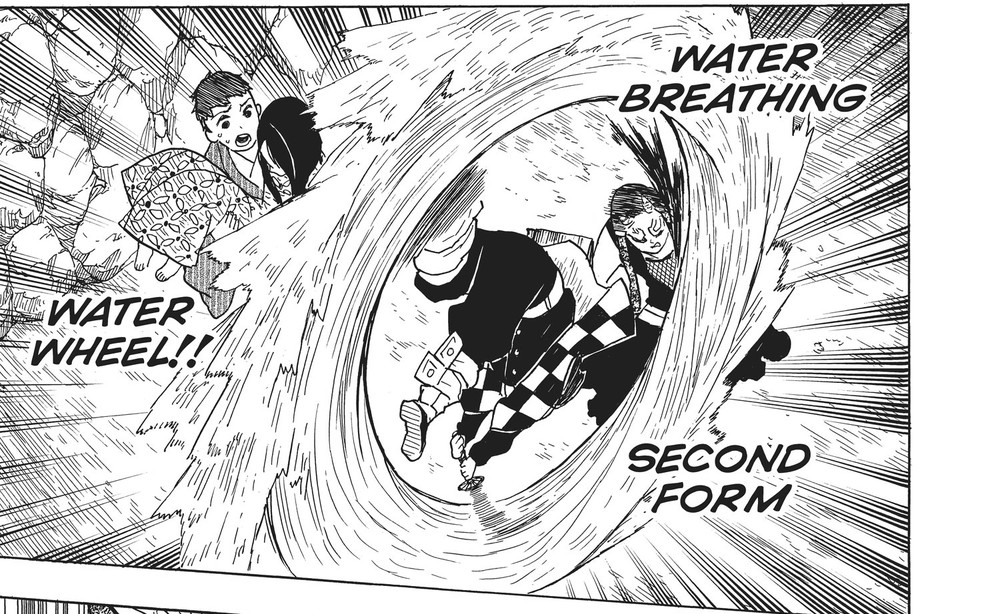
Water Wheel is the workhorse of the style — the corpus shows it fired on its own eight separate times across nine volumes, more than any other numbered form in this dictionary. That frequency tracks with what the name describes: a spinning full-body cut is a generalist's tool, useful against a swarm of thread-limbs (the Vol. 2 Yahaba fight) or a cornered demon in a collapsing corridor (Vol. 3) alike, which is presumably why Urokodaki teaches it early and Tanjiro keeps reaching for it.
VIZ's handling of the 横水車 variant is worth flagging as a small translation choice: rather than coin a new name, the localization keeps "WATER WHEEL" as the anchor and adds "LATERAL" as a modifier ("SECOND FORM: LATERAL WATER WHEEL"), mirroring how the Japanese does the same thing — 横 (yoko, "sideways") stacked onto the unchanged base compound rather than replaced. That's a deliberate consistency choice: a reader encountering 横水車 for the first time in Vol. 3 (against the Tsuzumi Mansion demon) or Vol. 5 (against Rui) instantly recognizes it as Form Two wearing a different angle, not a brand-new twelfth technique.
The corpus OCR stumbles on this form more than most — 水車 gets misread as 懊水車 (Vol. 5 p.13) and even 本車 (Vol. 17 p.115), both clearly scanner artifacts rather than printed text, since the VIZ side renders a clean "WATER WHEEL!" in every instance. It's a reminder that the raw Japanese captured here is a scan of ink, not a guaranteed clean transcript — the corrected_jp field exists precisely to flag where a human (or the image itself) overrides what the OCR first produced.