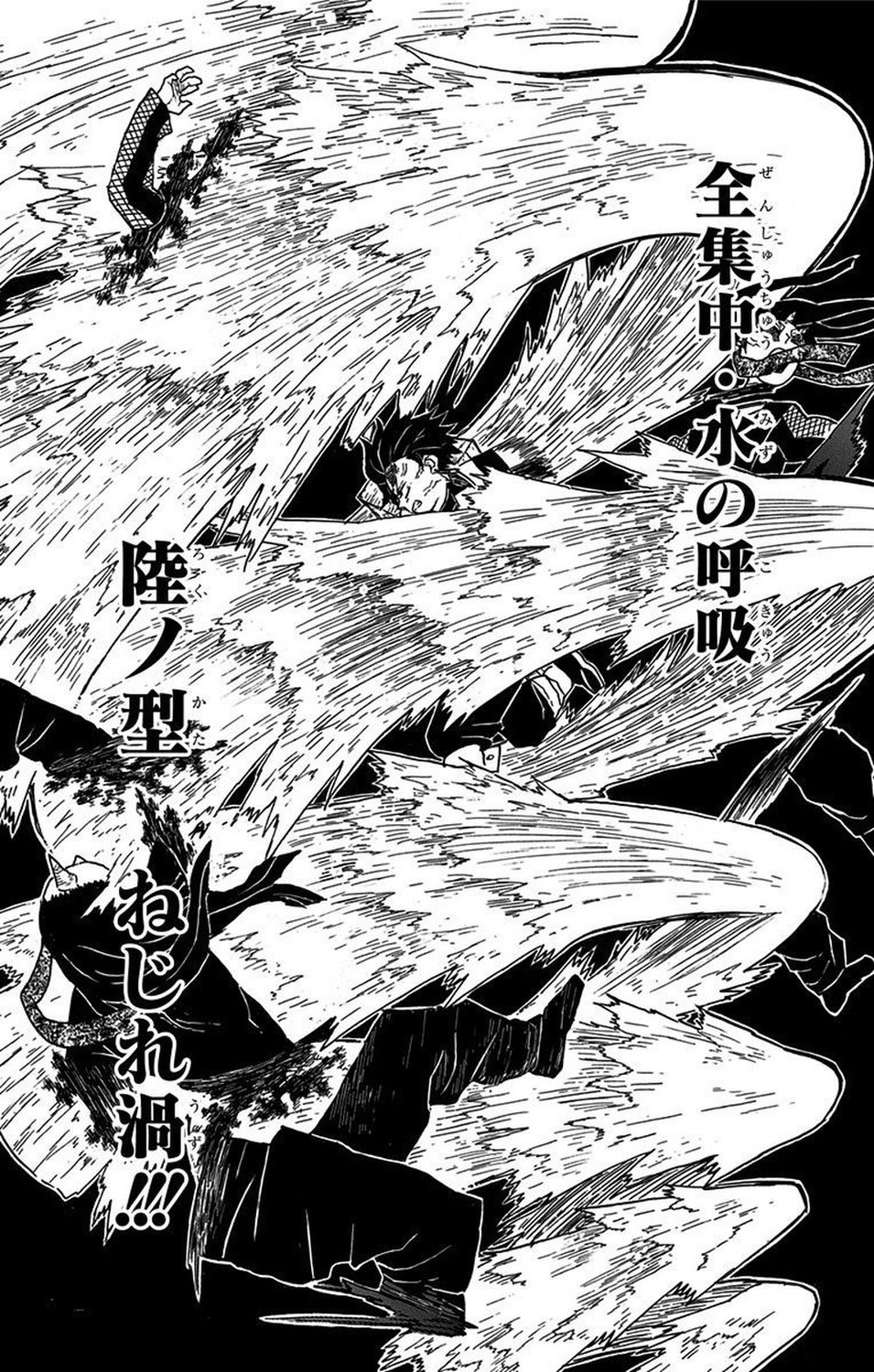
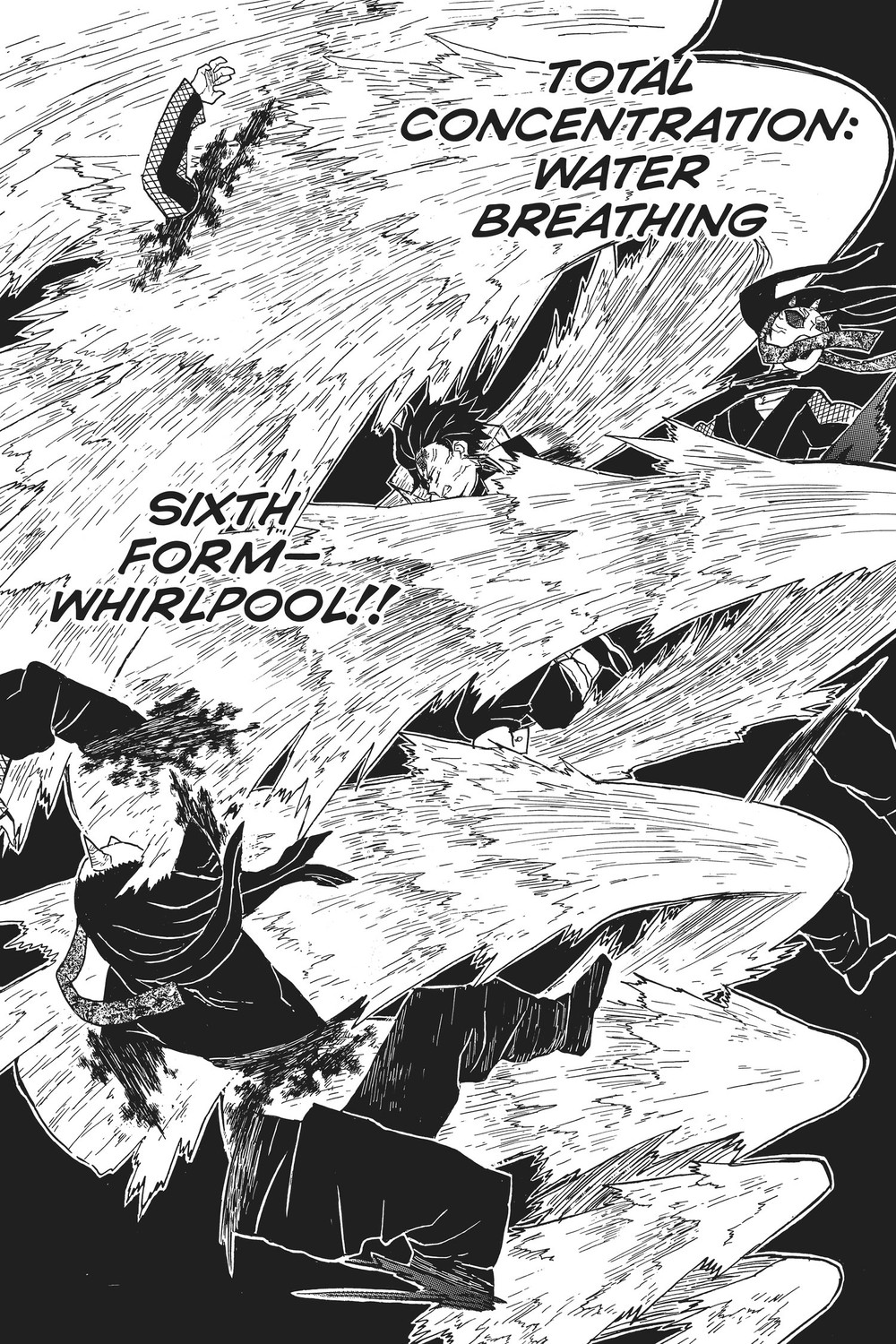
This is the one numbered form in the dictionary whose Japanese name is spelled partly in kana rather than all kanji — ねじれ (nejire) has a perfectly good kanji form (捩れ/捻れ) that the series simply doesn't use. That's a small but real authorial choice: kana softens the visual weight of the name compared to the dense kanji compounds used for Forms One, Four, Seven, and Eight, and it keeps the twisting motion readable at a glance rather than requiring an uncommon character.
The Vol. 3 fight against the marionette-thread demon Yahaba is where this form earns its narrative purpose: the corpus explicitly narrates the technique's mechanical logic in Tanjiro's internal monologue — 'I'll wind them up with [Form Six] and use the footwork of Form Three' — before he then reflects afterward, 'out of the water, Whirlpool's force is usually weaker... but his own attack increased its power, and it wound the arrows up!' That's an unusually explicit piece of in-fiction technique commentary: the manga is telling the reader, in the moment, why a water-themed twisting cut is specifically good at snaring thread-like attacks, and noting the technique's own environmental weakness (reduced power outside of water) as a design constraint the protagonist has to work around.
VIZ's "WHIRLPOOL: FLOW!" for the combined ねじれ渦・流流 variant is a rare case of the localization compressing two technique names into a single English beat rather than stacking both in full — understandable given panel space during a rapid-fire combo, but it does mean an English-only reader can't tell from that panel alone that two separately numbered forms (Six and Three) are being fused in real time.