Sanji's first-person is 俺 (ore), the standard tough-guy "I" of nearly every Straw Hat man, and his sentence endings match it: ねェ for ない, dropped syllables, the clipped -ぜ/-だぜ swagger of someone who talks like he's already halfway through a cigarette. 「クソ剣士にフォローされてちゃ...おれの立つ瀬がねェんだよ!!!」— snapped at Zoro mid-fight, furious at needing help — runs on exactly this register: 立つ瀬がない, "no place left to stand," is Sanji's pride translated into an idiom about literally having nowhere to put his feet. It's baseline Straw Hat masculine speech. What makes Sanji's voice distinctive is what happens to that baseline the instant a woman enters the panel — and what happens to it, once, at the one moment his whole vocabulary fails him.
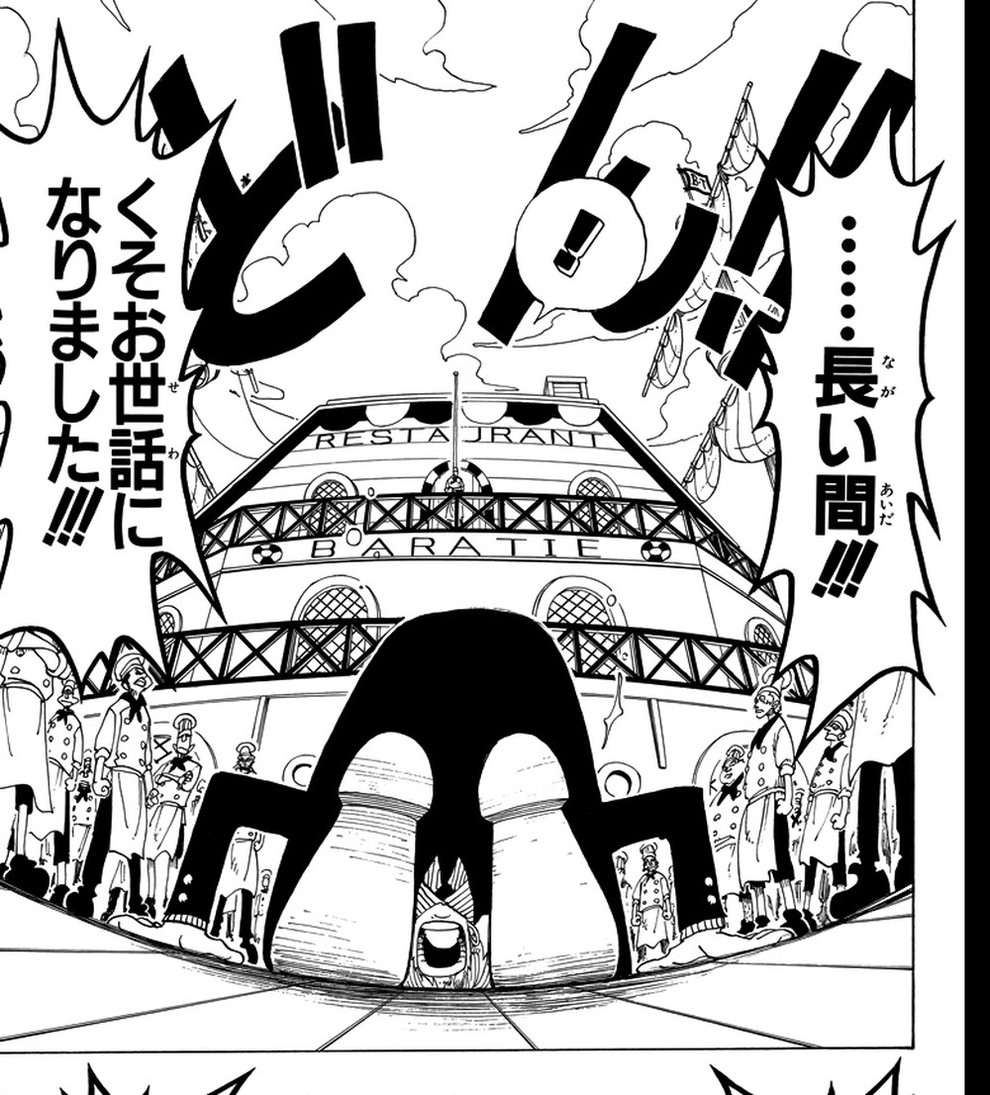
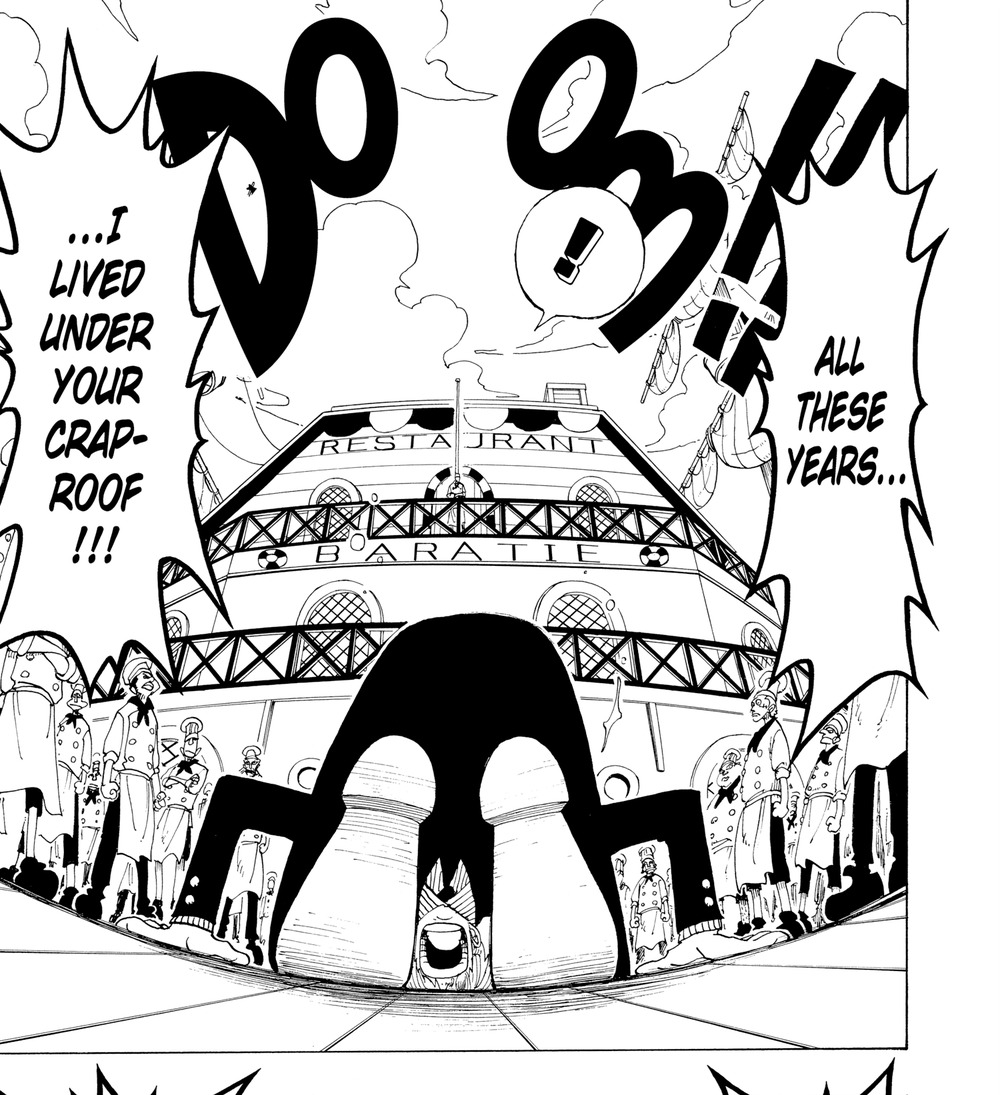
クソ (kuso, "crap/damn") is Sanji's signature intensifier, and for the eight years the flashback volumes cover, he spends nearly all of it on Zeff: クソジジイ ("crap-geezer"), volleyed back as クソチビナス ("crap-baby-eggplant"), a running insult contest that is also, everyone including Sanji knows, a love language. Then he leaves. Lined up with the whole restaurant staff outside the Baratie, unable to look anyone in the eye, he gets exactly one sentence out: 「くそお世話になりました!!!」— literally "I received your CRAP-care!!!" 世話になる is ordinary, humble, formal Japanese for being looked after by someone you owe; ordinarily it takes an お honorific, not a クソ. Sanji can't manage the debt straight, so he routes eight years of gratitude through the same vulgar prefix he's used to insult the man the entire time — and it's the only way the sentence will come out of his mouth at all. VIZ renders クソ consistently as "crap-" everywhere it appears on this page — crap-geezer, crap-roof — so an English reader who's tracked the insult across a hundred pages recognizes instantly, no footnote required, that the same word is doing the crying now that used to do the fighting. That consistency is a real translation achievement: the joke only survives if "crap-" never breaks formation.
Around women, that entire register disappears. 「レディーはソフトに扱うもんだぜ」— "a lady is a thing one handles gently, y'know" — states chivalry as a general rule via もんだ, the grammar of natural law rather than personal preference; 「なぜならか弱いレディーが2人おれの助けを待っている」reaches for か弱い, "frail," the standard vocabulary of damsel-in-distress rescue fiction, mid-battle, as a serious justification for changing his plans. Toward Nami specifically he goes further still, into actual sonkeigo verb morphology — 「フルーツのマチェドニアを召し上がれ」, commanding her to eat with 召し上がる, the honorific verb reserved for elevating someone else's action, examined in full at 召し上がる and the deference English can't conjugate. No other male Straw Hat reaches for that grammar on anyone. It's the same fragile pride that snaps 立つ瀬がねェ at Zoro, wearing formalwear instead of a snarl.
The cooking vocabulary carries its own charge. 「食いてェ奴には食わせてやる!!!コックってのはそれでいいんじゃねェのか!!!」— thrown at the entire kitchen staff of the Baratie, alone, defending Don Krieg's starving men — and 「腹を空かせた奴にメシを食わせるまではコックとしてのおれの正義」to Gin a page later both repeat the same causative 食わせる, "make/let eat," as a personal ethic. 正義, "justice," is a heavy, almost superhero-register word for a policy about who gets fed — and Sanji means it at that weight, staking his job and his standing with Zeff on a single hungry pirate crew he has every reason to hate. The same conviction, aimed at himself nine years earlier as a starving apprentice cook, produces 「おれはいつか必ずその海を探し出すんだ!!」— the All Blue vow, 必ず ("without fail") turning a boy's dream into a promise with the same grammatical weight as his adult ethics.
Two of this page's lines are the taunting, idiom-driven Sanji covered in full elsewhere on the site: 「図星じゃねェかよ」, thrown at Mr. 2 Bon Kurei as a rhetorical dare, and 「腑に落ちねェ……!!」, growled at the news the Going Merry can't be saved — see 図星 and the archery metaphor VIZ actually kept and 腑に落ちない and the organ English only sometimes finds for the full idiom histories. And the flip side of Sanji's chivalry — what it looks like described from outside, by an enemy who's just watched it cost him an opening — is Bon Kurei's own accusation a page earlier in that same fight: 血も涙もない, "neither blood nor tears", hurled at Sanji for refusing to hit a face that looks like Nami's. For the two other Straw Hats whose speech this site has already mapped in the same detail, see Luffy's quotes page and Nami's — three very different first-person pronouns, three different theories of how a crew talks to itself.