The Moment
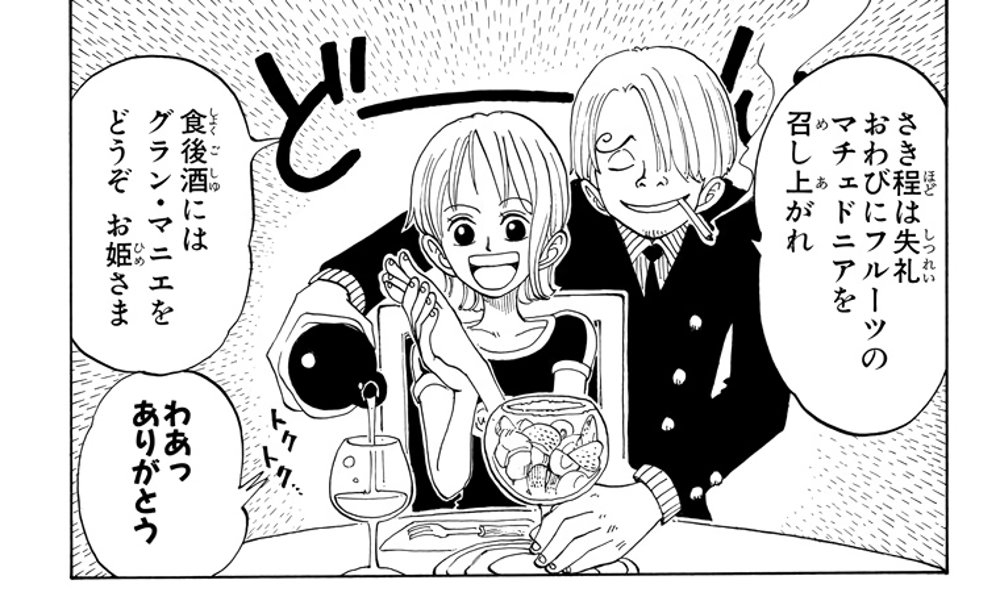
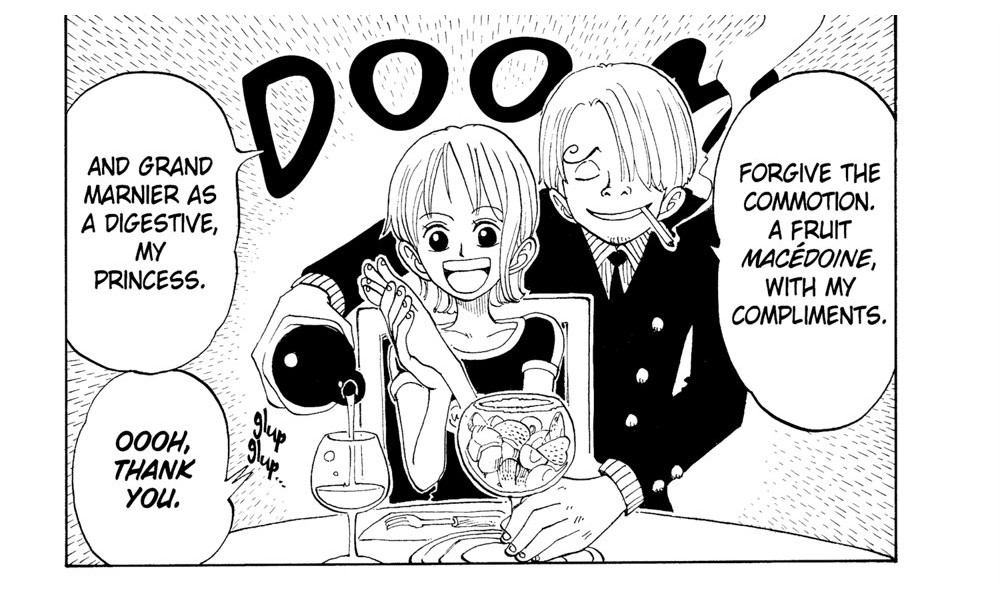
The Baratie has just stopped shaking. A page earlier, Sanji screamed a vow across the whole restaurant at the old owner-chef Zeff — 「てめェが死ぬまでな!!」 ("UNTIL THE DAY YOU DIE!!") — the kind of declaration that stops every conversation in the room. Zeff shot back just as loud, and the regulars watched the two of them go at it in front of a full house. Then, one panel later, Sanji is back at Nami's table, cigarette between his teeth, presenting a glass bowl of fruit like nothing happened:
「さき程は失礼 おわびにフルーツのマチェドニアを召し上がれ」
Sakihodo wa shitsurei, owabi ni furūtsu no machedonia o meshiagare.
VIZ's English edition prints: "FORGIVE THE COMMOTION. A FRUIT MACÉDOINE, WITH MY COMPLIMENTS." (Vol. 6, p.31).
Grant the rendering its due first: it is exactly the register an English-language sommelier or maître d' would reach for, and "with my compliments" lands as genuinely gracious, unforced English. The problem isn't tone — VIZ's line is charming. The problem is that the sentence it's translating has a verb doing something no English verb can do, and that verb simply isn't there anymore.
The Original
召し上がる (meshiagaru) is built from two honorific pieces, stacked. The first is 召す (mesu), an old multipurpose sonkeigo verb: classical and formal Japanese used it as the polite way to say a social superior summons something, wears something, rides something, catches a cold, or eats/drinks — honorific by function, not by literal meaning, a catch-all verb for "whatever a superior does." The second piece is 上がる (agaru), "to rise, go up," which on its own was sometimes pressed into service as a milder honorific for eating or drinking (お茶を上がれ, roughly "do have some tea"). Fuse the pre-masu stem of 召す (召し) onto 上がる and you get a doubly reinforced honorific verb: to deign to eat/drink.
The line ends in 召し上がれ — the ordinary え-row imperative of a godan verb, the same pattern that turns 読む into 読め. Grammatically, that makes the sentence a command. But because the honorific is baked into the verb stem itself, not layered on top of it, the command never stops sounding gracious. This is the trick worth sitting with: you can order someone around in Japanese using a verb that compliments them while you do it, and the politeness survives the imperative fully intact. English has no verb built the same way — "eat!" is always a command, no matter how you dress it, because the courtesy has nowhere to live except in the words around it.
召し上がる belongs to a three-part system that governs almost every verb of consequence in Japanese: 尊敬語 (sonkeigo, "respect language") raises the person you're talking about — their eating becomes 召し上がる, their being/going/coming becomes いらっしゃる, their speaking becomes おっしゃる. 謙譲語 (kenjōgo, "humble language") lowers you — your own eating in front of a superior becomes いただく, your speaking becomes 申す, your going becomes 伺う. 丁寧語 (teineigo, "polite language") is the baseline です/ます layer everyone learns in week one — formality without any claim about who outranks whom. One real-world action, eating, therefore has at minimum three completely different verbs, and choosing the wrong one for the social situation is a genuine mistake, not a stylistic preference. Vocabulary-wise, 召し上がる is commonly taught around N4, right alongside いらっしゃる, as one of the first "irregular" honorific verbs a learner memorizes by rote — but the system it belongs to is core N3–N2 grammar, tested explicitly through N2, because using keigo correctly requires tracking who is speaking, who is being spoken about, and who is superior to whom, all at once, sentence by sentence.
VIZ's Choice
Only one occurrence of 召し上がる/召し上げ survives in the volumes on file, so there's no scatter to chart — but the single data point is telling on its own. VIZ doesn't attempt to translate the verb 召し上がる at all. Instead of an English imperative ("do eat," "please partake"), the translation restructures the whole clause into a noun phrase gifted to the reader: "A FRUIT MACÉDOINE, WITH MY COMPLIMENTS." That's a real and clever move — English restaurant culture has its own ready-made formula for a free, gracious offering ("with the chef's compliments"), and VIZ reaches for that formula instead of forcing an awkward literal imperative. It solves the politeness problem. It does not solve the verb problem: nothing in the English line marks that the original sentence commanded Nami, using a verb built to flatter her, to eat. The compliment has moved from the act of eating onto the act of giving — a full swap of what is being made polite, not just a swap of words.
The Gap
The verb disappears, and with it the direction of the bow. 召し上がる doesn't just mean "eat politely" in the abstract — it specifically marks that Sanji is elevating Nami's action. VIZ's "with my compliments" is polite, but it's polite about the giving, from Sanji's side; nothing marks that the eating itself was the thing being honored. The grammatical fingerprint of who bows to whom is gone.
The command survives; the grace note built into it does not. 召し上がれ is, technically, an order — and it stays warm anyway, because the deference is inside the verb stem. VIZ's line isn't an order at all; it's a gift statement. That's a fair workaround, but it means English had to change the sentence type (imperative → noun phrase) just to keep the tone gracious, because English has no imperative verb that can pull off the same trick.
One occurrence, and it's already representative of the whole problem. This isn't a case where VIZ scattered five different renderings across five volumes (compare our piece on 因縁) — it's a case where the category itself, sonkeigo verb morphology, has no English equivalent to scatter across in the first place. Every rendering of every future 召し上がる/いらっしゃる/おっしゃる line will face this same wall: English can approximate the warmth, never the grammar.
What If
- "Please partake of this fruit macédoine — my apologies for the earlier commotion." — keeps the imperative shape and gestures at deference with "partake." Cost: reads stiffly archaic rather than warmly hospitable, and still can't mark who is being elevated the way the Japanese verb does.
- "Do have some fruit macédoine — my apologies for the fuss." — natural, warm hosting English. Cost: the honorific machinery vanishes completely; nothing marks that this verb exists specifically to flatter the guest.
- "Fruit macédoine, my princess — please, do enjoy." — keeps VIZ's charm and leans on direct address ("my princess," already present one line later) to recover some of the social elevation. Cost: that's a different politeness system entirely — address terms, not verb choice.
- VIZ's actual line, read as a strategy rather than a translation: "with my compliments" sidesteps the untranslatable verb by converting deference into an idiom of gift-giving. Cost: 召し上がる disappears, and so does the specific act of complimenting the eating — what's left compliments the giving instead.
Every option pays because English has no honorific verb slot to spend from. The translator isn't choosing between a good option and a bad one; they're choosing which part of the Japanese sentence gets to keep its politeness, because English can't hold all of it at once.
Take-away
召し上がる is the first stop in a Japanese grammar feature that has no English seat at all: verbs that change form depending on whose action they describe and how that person ranks relative to the speaker. 食べる, 召し上がる, いただく — three verbs, one action, three different bows.
Three rules of thumb to carry off this page:
- Sonkeigo raises; kenjōgo lowers — and they're never interchangeable. 召し上がる is never used for your own eating, and いただく is never used for someone else's. If a keigo verb feels backwards, check who is supposed to be elevated.
- The imperative doesn't erase the honorific. 召し上がれ, いらっしゃい, and their cousins can command someone while still complimenting them — a fusion English simply has no verb form for.
- When a translation swaps a verb for a noun phrase ("with my compliments" for 召し上がれ), ask what moved. Often the politeness survives while the specific social direction it was marking does not.
This piece opens a keigo cluster; watch for companion articles on いらっしゃる, 存じる, and 恐れ入る, plus the honorific verbs Demon Slayer's and Naruto's more formal speakers reach for. For a different way Japanese hierarchy collapses in English — this time through the pronoun rather than the verb — see 貴様 and the pronoun system English flattens into "you" or おぬし and the archaic "you" that dissolves into plain "you". More translation notes at the One Piece translation notes index.
Every Japanese and English line quoted above is a byte-exact capture from the cited editions — ONE PIECE Vol. 6 (Japanese) and One Piece Vol. 6 (VIZ Media) at the corresponding panel — via our bilingual page database; see Sources below.