The Moment
Alabasta, in the rubble-strewn streets of the royal capital. Sanji is fighting Mr. 2 Bon Kurei — a Baroque Works officer agent who can swap faces at will with his Clone-Clone Fruit, and who has spent this entire duel wearing Nami's. Earlier in this very fight (Vol. 21, p.16), Bon Kurei bragged about exactly the weapon he thought that disguise gave him: 「過去にこんな奴がいたわ...!“友情”によってあちしに手も足も出せなくなった男...」— "IN THE PAST, I'VE FOUGHT AGAINST ONE SUCH FOE WHO COULDN'T BRING HIMSELF TO HARM A FRIEND!!" (see 手も足も出ない for that idiom's own tangled history in this series). Bon Kurei was right about the chivalry — Sanji won't hit a face that looks like Nami's — but wrong about what it would cost him.
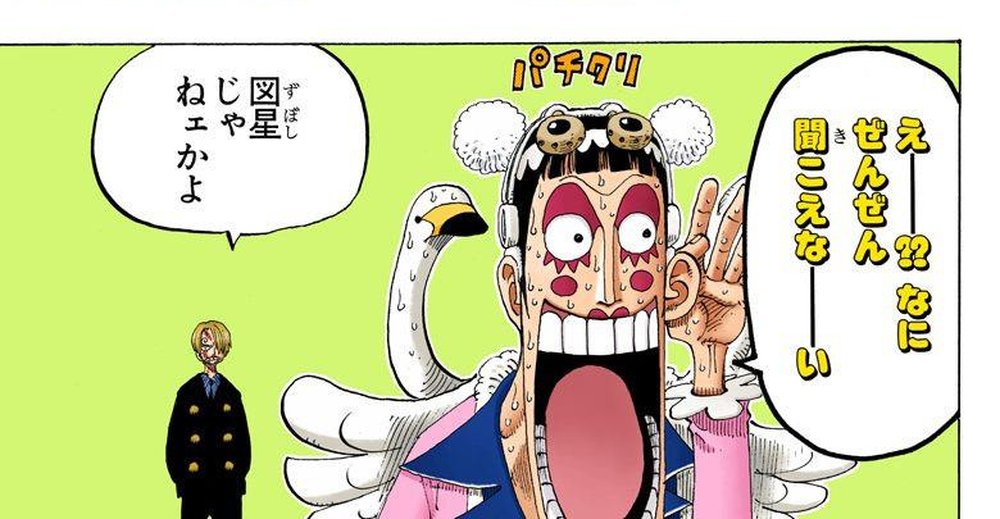
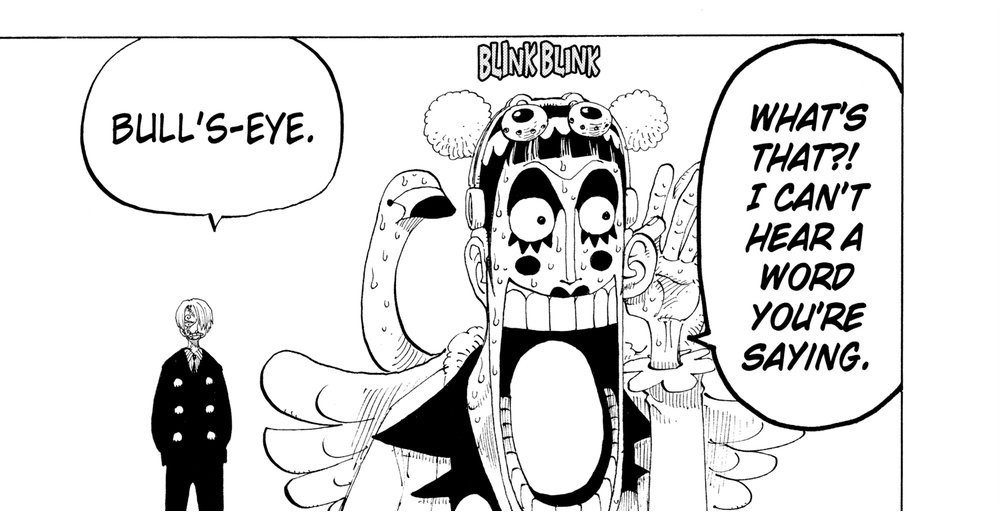
By page 32, Sanji has turned that same fact into a diagnosis. He lays it out cold: 「確かにおれから攻撃する事はできねェが...お前がおれに仕掛けてくる瞬間...お前は必ずオカマに戻る...左手で自分の顔にさわる事でな..!!」— "I ADMIT THAT I CAN'T BRING MYSELF TO ATTACK YOU THEN... BUT THERE'S A MOMENT WHEN YOU'RE VULNERABLE — JUST BEFORE YOU ATTACK, YOU ALWAYS TURN BACK INTO YOURSELF... BY TOUCHING YOUR FACE WITH YOUR LEFT HAND!" Bon Kurei's eyes go wide and blank — パチクリ, "blink blink" — the sound of a secret landing in the open air. Into that silence, Sanji plants two words:
「図星じゃねェかよ」
Zuboshi ja nē ka yo
VIZ's English edition prints: "BULL'S-EYE." (Vol. 21, p.37).
Give VIZ its due before anything else: this is the rare occasion on this site where the concrete image survives the crossing intact. 図星 is an archery word, and "bull's-eye" is a target-shooting word, and for once a Japanese idiom about hitting a mark lands in English as an idiom about hitting a mark. That's not nothing. But sit the two lines side by side and the fit isn't quite as perfect as it first looks.
The Original
図星 (zuboshi) is two ordinary kanji doing one very specific job. 図 (zu) means "diagram, chart, plan" — it's the 図 in 地図 (chizu, "map") and 図書館 (toshokan, "library"). 星 (hoshi/boshi) means "star." Put together, the compound isn't poetic invention; it's a technical term. On a traditional Japanese archery target (的, mato), the black dot painted dead center — the aiming point every archer's eye is drawn to — was called the 星, the "star," set against the target's pale face the way a real star sits against a night sky. 図星 is that specific dot: the bullseye on the diagram.
From there the idiom writes itself. 図星を指す ("to point at the bullseye") or 図星を突く ("to strike the bullseye") means to guess, precisely and correctly, at something someone was hiding — a motive, a feeling, a fact they'd rather not have named out loud. And the stock exclamation for the moment a guess lands is 図星だ / 図星でしょ / 図星じゃない? — "that's exactly it," usually surrendered by (or said about) the person whose secret just got read.
Sanji's line runs that grammar slightly against its own grain. じゃねェ is the rough, contracted, dialectal-masculine form of じゃない — the printed panel spells it じゃねェ; note that the bilingual corpus this site quotes from mis-transcribes the line as 図星じゃないねェかよ, doubling the negation, an OCR slip this article corrects against the actual printed page (see Sources). かよ is a rhetorical tag, not a real question — it dares the listener's silence to count as an answer. So 図星じゃねェかよ isn't Sanji being told he's right; it's Sanji, the one who did the guessing, claiming the hit and daring Bon Kurei to deny it. 図星 itself is common spoken vocabulary, roughly JLPT N2 — everyday enough for a dating show or an interrogation drama, idiomatic enough that no beginner will guess its archery logic from the kanji alone.
VIZ's Choice
図星 appears exactly once in the One Piece volumes in our corpus, so there's no scatter table to read here — just one translator's single decision, worth sitting with on its own.
VIZ chose "BULL'S-EYE." — and for once didn't have to choose between the image and the sense, because English happens to keep an archery-and-target idiom of its own on the same shelf: "bull's-eye" names a bang-on guess or shot exactly the way 図星 does. That's a genuine, happy accident of two unrelated language histories converging on the same function. But they aren't quite the same picture: English "bull's-eye" traces back to shooting and dart-game targets built around a literal ox's or bull's eye (or, by a rival etymology, the small round "bull's-eye" window of old English architecture) used as the aiming spot; Japanese 図星's 星 is a night-sky star painted onto a Japanese archery butt. Two different objects, two different mental pictures, one shared job — "the mark you hit when you're exactly right." The convergence is real, but it's a convergence of function, not of image, and a surface-level "same idiom!" reading hides that seam.
What VIZ's flat, period-stopped statement does lose is the shape of the Japanese sentence itself: 図星じゃねェかよ is a taunt thrown as a rhetorical question, not a verdict calmly announced. "BULL'S-EYE." reads like Sanji noting a fact for the record. じゃねェかよ reads like Sanji leaning in and daring Bon Kurei's stunned silence to be the confession.
The Gap
The picture only rhymes; it doesn't match. "Bull's-eye" and 図星 both describe a mark hit dead center, but they're not translations of each other so much as parallel inventions — an ox's-eye-shaped shooting target on one side, a night-sky 星 painted on a kyūdō butt on the other. Treating "BULL'S-EYE." as a clean equivalent papers over the fact that the two cultures built the same function out of two unrelated objects; a reader who assumes English simply borrowed Japan's picture (or vice versa) is assuming a connection that isn't there.
The direction of the idiom quietly reverses. Ordinarily 図星 belongs to the exposed party — the one who got caught, admitting "you're right, that's exactly it." Sanji instead claims it for himself, the one who did the guessing, and uses it to demand Bon Kurei confirm the hit. "BULL'S-EYE.", printed flat, without a question mark or a dare in its grammar, reads as a simple correct observation — it doesn't signal that Sanji is doing something slightly unusual with the phrase's normal ownership.
The taunt loses its lean-in. かよ turns a statement into a dare: "that's it, isn't it — huh?" It's Sanji needling a rival who has gone silent rather than admit anything, forcing the silence itself to be the confession. A clipped, period-ended "BULL'S-EYE." is Sanji stating a fact for an audience. The Japanese has him goading Bon Kurei directly, to his face, mid-fight.
What If
- "Bull's-eye, isn't it?" — restores the rhetorical dare that じゃねェかよ carries. Cost: softer, slower landing than VIZ's clipped punch; loses some of the two-beat rhythm of the gag.
- "Hit the mark, didn't I?" — keeps the taunting tag-question shape with a different English idiom. Cost: trades away the specific, concrete target image for a vaguer "mark."
- "Struck a nerve, huh?" — leans into the needling, confrontational half of the line. Cost: drops the archery/target picture completely; reads as generic tough-guy dialogue rather than an idiom rooted in a very Japanese object.
- Keep VIZ's word, restore the dare: "BULL'S-EYE, AIN'T IT?" — minimal surgery, same bubble-length constraints, same core image. Cost: "ain't it" risks a dated, almost cartoonish register that doesn't quite match Sanji's usual cool delivery.
Every option trades the same two things against each other: keep the taunt's grammar and the line lengthens; keep VIZ's punch and the dare flattens back into a statement.
Take-away
図星 is a rare case on this site: a Japanese idiom whose central image — a small round mark hit dead center — happens to have an English idiom built the same way, so "BULL'S-EYE." isn't a rescue operation so much as a lucky, pre-existing match. But a lucky match still isn't an identical phrase: the object behind each idiom is different, and the grammar Sanji actually speaks in — a taunting dare, not a flat verdict — doesn't survive the crossing even when the image does.
Three rules of thumb to carry off this page:
- A shared function isn't a shared picture. When two idioms in two languages do the same job ("hit the mark exactly"), check what object each one is actually picturing before calling them equivalent. 図星's star and English's ox-eye target are cousins by coincidence, not by descent.
- Watch who's allowed to say the idiom. 図星 is normally surrendered by the person exposed; Sanji claims it for himself as the one who guessed right. That reversal is content, not decoration — the same word doing a slightly different job than its dictionary entry expects.
- A period is not a question mark. じゃねェかよ, なにか, だろ — Japanese sentence-final particles routinely turn a claim into a dare or a request for confirmation. English translations that resolve these into flat declaratives quietly change who's in control of the exchange.
Sanji's read of Bon Kurei's tell doesn't come from nowhere — see 手も足も出ない for the earlier beat in this same fight, where Bon Kurei first bragged about the very weakness — Sanji's chivalry — that gets turned against him sixteen pages later. Or browse the One Piece translation notes index.
Every Japanese and English line quoted above is a byte-exact capture from the cited editions — ONE PIECE Vol. 21 (Japanese) and One Piece Vol. 21 (VIZ Media) at the corresponding panels — via our bilingual page database; see Sources below.