The Moment
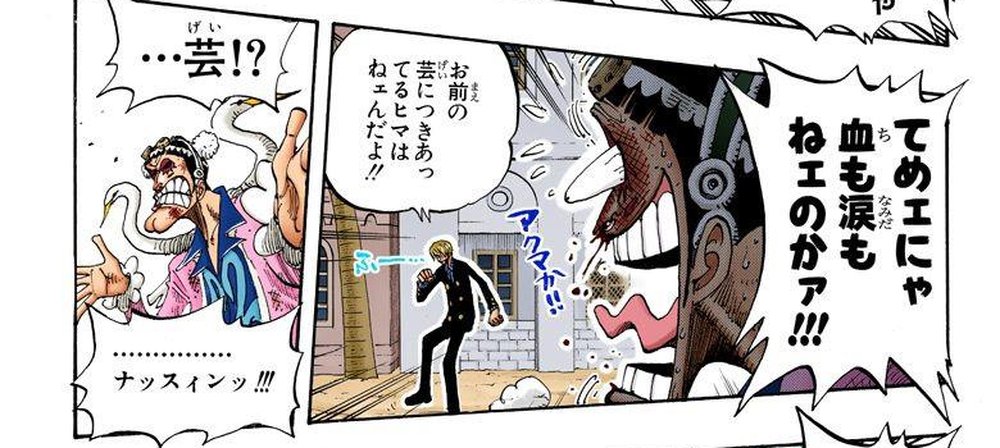
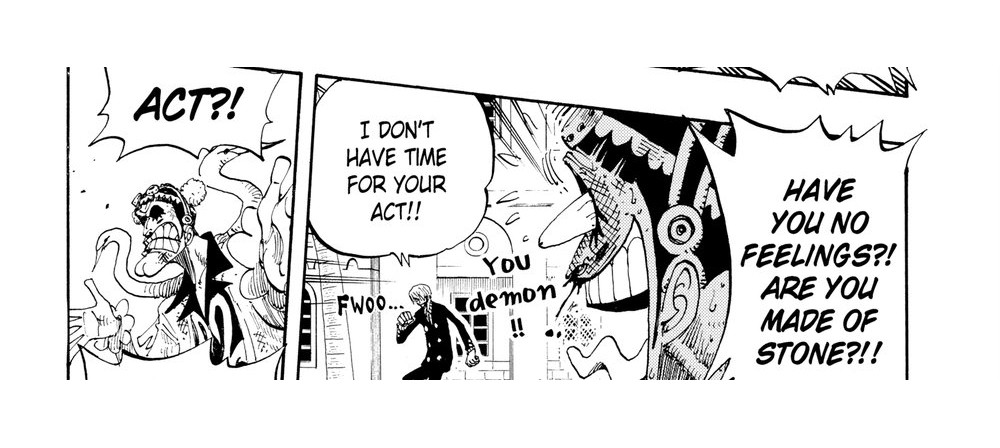
Alabasta, in the last chaotic stretch of the rebellion. Alubarna's streets are on fire, and Sanji has caught up to a spy disguised as Princess Vivi: the Baroque Works officer agent Mr. 2 Bon Kurei, whose Devil Fruit power lets him swap faces, voices, and whole bodies with anyone he's touched. Sanji ends the chase with a kick — "NOW IT'S MY TURN!!" — and a taunt riding the follow-through: 「遊んでんじゃねェぞクソ野郎!!!」, "PLAYTIME'S OVER, CLOWN!!" Bon Kurei goes down grunting (「ウゴ!!!」— "UGH!!"), then looks up, genuinely stung, and echoes back the word that hurt him: 「...芸!?」— "ACT?!"
Sanji doesn't blink: 「お前の芸につきあってるヒマはねェんだよ!!」 — "I DON'T HAVE TIME FOR YOUR ACT!!" — and this, not the kick, is what breaks him. Bon Kurei's shapeshifting, his disguises, his whole terrifying performance: Sanji just filed it under "act," a party trick. Bon Kurei's answer fills the widest, jaggedest bubble on the page:
「てめェにゃ血も涙もねェのかァ!!!」
Temē nya chi mo namida mo nē no ka!!!
VIZ's English edition prints: "HAVE YOU NO FEELINGS?! ARE YOU MADE OF STONE?!!" (Vol. 21, p.16).
Grant the rendering its due: it's a great manga bubble. Two rhetorical questions, both punchy, both landing where the lettering has room to shout. Bon Kurei's aggrieved theatricality survives completely — he goes on, in the very next bubble, to insist 「芸ではナッスィンッッ!!!」 ("THIS AIN'T NO ACT!!") and to invoke an old rival who once spared him out of friendship: 「...過去にこんな奴がいたわ...!“友情”によってあちしに手も足も出せなくなった男......」 — "IN THE PAST, I'VE FOUGHT AGAINST ONE SUCH FOE WHO COULDN'T BRING HIMSELF TO HARM A FRIEND!!" That line, and the idiom hiding inside it, gets its own article — see the paralyzed hands and feet of 手も足も出ない, spoken two bubbles later on this exact page.
But look at what the two rhetorical questions did to the one sentence they're translating. 「てめェにゃ血も涙もねェのかァ!!!」 doesn't ask about feelings in the abstract, and it doesn't reach for a mineral. It asks about two specific substances — 血, blood, and 涙, tears — and whether Sanji has either. VIZ's stone is a fine image. It just isn't this image.
The Original
Two nouns, one grammar frame, one negative:
- 血 (chi) — blood. Elementary-school kanji (N4), and one of the most emotionally loaded single characters in the language — it's the word underneath 血のつながり ("blood ties," family), 血が通う ("blood circulates," said of anything humane and alive — an organization, a rule, a face), and 血だらけ (drenched in blood, violence). Blood, in Japanese as in English, is life moving through a body.
- 涙 (namida) — tears. A slightly later kanji (closer to N2), and the physical proof that something has reached you: 涙もろい (easily moved to tears), 涙を飲む (to swallow one's tears — to endure something bitterly), 感涙 (tears of deep emotion).
- 〜も〜も + [negative] — the same "neither ~ nor ~" frame that runs 手も足も出ない (see our sister article): two body-nouns negated together, so the sentence doesn't deny one thing, it denies a pair.
Put together: 血も涙もない — literally "[there is] neither blood nor tears" — and, of a person, you have neither. The grammar is flexible in a way English "heartless" isn't. It runs as a predicate (Xに(は)血も涙もない, "X has neither blood nor tears") — the shape of our headline line, てめェにゃ血も涙もねェのか (にゃ being a rough spoken contraction of には) — and it runs as an attributive clause stacked straight in front of a noun (血も涙もない女, "a neither-blood-nor-tears woman") with no relative pronoun needed at all.
What makes the phrase land isn't just "no feelings" — it names two different failures at once. Blood is what makes you a living, related, warm-blooded creature; sever it and you're not connected to anyone, not even alive in the way that matters. Tears are proof that something moved you; take them away and nothing can reach you, however hard it tries. A person with neither isn't just cold — a person with neither is barely a person: no kinship, no capacity to be moved. That's a serious accusation to make of anyone, which is exactly why Oda hands it to Bon Kurei, a character whose entire argument with the world is that he is full of feeling, however garish the packaging.
The idiom isn't on any JLPT syllabus by name, but its parts triangulate to roughly N2: 血 alone is beginner vocabulary, 涙 is intermediate, and the も〜も negative-pair frame is grammar most learners meet around N3–N2. Native speakers reach for the whole idiom as a completed unit — the way English speakers reach for "heartless" — not as an assembled sentence.
VIZ's Choice
Both occurrences on file, side by side:
| Vol. / p. | Japanese | VIZ English |
|---|---|---|
| 21 / 16 | てめェにゃ血も涙もねェのかァ!!! | HAVE YOU NO FEELINGS?! ARE YOU MADE OF STONE?!! |
| 33 / 59 | 完全に無視!無視!!!血も涙もない女!!航海士ナミ!!! | NAVIGATOR NAMI IS ABSOLUTELY HEARTLESS!! |
Two appearances, two completely different grammatical jobs for the Japanese idiom — predicate question in Vol. 21, attributive noun-phrase in Vol. 33 — and English answers with two completely different substitutions.
Vol. 33 is the plainer case. During the Davy Back Fight's Donut Race, a Foxy Pirate nicknamed オヤビン ("Boss") disguises himself as a drowning old woman and wails from the water — 「あァそこ行く船の方々助けてくれませんか」, "YOU THERE IN THE BOAT... WILL YOU HELP ME?" — hoping Nami's crew will stop and forfeit the race. A narration box, in the bold jagged lettering the series reserves for sports-commentary asides, delivers the verdict on Nami's reaction: 「完全に無視!無視!!!血も涙もない女!!航海士ナミ!!!」 — VIZ: "NAVIGATOR NAMI IS ABSOLUTELY HEARTLESS!!" Here 血も涙もない sits directly in front of 女, "woman" — the attributive shape — and "HEARTLESS" is a tidy one-word match for the job the phrase is doing as a pre-noun modifier, even as it collapses two organs into one.
Vol. 21 does something more interesting, because it doesn't just abstract the idiom — it re-embodies it, with different body parts. "FEELINGS" absorbs the first half of the accusation (do you feel anything), and a second sentence supplies a fresh physical image for the second half: "ARE YOU MADE OF STONE?!" That's not a random intensifier. It's English going shopping in its own body-idiom aisle and coming back with a rock.
The Gap
A paired image collapses into a single organ, or no organ at all. 血も涙もない names two different failures — no warmth or kinship (blood) and no capacity to be moved (tears) — and needs both absent before the accusation sticks. "HEARTLESS" merges both failures into the fate of one English organ, the heart, which carries the entire emotional load blood and tears split between them in Japanese. "HAVE YOU NO FEELINGS?!" doesn't even keep an organ — it's pure abstraction, a mood-report with no anatomy left in it at all.
English reaches for a different body strategy: transformation, not absence. This is the genuinely interesting swap. 血も涙もない is a lack — you are missing two substances that ought to be there, phrased almost like a clinical finding. "ARE YOU MADE OF STONE?!" is a transformation — you have been built from something that was never alive. Both languages solve "merciless" with the body; Japanese subtracts fluid, English substitutes mineral. Set 血も涙もない beside English's own coldness family — "cold-blooded," "stone-cold," "heart of stone," "stony-faced" — and the pattern holds: where Japanese empties the body of what should be flowing through it, English petrifies or chills what's still there. Two different diagnoses of the same monster.
The specific charge carried by 血 has no English seat. "Heartless" and "made of stone" both land on emotional coldness. But 血 is doing double duty in Japanese — it isn't only a feeling-word, it's the word for kinship, for being connected to other living things at all (血のつながり, 血が通う). Bon Kurei isn't only accusing Sanji of failing to feel; he's accusing him of failing to be kin — of standing outside the whole circulatory system of loyalty this exact scene is busy establishing between Bon Kurei and his own allies. English's organs don't carry that kinship freight; a heart, in English idiom, is a private instrument, not a shared bloodline.
What If
- "Have you no blood, no tears in you?!" — keeps the paired fluids and the question shape almost verbatim. Cost: reads stranger in English than in Japanese, since English has no ready-made idiom in this exact wording; the reader does a beat of work the Japanese reader never has to.
- "Is there nothing warm in you at all?!" — keeps blood's warmth-and-life connotation without the anatomy lesson. Cost: drops tears, and with them the paired structure that makes the Japanese accusation feel total rather than partial.
- "Don't you bleed?! Don't you cry?!" — splits the couplet into two short English body-verbs, preserving both the twofold shape and the punch. Cost: reads first as a literal physical dare before it lands as a character accusation — a beat of ambiguity the Japanese doesn't have.
- Keep VIZ's stone, add the blood back: "Not a drop of blood in you — are you made of stone?!" — preserves the punchy transformation image and reintroduces the missing fluid. Cost: loses tears entirely, and stacks two images (absence and transformation) where Japanese only needed one.
None of these is free, and that's the honest lesson: 血も涙もない is a compact idiom — one negative, two nouns, total coverage — and every English fix either restores the substance and loses the compactness, or keeps the compactness (like VIZ) and trades in different substances altogether.
Take-away
血も涙もない tells you a person is missing two specific things — the fluid that makes you kin and alive, and the fluid that proves something reached you — and English, lacking a ready two-part equivalent, reaches instead for a single organ ("heartless") or a mineral transformation ("made of stone"). Both work as insults. Neither is quite the same insult.
Three rules of thumb to carry off this page:
- When you meet 〜も〜も + negative, expect a pair, not a summary. 血も涙もない (this article) and 手も足も出ない (our sister piece) both deny two body-nouns at once; English regularly flattens the pair into one abstract word, and the flattening is where the vividness leaks out.
- 血 almost never means only "blood." Track it into 血のつながり, 血が通う, 血筋 — it's Japanese's default word for kinship and living connection, which is why "heartless" undertranslates it: heartless is about feeling, and 血 is about feeling and belonging.
- When English swaps one body image for a different body image — stone for blood here, craw for viscera in our piece on 腑に落ちない — that's not laziness, it's the translator paying the same kind of coin, just minted differently. Worth noticing the exchange rate every time.
For the moment two bubbles later on this very page, when the same fight produces an entirely different body idiom, see the paralyzed hands and feet of 手も足も出ない. For another organ that only sometimes finds its English match, see the digestive metaphor of 腑に落ちない. Or browse the One Piece translation notes index.
Every Japanese and English line quoted above is a byte-exact capture from the cited editions — ONE PIECE Vol. 21 & Vol. 33 (Japanese) and One Piece (VIZ Media) at the corresponding panels — via our bilingual page database; see Sources below.