The Moment
Volume 2. Orange Town — a town Buggy the Clown's cannons have already emptied, where the visible population is down to a rubber boy, a thief, and one very stubborn little dog guarding a shop. The top of the page is all warmth: Luffy grinning his goodbyes to the dog, Nami managing a smile. Then the report lands where Buggy is holding court:
「モージがやられた!!?」 — "MOHJI WAS DEFEATED!?"
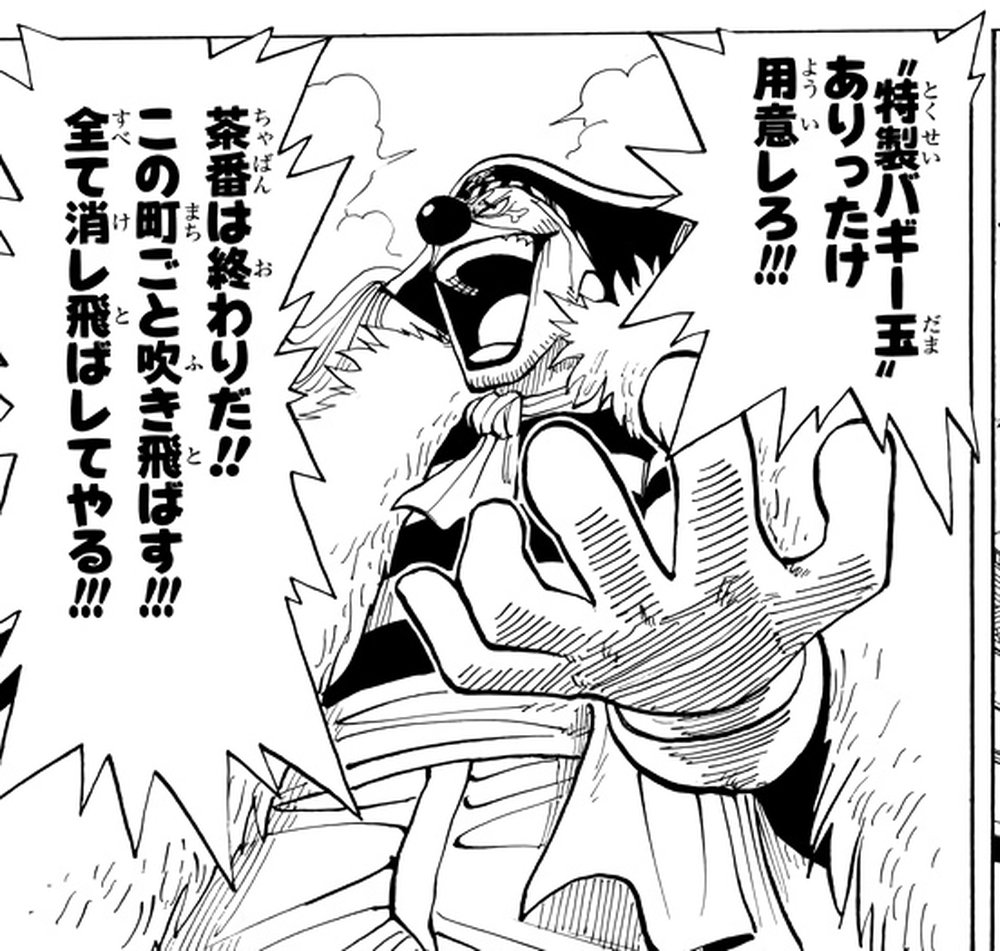
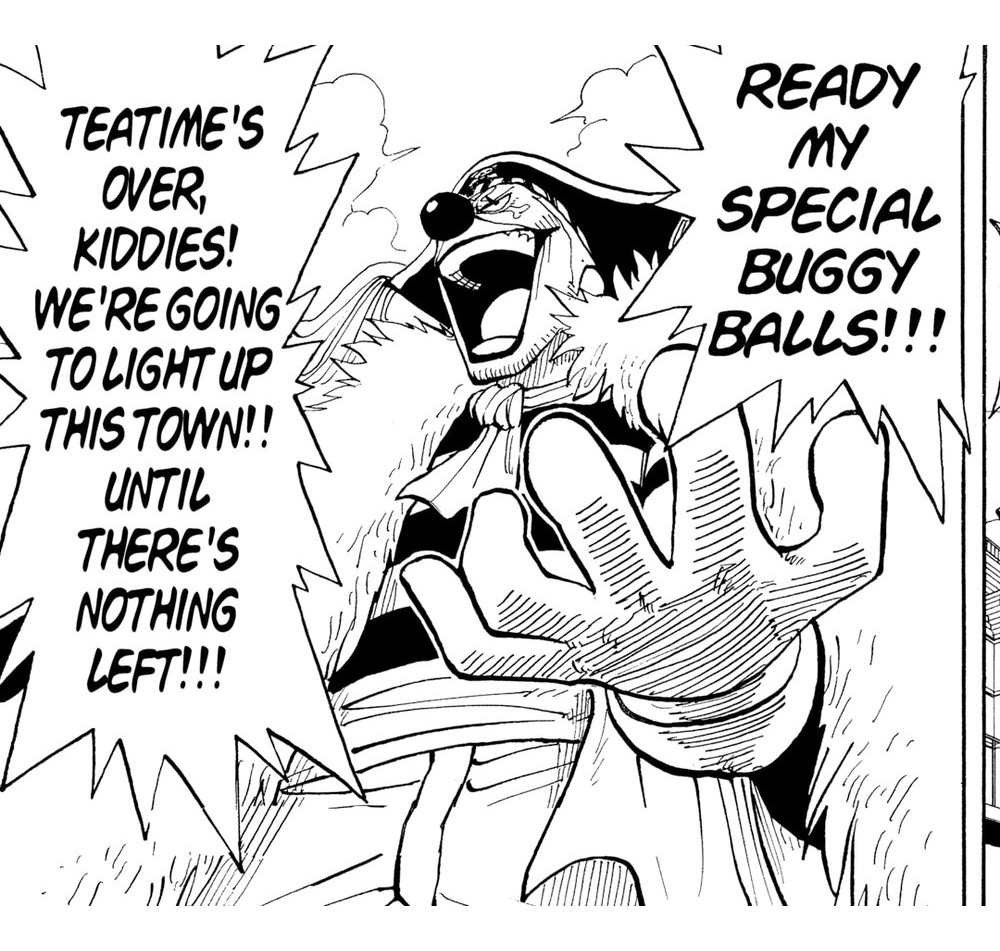
Mohji is Buggy's beast-tamer first mate — the same Mohji whose criminal-record luck stars in our 悪運 article — and his defeat means the pests have officially stopped being funny. Buggy's answer comes in two bubbles. First the order: 「〝特製バギー玉〟ありったけ用意しろ!!!」 — "READY MY SPECIAL BUGGY BALLS!!!" Then the declaration:
「茶番は終わりだ!!この町ごと吹き飛ばす!!!全て消し飛ばしてやる!!!」
Chaban wa owari da!! Kono machi goto fukitobasu!!! Subete keshitobashite yaru!!!
VIZ's English edition prints: "TEATIME'S OVER, KIDDIES! WE'RE GOING TO LIGHT UP THIS TOWN!! UNTIL THERE'S NOTHING LEFT!!!" (Vol. 2, p.113).
Usually this column grants the translator their due and then counts the losses. Today the due is the story. "Teatime's over, kiddies" is a genuinely good villain line: a stock English menace formula, a sneer of nursery condescension, party imagery that fits a circus clown down to the red nose. There is just one problem, and it is a beauty — there is no tea in 茶番. Or rather, there is, but it has been dead for three hundred years, and it worked backstage at the kabuki theater.
The Original
Take the word apart. 茶 (cha) is "tea," one of the first kanji any learner meets. 番 (ban) is "duty, turn, watch" — the 番 of 当番 (tōban, "on duty"), 留守番 (rusuban, "watching the house"), 交番 (kōban, "police box"). Literally, 茶番 is "tea duty."
And that is exactly what it once meant. In Edo-period kabuki, the lowest-ranking actors — the crowd of the communal dressing room — took turns brewing and serving tea. The standard dictionary account says these tea-duty actors had a party trick: at backstage gatherings they improvised comic skits out of whatever props lay to hand. The skits were called 茶番狂言 (chaban kyōgen, "tea-server's theatricals"), the name was clipped back down to 茶番 — and the word walked out of the dressing room meaning what it means today: a transparent, hammy, insulting-to-your-intelligence performance. A farce. A charade. とんだ茶番だ — "what an utter farce"; 茶番劇 — the newspaper word for a scripted Diet session or a staged apology. The third dictionary sense, "person who serves tea," still sits there like a museum label.
Now enjoy the symmetry: English built its word the same way. "Farce" is French farce, "stuffing" (the culinary kind, from Latin farcire) — comic filler once "stuffed" between the acts of solemn religious plays. Both languages named cheap comedy after the refreshments. The difference is that no translator has ever rendered "this farce" as "this meatloaf" — while the tea inside 茶番 leaked back out onto VIZ's page.
One more gift for learners: flip the compound and you do get tea. 番茶 (bancha) is everyday coarse-leaf green tea. 茶番 is a farce; 番茶 is a beverage. Order is everything.
As vocabulary, 茶番 sits off the JLPT lists — call it N1-plus editorial Japanese — even though both kanji are N5. The grammar around it in Buggy's line is blunt force throughout: ~は終わりだ is a guillotine declarative; 町ごと uses ごと, "together with the whole ~" (the town and everything in it); ~てやる is the benefactive twisted into a threat; and the stacked !! turn the bubble into a scream.
VIZ's Choice
Here is every appearance of 茶番 in the volumes we have on file, side by side with the official English:
| Vol. / p. | Japanese | VIZ English |
|---|---|---|
| 2 / 113 | 茶番は終わりだ!!この町ごと吹き飛ばす!!!全て消し飛ばしてやる!!! | TEATIME'S OVER, KIDDIES! WE'RE GOING TO LIGHT UP THIS TOWN!! UNTIL THERE'S NOTHING LEFT!!! |
| 13 / 55 | 茶番ね | HOW FUNNY !! |
| 33 / 151 (EN p.155) | 茶番はいいから次いけよ | ENOUGH OF THIS RIDICULOUS FARCE. ON TO THE NEXT GAME. |
Three appearances, three strategies — and the quality ranking comes out upside down from the order you would guess.
Vol. 13 — the deletion. The aftermath of Whiskey Peak. Ms. Monday, Baroque Works' checker-dressed bruiser, decides to die usefully — 「友達の盾になってブチのめされたいもんだ……!」, "...I'D RATHER DIE HELPING A FRIEND." — and plants herself between the fleeing princess Vivi and the hunters sent after her. Mr. 5 is unimpressed: 「Mr.9に続きお前もかミス・マンデー」 — "FIRST MR. 9, NOW YOU, MS. MONDAY?" And beside him, parasol on her shoulder, Miss Valentine giggles — 「キャハハ」, "KYA HA HA!!" — and files her one-word review: 「茶番ね」. VIZ prints "HOW FUNNY !!" But 茶番ね is not amusement; it is theater criticism as cruelty. What a farce. Self-sacrifice dismissed as hammy melodrama — a performance too transparent to move a professional. "How funny" keeps the malice and loses the frame: in English she is entertained; in Japanese she is panning the show.
Vol. 33 — the bullseye. Long Ring Long Land, mid-Davy Back Fight. Foxy's crew stages a mass weeping devotion scene — the boss literally sinks into the ground under the weight of his own emotions while his men sob and chant 「いやんオヤビン私達にはあなたが必要ですよっ!!!」 — "KYAAH! WE NEED YOU, BOSS!!" Sanji, cigarette lit, has seen enough: 「茶番はいいから次いけよ」. VIZ: "ENOUGH OF THIS RIDICULOUS FARCE. ON TO THE NEXT GAME." That is the dictionary seat, occupied dead center — "farce," with "RIDICULOUS" bolted on to recover the sneer. If anything the English is stiffer than Sanji's drawled ~はいいから…いけよ, a heckle delivered around a cigarette. But the finding matters: "farce" was on VIZ's shelf the whole time. Vol. 2's teatime was not forced on the translator by English poverty. It was a slip — or a swing.
Vol. 2 — the accident that lands. "Teatime" behaves exactly like the classic learner misreading: the character 茶 translated instead of the word 茶番. Whether the translator genuinely misparsed the compound, or looked at a clown, a doomed town, and a bubble full of contempt and reached for tea party on purpose, is unknowable from the printed page. What is knowable is why it works: "teatime's over" already exists in English as a fun's-over menace idiom; the invented "KIDDIES!" makes the condescension explicit, demoting the town's defenders to children; and the pragmatic payload of 茶番は終わりだ — the performance is over; now comes the real violence — arrives fully intact. The metaphor changed address, theater to nursery. The delivery — a showman announcing the end of the entertainment portion of the evening — is the same.
The Gap
The kanji got translated; the word didn't. 茶番 relates to tea the way "farce" relates to stuffing — only in the etymology. Reading it as tea-something is like reading 皮肉 (hiniku, "irony") as "skin and flesh": the parts are right there, and they are the wrong place to look. VIZ's line is that misreading, typeset in an official edition — and the reason no editor flinched is that the accident landed on a working idiom. A false friend with a safety net.
A lucky landing still moves the target. In Japanese, Buggy is a critic closing a flop: the town's resistance was a performance, transparent and beneath him, and the curtain falls now. In English he is a governess ending a children's party. The menace survives; the insult changes species — you can mock someone as a bad actor or as a toddler, and those are different contempts. The same drift touches the rest of the bubble: 吹き飛ばす, "blow the whole town away," becomes "LIGHT UP THIS TOWN," a bonfire where the Japanese has a blast wave.
When the metaphor is the knife, cutting it changes the wound (Vol. 13). Miss Valentine's 茶番ね works because it reframes a woman's death-stand as genre — cheap melodrama, badly acted. That is a colder cruelty than laughter: it denies the sacrifice even the dignity of being real. "HOW FUNNY !!" keeps her giggling and throws away her review.
Three rhyming scenes, no rhyme in English. A villain's curtain-drop, an assassin's pan, a cook's heckle — in Japanese all three reach for the same word, and a reader learns the concept the way you learn any word: by triangulation. The English reader is handed tea, laughter, and farce, one each, and the triangle never closes.
What If
The menu for Buggy's line, with prices:
- "THE FARCE IS OVER!! I'LL BLOW THIS WHOLE TOWN SKY-HIGH!!" — keeps the curtain-drop theater metaphor 茶番 actually carries. Cost: "farce" is a critic's word, faintly bookish in a screaming clown's mouth — and VIZ's nursery condescension, which is genuinely funny, disappears.
- "PLAYTIME'S OVER!!" — the same fun's-over pragmatics, no false friend. Cost: playground instead of theater; the "your performance fooled no one" sneer is gone.
- "SHOW'S OVER, FOLKS!!" — keeps a performance frame and suits a showman-clown perfectly. Cost: a ringmaster's warmth where 茶番 is pure contempt. A chaban is not a show that ended; it is a show that never deserved staging.
- "ENOUGH OF THIS CHARADE!!" — "charade" is English's cleanest seat for a transparent performance, and Vol. 33's "farce" proves the shelf exists. Cost: formal-villain diction, and the guillotine snap of 終わりだ goes soft.
Notice the shape of the trade: English can match the pragmatics (playtime, teatime) or the metaphor (farce, charade), but matching both plus the speaker's brand of showmanship is a jackpot. The strange verdict of this article is that VIZ's false friend comes closest to the jackpot — while missing the word entirely.
Take-away
茶番 teaches a double lesson. First, the standard one: compounds are not arithmetic, and the most familiar kanji are the most dangerous bait. Second, the uncomfortable one: translation quality is judged at the output, not the process — a misreading can outperform a correct rendering, and an honest article has to say so through gritted teeth.
Three rules of thumb to carry off this page:
- Never trust a compound's kanji arithmetic. 茶番 has tea in it the way "farce" has stuffing in it. When an official translation seems to render a character instead of a word, suspect a false friend — then judge the printed line on its own two feet.
- Own 番 (ban). "Duty, turn, watch": 当番, 留守番, 交番 — and enjoy that the flipped compound, 番茶, really is tea. One kanji, and half a dozen everyday words unlock.
- Learn Japanese's bad-theater shelf. 茶番・茶番劇・猿芝居・三文芝居 — the standard register for calling something a sham. Half of Japanese political commentary is written in it.
VIZ's pun shelf is a recurring character in these pages: for wordplay the translators built on purpose, see the bilingual pun VIZ could only print half of in 煩悩鳳; for another borrowed English joke, the tombstone pun behind 往生しろ — or browse the One Piece translation notes index.
Every Japanese and English line quoted above is a byte-exact capture from the cited editions — ONE PIECE Vol. 2–33 (Japanese) and One Piece (VIZ Media) at the corresponding panels — via our bilingual page database; see Sources below.