The Moment
Volume 1. Shells Town, the Marine base, and the introduction of a certain green-haired bounty hunter. Roronoa Zoro has been tied to a post in the execution yard for nine days — 「もう九日間もこのままださすがにくたばりそうだぜ」 ("I'VE BEEN HERE FOR NINE DAYS AND I CAN'T TAKE ANYMORE.") — when he notices the two heads peeking over the wall and delivers the smoothest sales pitch a starving man ever made. The opener: 「礼ならするぜ」 ("I'LL MAKE IT WORTH YOUR WHILE."). The offer: 「その辺の賞金首ぶっ殺しててめェにくれてやる」 ("I'LL CAPTURE SOMEONE WITH A BIG PRICE ON THEIR HEAD AND GIVE ALL OF THE BOUNTY TO YOU."). And the closer, delivered with a grin under nine days of grime: 「ウソは言わねェ‥約束は守る」 ("YOU CAN TRUST ME. I'M A MAN OF MY WORD.").
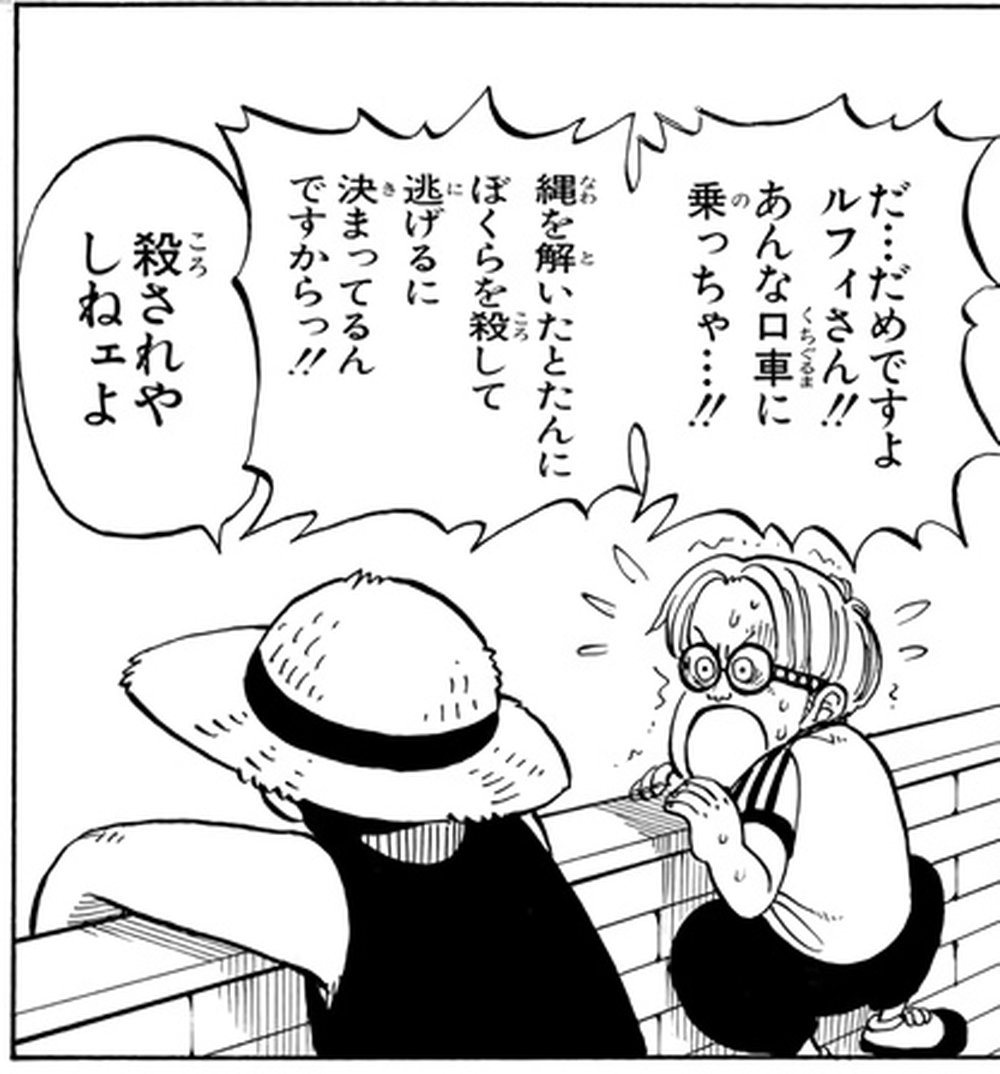
Luffy leans over the wall, visibly interested. And Coby — glasses fogged, hands at his mouth, polite to the last — produces the line this article is about:
「だ…だめですよルフィさん!!あんな口車に乗っちゃ…!!」
Da… dame desu yo, Luffy-san!! Anna kuchiguruma ni notcha…!!
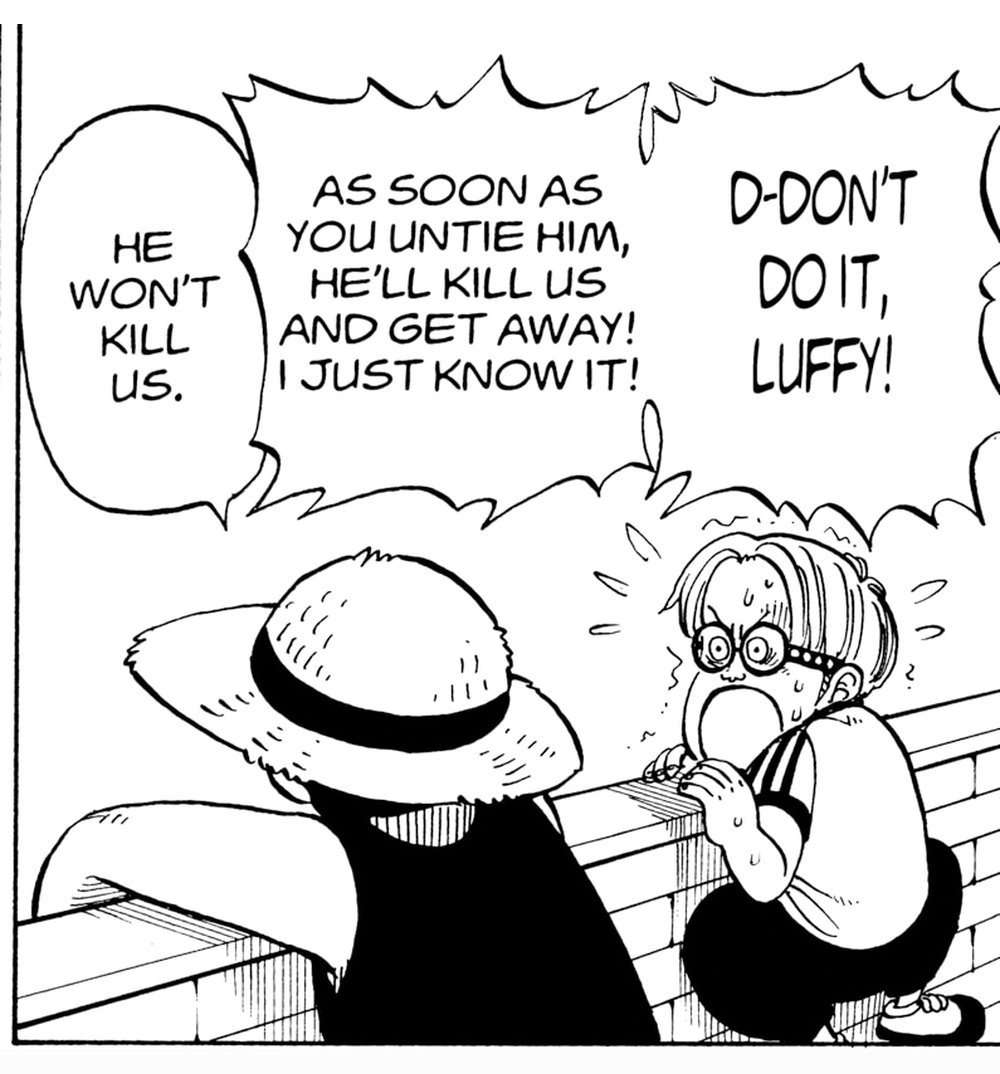
VIZ's English edition prints: "D-DON'T DO IT, LUFFY!" (Vol. 1, p.92).
Grant the rendering its due. The stutter survives — だ…だめ becomes "D-DON'T," a genuinely nice touch. The panic pitch survives. And the second half of the warning, one bubble over, arrives intact: 「縄を解いたとたんにぼくらを殺して逃げるに決まってるんですからっ!!」 → "AS SOON AS YOU UNTIE HIM, HE'LL KILL US AND GET AWAY! I JUST KNOW IT!" What never boards the English page is the idiom itself. あんな口車に乗っちゃ — don't climb aboard a mouth-wheel like that — is simply gone.
The Original
Take 口車 (kuchiguruma) apart, because both halves earn their keep.
口 (kuchi) is "mouth" — and Japanese files a whole genre of speech-acts under it. 口先 (kuchisaki), "the tip of the mouth," is lip service. 口がうまい (kuchi ga umai), "skilled of mouth," is a smooth talker. 口説く (kudoku) is to talk someone into something — to woo. 口が軽い (kuchi ga karui), "light of mouth," can't keep a secret. Where English scatters these across "lip service," "smooth," "sweet-talk," and "loose lips," Japanese keeps the whole anatomy in one drawer.
車 (kuruma) is "wheel; vehicle" — the 車 of 車輪 (wheels) and 歯車 (gears).
Put together: a mouth-wheel — talk pictured as a smoothly turning mechanism. The image runs in a family: 言い回し (iimawashi), a "turning" of phrase; 言いくるめる (iikurumeru), to roll someone up in words until they stop resisting. A 口車 is patter with momentum — round, frictionless, engineered to keep moving so the listener never finds a foothold to object from.
The idiom comes as a matched pair, and the verb choice is the whole moral. 口車に乗せる (noseru, transitive): to put someone aboard the mouth-wheel — to con them onto it. 口車に乗る (noru, intransitive): to climb aboard yourself. 乗る is the ordinary verb for boarding a bus — and it is also Japanese's verb for going along with things: 相談に乗る (to take up someone's problem), 誘いに乗る (to take up an invitation), 調子に乗る (to ride the momentum and get carried away). The deception is a vehicle; the victim is a passenger; and the boarding is voluntary. Nobody pushes you onto a 口車. You get on.
Coby's sentence is a small masterclass in panicked Japanese. The prohibition comes out first — だ…だめですよ, stutter, polite です, assertive よ — and the offending act trails behind it: あんな口車に乗っちゃ…!!, where 乗っちゃ is the contraction of 乗っては and the second だめ is swallowed whole by the trailing !!. あんな ("that kind of") holds Zoro's offer at a disdainful arm's length. And notice that even at scream volume, Coby keeps ですよ and ルフィさん — he is the boy who stays polite mid-shriek. The kanji are beginner-level; the idiom sits on JLPT N1 lists; the register is everyday enough for a consumer-fraud news item — 口車に乗せられて契約した, "signed after being taken in by the sales patter" — which is exactly the genre Coby thinks he is watching.
VIZ's Choice
This is the only appearance of 口車 in the 107 Japanese volumes we track, so there is no scatter to chart — the whole decision happens inside one cloud-shaped bubble. Here are its two halves, side by side:
| Vol. / p. | Japanese | VIZ English |
|---|---|---|
| 1 / 92 | だ…だめですよルフィさん!!あんな口車に乗っちゃ…!! | D-DON'T DO IT, LUFFY! |
| 1 / 92 | 縄を解いたとたんにぼくらを殺して逃げるに決まってるんですからっ!! | AS SOON AS YOU UNTIE HIM, HE'LL KILL US AND GET AWAY! I JUST KNOW IT! |
Read as triage, the choice is legible. The bubble is a jagged panic-cloud with three lobes; the lobe holding our line is the smallest, and VIZ fills it with four big letters' worth of alarm. The addressee survives, the prohibition survives, the stutter survives. And the danger content — he'll kill us and run — is fully restated in the next lobe anyway, so the 口車 clause could look redundant: cut the reason, keep the scream.
But 口車 was never information about the danger. It is Coby's evaluation of Zoro's speech — the claim that what just floated over the wall was not an offer but a con man's spinning wheel. That claim has no second bubble to survive in. Delete the clause and the English Coby is afraid of what Luffy might do; the Japanese Coby is afraid of what Luffy might believe.
The Gap
The accusation disappears. "Don't do it" objects to an action — untying a dangerous man. 口車に乗る objects to a persuasion — it says the pitch itself is rigged. In Japanese, Coby diagnoses Zoro: too smooth, too convenient, textbook patter. In English he merely panics. One clause, and the scene loses its only character who is reasoning.
English owned this exact vehicle and left it in the garage. Deception-as-a-ride is one of the rare metaphors both languages built independently: 口車に乗る and "to be taken for a ride" match image for image — vehicle, passenger, voluntary boarding, bad destination. A translator handed this line holds a nearly free equivalence, the kind that usually has to be invented. Four words of generic alarm use none of it.
The irony loses its filing. The long joke of this scene — visible only from later volumes — is that Zoro's 口車 is no 口車 at all. ウソは言わねェ‥約束は守る: he does not lie, and keeping his word becomes the defining trait of his entire character. Oda has Coby file the accusation precisely so the series can spend years disproving it. VIZ never files the accusation, so there is nothing on record to disprove — the English scene is a boy scared of a scary man, not a boy calling an honest man a con artist and being gloriously wrong.
Luffy's answer quietly changes address. The Japanese reply to Coby is a three-bubble boast: 「殺されやしねェよ」「おれは」「強いからね」 — "I won't get killed… because I'm strong." Luffy never engages the honesty question at all; he declares it irrelevant to someone like him. VIZ prints "HE WON'T KILL US." / "HE COULDN'T." / "I WOULDN'T LET HIM!" — the first-person-singular swagger recast as a bodyguard's group reassurance. It reads perfectly well; it just answers Coby's English line (danger!) rather than Coby's Japanese line (a con!). The two translations are consistent with each other — and jointly a few degrees off the original conversation.
What If
The menu and its prices:
- "N-NO, LUFFY! DON'T FALL FOR HIS SWEET TALK!" — keeps the accusation that the offer is patter. Cost: "sweet talk" leans soft and flirtatious; 口車 is a con man's wheel, not a suitor's honey.
- "D-DON'T LET HIM TAKE YOU FOR A RIDE, LUFFY!" — English's own deception-as-vehicle idiom, an almost eerie structural match for 口車に乗る. Cost: longer than the bubble lobe wants, and in older gangster slang "taking someone for a ride" ends in a ditch — darker than Coby means.
- "YOU CAN'T LISTEN TO THAT SMOOTH TALK, LUFFY!" — "smooth" preserves the frictionless, rolling texture of the 車. Cost: loses the boarding image; in Japanese the danger is that you climb on.
- Keep VIZ's panic, restore the clause: "D-DON'T DO IT, LUFFY! HE'S JUST SWEET-TALKING YOU!" — Cost: two sentences where the Japanese is one inverted shriek, and lettering space is real.
Notice what every option has to decide: whether Coby's warning is about danger or about salesmanship. The Japanese line is unambiguously about the second. VIZ's line is unambiguously about the first. Everything else is a matter of bubble geometry.
Take-away
口車に乗る is the idiom for being talked into the ride — glib speech as a smooth-spinning wheel, and falling for it as climbing aboard. When VIZ cut it down to "D-DON'T DO IT, LUFFY!", the panic survived and the diagnosis died: English Coby fears an action, Japanese Coby indicts a sales pitch — one the series will spend years revealing to have been honest all along.
Three rules of thumb to carry off this page:
- When Japanese talks about talk, check the 口 drawer. 口先, 口がうまい, 口が軽い, 口説く, 口車 — a whole anatomy of speech-acts English scatters across "lip service," "smooth," "loose lips," and "sweet-talk" lives under one kanji.
- Track what people 乗る. Buses, invitations, consultations, momentum, mouth-wheels — 乗る marks consent, being carried by something you agreed to board. That nuance of voluntary boarding is exactly what "don't do it" cannot say.
- When a two-part warning gets compressed, ask which half was information and which was judgment. Translators under space pressure keep the information — it usually reappears elsewhere. The judgment is the first casualty, and it rarely has a second bubble to hide in.
For another Vol.-1-era line about talk and trust — the proud liar VIZ took at his word — see the boast buried in 誇り/ホコリ; for a second body-part idiom English keeps rewording, see 手も足も出ない — or browse the One Piece translation notes index.
Every Japanese and English line quoted above is a byte-exact capture from the cited editions — ONE PIECE Vol. 1 (Japanese) and One Piece Vol. 1 (VIZ Media) at the corresponding panels — via our bilingual page database; see Sources below.