The Moment
Volume 16. Kagaya Ubuyashiki's estate has just detonated — a self-destruct trap laced with shrapnel specifically built to slow the regeneration of whoever set it off, a mechanism it takes Muzan Kibutsuji several panels of dawning realization to even parse. Half his face burned to bone and cracked flesh, he roars the name of the man responsible:
「産ッ 屋敷イイツ」
Ubu— yashiki-iiii!
VIZ's English edition prints: "UBU... ...YASHIKI-IIII!" (Vol. 16, p.94).
The next page explains what Muzan is reacting to. Kagaya didn't merely set a trap and retreat — he stayed inside it, along with his wife and children, and let it take all of them, wearing, by Muzan's own account, the same expression he always wore:
「仏のような笑みを貼りつけたまま己と」
Hotoke no yō na emi o hari-tsuketa mama, onore to…
VIZ: "WITH A BEATIFIC SMILE... ...HE DESTROYED HIMSELF..." (Vol. 16, p.95).
Now Muzan surveys the wreckage — the crater, the still-smoking mountainside, the trap sprung exactly as designed — and delivers his verdict in one cold, inverted sentence:
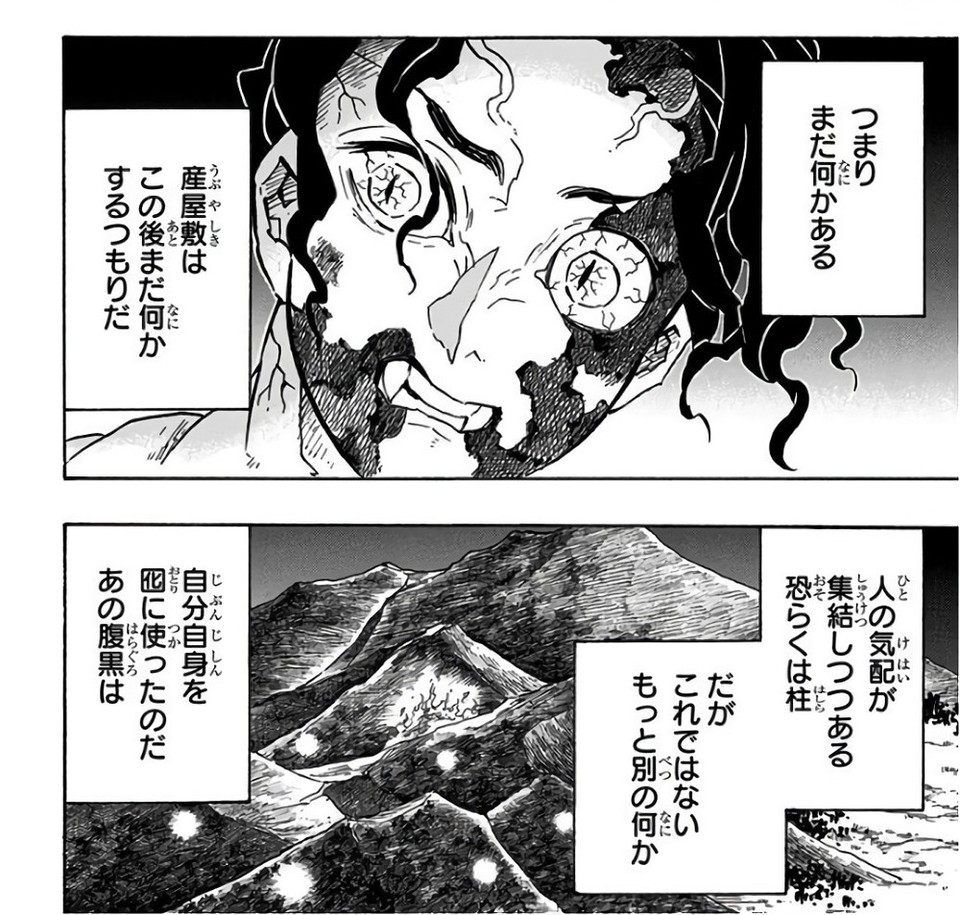
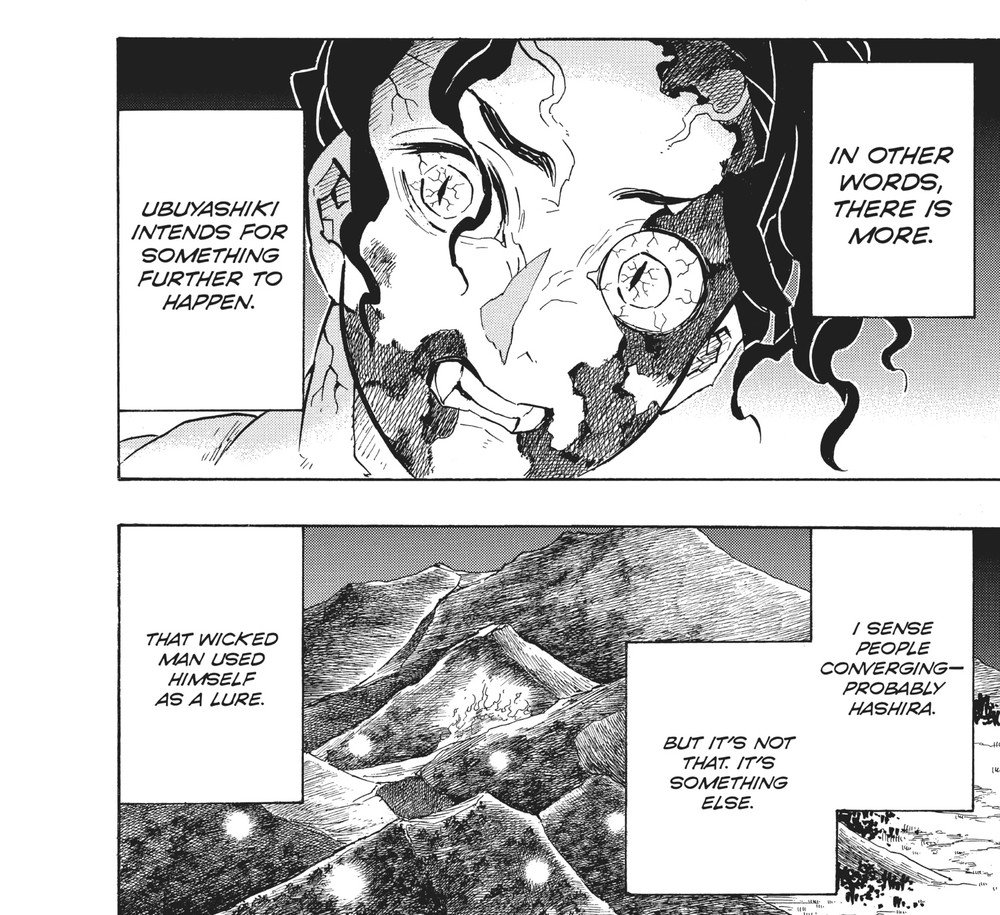
「自分自身を囮に使ったのだあの腹黒は」
Jibun jishin o otori ni tsukatta no da, ano haraguro wa.
VIZ's English edition prints: "THAT WICKED MAN USED HIMSELF AS A LURE." (Vol. 16, p.96).
Grant the rendering its due first: "wicked" is exactly the venom the scene calls for, and "used himself as a lure" is a clean, accurate translation of the mechanics — Kagaya really did make his own death the bait in a trap built to hurt Muzan. But look at what the Japanese sentence actually does, word by word. It doesn't open with a moral label. It opens with the mechanism — 自分自身を囮に使ったのだ, "[he] used himself as bait" — and only at the very end drops the epithet: あの腹黒は, "that black-belly." Muzan isn't calling Kagaya wicked. He's naming an organ.
The Original
Take 腹黒 apart. 腹 (hara) is "belly, stomach" — but in Japanese it has never been merely plumbing. 黒い (kuroi) is "black." Fused together and clipped into a bare noun, as Muzan uses it here — あの腹黒, "that black-belly" — the compound skips its usual adjectival form (腹黒い, haraguroi, "[someone] is black-bellied") and becomes a label slapped directly onto a person, the way English might snap "you snake" at someone rather than saying "you're snakelike."
The 腹 half of the compound is the load-bearing part, and it carries a whole cosmology. Japanese has treated the belly — not the face, not the chest, not the head — as the seat of a person's actual, unfiltered intentions for centuries. 顔 (kao), the face, is what a person chooses to display; 腹 is what's really there underneath, whether they choose to show it or not. A handful of idioms make the system explicit: 腹を割る (hara o waru), "to split the belly open," means to speak with total frankness; 腹の中 (hara no naka), "inside the belly," is the standard word for someone's real, often-hidden thoughts; 腹を決める (hara o kimeru), "to decide the belly," is to make up one's mind for good. The color word doing the damage is 黒 (kuro) — the same "hidden and corrupt" black behind 黒幕 (kuromaku), "black curtain," the unseen mastermind pulling strings behind a public front. 腹黒 isn't a person who lies with their mouth. It's a person whose truth-organ itself has gone dark.
As vocabulary, 腹黒い sits at ordinary intermediate level — roughly JLPT N3, the kind of word that shows up in office gossip and drama-villain descriptions, nothing archaic or obscure on its own. What elevates the register here is grammar, not vocabulary: Muzan doesn't build a normal descriptive sentence (あの男は腹黒い, "that man is black-bellied"). He inverts it, saving the epithet for last — predicate first, subject-and-verdict last — the structure of someone pronouncing a judgment after the fact rather than describing a trait up front.
VIZ's Choice
腹黒 appears exactly once in the volumes we have on file, so there's no scatter to chart across a table of occurrences — but the choice VIZ made here is worth sitting with next to a second choice, made two pages later, about the exact same organ.
"THAT WICKED MAN" trades Muzan's anatomical epithet for a moral one. It's accurate to the venom, and it's the natural English move — English doesn't have a ready-made noun for "a black-bellied person" the way Japanese has 腹黒, so a translator reaching for a one-word insult reasonably reaches for a character judgment instead of an organ. Two pages later, the manga returns to the same image, but this time as literal description rather than idiomatic label:
「私への怒りと憎しみが蝮のように」…「真っ黒な腹の中で蜷局を巻いていた」
Watashi e no ikari to nikushimi ga mamushi no yō ni… makkuro na hara no naka de tokuro o maite ita.
Kagaya's decades of hatred, coiled like a viper inside a belly the text now calls 真っ黒 (makkuro), "jet black" — not as a compound insult but as a plain descriptive clause. Here VIZ renders it with the organ fully intact: "HIS ANGER AND HATRED TOWARD ME WERE LIKE A VIPER... ...COILED WITHIN HIS BLACK GUT." Sandwiched between the two halves of that sentence, Muzan drops in a second remark: 「あれだけの殺意をあの若さで見事に隠し抜いたことは驚嘆に値する」 — "FOR ONE SO YOUNG TO SO SPLENDIDLY HIDE SUCH ANIMOSITY IS WORTHY OF ADMIRATION."
Put the two renderings side by side and a pattern appears: VIZ keeps the belly when the sentence describes it, and drops the belly when the sentence merely labels someone with it. That's not an error — a translator handling one panel at a time has no obligation to notice that 腹黒 on page 96 and 真っ黒な腹の中 on page 97 are the same image, deployed twice, three panels apart, almost certainly on purpose. But the two English sentences don't recognize each other as kin the way the two Japanese sentences plainly do.
The Gap
The verdict is imported; the anatomy is deleted. "Wicked" states a moral conclusion. 腹黒, used here as a bare noun, states a location and a color — an organ, gone dark — and lets the reader supply the moral conclusion unassisted. Coming from Muzan, a thousand-year killer, a straightforward moral condemnation of somebody else's "wickedness" reads as plain description; the bare anatomical label reads as something sharper — one schemer coldly clocking another's concealment, an irony English's tidier adjective quietly smooths away.
There's no belly idiom on the shelf to reach for. This hub has already tracked a similar organ-swap in 二枚舌 ("two tongues" → "two-faced"), and there English at least had "to speak with a forked tongue" sitting unused nearby — a genuine tongue-based idiom the translator could have chosen and didn't. 腹黒 offers no such alternative. English simply owns no standing idiom that locates deception in the stomach, so the swap from belly to character-trait isn't a decision between two available images; it's the only image available, which makes the loss total rather than a trade-off.
The scene's own callback goes silent. Gotouge writes the same image twice within three pages: 腹黒 as a hurled epithet, then 真っ黒な腹の中で蜷局を巻いていた as the literal picture behind it. VIZ translates the second instance with the organ intact — "COILED WITHIN HIS BLACK GUT" — and the first without it — "THAT WICKED MAN." An English reader gets a vivid black gut two pages after being told, unconnected, that a man was simply wicked, with nothing signaling that the author wrote the same picture twice on purpose.
What If
For 「自分自身を囮に使ったのだあの腹黒は」, the menu and its prices:
- "THAT BLACK-BELLIED ONE — HE USED HIMSELF AS BAIT." — the direct anatomical calque, keeping 腹 intact as the label. Cost: "black-bellied" isn't standing English idiom; a reader meets an odd image with no inherited meaning to lean on and needs the scene around it to supply the sense.
- "THAT DARK-HEARTED ONE — HE USED HIMSELF AS BAIT." — swaps 腹 for an organ English does use for hidden truth ("speak from the heart," "heart of darkness"). Cost: "heart" carries its own English baggage of feeling and passion, softer than the specifically calculating, strategic deception 腹黒 accuses Kagaya of.
- "THAT SCHEMER — HE USED HIMSELF AS BAIT." — clean, idiomatic, and nails the calculation precisely. Cost: deletes the anatomy entirely, and with it the irony of the story's greatest schemer reaching for that particular word.
- Keep VIZ's "THAT WICKED MAN," and let "COILED WITHIN HIS BLACK GUT" two pages later do the anatomical work on its own. Cost: it only works if the reader consciously links two bubbles seven lines apart — nothing in the headline sentence itself signals that an organ was ever in play.
Take-away
腹黒 isn't hard to gloss — "wicked," "sly," "two-faced" all get the plot across in one word. What the gloss drops is the specific claim underneath all three: that Japanese keeps a whole grammar of truth-telling organized around the belly, and this word marks the one case where that organ has gone bad.
Three rules of thumb to carry off this page:
- When you meet 腹黒, look for the belly-system running underneath it: 腹を割る (speak frankly), 腹の中 (one's real thoughts), 切腹 (an entire death ritual built on the belief that the belly can't lie). One organ, one logic, applied to honesty from every angle — 腹黒 is simply that logic gone dark.
- Watch for organ swaps whenever Japanese blames a body part for deception and English doesn't have the matching part to blame back: tongue → face in 二枚舌, belly → abstract trait in 腹黒. English's dishonesty vocabulary clusters around the face and the character judgment, almost never the torso.
- When a scene repeats an image on purpose — once as a label, once as a literal description — check whether the translation preserves the recurrence or accidentally launders it into two sentences that no longer recognize each other.
For the ritual logic behind the belief that a cut belly proves a clean conscience, see 切腹・介錯 and the duelist's second English sent instead; for the other organ-swap this hub has tracked inside a duplicity idiom, see 二枚舌 and the body part VIZ traded for a face; for more of what English's "Heaven" and moral vocabulary quietly import into this same volume's monologues, see 天罰 and the impersonal heaven English keeps personifying; and for another organ standing in for a personality trait, see 肝が据わる・腰を抜かす and the anatomy English flattens to adjectives — or browse the Demon Slayer translation notes index.
Every Japanese and English line quoted above is a byte-exact capture from the cited edition — 鬼滅の刃 Vol. 16 (Japanese) and Demon Slayer: Kimetsu no Yaiba Vol. 16 (VIZ Media) at the corresponding panels — via our bilingual page database; see Sources below.