The Moment
Mock Town — Jaya Island's harbor of small-time bounty hunters and worse, the last rough stop before the Straw Hats sail for the legendary Sky Island. A local tries to talk Nami into ditching her crew for a better offer; she doesn't blink:
「お生憎…!!あんた達みたいな小物チームには私は勿体ないわ!!!!」
Oainiku…!! Anta-tachi mitai na komono chīmu ni wa watashi wa mottainai wa!!!!
VIZ's English edition prints: "SORRY, I'M NOT INTERESTED... IN JOINING A GANG OF THIRD-RATE BULLIES!" (Vol. 24, p.174).
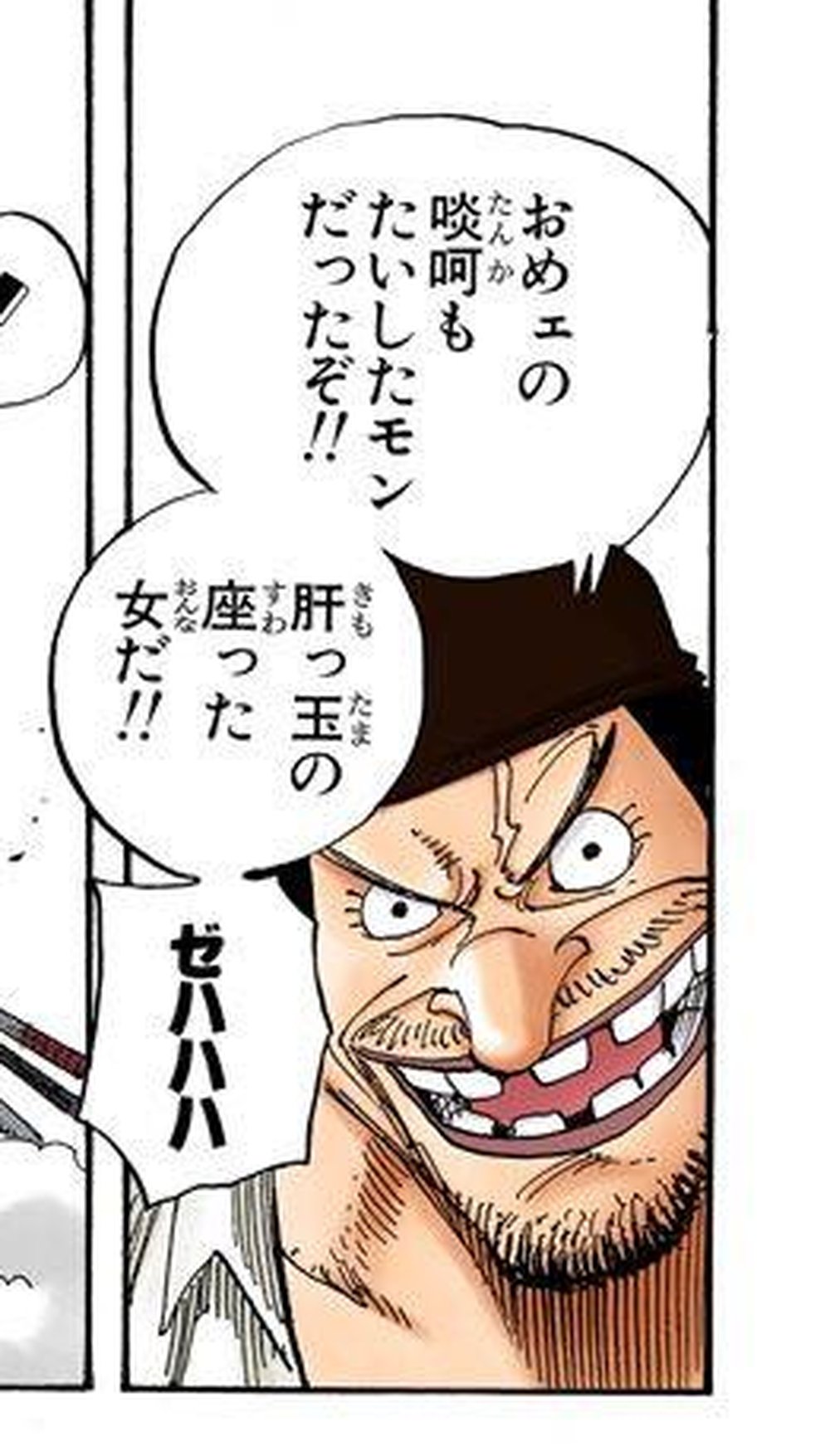
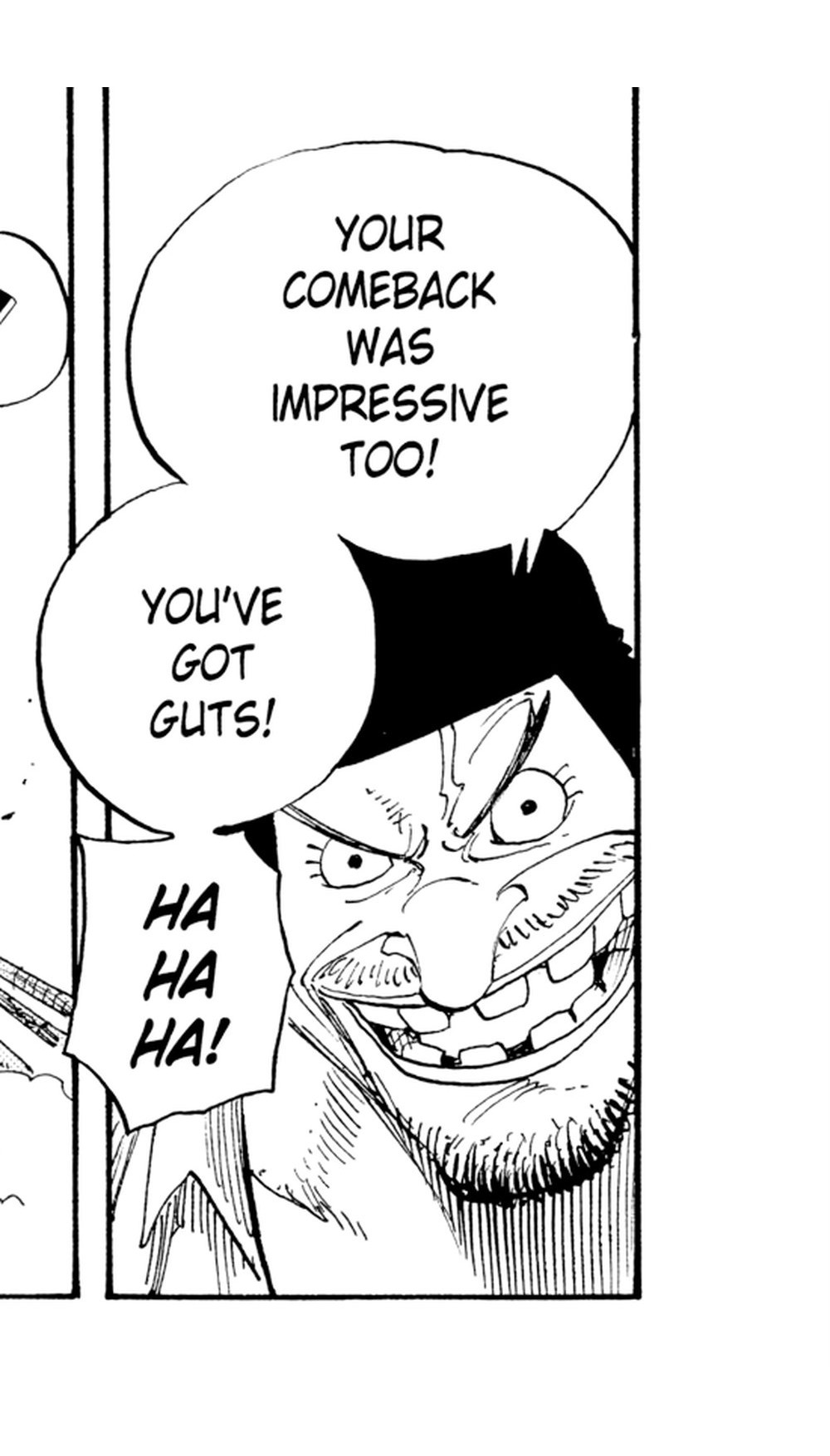
The room laughs at her instead of backing off — until Zoro and Luffy, off-panel, back the insult up with their fists. A few pages later, both men stagger back into frame bruised and grinning, and the very same bearded local who'd been mocking her a moment earlier turns serious. He aims two compliments at once — one straight at Nami, one to the room about her:
「おめェの啖呵もたいしたモンだったぞ!!肝っ玉の座った女だ!!」
Omee no tanka mo taishita mon datta zo!! Kimottama no suwatta onna da!!
VIZ's English edition prints: "YOUR COMEBACK WAS IMPRESSIVE TOO! YOU'VE GOT GUTS!" (Vol. 24, p.177).
Grant the rendering its due immediately, because this is a rarer case on this hub than you might expect: VIZ's choice is genuinely good. "Guts" isn't a lazy placeholder reached for under deadline pressure — it's English arriving, unprompted, at the exact same body-metaphor family Japanese is using. Both languages agree courage lives somewhere in the torso. They just disagree, by one organ, about where.
The Original
肝っ玉 (kimottama) breaks into three moving pieces.
肝 (kimo) is the liver — not a metaphorical one, the actual organ, the same 肝 that shows up in 肝臓 (kanzō, "liver" in a biology textbook). In the somatic logic running through Japanese emotional vocabulary, the liver is where nerve lives: large, deep, load-bearing, impossible to reach casually — exactly the organ you'd trust with something as essential as courage.
っ is a sokuon, a small つ that doubles the consonant after it. 肝 + 玉 would ordinarily read kimo-tama; the small っ tightens it into kimottama, the same emphasis-by-doubling trick behind やっぱり. It's punch added by grammar alone.
玉 (tama) means "ball, sphere, jewel." Attach it to a body part and it typically swells that part into something assessable, weighable, almost tactile — 目玉 (medama, "eyeball") is the same move. Here, it turns a liver into a liver-ball: not just an organ, but an object whose size you could judge, the way a big, thick 肝っ玉 marks someone as bold and a nonexistent one marks a coward.
Then the sentence adds a verb: 座った, from 座る/据わる (suwaru), "to sit, to settle firmly into place." A liver-ball that has 座った has sat down and stayed down — composed, unshaken, immovable regardless of what happens around it. This is the noun-ified, folksier cousin of a plainer, more common verb phrase: 肝が据わる (kimo ga suwaru, "the liver settles/sits"), the idiom our Demon Slayer companion piece traces through Mitsuri Kanroji's mother's backstory. Where 肝が据わる describes an ongoing state of nerve, 肝っ玉 packages that same liver into a noun — something you can have, lack, or measure: 肝っ玉がある (to have guts), 肝っ玉が太い (lit. "a thick liver-ball," i.e. audacious), 肝っ玉がない (spineless).
Grammatically the headline sentence is unglamorous: [NOUN]の[past-tense verb]女だ, "a woman whose [X] did [Y]." All the interesting work is in the vocabulary, not the structure. As a set idiom, 肝っ玉 sits around JLPT N2 — common enough that any regular manga or drama audience has met it, specific enough that a first-year learner hasn't.
VIZ's Choice
Only one occurrence of 肝っ玉 turns up in the volumes on file, so there's no scatter-table to read the way there is for 因縁 or 手も足も出ない elsewhere on this hub — but the single data point here is unusually clean, and worth sitting with instead of rushing past:
肝っ玉の座った女だ!! → "YOU'VE GOT GUTS!"
Most 肝-idioms on this hub's sister sites tell a story of loss: 肝が据わる collapses into flat adjectives, 肝に銘じる gets rerouted from the liver to the muscles. This one is different. "Guts" isn't a rescue operation or a compromise — it's the one English idiom that independently arrived at the identical underlying idea: courage as a physical mass, sitting low in the body, sturdy enough to withstand pressure. Push the etymology a step further and the parallel gets sharper still. English "guts," in the courage sense, is a 19th-century extension of the literal guts — the intestines, the bowels — hauled up out of slaughterhouse vocabulary into a compliment. That is exactly kimottama's own trajectory: blunt anatomy, promoted into praise.
Set the two idioms side by side, organ against organ:
- Japanese: 肝 (liver) — solid, filtering, seated high in the abdomen.
- English: guts (intestines/bowels) — hollow, processing, seated low in the abdomen.
Different organs, identical theory of the body: something visceral, something outside conscious control, is where real bravery lives — not the head, not even the heart, but down in the working meat of you. That's a near-miss most translation pitfalls on this hub would envy.
The Gap
Grant VIZ everything above, and three seams still show.
(1) The organ itself moves. A reader fluent in both idioms notices immediately: Japanese names the liver; English's "guts" names the bowels. It's a one-organ error, not a conceptual one — but it means a bilingual reader can never point at 肝っ玉 and "guts" and say they're naming the same body part. Only the same job.
(2) The posture disappears. 座った is doing real narrative work — not just "she has guts" but "her liver sat down and stayed down." It's an organ that could have panicked (compare 肝を冷やす, "to chill the liver," the standard idiom for being frightened) and simply didn't. "YOU'VE GOT GUTS!" is a flat, static possession, present tense, with no before-and-after built in. The Japanese hides a tiny drama inside its own grammar — something could have unseated her, and it didn't — that the English quietly erases.
(3) The size-word vanishes. 玉 fattens the idiom into something almost tactile: a liver-ball you could heft and size up. That's the same 玉 behind 肝っ玉が太い (audacious) and behind the classic set phrase 肝っ玉母さん — "a gutsy, take-no-nonsense mother," a recognizable stock character type and even a well-known 1970s TV drama title — where the liver-ball hardens into an entire personality archetype. "Guts" carries none of that roundness or heft; it's a flat plural noun where kimottama is almost cartoonishly physical.
What If
- "That's one steel-livered woman!!" — keeps both the organ and the settled, unshakeable image. Cost: "steel-livered" isn't standard English; it reads invented, and inventions slow a reader down mid-brawl.
- "Her nerve doesn't budge, does it!!" — captures 座った's steadiness directly. Cost: no organ survives at all; "nerve" is pure abstraction where the Japanese is viscera.
- "That woman's got backbone!!" — trades one English body-idiom for another: same strategy as "guts," different anatomy. Cost: swaps Japanese's soft, deep-organ image for English's structural, load-bearing one — a different flavor of toughness entirely.
- Keep VIZ's "GUTS," but earn the escalating boast the Japanese piles on: "Now THAT is a woman with real guts!!" — Cost: still the wrong organ, but restores some of the emphasis (おめェの…も → たいしたモン → 肝っ玉の座った) that the clipped original sacrifices to translation's economy.
Take-away
肝っ玉 is the rare entry on this hub where the pitfall isn't a hole in English's vocabulary — it's a near-perfect parallel idiom, filed one organ away. Japanese and English both decided, independently, that courage is a physical thing sitting low in the body, measurable and firm; they just disagreed about which viscera to put it in.
Three rules of thumb to carry off this page:
- When a body-courage idiom crosses into English, check whether English already has a matching organ metaphor before assuming the concept is untranslatable. 肝っ玉 → "guts" proves the match sometimes already exists — you just have to notice it moved one organ over.
- 座る/据わる (suwaru), "to settle, to sit firmly," is the verb Japanese reaches for whenever courage, focus, or resolve needs to describe staying steady, not just being steady. Watch for it wherever 肝, 腹, or 腰 shows up — it's doing narrative work a static English adjective usually drops on the floor.
- 玉 (tama) as a body-part suffix inflates whatever it's attached to into something assessable — bigger, rounder, more "there." 肝っ玉, 目玉, and their cousins all run the same trick; English rarely has a matching suffix, so the heft has to be rebuilt by hand with an extra adjective if you want to keep it.
This word belongs to a small liver-and-memory cluster running across the hub's sister sites: Demon Slayer's own 肝が据わる, the verb-phrase parent of this noun, anchors a scene about Mitsuri Kanroji's mother's nerve set against a first-time collapse of the hips (our Demon Slayer sister article covers it); Naruto's 肝に銘じる takes the identical organ and files a lesson onto it instead of courage, in the scene where Might Guy hands Rock Lee a rule he must never forget (our Naruto sister article covers that one). Three manga, one organ, three different jobs: nerve, memory, and here, sheer boldness.
For more of what English relocates in this series' body-idioms, see the digestive act of understanding in 腑に落ちない, the hip-and-coward idiom of 腰が抜ける・腰抜け, and the paralyzed hands and feet of 手も足も出ない — or browse the full One Piece translation notes index.
Every Japanese and English line quoted above is a byte-exact capture from the cited editions — ONE PIECE Vol. 24 (Japanese) and One Piece (VIZ Media) at the corresponding panels — via our bilingual page database; see Sources below.