The Moment
The page before this one is Naruto at his most ordinary self: confused, loud, and unwilling to let a mystery sit unexplained. Sakura has just been reduced to tears watching Tsunade of the Sannin refuse to help — 「あ~~っ」/「何がどーなってんだってばよ!」/「火影になれって何だよ!?」 — "WHAT THE HECK'S GOING ON?!" "WHERE DID THIS HOKAGE THING COME FROM?!" Naruto, small and outraged, wants the whole chain of events explained from the top, and he isn't going to stop asking.
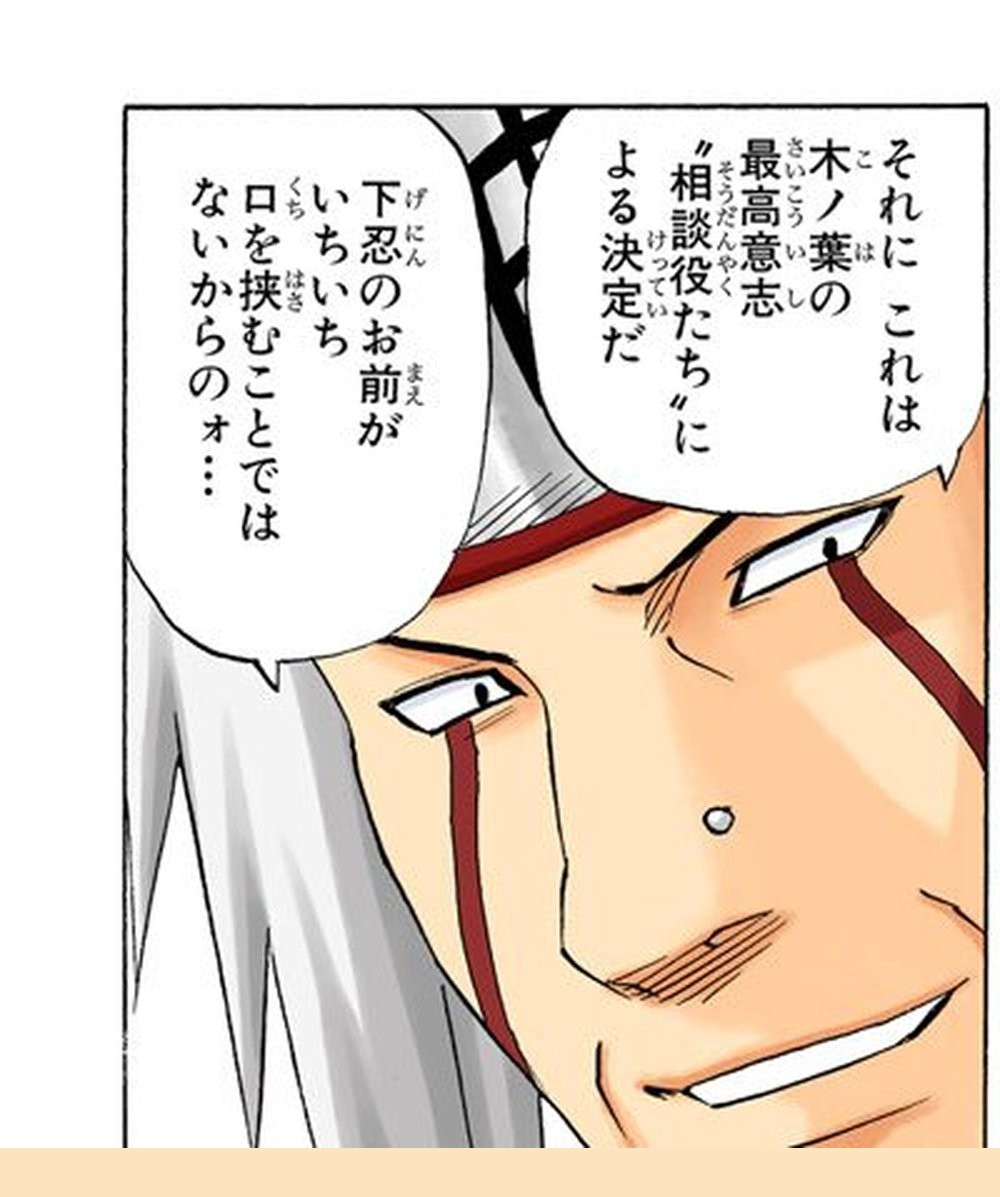
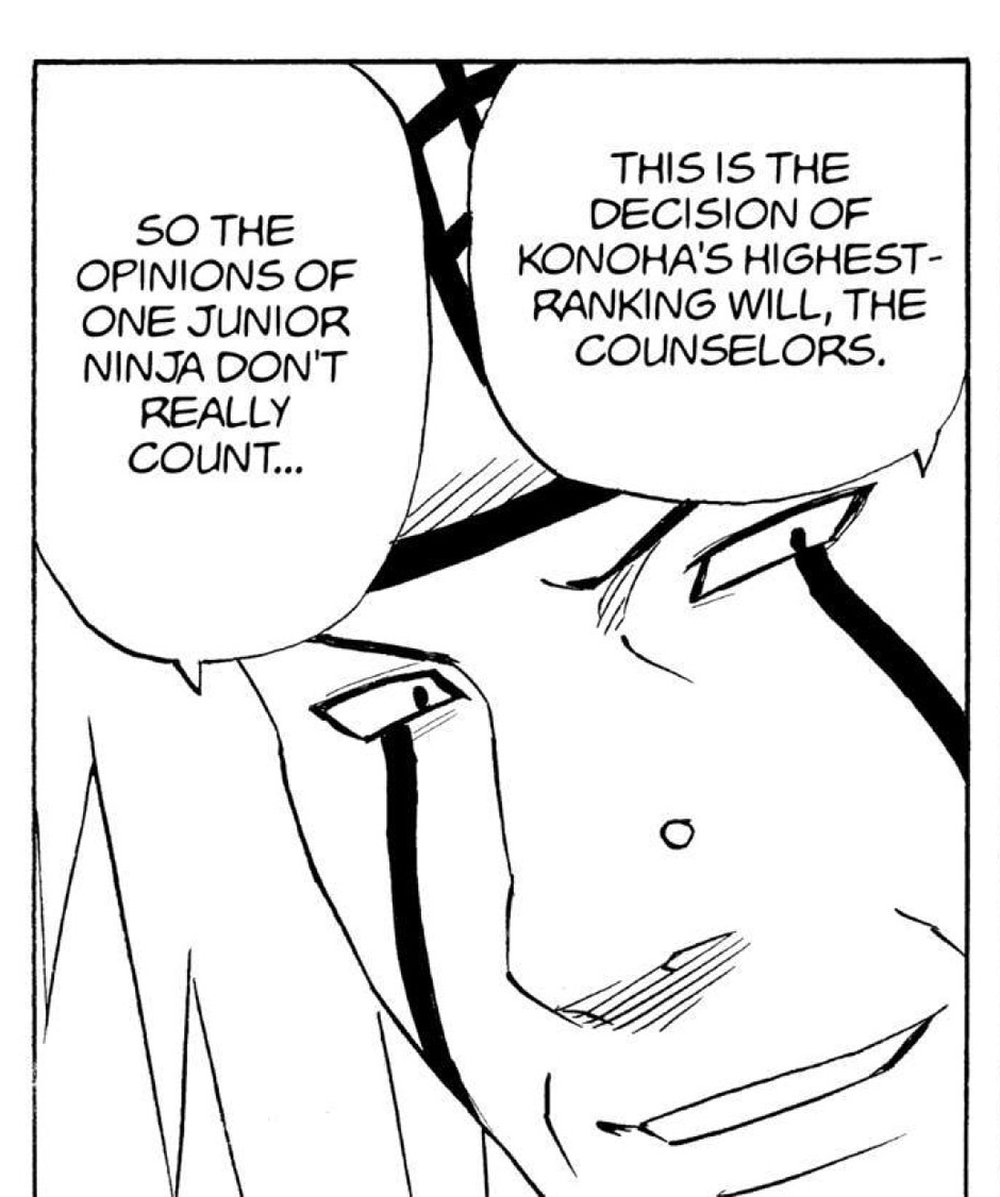
So Jiraiya explains — at length, across half a page of exposition delivered from an inn table over sake and food. Tsunade, he tells them, is the only real choice for Fifth Hokage: granddaughter of the First Hokage, a hero of the last great war, unmatched in both combat and medical jutsu, and — this part addressed to Sakura's alarm about Orochimaru's offer — a decision already made by Konoha's ruling council, the 相談役たち ("counselors"). It's a lot of information, delivered patiently. And somewhere in the middle of it, Naruto keeps talking over him. Jiraiya turns, and says:
「下忍のお前がいちいち口を挟むことではないからのォ...」
Genin no omae ga ichiichi kuchi o hasamu koto de wa nai kara no-ō…
VIZ's English edition prints: "SO THE OPINIONS OF ONE JUNIOR NINJA DON'T REALLY COUNT..." (Vol. 18, p.90).
Grant the rendering its due first. It lands exactly where it needs to: an old man losing patience with a kid who won't stop interrupting a serious conversation. The put-down is clear, the age-and-rank gap is clear, and the sentence reads naturally in a speech bubble — nothing about it trips a reader up. The trade only becomes visible once you go looking for the mouth.
The Original
Take 口を挟む apart at the joint. 口 (kuchi) is "mouth." 挟む (hasamu) is "to sandwich, to pinch, to wedge between two things" — the verb your chopsticks perform closing on a piece of food, or a bookmark performs pressed between two pages. Bolt the body part onto the verb and you get an idiom that pictures a conversation as a physical space with an inside and an outside: to 口を挟む is to force your mouth into a gap that wasn't left open for it. It isn't a neutral synonym for "interrupt" — it names the specific mechanism, mouth-first, uninvited.
The rest of Jiraiya's sentence builds its authority around that image rather than beside it. 下忍 (genin) is the lowest of Konoha's three shinobi ranks — 下忍, then 中忍 (chunin), then 上忍 (jonin) — so 下忍のお前 opens the put-down by naming, precisely, why Naruto has no standing in this room. いちいち is the adverb for "one by one, every single time," almost always carrying a note of exasperation; it recasts what's happening not as one interruption but as a pattern Jiraiya has been tolerating and is now done tolerating. The verdict itself rides on the grammar frame 〜ことではない: [verb] + こと (which turns the verb into a noun-shaped thing, "the act of...") + では (topic-marked copula) + ない (negation) — literally "[the act of X] is not the case," Japanese's standard mold for "that's not your place to do." And the sentence closes on からのォ — から ("because") plus the explanatory の, plus a small-katakana ォ stretching the final vowel into a growl. That stretched のォ is a recurring Jiraiya speech tic, the sound of an old man settling a matter rather than losing his temper.
A more formal cousin of the idiom, 差し挟む (sashihasamu), "to insert, to interpose," shows up in stiffer prose — 疑いを差し挟む余地がない, "there is no room to raise a doubt" — confirming the whole family runs on one image: a mouth, an objection, a comment, physically wedged into space that belonged to someone else.
VIZ's Choice
Only one occurrence of 口を挟む turns up in the Naruto volumes on file — no scatter across scenes to chart, just one line and one solution to weigh on its own terms.
"THE OPINIONS OF ONE JUNIOR NINJA DON'T REALLY COUNT" is a smooth, idiomatic English put-down, and it's worth noticing what it gets right before cataloguing what it trades away. It keeps the dismissal. It keeps the generational and hierarchical gap — an adult talking down to a kid. It keeps the outcome: Naruto is being told, unambiguously, to stop talking. Where it diverges from the Japanese is in what kind of dismissal it is. 口を挟む, wrapped in ことではない, is a procedural objection — a ruling about who has the floor, independent of what they'd say. "Don't really count" is a substantive one — a claim about the value of the content itself, as if Jiraiya had actually weighed Naruto's opinions and found them wanting. Those aren't the same insult, even if both send Naruto back into his seat. VIZ picked the version that reads more smoothly as a line of dialogue; the cost is a real shift in what, exactly, Jiraiya is asserting about Naruto.
Worth a smaller side note: elsewhere in the VIZ Naruto translation, 下忍 is very often kept as the loanword "Genin," capitalized and untranslated, alongside occasional paraphrases like "junior ninja" or "rookie." This line falls on the paraphrase side of that inconsistency — not a unique choice, but one instance of a scatter that runs throughout the whole series' translation of the rank system.
The Gap
A rule about rank becomes a verdict about worth. ことではない tells Naruto: this decision is above your station; you don't get to weigh in — a statement about who may speak, regardless of what they'd say. "The opinions of one junior ninja don't really count" tells him something adjacent but distinct: what you'd say wouldn't matter even if you were allowed to say it. One is being shut out of a room; the other is being told your voice has no weight. Jiraiya's Naruto is the first. VIZ's Naruto is the second.
いちいち's drumbeat disappears. The adverb marks a pattern — Naruto cutting in again, and again, through one long explanation — not a single lapse. Losing it turns a running complaint about an ongoing habit into what reads like one-time commentary on this one interruption.
The mouth vanishes, and with it the idiom's whole physical logic. "Opinions... don't count" is an abstraction about value. 口を挟む is a small, almost violent picture: an object crammed into a gap that wasn't open for it. English keeps the outcome — Naruto silenced — and drops the image that got him there.
Jiraiya's growl flattens into a memo. からのォ is warm, informal, unmistakably spoken; "don't really count" reads more like a policy statement than something growled across a dinner table by a man who is, underneath the scolding, fond of the kid he's scolding.
What If
The menu, and what each option costs:
- "IT'S NOT A GENIN'S PLACE TO KEEP BUTTING IN..." — keeps the rank-based ことではない structure, and "keep" recovers some of いちいち's repetition. Cost: leans on the reader already knowing what a genin is.
- "YOU'RE A GENIN — YOU DON'T GET A SAY, NOT EVERY SINGLE TIME." — restores both the rank framing and いちいち explicitly. Cost: splits Jiraiya's single unbroken growl into two clipped sentences.
- "A GENIN DOESN'T GET TO KEEP WEDGING HIS WAY INTO THIS." — keeps the mouth/wedge image alive through "wedging," without naming the body part outright. Cost: reads more literary than a growled aside needs to.
- Keep VIZ's shape, restore the rank: "SO A GENIN'S OPINION DOESN'T GET A VOICE HERE — NOT EVERY TIME YOU BUTT IN." — Cost: still trades the mouth for an abstraction, just a more accurate one than "don't really count."
Take-away
口を挟む asks a translator to hold three things at once: a body part (mouth), a spatial verb (wedge between), and — in this particular line — a procedural judgment about standing, not a substantive one about worth. VIZ's clean, readable line keeps the sting and loses the specific shape of what's stinging: not your ideas are bad, but this isn't your meeting.
Three rules of thumb to carry off this page:
- 挟む is always about betweenness. Chopsticks, a bookmark, a mouth — the verb pictures one thing forced into a gap between two others. Once you see that image, 口を挟む and its formal cousin 差し挟む click into the same family.
- Watch for procedural objections turning substantive in translation. "You have no standing to speak" and "what you'd say doesn't matter" produce the same silence but assert very different things — and English idiom tends to default to the second because it's punchier.
- いちいち is a pattern-word, not a moment-word. When it disappears, a running complaint about a habit can read as commentary on a single incident instead.
Naruto's mouth-idiom cluster runs deeper than this one line: the same hub carries the sister case of a mouth that won't open under pressure in 口を割る and the interrogation verb English loosens into "talk" — the organ that refuses to crack, instead of one that forces its way in — and the etymology of a very different kind of self-restraint in 堪忍袋 and the bag that holds your temper. For the ear's side of listening rather than interrupting, see 耳を貸す and the Shakespearean idiom VIZ chose not to use. 口を挟む itself is also the subject of a companion piece on this batch's Demon Slayer hub, where the same idiom appears not as dialogue but as narration — a caption describing the famously silent Hashira Giyu Tomioka speaking up for once, which VIZ renders as "TOMIOKA'S DISTRACTION HELPED." Two different works, two very different speakers, one idiom, and English reaching for a different substitute each time. Browse the full Naruto translation notes index for more.
Every Japanese and English line quoted above is a byte-exact capture from the cited edition — NARUTO―ナルト― Vol. 18 (Japanese, colored digital edition) and Naruto Vol. 18 (VIZ Media) at the corresponding panel — via our bilingual page database; see Sources below.