The Moment
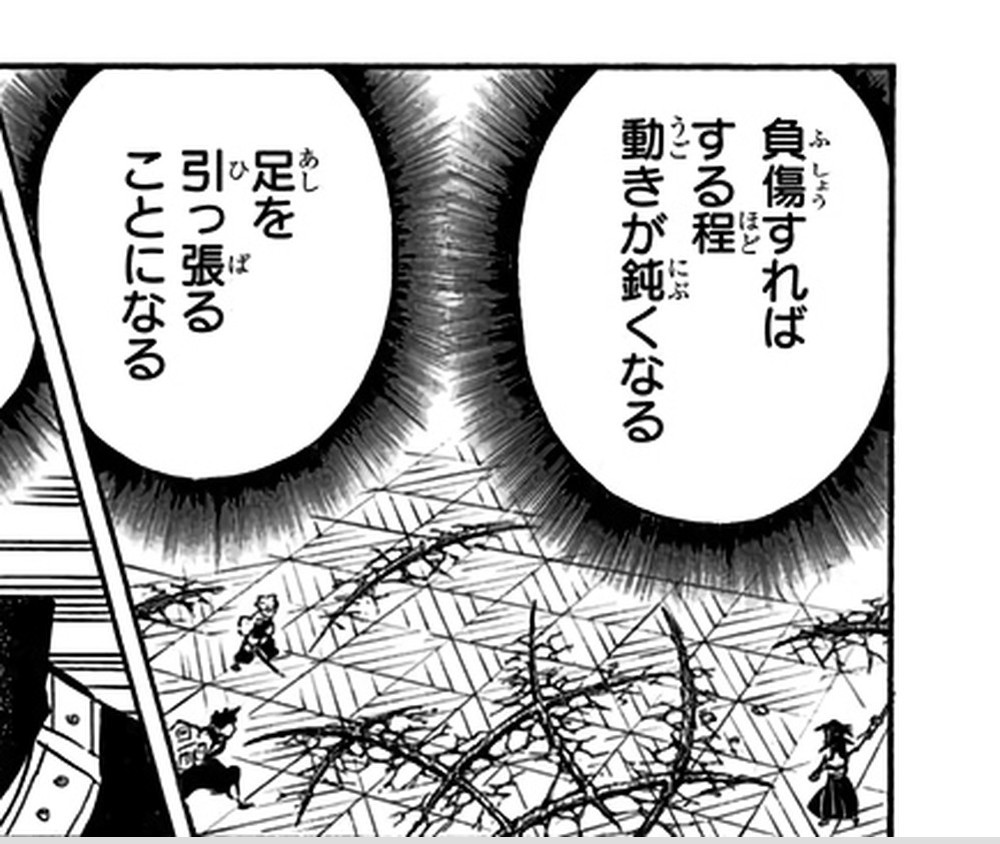
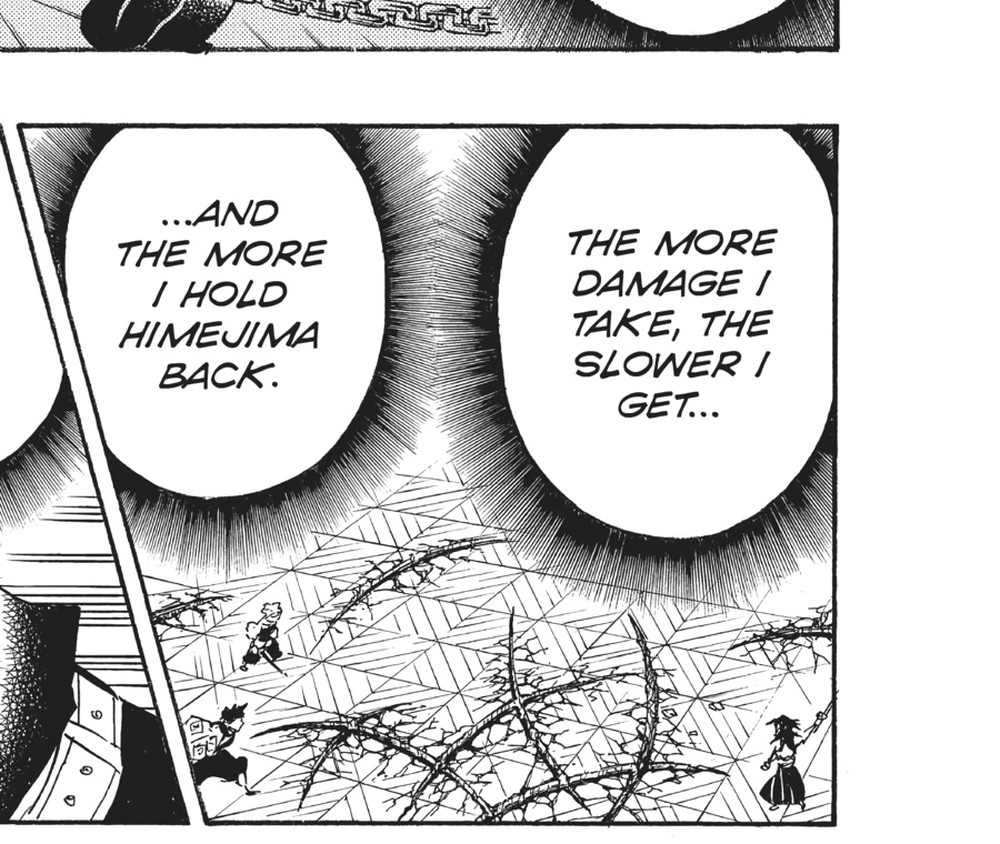
The Infinity Castle, deep in the story's final battle. Genya Shinazugawa — the Corps' one member who isn't a swordsman, who fights by literally eating the techniques of the Hashira around him — is paired with Himejima Gyomei, the Stone Hashira, against the upper-rank demon Kokushibou. A neighboring bubble sets the stakes in one line: 悲鳴嶼さんが鎖で攻撃の軌道を変えてくれなけりゃ / 指どころか両腕共落とされてた — “IF HIMEJIMA HADN'T USED HIS CHAIN TO ALTER THE ANGLE OF THE ATTACK... I WOULD HAVE LOST BOTH OF MY ARMS AND NOT JUST MY FINGERS.” Genya is bleeding, his rare blood barely slowing the demon down, and he thinks through the arithmetic of his own decline:
「負傷すればする程動きが鈍くなる…足を引っ張ることになる」
Fushō sureba suru hodo ugoki ga nibuku naru… ashi o hipparu koto ni naru.
The real VIZ print, split across the same two speech bubbles as the Japanese, reads: “THE MORE DAMAGE I TAKE, THE SLOWER I GET... AND THE MORE I HOLD HIMEJIMA BACK.” (Vol. 20, p.49).
That page number is worth pausing on. Our bilingual corpus pairs this Japanese line with a different English string — “I'LL JUST BE A BURDEN.” — tagged to English page 48. Opening the actual page images tells a different story: English p.47 carries a VIZ chapter-title page (“CHAPTER 172: A WEAKLING'S POTENTIAL”) at the exact spot where the Japanese tankobon has no equivalent break — the content on Japanese p.47 (稀血 barely working, 不死川 shouted mid-fight) is the content VIZ prints on p.48. Every page from there on runs one page ahead in English, so the panel that matches this JP p.48 dialogue prints on English p.49, not p.48. “I'LL JUST BE A BURDEN.” does not appear anywhere on that shifted p.48 either (its actual dialogue is “SHINA-ZUGAWA!!”, “I WAS BARELY ABLE TO RESPOND!”, “DAMN!”) — it is a stray artifact of the corpus's automatic page-number pairing, not a VIZ line at all, and not the rendering of 足を引っ張ることになる. The line actually printed on English p.49 is the one bolded above, and it's the one this article is built on. (Full byte-exact corpus citations for both readings are in Sources and References below, with the discrepancy flagged.)
Eleven pages into the next volume, the idiom returns from the opposite side of the battlefield. Mitsuri Kanroji, the Love Hashira, has just been hit by an attack no one saw coming — 「何だあの技は!?甘露寺は攻撃を避けたはず…!!」, “WHAT WAS THAT TECHNIQUE?! I THOUGHT KANROJI HAD DODGED IT!” — and is carried off for treatment: 手当てを頼む / この紙を持ってるつり目の隊員を捜せ、愈史郎という — “TREAT HER.” / “FIND THE CORPS MEMBER WITH THE SLANTED EYES WHO HAS THIS PAPER. HIS NAME IS YUSHIRO.” Bloodied, one eye barely open, she pleads to stay in the fight:
「待って 私まだ 戦える 今度は足を引っ張らないようにするから」
Matte. Watashi mada tatakaeru. Kondo wa ashi o hipparanai yō ni suru kara.
VIZ, split across the same four bubbles, right to left: “WAIT. I CAN STILL... ...FIGHT. I WON'T HOLD YOU BACK!” (Vol. 22, p.13). The same one-page offset applies here — the corpus's paired English, “I WON'T BE A BURDEN THIS TIME.”, is tagged to JP-matching page 12, but the panel that actually carries this dialogue in the VIZ edition is p.13. Grant both renderings their due before picking them apart: “HOLD ___ BACK” is accurate, it's idiomatic, and — as the next two sections lay out — it dodges a landmine that a more literal-minded translator might have stepped on.
The Original
足を引っ張る breaks into 足 (ashi), “foot/leg” — Japanese doesn't split the limb into “foot” and “leg” the way English does; one word covers hip to toe in ordinary speech — plus 引っ張る (hipparu), “to pull hard, to tug, to drag.” 引っ張る is itself a fused compound: 引く (hiku, “to pull,” one of the first verbs any learner meets, N5) plus 張る (haru, “to stretch taut, to spread,” N4), welded together with the small っ Japanese uses to fuse two verb stems into one forceful action — the same pattern as 引っ越す (hikkosu, “to pull up stakes and move house”) or 引っ掛かる (hikkakaru, “to get caught on something”).
So 足を引っ張る pictures something very physical: a line of people moving forward together, and a hand reaching out to seize an ally's leg and yank it backward mid-stride — not necessarily out of malice, just enough to make the whole line stumble. From that image the idiom generalized to cover any drag on a group's forward motion: incompetence, slowness, a mistake, an injury — anything that turns one member into ballast the others must haul along. It's common enough to sit on most N3 idiom lists, even though every kanji in it (足, 引, 張) is taught by N5. That gap — easy characters, fixed idiomatic meaning — is exactly the kind of word a learner can mistranslate with total grammatical confidence, because nothing about the individual pieces warns you the whole is doing something different.
And here is the trap this article is built around. English owns an idiom that looks like a mirror translation of 足を引っ張る, kanji for word: “to pull someone's leg.” Say it out loud next to the Japanese and the resemblance is uncanny — same limb, same verb, same grammatical shape. But “pull someone's leg” means to tease them, to make a harmless joke at their expense, to fool them for fun. It carries none of the sabotage, none of the burden, none of the dead weight. A translator working fast, or a learner leaning on the literal image, could see 足を引っ張ることになる and write “I guess I'm pulling his leg” — grammatically defensible, semantically catastrophic. Genya's line is about the dread of becoming a liability in a life-or-death fight; “pulling his leg” turns that dread into stand-up comedy. This is a false friend in the purest sense: not a word that sounds similar by accident, but a whole idiom, image and all, that points in the wrong direction.
Grammar is where the two occurrences in this article diverge. Genya's line ends in ことになる (koto ni naru), “it turns out that…” or “it becomes the case that…” — a distancing, almost clinical construction that reports an outcome as though it were happening to him rather than something he is doing: not “I will hold Himejima back” but “it will come to be that I hold Himejima back,” dread filed as an observed fact rather than owned as an action. Mitsuri's line ends in ~ないようにするから (~nai yō ni suru kara), “I'll make sure not to…, because…” — everyday N4 grammar for a deliberate, ongoing effort, spoken here as a vow with a reason attached. One sentence is a diagnosis; the other is a promise. Same idiom, same fear, two completely different grammatical postures toward it.
VIZ's Choice
Both occurrences of 足を引っ張る in the volumes on file, matched to the real VIZ panels (not the corpus's misaligned page pairing — see The Moment above):
| Vol. / JP p. (VIZ p.) | Speaker | Japanese | VIZ English (as printed) |
|---|---|---|---|
| 20 / 48 (p.49) | Genya Shinazugawa | …足を引っ張ることになる | ...AND THE MORE I HOLD HIMEJIMA BACK. |
| 22 / 12 (p.13) | Mitsuri Kanroji | 今度は足を引っ張らないようにするから | I WON'T HOLD YOU BACK! |
Two different speakers, two different situations — a chronically weaker fighter watching his own decline in real time, and one of the strongest Hashira in the Corps refusing to let one bad hit sideline her — and VIZ lands on the same two-word fix both times: “hold [someone] back.” That's convergence, and it's the good kind. “Hold back” is accurate (it names the impeding, not the tone), it's completely natural English, and — this is the part worth sitting with — it is nowhere near “pull someone's leg.” The translator (or translators, across two different volumes) never reached for the false friend, not even once, despite the idiom offering it up on a plate twice.
Look closer at how each line carries its speaker's grammar into English anyway. Genya's version is folded into an ongoing description — “...AND THE MORE I HOLD HIMEJIMA BACK” continues a “the more X, the more Y” construction, keeping some of ことになる's sense of an outcome unfolding rather than a decision made. Mitsuri's version is a bare, exclaimed vow — “I WON'T HOLD YOU BACK!” — with the full stop and the volitional “won't” doing real work to preserve the promise-shape of ないようにするから. VIZ didn't just pick the same words twice by coincidence; the sentence architecture around those words still tracks the difference between dread and resolve, even if the idiom itself flattens into a single formula.
The Gap
The false friend was right there, and nobody took it. “To pull someone's leg” is close enough to 足を引っ張る in form that a rushed or literal-minded translation could produce it by accident — and the result would not be a subtle mistranslation, it would be a scene-breaking one. Imagine Genya's mid-battle self-diagnosis rendered as “I guess I'm pulling his leg”, or Mitsuri's plea as “I won't pull your leg this time”: both read as jokes, both would land as comic relief in scenes built on dread and desperation. VIZ's real choice is worth crediting precisely because the failure mode it avoided is this bad, not because the successful choice was hard to find once the trap was recognized.
Even the correct fix drops the leg. “Hold [someone] back” is accurate and idiomatic, but nothing in it pictures a leg, a hand, or a grip. 足を引っ張る's whole rhetorical force comes from a specific, almost cartoonish image — someone's fingers closing around an ally's ankle mid-stride — and English's nearest safe idiom describes the same outcome (restraint, impediment) through an entirely different, bodiless mechanism: two people, one holding, neither one's legs involved. The reader gets 足を引っ張る's meaning without ever seeing the picture the word is named for.
The grammar contrast survives only in scaffolding, not in the idiom itself. Genya's fatalistic ことになる and Mitsuri's vowed ないようにするから are doing very different emotional work in Japanese — an outcome reported versus an outcome promised — and English can only gesture at that difference through surrounding sentence shape (a continuing clause versus an exclaimed vow), not through the two-word idiom translation itself, which is identical in both lines. A reader working only from the English has to infer the dread-versus-resolve contrast from context and punctuation; a reader of the Japanese hears it baked into the grammar before the meaning of 足を引っ張る even lands.
What If
No rendering is free; here is the menu and its prices.
- “I'll be dead weight.” — keeps the physical drag-image (something heavy attached to a moving body) without colliding with “pull someone's leg.” Cost: “dead weight” is inert, missing the active grip that 引っ張る's verb still implies — nobody is pulling anything in “dead weight,” they're just carrying it.
- “I'll be the one dragging him down.” — keeps the pull/drag verb family alive (引っ張る is “to drag” as much as “to pull”) and stays close to Genya's fatalistic register. Cost: longer than the idiom it's translating, and loses the compact, almost proverbial snap of the Japanese.
- “I won't trip you up this time.” — for Mitsuri's vow, this keeps a literal foot/leg image (tripping is exactly the kind of stumble 足を引っ張る pictures) while staying safely clear of the false friend. Cost: “trip up” has its own secondary English sense — to catch someone in an error or a lie — which could send a reader briefly down the wrong path.
- “I won't be the one holding your leg.” — the most literal option, tried here as a thought experiment for Mitsuri's line. Cost: unnatural, over-literal English no native speaker would say mid-battle; it demonstrates why VIZ didn't attempt it, even though it's the closest any English sentence can get to the actual Japanese picture.
Notice the shape of the trade-off across all four: the closer an option gets to the leg-image, the more it risks sounding invented or drifting toward the false friend's territory; the safer options (VIZ's own “hold back” among them) buy naturalness by giving up the picture entirely. There may not be an English phrase that gets both at once — which is itself the lesson.
Take-away
足を引っ張る is a word where the danger isn't obscurity, it's false confidence. Every piece of it is beginner vocabulary; the idiom it forms is common enough to appear in sports recaps and office small talk; and English happens to have already built a trap shaped exactly like it. The idiom doesn't need a dictionary. It needs a translator who knows to distrust the resemblance.
Three rules of thumb to carry off this page:
- When a Japanese idiom has an English “twin,” check the twin's meaning before you trust its shape. 足を引っ張る and “pull someone's leg” share a limb and a verb and mean close to opposite things — the resemblance is the danger, not the reassurance.
- 足 rarely distinguishes foot from leg, and idioms built on it usually care about motion, not anatomy. 足を引っ張る, 揚げ足を取る, 二の足を踏む — all three picture a moment in someone's stride, not a body part in isolation.
- Watch the sentence ending, not just the idiom. ことになる and ないようにするから turn the identical idiom into a diagnosis and a vow, respectively — the grammar around a fixed expression is often carrying more emotional information than the expression itself.
This isn't a Kimetsu-only trap, either: 足を引っ張る is one of the most common idioms in the language, and it shows up just as readily in Naruto's ensemble fights, wherever a genin worries about slowing down a team of jonin — any translator working that manga's battle monologues would meet the same false friend waiting in the same place.
For more of Demon Slayer's body-idiom cluster — where Japanese grades a feeling by an organ or a limb and English has to reach for an adjective instead — see 肝が据わる・腰を抜かす and the anatomy of courage and terror, drawn from this same Mitsuri Kanroji's own backstory chapter; 鼻が利く and the object English demands; 顔色 and the complexion English stops reading; and 図体 and the sneer VIZ translates into a simple fact. Or browse the full Demon Slayer translation notes index.
Every Japanese and English line quoted above is a byte-exact capture from the cited editions — 鬼滅の刃 Vol. 20 & 22 (Japanese) and Demon Slayer: Kimetsu no Yaiba (VIZ Media) at the corresponding panels — via our bilingual page database, with one caveat: the corpus's automatic JP–EN page pairing runs one page behind the true VIZ pagination at both panels cited here (JP p.48 pairs with VIZ p.49; JP p.12 pairs with VIZ p.13), so the “viz” field and the quoted English above reflect the true printed page, confirmed against the page images directly, while sources[] and references[] preserve the original corpus bytes for auditability. See Sources below.