The Moment
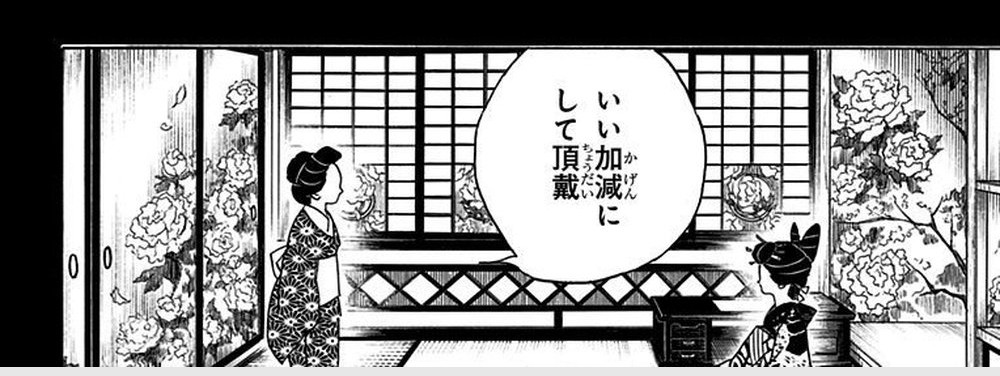
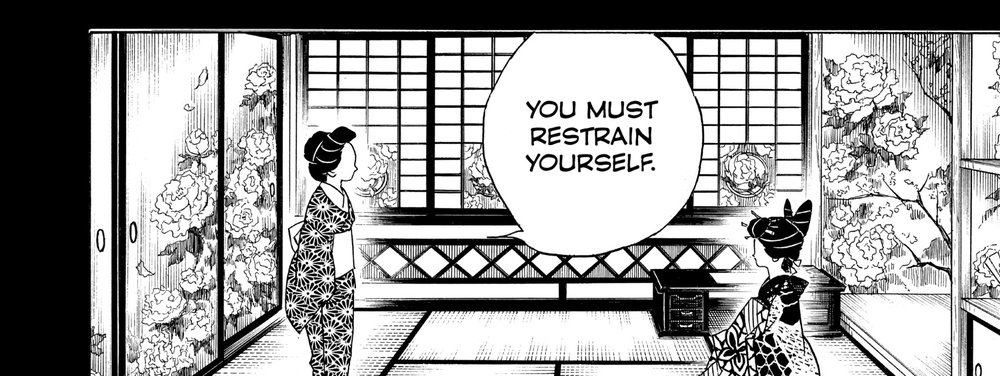
Volume 9 opens a flashback with a caption: 「炭治郎たちが潜入する2日前 京極屋」 — "HOUSE KYOGOKU: TWO DAYS BEFORE TANJIRO AND THE OTHERS ARRIVED." Nobody has entered the Yoshiwara pleasure district yet. Inside one of its houses, two women stand in a lantern-lit room. One, plainly dressed, faces the other — an elaborately coiffed courtesan seated near a low table, a forest of ornamental kanzashi bristling from her hair. The plain woman speaks first:
「いい加減にして頂戴」
Ii kagen ni shite chōdai.
VIZ's English edition prints: "YOU MUST RESTRAIN YOURSELF." (Vol. 9, p.70).
The courtesan's face fills the next panel, composed and faintly amused: 「何を?」 — "WHATEVER DO YOU MEAN?" A few pages later the dialogue confirms who's speaking to whom: this is House Kyogoku's proprietress (女将, okami), and the courtesan she's addressing is Warabihime — the house's most requested oiran, and, as the chapter title already announced (第74話「堕姫」, "Chapter 74: Daki"), secretly the Upper Rank Six demon Daki. The okami's very next line spells out why she's at the end of her patience: 「自殺した子はアンタが虐め殺したようなもんだろう」 — "AND YOU BASICALLY BULLIED THAT ONE GIRL TO DEATH." Daki's reply, dripping with hurt feelings: 「酷いこと言うわね女将さん」 — "YOU SAY SUCH HURTFUL THINGS, OKAMI."
Grant VIZ's line its due: "YOU MUST RESTRAIN YOURSELF" is clean, forceful English that lands the okami's exasperation immediately. What it can't carry is the one grammatical fact every Japanese reader absorbs without noticing: the word doing the scolding, 頂戴, is not a bare imperative. It is, structurally, still a receiving verb — the okami is disciplining the most dangerous person in her house while her own sentence keeps her, grammatically, in the position of asking for a kindness rather than issuing an order.
The Original
Start with the kanji, because they still remember a physical gesture. 頂 (chō, kun'yomi itadaki) means "the crown of the head" or "a summit" — the same 頂 as in 頂上 (chōjō, "mountaintop") and 頂点 (chōten, "apex, vertex"). 戴 (tai) means "to reverently place upon the head" — the same 戴 as in 戴冠式 (taikanshiki, "coronation," literally "crown-wearing ceremony") and 推戴 (suitai, "to hold someone up as a leader"). Put them together and 頂戴 pictures an old formal gesture: receiving a gift, an edict, or a kindness by lifting it reverently to the very top of your own head — the most physically humble posture Japanese vocabulary has fossilized into a verb.
From that image, 頂戴 grew into the kenjōgo verb 頂戴する, "to humbly receive" — the more colloquial cousin of いただく, which itself is the verb hiding inside いただきます, said before every meal in the country. And then colloquial Japanese pushed 頂戴 one step further: bolted onto a te-form verb as 〜て頂戴, it stops being a full sentence and becomes a sentence-final request particle in its own right. Grammatically, 〜て頂戴 restructures "do X" as "[if you do this,] I will humbly receive [the favor of it]." The listener's compliance is reframed, mid-sentence, as a gift given to the speaker — even when the speaker is furious, even when the speaker outranks the listener completely.
Run that grammar through the headline line. いい加減に is idiomatic — "to a reasonable degree," the same phrase inside the common scolding いい加減にしろ, "that's enough already." して is the te-form of する, "to do." 頂戴 closes it out. Literally: "do [stop] to a reasonable degree, and I will receive that courtesy from you." Even at the exact moment she's pulling rank on her own top earner, the okami's grammar keeps her in the posture of a woman asking for, and about to gratefully accept, a kindness.
As vocabulary, 頂戴する sits around JLPT N2 — a formal step up from the N4/N5 いただきます everyone learns first. But the colloquial 〜て頂戴 request form lives outside that scale entirely: it's a spoken-register fixture, historically marked feminine and domestic — mothers to children, mistresses to servants, older women in general — softer and more intimate than 〜てください, blunter and more childlike than 〜ていただけますか. Bare ちょうだい, stripped of any verb at all, drops even further: a small child's flat "gimme" for an object, no humility left in the shape, just muscle memory of a phrase heard a thousand times.
VIZ's Choice
Every clear appearance of 頂戴 in the volumes we have on file, alongside the official English:
| Vol. / p. | Japanese | VIZ English |
|---|---|---|
| 1 / 13 | こっちも炭をちょうだい | GIVE ME SOME CHARCOAL TOO! |
| 9 / 70 | いい加減にして頂戴 | YOU MUST RESTRAIN YOURSELF. |
| 9 / 85 | 手当てしてやって頂戴 | PLEASE, TEND TO HER INJURIES. |
| 17 / 50 | 多く頂戴せねばならぬ | ...THEY MUST RECEIVE... |
Four appearances, four unrelated-looking English sentences — and once the speakers are named, the scatter turns into a small character study. Row 1 is a nameless village boy hollering at Tanjiro's family charcoal stall in Chapter 1, using bare ちょうだい the way any child anywhere asks for candy: no politeness intended or received, just a fossilized request shape. Row 2 is the House Kyogoku proprietress, our headline line. Row 3, fifteen pages later, is Daki herself — still performing Warabihime, still unmasked to her own household — telling an attendant 「入って来たばかりの子につらく当たりすぎたね 手当てしてやって頂戴」 ("I WAS TOO HARD ON THE GIRL. AFTER ALL, SHE IS STILL NEW TO OUR HOUSE. PLEASE, TEND TO HER INJURIES.") — the exact same 〜て頂戴 grammar the okami used on her, now flowing back down to someone beneath Daki in the house hierarchy. Row 4 belongs to Kokushibo, Upper Rank One, explaining to a bleeding Genya Shinazugawa how demon transformation works: 「呼吸が使える者を鬼とする場合…多く頂戴せねばならぬ」 ("FOR SOMEONE WHO CAN USE BREATHING TECHNIQUES TO BECOME A DEMON… THEY MUST RECEIVE… A GREAT DEAL OF BLOOD FROM HIS LORDSHIP.") — no request nuance left at all, just the bare kenjōgo verb "receive," locked into the archaic negative-obligation ending ねばならぬ that marks Kokushibo's centuries-old speech.
Look at what happens to "please" across just Rows 2 and 3. Same construction, 〜て頂戴, fifteen pages apart, spoken first to Daki and then by Daki — and VIZ keeps the softener once ("PLEASE, TEND TO HER INJURIES") and drops it once ("YOU MUST RESTRAIN YOURSELF"). That's not a translator error; it's a translator making a fresh, locally sound call every single time, because English has no single fixed slot for what 頂戴 is doing.
The Gap
The bow disappears into the imperative. いい加減にして頂戴 is, underneath its anger, still built as a request the okami will humbly receive — she is disciplining Daki while her own grammar keeps her curtseying. "YOU MUST RESTRAIN YOURSELF" is bare command, full stop; nothing in the English marks that a small, reflexive courtesy survived even her fury.
One grammar, two unrelated English registers. A reader meeting only the English has no way to notice that "YOU MUST RESTRAIN YOURSELF" (Row 2) and "PLEASE, TEND TO HER INJURIES" (Row 3) come from the identical Japanese construction, spoken by two people in the same power relationship reversed. In Japanese the rhyme is audible instantly — both times, 頂戴 is doing the exact same grammatical work. In English the rhyme is invisible.
The receiving-verb core evaporates. 頂戴's root sense is simply "to receive." That's the one thread running under a scolding, a polite request, and a demon lord's clinical account of drinking blood (Row 4) — three wildly different scenes that are, underneath the Japanese, one verb wearing three outfits. "Give me," "you must," "please," and "must receive" read, in English, as four unconnected idioms. The word that would have tied them together for a Japanese reader is nowhere in the translation, because it was never translatable as a single fixed English item to begin with.
What If
For the headline line, the menu and its prices:
- "Do be so kind as to restrain yourself." — self-consciously formal English, at least signaling politeness-under-strain. Cost: reads like an English drawing room, not a Yoshiwara back room.
- "I'd be grateful if you'd restrain yourself." — restores the receiving-logic on the surface: her compliance becomes a kindness given to the speaker. Cost: too many words for the panel, and the icy compression of いい加減にして頂戴 is gone.
- "Please, restrain yourself." — at minimum keeps "please" consistent with VIZ's own Row 3 rendering of the identical grammar. Cost: still no trace of 頂戴's kenjōgo, receiving-verb architecture.
- Keep VIZ's line, and let the panel carry the rest. The composed kimono, the careful staging of tatami and paper screens, the moonlit establishing shot — the art already reads as aristocratic, controlled anger. Cost: nothing in the WORDS signals deference at all; the reader is entirely dependent on noticing tone from art rather than language.
Every option pays because English never built an ordinary-register verb whose whole job is to make a command sound like a favor received. The closest living cousins — "if you please," "I'd be obliged" — are borrowed from a register English barely still speaks in.
Take-away
頂戴 isn't hard to gloss — "please," "give me," "you must" all get a scene's plot across. What's hard to keep is the fact that, underneath every one of those English shapes, one Japanese verb is quietly performing the posture of someone receiving a kindness, never someone demanding one — right up to the moment a demon uses that same soft grammar to order her own violence tidied up.
Three rules of thumb to carry off this page:
- When 〜て頂戴 shows up, don't just translate the request — notice who's grammatically bowing. It's always the speaker, however much power they actually hold in the scene.
- 頂戴 and いただく are the same receiving-verb wearing two different registers: いただく is the everyday, textbook-safe form; 頂戴 is its softer, more feminine-coded, more colloquial twin — and, stripped of any verb at all, a child's word for "gimme."
- Track 頂戴 against its mirror images: くださる (the honorific twin on the giving side, covered in our sister piece on Naruto) and 差し上げる (the humble giving-up verb, still to come on this hub) — three words drawing the same social ladder from three different rungs.
For more of Demon Slayer's keigo machinery, see 参る and the humble bow hiding inside "go", 致す and the humble bow hiding inside "do", and 申す・申し上げる and the humble bow hiding inside "say" — or browse the Demon Slayer translation notes index.
Every Japanese and English line quoted above is a byte-exact capture from the cited editions — Demon Slayer: Kimetsu no Yaiba Vol. 1, 9 & 17 (Japanese) and Demon Slayer: Kimetsu no Yaiba (VIZ Media) at the corresponding panels — via our bilingual page database; see Sources below.