The Moment
The Fire Temple: a shinobi monastery famed enough that the text itself pauses to introduce it — 火の国に“火ノ寺”ありと謳われた忍寺だ, "THIS FIRE TEMPLE IS A FAMED SHINOBI TEMPLE LOCATED IN THE LAND OF FIRE." Two Akatsuki operatives, Hidan and Kakuzu, have just smashed through its barrier seal. Their own dialogue on the page is loose and slangy — Hidan needling his partner with オイ…金儲けが狙いじゃねーだろうな? ("...NO MATTER WHERE YOU ARE!" in VIZ's split rendering) and そんなのでボウズを殺ると地獄へ落ちるぜ ("KILLING A MONK FOR MONEY WOULD ONLY GAIN IS A TICKET STRAIGHT TO DAMNATION!"), Kakuzu firing back with the dry pun 地獄の沙汰も金次第だ, "AND THEY SAY MONEY TALKS..." (literally: even hell's verdicts run on money).
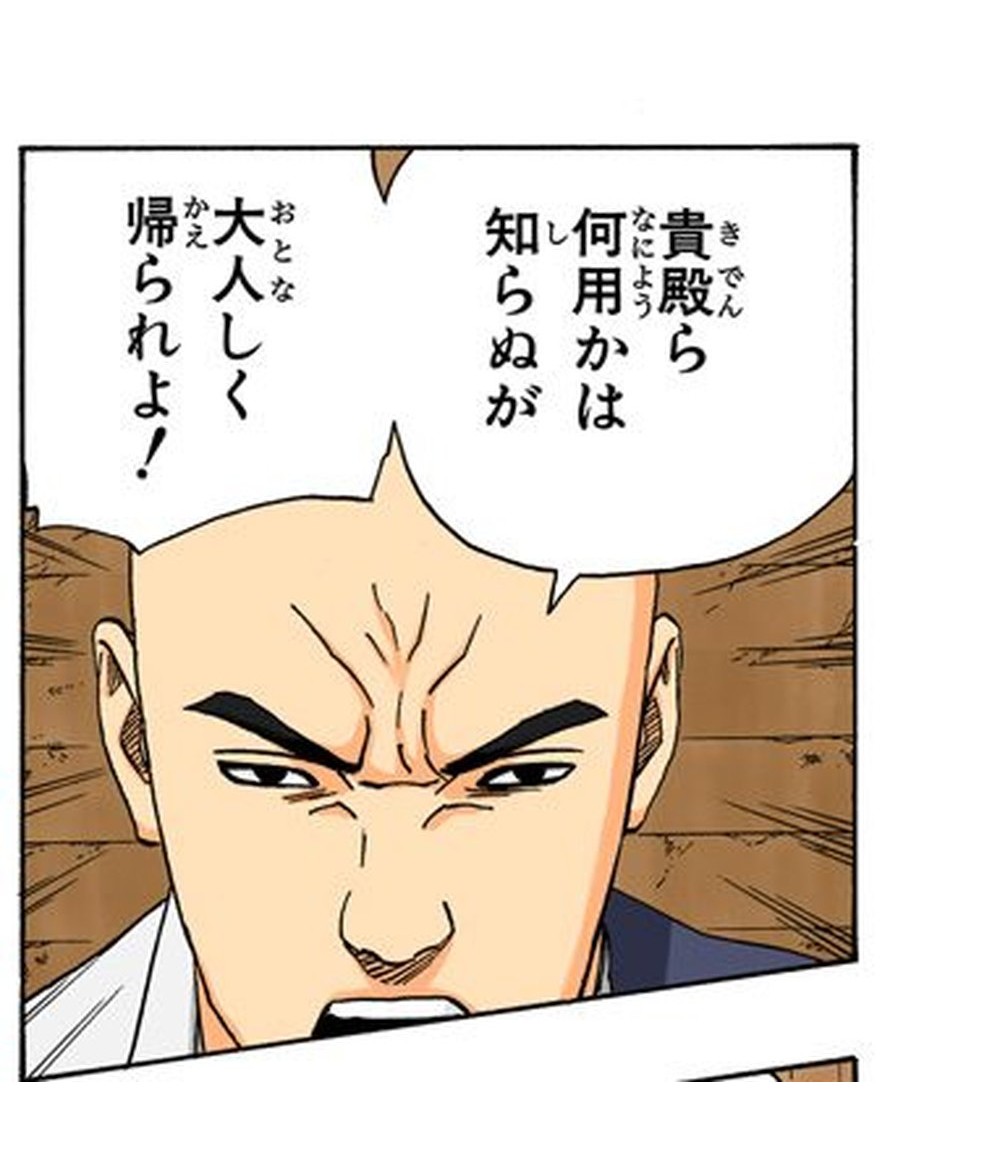
The man who steps out to meet them is not rattled by any of it. He is Chiriku — chief priest of the temple, and a former member of the Twelve Guardian Ninja who once stood watch over the Fire Daimyo himself. A few panels earlier he simply says ワシが出る, "I'll go," and takes the fight himself. Now, facing two hired killers, he opens with:
「貴殿ら何用かは知らぬが」
Kiden-ra nani yō ka wa shiranu ga
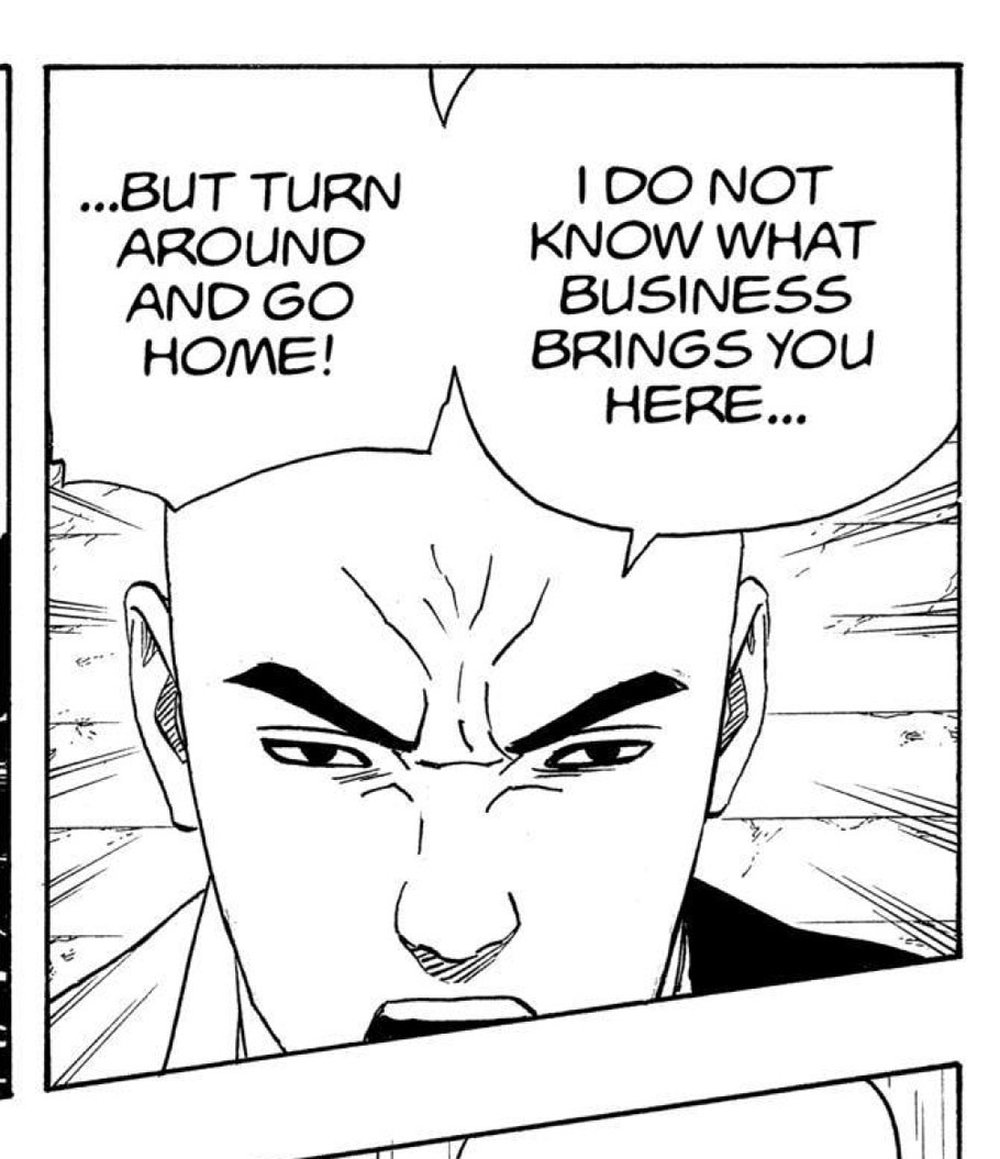
VIZ's English edition prints: "I DO NOT KNOW WHAT BUSINESS BRINGS YOU HERE..." (Vol. 35, p.89), continuing in the same panel with "...BUT TURN AROUND AND GO HOME!"
Grant the rendering its due first: "I DO NOT KNOW" instead of the contraction "I don't know" is a real, if small, choice — it reads more deliberate, more measured, than casual English. But hold the Japanese next to it. Chiriku has just been ambushed by armed intruders in his own temple, and he addresses them with 貴殿ら — a pronoun that grants rank, not just formality — plus 知らぬ, the classical negative that hasn't been ordinary spoken Japanese for a very long time. He is not being merely polite. He is speaking to Hidan and Kakuzu as though they were fellow officers he happened to outrank, and doing it on purpose.
The Original
貴殿 (kiden) is a word this hub's own family of sites already knows well: the identical pronoun appears on the One Piece hub, spoken first by Karoo — Princess Vivi's loyal ostrich, begging Zoro with warrior courtesy he hasn't remotely earned the standing to use — and later by the samurai Kin'emon, so relentlessly that another character mocks him for it on the page. Kanji for kanji, 貴殿 is 貴 (ki), "noble, esteemed" — the same 貴 that opens 貴様 (kisama, this hub's hostile second-person pronoun) — plus 殿 (dono), the honorific suffix trailing a name or title in formal address: 田中殿, 隊長殿. Where the 様 in 貴様 wore all the way down into an insult over the centuries, 殿 never curdled; 貴殿 still opens formal Japanese business letters today, addressed to a single man, exactly where it once opened a formal challenge between warriors.
Here the word takes an unusual passenger: the plural ら, ordinarily blunt and casual (彼ら, or the hostile 貴様ら) grafted onto Japanese's most peer-elevating pronoun. 貴殿ら reads, roughly, "you two, of noble standing" — courtly address stretched, slightly awkwardly, over two men who have just broken down a wall.
The clause finishes with two more period-flavored choices. 何用 (nani yō) — 何 "what" + 用 "business, errand" — is the set question a gatekeeper in a samurai drama asks a stranger at the door: 何用でございますか, "what business have you." And 知らぬ is not modern 知らない; it is 知る plus the classical negative auxiliary ぬ, the same fossil grammar that survives today only in set phrases like 知らぬが仏 ("ignorance is a Buddha" — ignorance is bliss). Three separate old-formal markers — 貴殿, 何用, 知らぬ — stack inside one seven-word clause. This is not one archaism; it is a whole register, assembled on purpose.
VIZ's Choice
This is the only confirmed appearance of 貴殿 in the Naruto volumes on file — a single, carefully placed use rather than a scattered pattern, so there is no table of variants to read across. The interest here is not how VIZ solved it five different ways, as with a scattered word, but what a single, well-built formal sentence loses when it is rendered into English's one "you."
VIZ's "I DO NOT KNOW WHAT BUSINESS BRINGS YOU HERE..." is fluent, accurate in its content, and — credit where due — the choice to spell out "do not" rather than contract it is exactly the kind of small, real signal a translator reaches for when a line needs to sound a shade more formal than the English around it. It is not a failure of effort. It is a demonstration of the ceiling: English can nudge a sentence toward formality with word choice and cadence, but it cannot reach for a different pronoun the way Japanese can, because it does not have one waiting.
The Gap
"You" cannot perform an elevation. 貴殿 does not simply mean "you, but fancier." It enacts a specific social move: treating the addressee as a person of rank, deserving of peer-to-peer respect, regardless of what they have actually done to earn it. That is precisely Chiriku's gambit — meeting armed killers with the composure due an equal rather than the fear due a threat — and the whole point evaporates the instant the pronoun is just "you."
The archaism vanishes without a trace. 知らぬ marks this sentence as costume-grade old-formal the moment a Japanese reader's eye crosses it — the identical signal でござる sends elsewhere in this series, and which this hub has already tracked through Kakashi's own author-note gag. "I DO NOT KNOW" is careful modern English. It is not two centuries removed from casual speech, and nothing in the sentence tells an English reader that it should sound that way.
The clash across the gutter goes quiet. On the printed page, Chiriku's 貴殿ら…知らぬが sits directly across from Hidan's オイ…金儲けが狙いじゃねーだろうな? and Kakuzu's punning 地獄の沙汰も金次第だ — two registers of Japanese, centuries apart, sharing one confrontation. VIZ's English draws all three lines from the same contemporary conversational register ("KILLING A MONK FOR MONEY," "AND THEY SAY MONEY TALKS," "I DO NOT KNOW WHAT BUSINESS"), so the priest reads as merely polite rather than as a man deliberately speaking a dead formal register at men who broke down his wall.
What If
No option is free; here is the menu and its prices.
- "I know not what business brings you here, but go home in peace." — "know not" imports a genuine trace of 知らぬ's archaism. Cost: risks tipping from controlled old-formal into pure pastiche.
- "What business you gentlemen have here, I could not say — but be gone." — the inversion and "gentlemen" both gesture at rank-granting, period-flavored address. Cost: "gentlemen" lands warmer and more clubbable than 貴殿 aimed at intruders who came to kill him.
- "Whatever your business, I do not know it — but leave, quietly." — keeps VIZ's accuracy and adds a comma-pause mimicking the clause-by-clause formality of the Japanese. Cost: still no distinct diction; the pronoun problem is unsolved.
- Keep VIZ's line as printed. — Cost: correct, and already quietly more formal than a contraction would allow, but 貴殿's specific act of elevation is nowhere in the English at all.
Take-away
貴殿 does one thing English's "you" structurally cannot: it grants the person being addressed a rank, on the spot, whether or not they have earned it. A princess's ostrich uses it to beg; a samurai uses it as his whole verbal identity; here, a priest uses it as armor, refusing to let two hired killers set the terms of how he speaks to them.
Three rules of thumb to carry off this page:
- 貴殿 is a move, not a mood. It doesn't just mark a sentence as "formal" — it performs the specific act of extending peer-level respect to the addressee. Ask who is being elevated, and why, whenever you meet it.
- Watch for archaism stacking. One old-fashioned marker (貴殿, ござる, ぬ) can be a style choice; three in one clause, as here, is a whole register being assembled on purpose.
- Register is often relational, not absolute. Chiriku's formality only lands as a choice because it sits directly across the page from Hidan's slang — read the surrounding voices, not just the line being translated, to see what a register is doing.
For the pronoun's fallen twin — the same "noble" 貴 root, worn down into an insult — see this hub's own 貴様 companion piece on the One Piece site, or the identical word 貴殿 used by an ostrich and a samurai at /japanese/kiden-one-piece/. For more of this same old-warrior register inside Naruto itself, see the sister pieces on 拙者 and Pakkun's samurai "I", でござる and the copula English has no voice for, and わし, the elder pronoun every VIZ line just calls "I" — or browse the Naruto translation notes index.
Every Japanese and English line quoted above is a byte-exact capture from the cited editions — NARUTO Vol. 35 (Japanese) and Naruto Vol. 35 (VIZ Media), p.89 — via our bilingual page database; see Sources below.