The Moment
Alabasta arc, early volumes. Vivi's group has just parted ways with the Baroque Works assassins Mr. 5 and Miss Valentine on the docks outside Nanohana, and the danger closing in on the princess is now impossible to ignore. Zoro, off on his own business nearby, has just weathered a hit from Mr. 5's bizarre Devil-Fruit-boosted nose — 「おいおい何て危ねェハナクソだ...!!」, "WHOA, HIS BOOGERS PACK A WALLOP!" — when someone throws themselves at his leg and holds on for dear life. It's Karoo: Princess Vivi's loyal ostrich, a nonhuman companion who never once, in the whole arc, drops the elevated diction of a knight addressing a fellow man of honor.
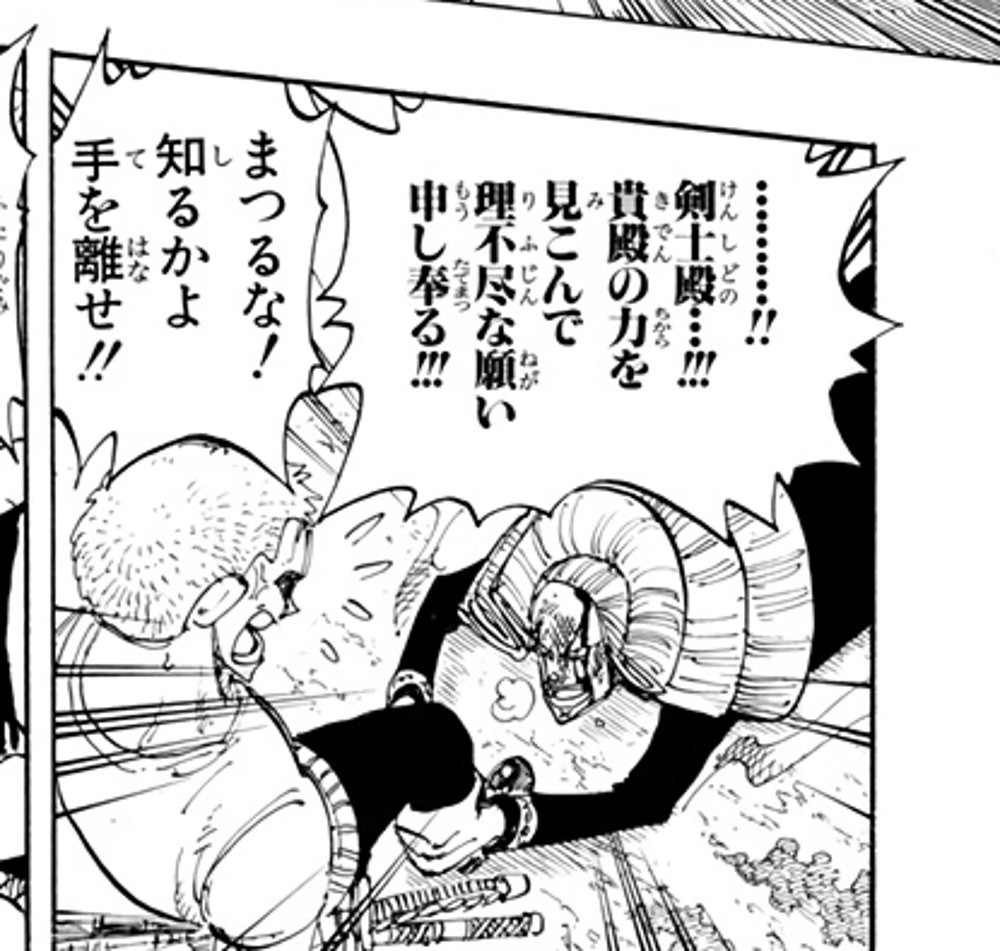
「……?剣士殿……!!!貴殿の力を見こんで理不尽な願い申し奉る!!!」
……? Kenshi-dono……!! Kiden no chikara o mikonde, rifujin na negai mōshi tatematsuru!!!
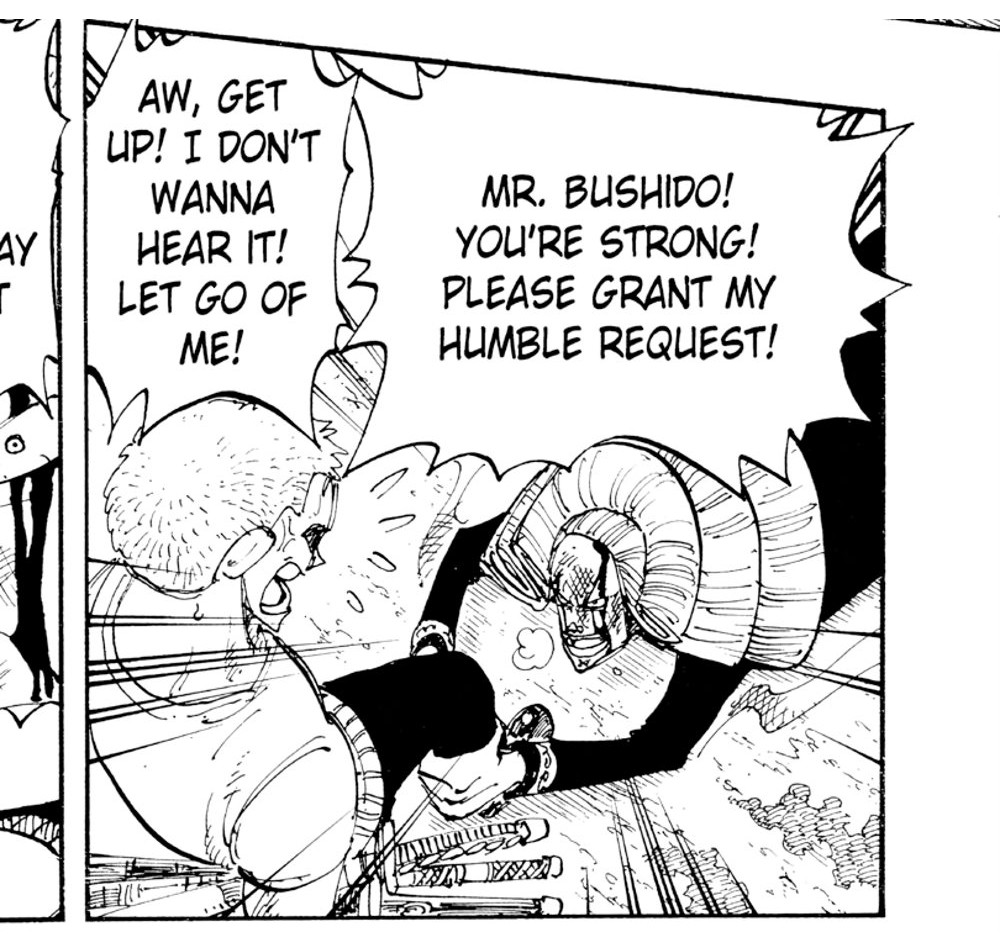
VIZ's English edition prints: "MR. BUSHIDO! YOU'RE STRONG! PLEASE GRANT MY HUMBLE REQUEST!" (Vol. 13, p.44.)
Zoro's answer arrives immediately, in the roughest register the language owns:
「まつるな!知るかよ手を離せ!!」
Matsuru na! Shiru ka yo, te o hanase!!
VIZ: "AW, GET UP! I DON'T WANNA HEAR IT! LET GO OF ME!"
Grant the translation its due first: "MR. BUSHIDO" is a genuinely clever fix. Zoro is nobody's "Mister" this early in the story, but "Bushido" imports exactly the flavor Karoo's whole manner of speech is reaching for, compressed into a nickname an English-language reader can clock instantly. The panel lands; the comedy of a small, panicked, formally-spoken bird practically prostrating itself in front of an annoyed teenager works in English about as well as it works in Japanese.
But watch what happened to the actual pronoun. 剣士殿 ("Mister Swordsman," title plus the honorific 殿) supplies the nickname. 貴殿 — a second, separate honorific, aimed not at Zoro's title but at Zoro himself — dissolves into the bare contraction "YOU'RE." And 理不尽な願い, literally "an unreasonable, unjust request," Karoo's own admission in the same breath as his courtesy that he has no right to ask this, becomes "MY HUMBLE REQUEST." Humble is not unreasonable. Karoo isn't being modest. He's confessing that what he's about to ask crosses a line — and doing it in the single most elevated register Japanese owns for addressing a stranger.
The Original
Take 貴殿 apart the way this hub has taken apart every second-person pronoun in this corpus.
貴 (ki) is "noble, precious, esteemed" — the same 貴 that opens 貴様 (kisama), this hub's hostile pronoun, and 貴社 (kisha), "your esteemed company," still the standard way a Japanese business letter addresses its recipient's employer today. 殿 (dono) is an honorific suffix trailing a name or title — 田中殿, 隊長殿, 各位殿 — one rung below 様 on Japanese's honorific ladder (roughly 様 > 殿 > さん > くん > bare name), but far from casual: it's the address of formal correspondence, military rank, and, in period fiction, of samurai speaking to samurai.
Put 貴 and 殿 together and 貴殿 parses as something like "your noble lordship" or "the esteemed person before me." Etymologically it is 貴様's twin: both are honorific compounds built on the same root, both trace to genuinely respectful samurai-era address. And there the resemblance ends. 貴様 wore all the way down — centuries of overuse turned an honorific into an insult, tracked at length in our companion piece on 貴様. 貴殿 never took that road. 殿 stayed formal instead of curdling, and 貴殿 rode along with it: it remains, today, a live and correct way to open a formal letter to a man whose standing you respect — 貴殿におかれましては, "as for your esteemed self," the stock opening of Japanese business correspondence.
That double life — martial address AND modern epistolary courtesy — is what sets 貴殿 apart from every other pronoun in this hub. おぬし, covered in our companion piece, is role-language: a stock marker for "this character is old-fashioned," worn by anyone from a mountain hermit to a deposed king regardless of who they're actually addressing. 貴殿 is narrower and sharper: it specifically marks the speaker as extending peer-level respect — real or aspirational — to the person being addressed. It doesn't say "I am from an earlier century." It says "I am speaking to you as one person of standing speaks to another," whether or not that's actually true.
Which is exactly the joke sitting inside Karoo's line. Karoo is a talking ostrich with no combat ability whatsoever, addressing the strongest swordsman he's ever met, in the vocabulary a fellow warrior would use toward another. He isn't lying, exactly — he means every syllable of the respect — but the elevation is aspirational, not earned. That gap between Karoo's actual station and the peer-to-peer register he reaches for is most of why the scene is funny at all. Grammatically the sentence around 貴殿 is unremarkable — の marks simple possession (貴殿の力, "your esteemed strength"), 申し奉る is the archaic humble-honorific verb 申す plus 奉る stacked for maximum deference — but none of that grammar sits on any JLPT list. Pronoun and address-term register, as with every word in this hub's second-person family, falls outside the standard vocabulary tests entirely; functionally, reading 貴殿 correctly in the wild — recognizing it as martial-formal rather than merely "old" — is deep into N1 territory, the register of legal documents and period drama rather than daily conversation.
VIZ's Choice
Every appearance of 貴殿 found in the volumes on file, spanning two arcs and three speakers:
| Vol. / p. | Speaker → Addressee | Japanese | VIZ English |
|---|---|---|---|
| 13 / 44 | Karoo (Vivi's ostrich) → Roronoa Zoro | ……?剣士殿……!!!貴殿の力を見こんで理不尽な願い申し奉る!!! | MR. BUSHIDO! YOU'RE STRONG! PLEASE GRANT MY HUMBLE REQUEST! |
| 68 / 97 | Kin'emon (disembodied head) → Sanji | マユゲのお方貴殿名を何と申される | EYEBROW GENTLEMAN, I WISH TO KNOW YOUR NAME. |
| 68 / 97 | Sanji → Kin'emon (mocking) | 何が貴殿だ体が調子よく戻ったら申し奉りやがって!! | AND GENTLEMAN? SO YOU GET YOUR BODY BACK... ...AND ALL OF A SUDDEN YOU'RE MR. MANNERS?! |
| 69 / 29 | Kin'emon → "Brownbeard" (a Punk Hazard subordinate) | 貴殿茶ひげ殿と申されたか | YOU SAID YOUR NAME WAS BROWNBEARD? |
(Housekeeping note: the second and third rows come from the corpus's Punk Hazard-arc page records, which store dialogue as a flat list rather than the aligned jp/en pairs[] used for most of this corpus — a schema shift the bilingual database makes somewhere past the arc's start. We matched each line to its panel by hand against the printed page art rather than trust an automatic alignment; see Sources for how these are cited.)
Four lines, three different relationships, one consistent translator's move: 貴殿 itself never survives as a marked word. What survives instead is invented address-term flavor bolted onto the surrounding sentence — "MR. BUSHIDO," "EYEBROW GENTLEMAN," "MR. MANNERS" — real compensation, genuinely funny, and entirely disconnected from the pronoun actually doing the bowing in Japanese.
Kin'emon is the more instructive case, because he isn't a one-scene gag character the way Karoo is — he's a recurring samurai from Wano whose entire verbal identity is built on exactly this register (拙者 for "I," 貴殿 for "you," でござる sentence endings), the genuine article this hub's おぬし piece calls "the full old-sage kit." And the manga itself notices how it sounds: reunited with his own body after being split into pieces at Punk Hazard, Kin'emon greets Sanji with the courtliness of a man who has never spoken any other way — 貴殿名を何と申される, "might I ask your esteemed name" — and Sanji, who spent the previous chapters getting insulted by Kin'emon's disembodied, foul-mouthed severed head, snaps back: 何が貴殿だ, "the hell's with this 'kiden' business." That's a character inside the story reacting to the pronoun itself as a jarring register shift — and VIZ's "AND GENTLEMAN?" mocks the wrong target, a vague politeness rather than the one specific, loaded word that provoked it.
The Gap
The elevation-of-a-stranger move disappears. 貴殿 doesn't just mean "you, formally" — it performs a specific social act: treating the addressee as a peer of standing, whether or not the speaker has any right to claim that footing. Karoo, an ostrich with no sword, using it on Zoro is the whole joke; Kin'emon, an actual samurai, using it on a modern pirate is a genuine cultural collision. English "you" cannot perform an elevation, because it has nowhere to climb from.
理不尽な flips polarity — an admission becomes false modesty. Karoo's 理不尽な願い concedes, in the same breath as maximal courtesy, that his request is unfair. VIZ's "MY HUMBLE REQUEST" replaces that admission with the opposite rhetorical move: not "I know this is wrong of me" but "I am being modest." The Japanese line owns its own unreasonableness; the English line performs humility instead of confessing fault.
The story's own joke about the register goes flat. Sanji's 何が貴殿だ is a character explicitly mocking a pronoun choice — the manga pointing at 貴殿 and laughing at how theatrical it sounds coming from someone who, three panels earlier, was cursing him out as a disembodied head. "AND GENTLEMAN?" mocks the address term "gentleman" instead, which VIZ had to invent in the first place to compensate for 貴殿 in the previous line — the joke survives only because the compensation happened to be mockable, not because the pronoun itself was.
Two honorifics collapse into one nickname. Karoo's line stacks 殿 twice in five words — 剣士殿, then 貴殿 — naming Zoro's station and elevating Zoro's person in the same honorific register, back to back. "MR. BUSHIDO! YOU'RE STRONG!" keeps the doubling as two sentences, but only the first still carries any honorific weight; the second is a flat statement of fact.
What If
For Karoo's line specifically, the menu and its prices:
- "Sir Swordsman...!! I know full well how unreasonable this is, but I am counting on your esteemed strength!!!" — keeps both the courtliness and Karoo's admission of fault. Cost: long for a manga bubble, and "sir" undersells the peer-to-peer reach of 貴殿, sounding more like servant-to-lord than warrior-to-warrior.
- "Master swordsman — forgive my impertinence, but I must ask this of you, of all men!!!" — "impertinence" recovers 理不尽な's self-aware guilt. Cost: "master" tilts the relationship toward subordination rather than the equality Karoo is reaching for.
- "You, sir — I've no right to ask, but I need your strength!!!" — blunt, keeps the confession of overreach front and center. Cost: the pronoun's specific formality collapses into the address tag "sir," the same move VIZ's own line makes.
- Keep VIZ's "MR. BUSHIDO! YOU'RE STRONG! PLEASE GRANT MY HUMBLE REQUEST!" — Cost: "Mr. Bushido" is a real, clever save for 剣士殿, but 貴殿 itself is gone, and "humble" doesn't just soften 理不尽な — it reverses it.
Every option pays for the same reason: English's one flat "you" cannot also perform "and I am choosing, right now, to treat you as my equal." That has to be said outright, in extra words the Japanese sentence never needed.
Take-away
貴殿 is 貴様's untarnished twin — built from the identical "noble" root, but where 様 wore down into an insult, 殿 held its formal ground, and the word rode along with it into the vocabulary of modern letters and manga swordsmen alike. When a small, powerless character reaches for it anyway, as Karoo does, the mismatch between his station and his diction is the entire joke.
Three rules of thumb to carry off this page:
- 貴殿 performs an act, not just a register. It doesn't only mean "formal you" — it extends peer-level respect, earned or not. Ask who's granting equality to whom before you flatten it to "you."
- Track 殿 (dono) as a suffix independently of 貴殿 the pronoun. The same honorific glues "Mister Swordsman" (剣士殿) to "your esteemed self" (貴殿) in one breath — watch for it doubling up on titles and names alike.
- Don't let an admission of fault read as modesty. 理不尽な願い confesses "this request is unfair of me"; "a humble request" claims something closer to the opposite. Keep the two apart even when a translation compresses them.
This word completes a spectrum this hub has been mapping one pronoun at a time: 貴様 (kisama) and てめェ (temee) at the hostile floor, おのれ (onore) as a third insult English splits three ways, おぬし (onushi) as the archaic-but-not-hostile role-language cousin — and now 貴殿, the formal-martial register that never fell at all. (Demon Slayer's own polite default, 貴方/anata, sits at a different pole again: courteous but distant rather than either hostile or martial — one more face of the same problem, English's "you" having exactly one setting where Japanese keeps a dial.) For the honorific that shares 貴殿's root and lost its dignity, see 貴様 and the pronoun system English flattens into "you"; for the cruder cousin one notch below it, see てめェ and the humble "I" that turned around to insult you; and for the archaic "you" that stayed dignified without ever being martial, see おぬし and the register that dissolves into plain "you". For more places where a single Japanese word carries more social information than English can hold, browse the One Piece translation notes index.
Every Japanese and English line quoted above is a byte-exact capture from the cited editions — ONE PIECE Vol. 13 & Vol. 68–69 (Japanese) and One Piece (VIZ Media) at the corresponding panels — via our bilingual page database. The Vol. 68–69 citations come from the corpus's dialogues-only page records for that arc (no aligned pairs[] index available) and were verified by hand against the official page art; see Sources below.