The Moment
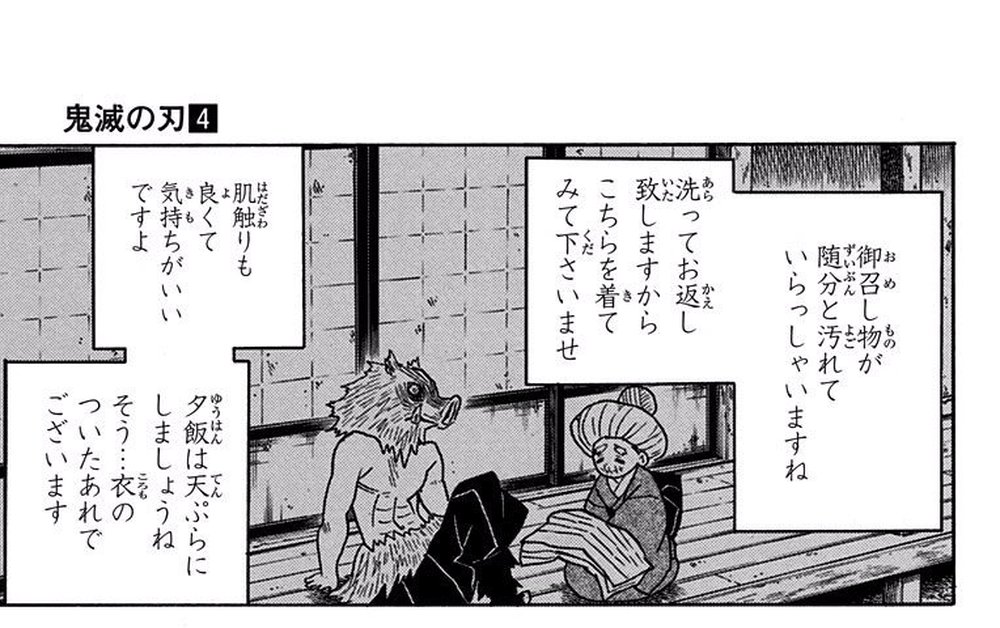
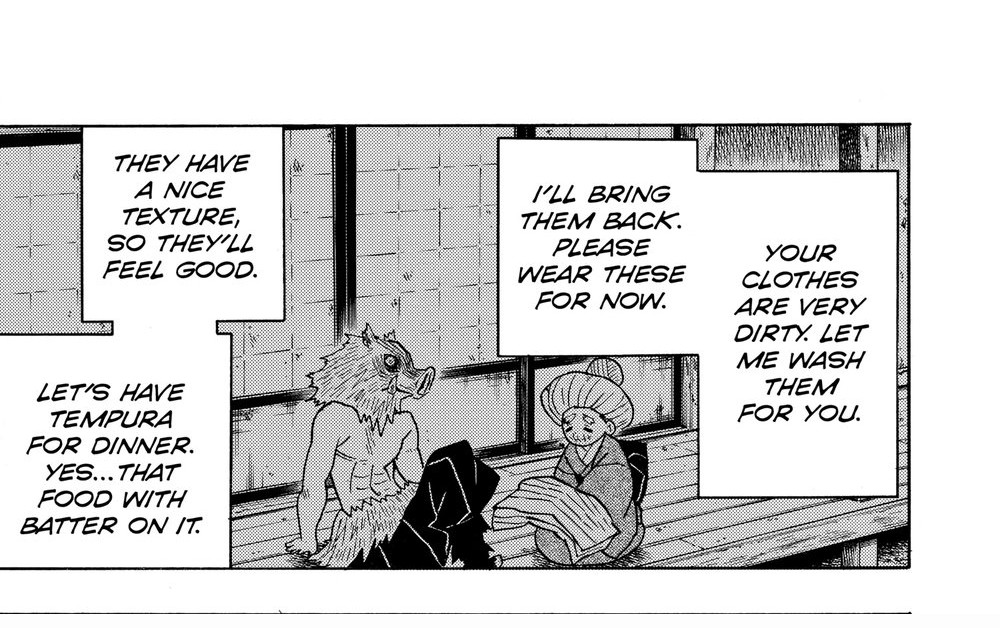
Volume 4. Inosuke Hashibira — feral, boar-masked, allergic to anything resembling comfort — has been taken in at the Butterfly Estate, Shinobu Kocho's infirmary for wounded Corps members. He sits on the veranda beside an elderly attendant, his clothes torn to rags from the Tsuzumi Mansion fight. She looks him over and says, gently:
「御召し物が随分と汚れていらっしゃいますね 洗ってお返し致しますからこちらを着てみて下さいませ」
Omeshimono ga zuibun to yogorete irasshaimasu ne. Aratte okaeshi itashimasu kara kochira o kite mite kudasaimase.
VIZ's English edition splits the line across two bubbles: "YOUR CLOTHES ARE VERY DIRTY. LET ME WASH THEM FOR YOU." and, in answer to Inosuke's silence, "I'LL BRING THEM BACK. PLEASE WEAR THESE FOR NOW." (Vol. 4, p.59).
Grant the rendering its due: it's warm, clear, and completely serviceable — a kind old woman offering a wild boy clean clothes, exactly as the panel shows. What the English can't hold onto is the layered politeness stacked into every clause of the Japanese: 御召し物 (an honorific noun for "your clothing"), 汚れていらっしゃいます (sonkeigo — raising Inosuke's own state of being dirty, absurdly formal for a shirtless boy who talks to a boar), and, doing the quiet work in the second sentence, お返し 致します — not just "I'll return them," but "I will, humbly, cause the returning to happen." The line curtseys twice before it's finished — once up toward Inosuke, once down toward herself — and English performs neither bow.
The Original
Start with what 致 means before it means anything about politeness. The kanji (on'yomi チ, kun'yomi いた-す) carries the core sense "to cause to arrive; to bring about." You already know it from 一致 (icchi, "agreement" — literally two things "arriving" at the same point), 招致 (shōchi, "to invite/bring about," the verb a city uses when it 招致-s an Olympic bid), and the grimmer 致命的 (chimeiteki, "fatal" — "causing [life] itself to arrive [at its end]"). None of that family has anything to do with politeness; it's all causation and consequence.
Somewhere along the way, one branch of that causative sense hardened into pure grammar: 致す as kenjougo, the humble-language slot that plain する empties into whenever the action belongs to the speaker and the moment calls for self-effacement. This is the piece worth holding onto, because Japanese politeness isn't one dial — it's a three-way switch:
- する — plain, no rank information at all;
- 致す (kenjougo) — lowers the SPEAKER, used for the speaker's OWN actions;
- なさる (sonkeigo) — raises someone ELSE, used for actions belonging to a social superior.
One verb, one event, three grammatical postures — and which one you reach for depends entirely on whose action it is and who's in the room. Get the direction backwards — praise yourself with なさる, or lower your boss with 致す — and you've either bragged or insulted someone, purely through verb choice, before the sentence says anything about content. Most N3 textbooks introduce する/致す/なさる as a matched set for exactly this reason: they're not three separate words to memorize, they're one idea wearing three grammatical postures.
One idiom worth flagging even though it never surfaces in this corpus: 致し方ない (itashikata nai), "it can't be helped," freezes the same causative root into a fixed phrase — "there is no way to make [it] happen otherwise" — so worn down by everyday use that most fluent speakers no longer feel the kenjougo underneath it at all. It's proof of how far a humble verb can travel from its own humility once it fossilizes into an idiom.
VIZ's Choice
Every clean, image-verified appearance of 致す in the volumes we have on file, alongside the official English:
| Vol. / p. | Japanese | VIZ English |
|---|---|---|
| 4 / 59 | 洗ってお返し致しますからこちらを着て | I'LL BRING THEM BACK. PLEASE WEAR THESE FOR NOW. |
| 6 / 64 | 〝鱗滝左近次冨岡義勇が腹を切ってお詫び致します! | "...I, SAKONJI UROKODAKI, AND GIYU TOMIOKA WILL MAKE AMENDS BY SLICING OPEN OUR STOMACHS." |
| 7 / 39 | 拝見...致します... | ALLOW ME TO INSPECT ... |
| 9 / 19 | ご入用の物をお持ち致しました | WE BROUGHT THE THINGS YOU'LL NEED. |
| 12 / 24 | 承知致しました..... | AS YOU WISH! |
| 15 / 78 | 大変お待たせ致しました | THANK YOU FOR WAITING SO LONG. |
Six speakers, six completely different social positions, one identical grammatical bow. Row 1 is the unnamed elderly attendant tending Inosuke. Row 2 is a written vow — read aloud before Kagaya Ubuyashiki — jointly authored by Sakonji Urokodaki, Tanjiro's retired trainer, and Giyu Tomioka, the Water Hashira, promising to disembowel themselves if Nezuko ever attacks a human. Row 3 is the ticket collector aboard the Mugen Train, punching tickets in the row where Tanjiro sits — the very panel where he first murmurs that something smells wrong. Row 4 is Kotetsu's family in the Swordsmith Village, delivering supplies to a recovering Tanjiro and Inosuke. Row 5 is Gyokko, an Upper Rank demon, answering an order from Muzan Kibutsuji with a bow. Row 6 is an unnamed young attendant at Kagaya Ubuyashiki's estate, greeting Giyu Tomioka as he arrives for an emergency Hashira meeting, moments after Shinobu Kocho and Gyomei Himejima have finished discussing the cost of the last mission.
Notice what unites all six rows, and it isn't tone — the scenes range from tender to ceremonial to sinister to businesslike. It's that VIZ's English never marks ANY of them as more deferential than ordinary competent dialogue: "bring," "will make amends," "allow me to inspect," "brought," "as you wish," "thank you for waiting" are all perfectly natural English, and all completely silent about the fact that Japanese grammar just made every one of these speakers kneel before finishing their sentence — servant and Hashira and demon alike.
The Gap
Zero-rank vocabulary, again. "Do" is used identically for a stranger and an emperor; English has no fork where Japanese has three lanes (する/致す/なさる). Every VIZ rendering above is accurate CONTENT and silently erases the fact that the speaker just lowered themselves grammatically before saying anything else.
The bow doesn't care about the speaker's morality — and English can't let the reader hear the rhyme. Gyokko's 承知致しました to Muzan is grammatically identical to Kotetsu's family telling Tanjiro お持ち致しました. A demon serving a monster and a swordsmith's family serving the Corps are, syntactically, performing the exact same courtesy. "AS YOU WISH!" and "WE BROUGHT THE THINGS YOU'LL NEED" read as generic manners in English; the Japanese is quietly showing that Muzan's court runs on the identical submission grammar as the Corps it hunts.
Written, ceremonial 致す disappears into ordinary prose. Urokodaki and Giyu's vow isn't casual politeness — it's a formal document, read aloud as testimony before Kagaya, and 腹を切ってお詫び致します carries the grammar of a blood oath. VIZ's flat, accurate "WILL MAKE AMENDS BY SLICING OPEN OUR STOMACHS" is faithful in content and loses the ceremony that the humble verb was signaling: this isn't an apology, it's sworn testimony.
A stock service phrase turns eerie exactly where the plot needs it to. 拝見...致します... from the Mugen Train conductor is textbook customer-service kenjougo — the kind of line a real conductor says on autopilot a hundred times a shift. Delivered with the mechanical, syllable-by-syllable pacing the page gives it (each 「...」 a beat of dead air), the sheer correctness of the humble grammar starts to feel less like courtesy and more like a recitation. "ALLOW ME TO INSPECT ..." keeps the eerie pacing but loses the specific texture of over-correct Japanese politeness curdling into something uncanny.
What If
For the headline line, the menu and its prices:
- "I'll see to it that they're washed and returned to you. Please wear these instead." — the passive-leaning "see to it" gestures at formal service. Cost: noticeably longer, and still nothing marks it as MORE deferential than ordinary English courtesy.
- "Allow me to have these washed and returned." — "allow me" is English's own small fossil of self-lowering language, the closest living cousin to kenjougo grammar. Cost: reads like vintage hotel-service English — the right flavor, possibly the wrong decade for a modern shonen panel.
- "These will be washed and humbly returned to you — please wear these for now." — spells the deference out directly. Cost: "humbly" as a stated adverb is exactly the over-explaining that kenjougo itself avoids; the Japanese never SAYS "humble," it just performs it grammatically.
- Keep VIZ's "I'LL BRING THEM BACK" and let the art carry the rest. The attendant's kneeling posture and headscarf already read as domestic-service deference before she says a word. Cost: nothing in the WORDS marks the bow; the reader depends entirely on noticing the panel.
The pattern across all four: English can gesture at self-lowering language ("allow me," "humbly"), but every gesture either sounds imported from an earlier century or over-explains what Japanese grammar does silently. English never built a live, ordinary-register way to say "I am now performing deference" without announcing it.
Take-away
致す isn't hard to gloss — "do" gets the plot across every time, the same way "go" or "come" does for 参る. What it loses is the fact that Japanese tracks, automatically and constantly, whose action is whose and who outranks whom — and English's one flat verb for "do" was never built to carry that information at all.
Three rules of thumb to carry off this page:
- Whenever you meet 致す, ask whose action it is, not what the action is. Kenjougo only ever lowers the SPEAKER'S own doing — if you see it attached to someone else's verb, you're looking at なさる or a different word entirely.
- Remember the three-way switch: する (plain) → 致す (lower yourself) → なさる (raise someone else). One event, three postures — and Japanese switches between them mid-conversation depending only on who's acting.
- Watch for 致す in unexpected mouths. The same bow that a servant offers a guest is the bow a demon offers Muzan — keigo tracks power, not virtue, and this manga uses that fact on purpose.
致す sits in the same keigo family this hub has already mapped from other angles — the humble "go/come," 参る; the self-effacing "I," 小生; the vanishing "you," 貴方; and honorific rank turned into an insult, 御身分. Together they sketch a grammar of rank running under nearly every relationship in this manga, hero and demon alike — for more of it, browse the Demon Slayer translation notes index.
Every Japanese and English line quoted above is a byte-exact capture from the cited editions — Demon Slayer: Kimetsu no Yaiba Vol. 4, 6, 7, 9, 12 & 15 (Japanese) and Demon Slayer: Kimetsu no Yaiba (VIZ Media) at the corresponding panels — via our bilingual page database; see Sources below.