The Moment
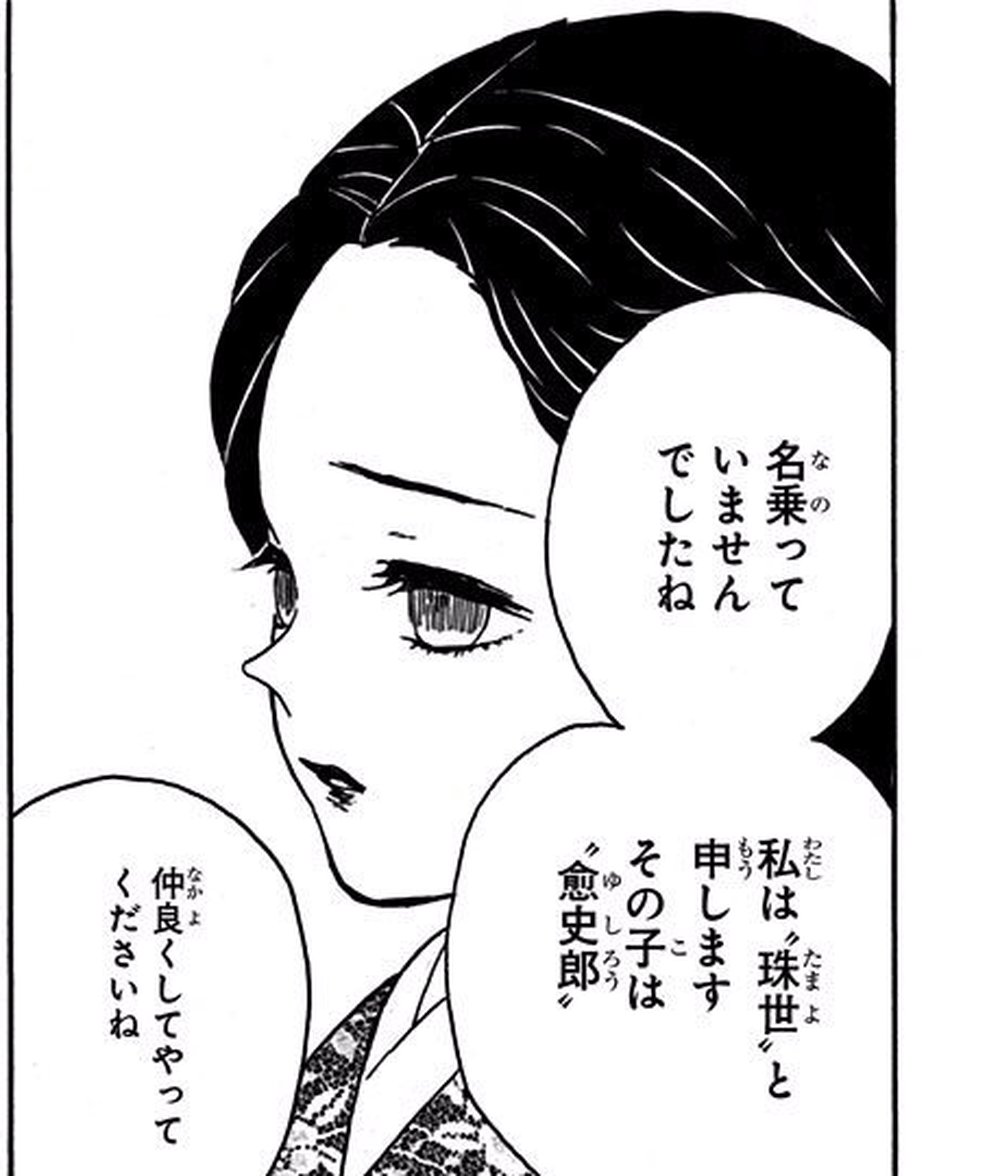
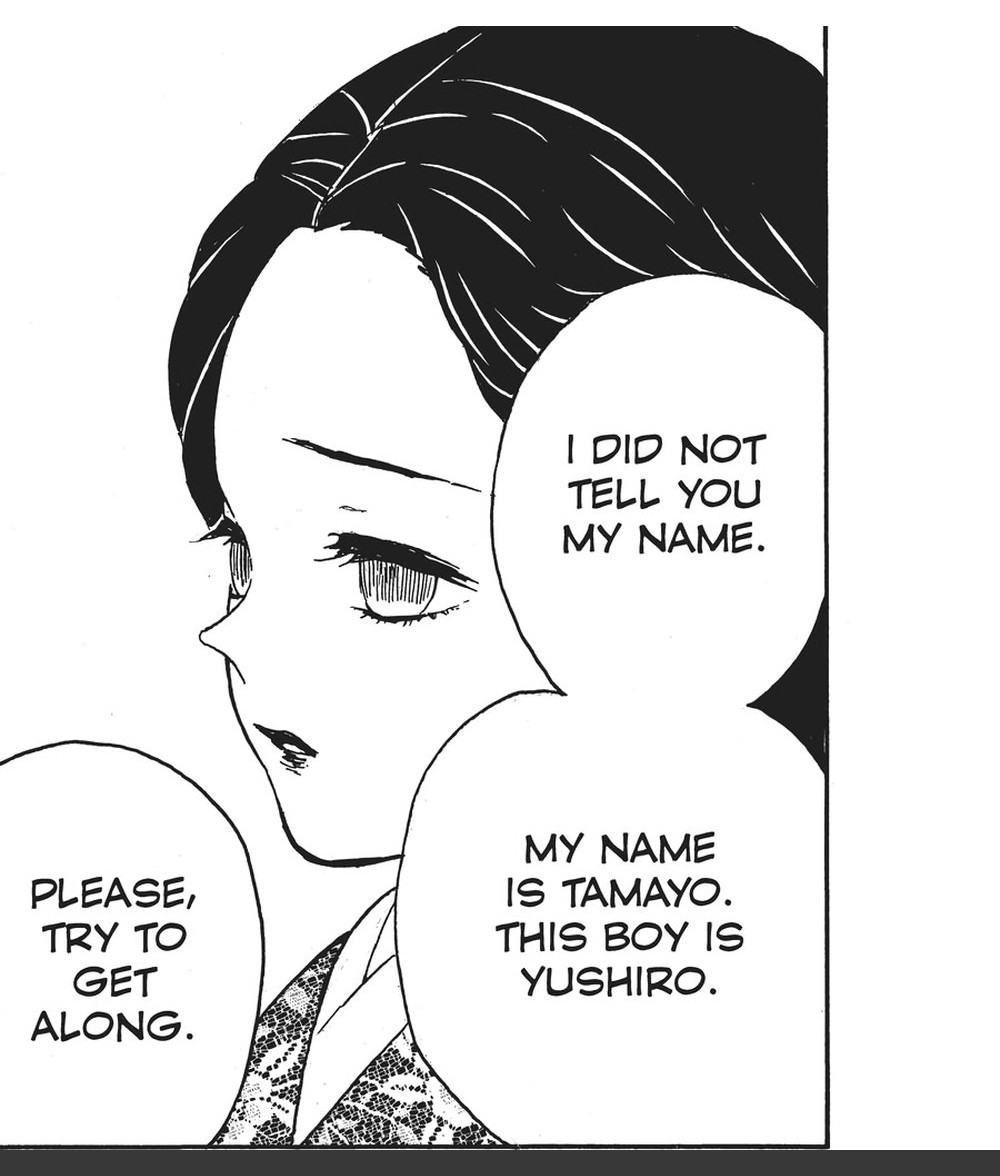
Volume 2. Tanjiro has just followed a demon doctor and her strange, silent attendant into hiding — Tamayo, centuries old, and the boy Yushiro, both watching him with the wary calm of people who have done this introduction before. Tamayo has already told Tanjiro she can help Nezuko; what she hasn't done yet is give her name. She fixes that now, in a quiet, close-up panel:
「名乗っていませんでしたね私は“珠世”と申しますその子は〝愈史郎〟仲良くしてやってくださいね」
Nanotte imasen deshita ne. Watashi wa "Tamayo" to mōshimasu, sono ko wa "Yushirō". Nakayoku shite yatte kudasai ne.
VIZ's English edition prints: "I DID NOT TELL YOU MY NAME. MY NAME IS TAMAYO. THIS BOY IS YUSHIRO. PLEASE, TRY TO GET ALONG." (Vol. 2, p.153).
Grant the rendering its due first: it is clean, warm, perfectly natural English, and it gets the plot fact exactly right — here are two names, remember them. Nothing is misreported. But look at the verb Tamayo actually reaches for. She doesn't say 私の名前は珠世です, the neutral "my name is Tamayo" a stranger might use with an equal. She says 申します — the humble, self-lowering verb for "to say." Before Tanjiro learns anything about her at all, Tamayo has already performed a small bow in his direction. VIZ's "MY NAME IS TAMAYO" reports the outcome of that bow and skips the bow itself.
The Original
申す (mōsu) is written with a single kanji whose oldest sense is "to extend, to state, to declare" — the same 申 hiding inside 神 (kami, "god": an altar plus the lightning-like radical that became 申), and separately preserved as the zodiac sign 申 (saru, "monkey"). As a verb, 申す has done the work of 言う ("to say") since classical Japanese. What modern grammar did was specialize it: 申す became kenjougo, humble language, so 〜と申します doesn't just report speech — it lowers the speaker relative to whoever is listening, the instant the verb appears.
Its formal escalation is 申し上げる: 申す + 上げる ("to raise, to lift"), literally "to lift my saying up [to you]." Where 申します already bows, 申し上げます bows lower still — the register for addressing a genuine superior, or for solemn written-style courtesy: thank-you speeches, funeral remarks, formal prayers for someone's health. It is the humble-language equivalent of switching from a nod to a full seated bow.
One cousin worth naming and then setting firmly aside: 申し訳 (mōshiwake), literally "an explanation for what is said" (訳, wake, "reason; meaning"). Centuries of use wore it down into the everyday noun for "excuse" — 申し訳ございません, "I'm terribly sorry" — and most Japanese speakers no longer feel a verb of saying inside it at all. It shares 申's root; it does not share 申す's job. This article tracks 申す and 申し上げる as living verbs of self-lowered speech, not the frozen apology noun built on their bones.
There is also a second, older life for the bare verb, and the corpus catches it red-handed. In a courtroom vignette in Volume 15, a magistrate confronts a blind, terrified thief and snaps 「手が悪いと申すか!!」 — "AND YOU SAY YOUR HANDS ARE TO BLAME?!" He isn't lowering himself to anyone; he outranks the man in front of him completely. He's using 申す because, in the clipped, period-drama Japanese the scene imitates, 申す was for centuries simply the plain literary verb for "say" — before the modern courtesy system narrowed it down to one specific direction. A learner who has only met the modern rule will misread that line as somebody being humble. Nobody in that scene is bowing to anybody; the verb is just old.
As vocabulary, textbooks introduce 申す alongside 参る and 致す as the basic kenjougo verb set, usually around N3; 申し上げる's written, high-formality register is closer to confident N2 use.
VIZ's Choice
Here is every clean occurrence of 申す / 申し上げる / 申し付ける in the volumes we have on file, with the speaker identified:
| Vol. / p. | Speaker | Japanese | VIZ English |
|---|---|---|---|
| 2 / 153 | Tamayo | 私は"珠世"と申しますその子は〝愈史郎〟 | MY NAME IS TAMAYO. THIS BOY IS YUSHIRO. |
| 6 / 59 | Sanemi Shinazugawa, to Oyakata-sama | 益々の御多幸を切にお祈り申し上げます | MASTER, I SINCERELY PRAY FOR YOUR INCREASED HAPPINESS. |
| 6 / 103 | an unnamed kakushi | 胡蝶様の申し付けにより参りました | WE COME ON ORDERS FROM LADY KOCHO. |
| 6 / 163 | Kanamori, the swordsmith | あ私は鉄穴森と申します | OH... ...I'M KANAMORI. |
| 13 / 88 | Gyokko, Upper Rank Five | 初めまして私は玉壺と申す者 | NICE TO MEET YOU. THEY CALL ME GYOKKO. |
| 15 / 42 | a magistrate (courtroom vignette) | 手が悪いと申すか!! | AND YOU SAY YOUR HANDS ARE TO BLAME?! |
| 15 / 79 | Amane Ubuyashiki | 今後皆様の前へ出ることが不可能となった旨心よりお詫び申し上げます | ...HE IS NO LONGER ABLE TO APPEAR BEFORE YOU. HE EXTENDS HIS HEARTFELT APOLOGY. |
| 15 / 80 | Gyomei Himejima | 承知...お館様が一日でも長くその命の灯火燃やしてくださることを祈り申し上げる... | UNDERSTOOD. I PRAY FROM THE BOTTOM OF MY HEART THAT THE LIGHT OF THE MASTER'S LIFE CONTINUES TO BURN EVEN ONE DAY LONGER... |
| 15 / 81 | Amane Ubuyashiki | 柱の皆様には心より感謝申し上げます | I AM DEEPLY GRATEFUL TO ALL THE HASHIRA. |
| 23 / 162 | the Ubuyashiki family, together | 心より感謝申し上げます | ...EXTEND OUR HEARTFELT GRATITUDE. |
Ten scenes sort cleanly into two clusters. The first is self-introduction: Tamayo, Kanamori, and Gyokko all reach for 〜と申します / 申す者 to state their own names, and VIZ answers with three unrelated English idioms — "MY NAME IS," "I'M," "THEY CALL ME" — that share no vocabulary at all. A Japanese reader hears the identical grammatical bow three times; an English reader can't tell these three scenes rhyme.
The second cluster is formal thanks and prayer, almost entirely orbiting the Ubuyashiki estate. Here VIZ's choices split between preserving some formality ("I SINCERELY PRAY," "I PRAY FROM THE BOTTOM OF MY HEART" — note the added intensifier, compensating for the lost register with volume instead of grammar) and dropping it outright ("I AM DEEPLY GRATEFUL TO ALL THE HASHIRA" carries no formal marker whatsoever). Notice, too, that the identical phrase — 心より感謝申し上げます, "from the heart, I humbly offer gratitude" — appears twice, eight volumes apart, spoken first by Amane alone and then by the whole Ubuyashiki family together at the story's close, and VIZ finds two different English sentences for it both times ("I AM DEEPLY GRATEFUL" vs. "EXTEND OUR HEARTFELT GRATITUDE"). One Japanese formula, repeated on purpose by the author as an echo; two English sentences that don't echo each other at all.
And the kakushi's 胡蝶様の申し付けにより参りました earns its own footnote: 申し付け here isn't the speaker lowering their own speech, it's the noun for someone else's order handed down — this hub's companion piece on 参る covers the rest of that exact line; the two humble-register cousins share a single panel.
The Gap
English has no grammatical slot for a lowered self. "My name is Tamayo" states a fact; 私は珠世と申します performs an act of deference on top of the fact, and English marks that act nowhere — not in the verb, not in the pronoun, nowhere a reader could point to and say "there, that's the bow."
Self-lowering and other-raising collapse into the same English word. 申す (lowers the speaker) and 仰る (raises the listener or a third party) are opposite grammatical operations built for the identical courtesy, and both translate as "say." The axis Japanese never stops tracking — who, exactly, is being lowered or raised, and relative to whom — simply isn't there to track once the sentence is in English.
The speaker can vanish from her own sentence. Amane's 「今後皆様の前へ出ることが不可能となった旨心よりお詫び申し上げます」 is Amane, in her own voice, humbly apologizing on her bedridden husband's behalf. VIZ's "HE IS NO LONGER ABLE TO APPEAR BEFORE YOU. HE EXTENDS HIS HEARTFELT APOLOGY." quietly moves the grammatical subject from Amane to Kagaya. It reads perfectly naturally — and it erases the fact that this is Amane's voice, Amane's lowered head, standing in for a man too ill to speak for himself.
The self-introduction cluster loses its rhyme. Tamayo, Kanamori, and Gyokko are drawn from three completely different corners of this story — a benevolent demon in hiding, a nervous background swordsmith, an Upper Rank killer — and in Japanese all three announce themselves with the exact same humble grammar. "MY NAME IS," "I'M," and "THEY CALL ME" are three good English sentences that happen to share nothing, so the pattern connecting a healer, a craftsman, and a monster disappears along with the verb that built it.
What If
For Tamayo's headline line specifically, the menu and its prices:
- "You may call me Tamayo. This is Yushiro." — "you may call me" recovers a shade of the self-effacing distance 申します carries, offering the name rather than simply stating it. Cost: reads a little stiff for a demon doctor talking to a frightened teenager — more butler than physician.
- "I go by Tamayo — humbly. This boy is Yushiro." — bolts the missing register directly onto the sentence. Cost: "humbly" as a stapled-on adverb is exactly the translator's crutch native English never produces on its own; it explains the bow instead of performing it.
- "Allow me to give you my name: Tamayo. This child is Yushiro." — borrows English's own low-frequency deference formula for a comparable effect. Cost: overlong for a manga bubble, and "allow me" reads a shade more archaic in English than 申します feels to a modern Japanese reader.
- Keep VIZ's plain "MY NAME IS TAMAYO," and let the panel do the rest — Tamayo's lowered eyes and folded hands are already performing, visually, the bow the verb performs grammatically. Cost: this only works because the art is doing grammar's job; a reader with only the words gets no register signal at all.
Take-away
申す and 申し上げる aren't hard to gloss — "say," in any of ten scenes, gets the plot across every time. What the gloss drops is the one piece of information Japanese never lets a self-introduction, a prayer, or an apology go without: who, exactly, just lowered themselves, and by how much.
Three rules of thumb to carry off this page:
- When you meet 〜と申します at a self-introduction, don't just note the name — note that the speaker chose to bow before giving it. That choice is often the character detail: a demon who doesn't need to defer to anyone, deferring anyway.
- Keep 申す's two lives straight: modern kenjougo (self-lowering, direction-specific) and the older, unspecialized literary "say" that period-drama dialogue still borrows, direction-blind. Same kanji, different centuries.
- Track the compass, not the vocabulary: 申す/申し上げる lower the speaker, 仰る raises the listener — the same courtesy system, pointed in opposite directions. Confuse the direction and you'll misread who is bowing to whom.
申す sits in the same keigo family this hub has already mapped from other angles — the humble "go/come" of 参る, the humble "do" of 致す, and the vanishing "you" of 貴方 — and the same estate scene it shares a panel with also anchors this hub's piece on 目の色を変える. Two more cousins wait in the wings for a future entry: 差し上げる, the humble "to give," and 伺う, the humble "to visit / ask / hear." Together they sketch a grammar of rank running under nearly every formal relationship in this manga — for more of it, browse the Demon Slayer translation notes index.
Every Japanese and English line quoted above is a byte-exact capture from the cited editions — Demon Slayer: Kimetsu no Yaiba Vol. 2, 6, 13, 15 & 23 (Japanese) and Demon Slayer: Kimetsu no Yaiba (VIZ Media) at the corresponding panels — via our bilingual page database; see Sources below.