The Moment
Syrup Village, three years in the making. Kuro — a legendary pirate captain with a fearsome reputation — faked his own death and took a job as Klahadore, the impeccably polite butler to a wealthy, orphaned girl named Kaya. The plan was patient and cold: earn her trust, then kill her and inherit everything, with nobody left alive who remembers the pirate underneath the glasses. When the village boy Usopp and the newly landed Straw Hats wreck the plan, Klahadore drops the act. Kuro straightens up, and the crew that has spent three years waiting for their captain to come back finally sees him again.
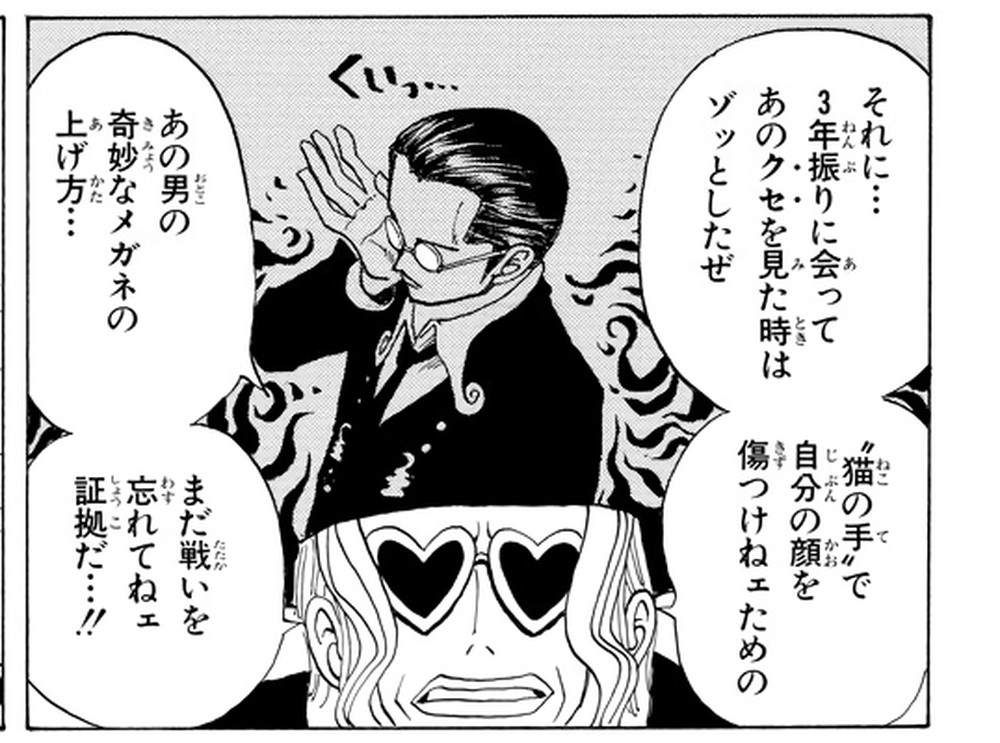
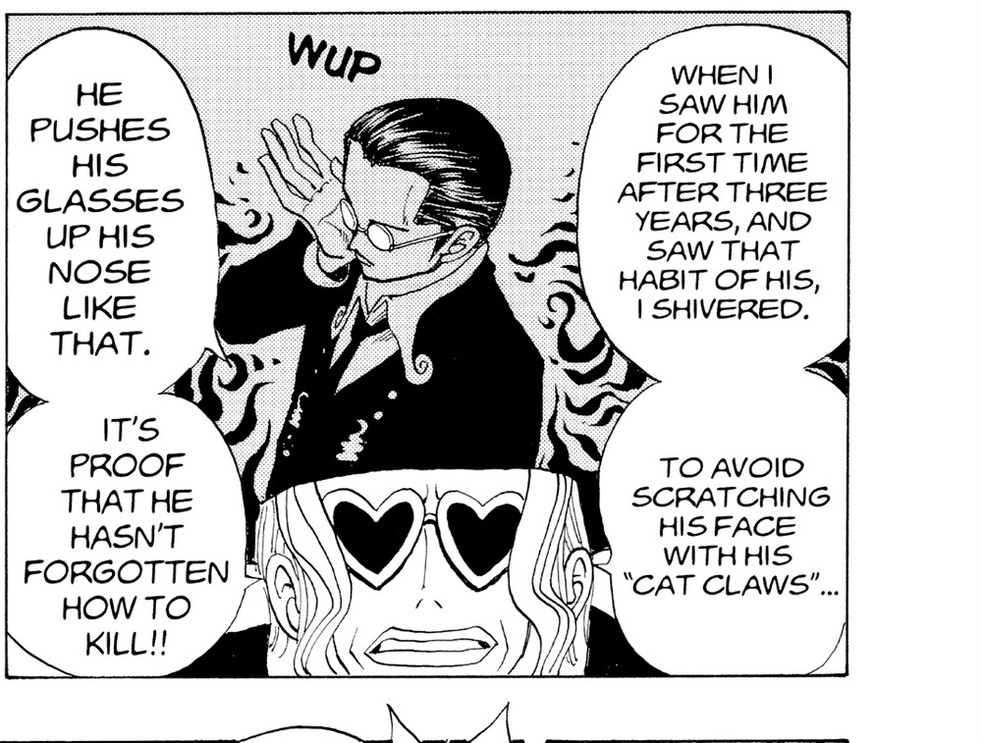
One of them narrates, watching Kuro absent-mindedly push his glasses up his nose:
「それに…3年振りに会ってあのクセを見た時はゾッとしたぜ あの男の奇妙なメガネの上げ方…〝猫の手〟で自分の顔を傷つけねェための…まだ戦いを忘れてねェ証拠だ…!!」
Sore ni… san-nen-buri ni atte ano kuse o mita toki wa zotto shita ze. Ano otoko no kimyō na megane no age-kata… "Neko no te" de jibun no kao o kizutsukenē tame no… mada tatakai o wasurenē shōko da…!!
VIZ's English edition prints: "WHEN I SAW HIM FOR THE FIRST TIME AFTER THREE YEARS, AND SAW THAT HABIT OF HIS, I SHIVERED. HE PUSHES HIS GLASSES UP HIS NOSE LIKE THAT… TO AVOID SCRATCHING HIS FACE WITH HIS 'CAT CLAWS'… IT'S PROOF THAT HE HASN'T FORGOTTEN HOW TO KILL!!" (Vol. 4, p.139).
Grant the rendering its due: it's clean, it's chilling, and "CAT CLAWS" reads exactly like what it is — the brand name of a weapon, printed the way an English-language antagonist's signature gear gets printed. The detail the narrator is pointing at is a genuinely sharp piece of characterization: even the most idle, habitual gesture a person makes — pushing up your glasses — has to be performed carefully by a man wearing five retractable blades on each hand. Three years of playing gentle butler never once made him forget that. VIZ gets every beat of it.
What it can't get is the two words sitting inside the quotation marks. In Japanese, 〝猫の手〟 isn't only a menacing weapon name. It's a phrase every reader in the audience already owns — from complaining about a busy shift, from a boss on the phone, from a hundred sitcoms — and the moment they read it, some part of them hears a much gentler sentence finishing itself in the background.
The Original
猫の手 (neko no te) breaks into exactly two pieces: 猫 (neko), "cat," plus の (no), the possessive particle, plus 手 (te), "hand" — or, for an animal, "paw." Both nouns are among the first hundred words anyone learns in Japanese (JLPT N5), and the grammar underneath is nothing at all: [NOUN]の[NOUN], the same pattern as 猫の目 ("cat's eyes") or 私の手 ("my hand"). On the page it's fenced inside quotation brackets, 〝…〟 — the manga's way of flagging a proper name, a nickname, a title. Read literally, it's simply what Kuro's crew calls his weapon: two clawed gauntlets, five retractable blades to a hand, sharp enough that their own owner has to mind where he puts his fingers.
But say 猫の手 out loud to a Japanese speaker with no other context, and it doesn't land as a description of an object. It lands as the front half of a sentence everyone already knows the back half of: 猫の手も借りたい (neko no te mo karitai) — literally "I'd even want to borrow a cat's paw," idiomatically "I'm so busy I'd take help from anywhere, even somewhere useless." The idiom's entire joke is the uselessness: a cat cannot hold a broom, cannot carry a tray, cannot do a lick of human work with that paw — so wanting to "borrow" it anyway is a small, self-deprecating admission of how desperate you've gotten. It is one of the most common busy-season complaints in the language — shopkeepers say it in December, restaurant staff say it during a lunch rush — and it needs no explanation to anyone who grew up hearing it.
Oda takes that soft, domestic, faintly comic idiom and welds it onto a killer's hand. The name isn't a coincidence dressed up as a pun — it's the entire joke of the character concentrated into two syllables: the harmless, proverbially useless cat's paw that people jokingly wish they could borrow, worn as a set of surgical blades by a man who spent three years playing gentle and harmless on purpose. Even the idiom's central irony — this paw looks helpful but can't actually do anything — inverts perfectly onto Kuro: for three years, as Klahadore, he looked helpful and harmless and could, in fact, do everything.
VIZ's Choice
The corpus carries three appearances of 猫の手, tight together across two volumes of the same arc:
| Vol. / p. | Japanese | VIZ English |
|---|---|---|
| 4 / 139 | 〝猫の手〟で自分の顔を傷つけねェための… | TO AVOID SCRATCHING HIS FACE WITH HIS "CAT CLAWS"... |
| 5 / 47 | うわっ!!"猫の手〟を折りやがった!!? | YARR!! HE BROKE THE CAPTAIN'S CLAWS!!! |
| 5 / 50 | C・クロの“猫の手”を…!! | CAP'N KURO'S CAT CLAWS! |
All three lines are crowd reaction — members of Kuro's own crew, watching the fight from a distance, narrating and reacting to their captain's weapon. None of the three is spoken by Kuro, Usopp, or Jango directly; the closest a named principal comes is Luffy's taunt on the same page as the third occurrence, 「あと5本だなその変な剣」 — "NOW YOU ONLY HAVE FIVE SWORD-CLAWS!" — counting down the blades as he breaks them one by one.
Two of the three keep "cat": Vol. 4's careful "CAT CLAWS" and Vol. 5 p.50's punchier "CAP'N KURO'S CAT CLAWS!" Both are reasonable, workable English weapon names. But look at the middle one. On p.47, the same two words — printed in the Japanese with the same quotation-mark treatment, 猫の手, unmistakably the weapon's fixed name — come out as "the captain's claws." Not cat claws. Not even an attempt at the pun. The cat is simply gone. That's not a translation choice driven by context (nothing about the panel calls for suppressing "cat"); it reads as the translator handling 猫の手 as a describable object rather than a fixed, quoted proper noun — losing consistency exactly where the Japanese punctuation was holding it in place. Where VIZ's handling of 因縁 scattered because English genuinely has no single seat for that concept, this scatter is smaller and stranger: the same three-syllable brand name, quoted the same way twice out of three appearances, gets rendered three different ways — and none of the three ever touch the proverb underneath.
The Gap
The proverb is completely silent. 猫の手 alone — no も借りたい required — is enough to summon 猫の手も借りたい for a Japanese reader, the same reflex that lets "kick the—" summon "bucket" for an English one without finishing the sentence. VIZ's "CAT CLAWS" is accurate to the object and inaudible as an allusion; nothing in the English phrase points anywhere.
The irony inverts into nothing. The whole point of naming a killer's weapon after the proverbially harmless, useless cat's paw is that the reader is supposed to feel the joke land wrong — a phrase about begging for token help, worn as murder weapons by a man who spent three years faking exactly that kind of harmless helpfulness. In English, "Cat Claws" just sounds cool. The gap between what the name promises (uselessness) and what it delivers (five retractable blades) — the entire reason Oda chose this idiom and not some other cat-word — doesn't exist for an English reader, because the promise was never made.
English's own "cat's paw" idiom is a false friend, not a bridge. English does have a "cat's paw" — from the old fable of a monkey tricking a cat into pulling roasted chestnuts out of a fire — but it means "a person used by someone else to do a dangerous, dirty job," which describes almost the opposite relationship (Kuro is nobody's tool; he is the danger). A reader who half-remembers that idiom gets steered toward the wrong meaning instead of the right one — the closest English phrase actively misleads where the Japanese phrase reliably informs.
The crew's visual cat-motif loses its verbal anchor. Kuro's men wear cat-eared hoods on the page; the crew is known as the Black Cat Pirates; Kuro's own name means "black," the classic color of the whole theme. In Japanese, 猫の手 is the one place where the visual cat joke and a verbal cat idiom touch — the weapon's name is doing double duty as both. In English the art still shows the cat-eared hoods, but the language beside it has stopped talking to the pictures.
What If
- "TO AVOID SCRATCHING HIS FACE WITH THOSE 'BORROWED CAT'S PAWS' OF HIS…" — smuggles the idiom's own verb (借りる, "to borrow") into the weapon's name, giving an attentive reader a thread to pull on. Cost: "borrowed" reads as a stray adjective with no idiom underneath it in English; the pun still needs a footnote to actually land.
- "…WITH THOSE CLAWS OF HIS — THE ONES EVEN A CAT COULDN'T USE FOR REAL WORK…" — spells out the idiom's internal logic (a cat's paw helps nobody) instead of just naming the weapon. Cost: turns a two-word proper noun into a small essay; unshoutable in a fight scene, and it explains a joke Japanese never explains.
- "…WITH HIS SO-BUSY-I'D-BORROW-A-CAT'S-PAW CLAWS…" — imports the whole proverb as a compound modifier, all in one gulp. Cost: unreadable in a speech bubble on first pass, and no English reader parses a six-word hyphenated idiom as a cool weapon name.
- Keep VIZ's "CAT CLAWS" — it's shoutable, accurate to the surface, and there's no clean English idiom under "cat's paw" to build on anyway (the real one points the wrong direction) — but spell it the same way every time it appears, and footnote 猫の手も借りたい at its first appearance. Cost: the proverb survives only in the margins, never inside the panel — but at least it survives somewhere, and the name stops drifting between "cat claws" and "the captain's claws" from page to page.
Take-away
Three rules of thumb to carry off this page:
- A phrase inside quotation marks that also happens to be a complete idiom fragment is rarely a coincidence. When a nickname or weapon name matches the front half of a set phrase word-for-word, assume the second half is meant to keep echoing in the reader's ear even though it's never printed.
- Learn idiom fragments as whole units, not just their dictionary halves. 猫 and 手 individually are both N5 words learned in your first month, but 猫の手 as a pair carries an entire idiom (猫の手も借りたい) that neither word carries alone — vocabulary lists rarely test this, but native ears never fail to hear it.
- Watch for Japanese's unusually large family of everyday cat idioms — 猫の手も借りたい (swamped), 猫をかぶる (to feign innocence, literally "to wear a cat" — worth remembering for a captain who wore a butler's face for three years), 猫舌 (can't handle hot food) — and be suspicious of any "false friend" English cat idiom (like "cat's paw," meaning someone else's tool) that looks similar but points a different way.
This joins two other Syrup Village–adjacent puns already on the site: Usopp's own self-mocking nickname in 誇り/ホコリ and the pride/dust homophone, and, a few volumes later in Skypiea, Zoro's bilingual cannon-pun in 108 Desires, 108 Pounds. For a very different kind of near-miss — Buggy's declaration that sounds like tea but means "farce" — see 茶番 and the false friend VIZ turned into a great line. Or browse the full One Piece translation notes index.
Every Japanese and English line quoted above is a byte-exact capture from the cited editions — ONE PIECE Vol. 4–5 (Japanese) and One Piece (VIZ Media) at the corresponding panels — via our bilingual page database; see Sources below.