The Moment
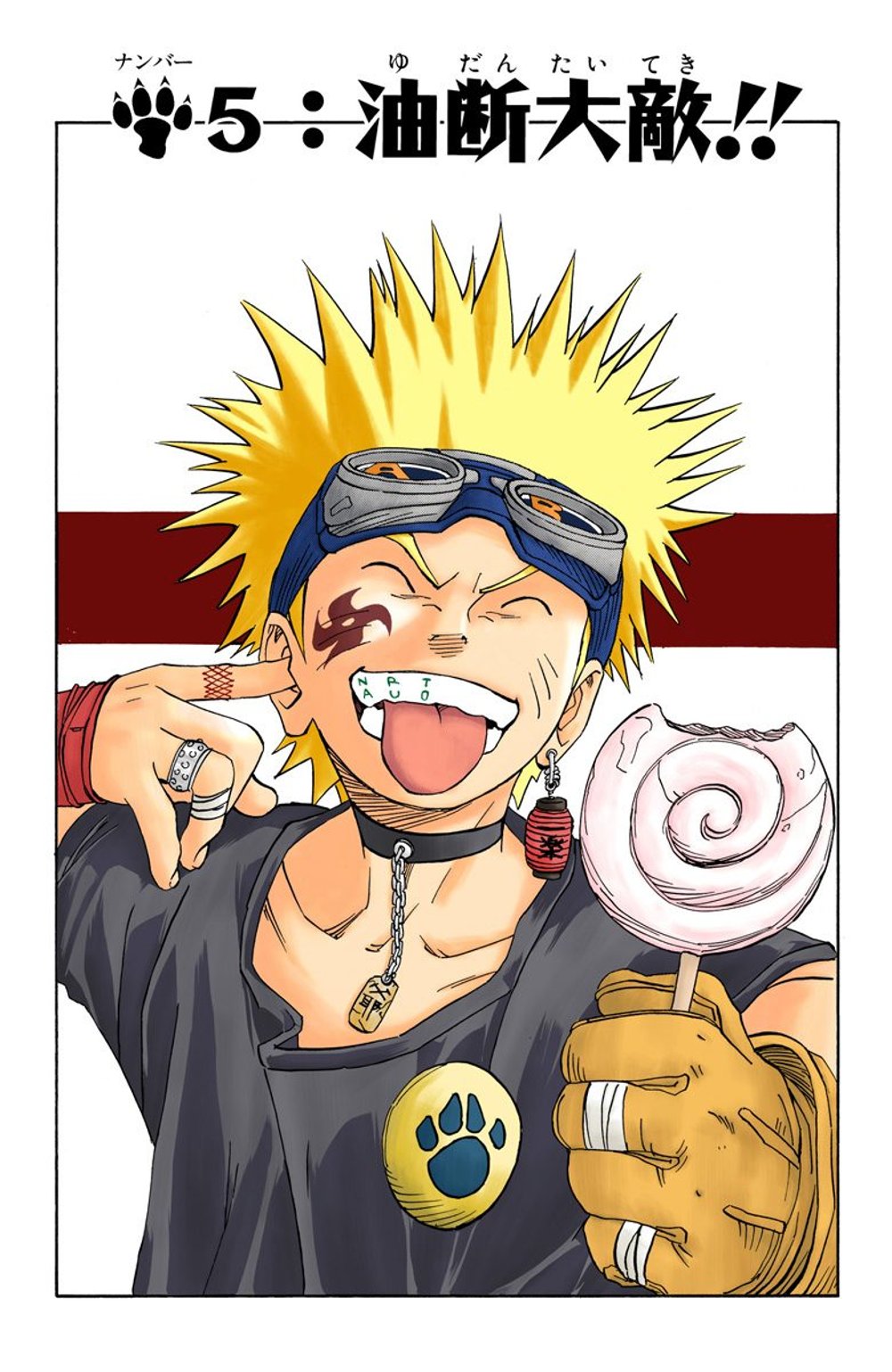
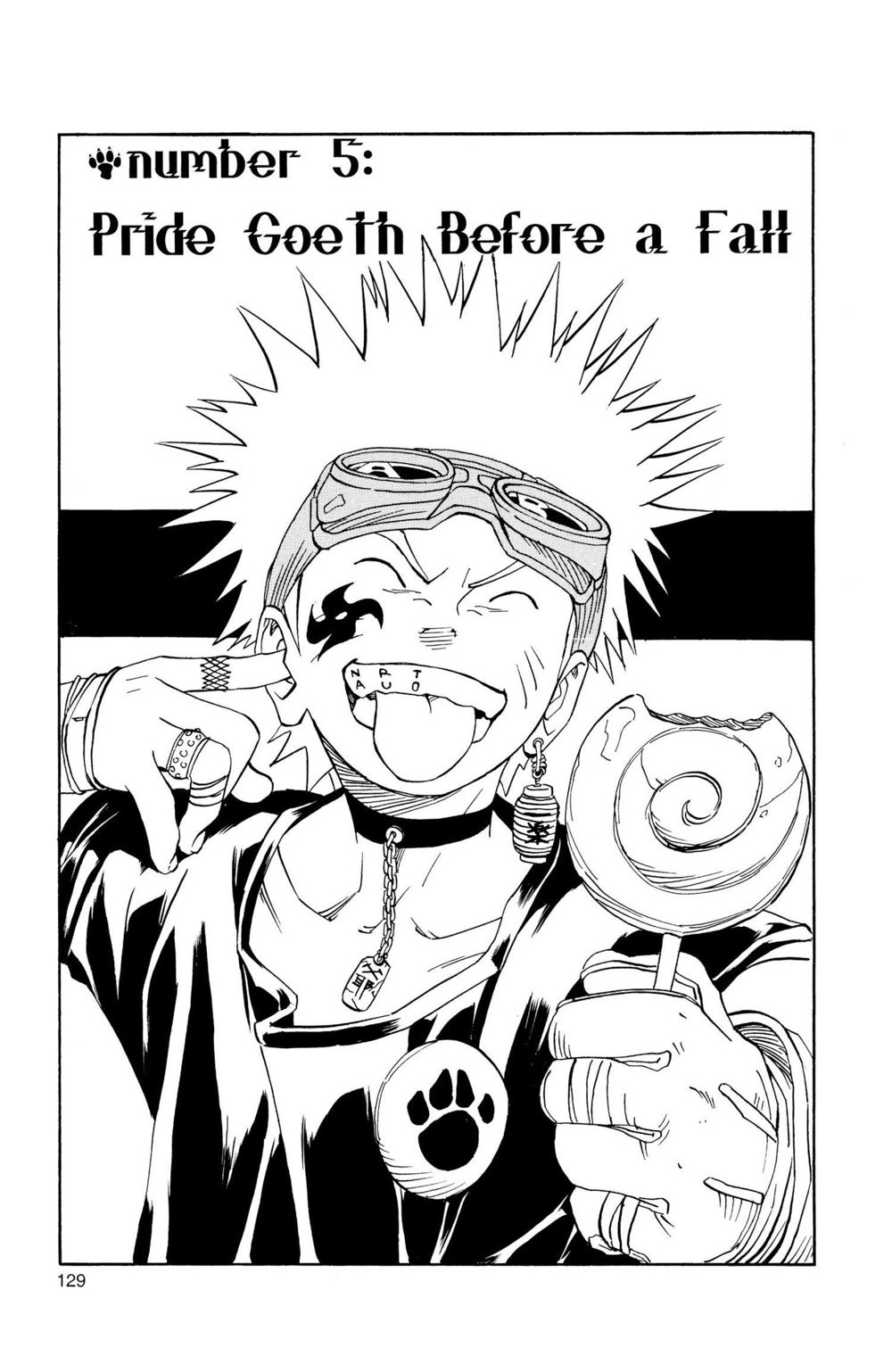
Volume 1, page 129. Team 7 has just been formed — Naruto, Sasuke, Sakura, and their new jonin sensei, Kakashi — and the real test is about to begin: the bell test, the survival exercise that decides whether any of them becomes a genin at all. Before a single panel of that test plays out, Kishimoto stops to print a chapter title, full-page, in the loudest typography the volume has used yet. A close-up of Naruto fills the frame — goggles pushed up, whisker-marked face split into a gap-toothed grin, a swirl lollipop held up to the reader like a trophy — and across the top, four bold kanji:
「5:油断大敵!!」
Go: Yudan taiteki!!
VIZ's English edition prints: "number 5: Pride Goeth Before a Fall" (Vol. 1, p.129).
Grant the choice its due before picking it apart. "Pride Goeth Before a Fall" is a real find — a half-remembered scrap of scripture (Proverbs 16:18) that most English readers can half-recognize without being able to place, exactly the relationship a Japanese reader has with a well-worn yojijukugo. It's archaic, aphoristic, and ominous in the same register as the original, and it sets the reader up perfectly for what the chapter is about to do to Naruto's ego. As a piece of English title design, it's close to unimprovable. The trouble starts when you ask what the four kanji actually say — because they aren't about pride at all.
The Original
Take 油断大敵 apart in two halves.
油断 (yudan) is 油 (abura), "oil," plus 断 (dan), "to cut off, sever, break" — literally, "a break in the oil." The phrase most Japanese speakers will offer if you ask where it comes from is a parable from the Nirvana Sutra (涅槃経): a retainer is ordered to carry a bowl brimming with oil across a crowded hall without spilling a single drop, on pain of death, and only survives by holding his attention perfectly unbroken — the oil that must never be "cut." The instant his focus is severed, so is the safety. (Etymologists disagree about how literally to take this story, but it is the folk explanation attached to the word across Japanese reference dictionaries, and it fits the kanji with suspicious precision.) Whatever its true origin, 油断 today just means: a lapse in attention, letting your guard down, for any reason at all.
大敵 (taiteki) is plainer: 大, "great, big," plus 敵, "enemy, foe" — the word for a formidable opponent, a rival army, a boss-tier threat. It shows up constantly in a stock Japanese collocation, X は Y の大敵 — "X is the enemy of Y" (skincare ads love 紫外線は美肌の大敵, "UV rays are the enemy of beautiful skin"). It personifies whatever follows as something you fight.
Bolt the two together and there's no verb, no subject, nothing but a verdict: "[Your own] carelessness — a great enemy." Grammatically, it's a noun sitting next to a noun; rhetorically, it's a battle cry. As vocabulary, 油断 alone is ordinary — roughly JLPT N3, the word a parent uses telling a child not to wander into traffic — while the fixed four-character compound 油断大敵 sits on N1 yojijukugo lists, because Japanese tests idioms at the advanced level almost regardless of how common their parts are. Everyone has known this phrase since grade school. That's precisely why it works as a punchline for a title page: the reader hears a maxim they've heard a thousand times, aimed squarely at a kid who is about to prove he hasn't learned it yet.
VIZ's Choice
油断大敵 doesn't stay on the cover. It resurfaces twice more inside the very chapter it titles — and VIZ answers it three different ways across three appearances:
| Vol. / p. | Context | Japanese | VIZ English |
|---|---|---|---|
| 1 / 4 | Table of contents | 5:油断大敵!! 129 (within the chapter list) | NUMBER 5 PRIDE GOETH BEFORE A FALL 129 |
| 1 / 129 | Chapter 5 title splash | 5:油断大敵!! | number 5: Pride Goeth Before a Fall |
| 1 / 141 | Kakashi, mid–bell test, to a hungry, off-guard Naruto | 世間じゃ油断大敵って言うんだよね | SO LEARN TO GET READY. DON'T THEY SAY THAT CHANCE FAVORS THE PREPARED MIND? |
| 1 / 143 | Naruto, taunting Kakashi after multiplying into eight shadow clones | 油断大敵!今度は一人じゃないってばよォ!! | GET READY! NOW YOU FACE A LOT MORE THAN JUST ONE OF ME! |
Row one and row two are the same choice twice — VIZ's table of contents faithfully echoes its own chapter-title decision, which at least proves the proverb-swap was a considered strategy, not an accident. But rows three and four are where the real story is. On page 141, Naruto has just gotten caught flat-footed and mutters an excuse using the bare word alone — さっきはチット油断しただけだってばよォ!!, "I JUST WASN'T READY, THAT'S ALL!" — and Kakashi, walking past without even looking back, needles him with the full idiom, framed explicitly as received wisdom: 世間じゃ油断大敵って言うんだよね, "that's what they say out there, isn't it — yudan taiteki." This is a citation, not a coinage; the せけん...って言うんだよね ("that's what people say") wrapper is doing the same work as quotation marks. VIZ unpacks it into an original-sounding aphorism of its own, "chance favors the prepared mind" — a real (and rather good) English maxim in its own right, borrowed from Louis Pasteur rather than Proverbs, but presented with no citation marker, so it reads as Kakashi's own line rather than a saying he's quoting.
Then, two pages later, Naruto — having just summoned eight solid clones of himself with the Shadow Clone technique — throws the same four characters back at Kakashi as a war cry: 油断大敵!今度は一人じゃないってばよォ!!, "yudan taiteki! This time it's not just one of me!" VIZ compresses the idiom to a single imperative, "GET READY!" — punchy, functional, and utterly disconnected from either of the other two renderings.
So: one Japanese phrase, recited by three different "speakers" (a chapter title, a scolding sensei, a boasting student) across fourteen pages, answered in English by a borrowed Bible verse, an unattributed maxim about a prepared mind, and a bare command to get ready. A Japanese reader hears the chapter's own title come back twice as dialogue — first as a rebuke, then as a boast, the same warning label first pasted on Naruto and then peeled off and slapped on Kakashi. An English reader gets three sentences that share no vocabulary and, therefore, no idea that they're the same joke.
The Gap
The wrong culprit stands trial. "Pride goeth before a fall" specifically indicts arrogance. 油断大敵 indicts nothing so specific — only that a lapse in attention, whatever its cause, is dangerous. And the chapter's own plot argues against the pride reading: two pages later, Naruto's actual lapse is framed around hunger and stamina, not ego (the panel just before Kakashi's rebuke shows Sakura fainting from a self-imposed diet and Naruto growling that he's "completely out of gas"). The English title promises a morality tale about hubris; the manga delivers a comedy about empty stomachs.
Combat becomes consequence. 大敵 personifies carelessness as an opponent — something a ninja fights and beats, the exact right metaphor for a story that will spend hundreds of chapters staging literal fights. "A fall" is something that merely happens to you, passively, after the pride has already done its damage. The chapter title stops being a battle cry aimed at the reader and becomes a warning label aimed at Naruto alone.
The self-quotation collapses. In Japanese, all three lines are visibly, audibly the same four characters — that's the entire mechanism of the joke: the title warns you, the sensei quotes the warning, the student weaponizes it right back. English builds three unconnected sentences instead, so the callback — arguably the chapter's cleverest structural trick — simply doesn't fire for a reader who can't see through to the kanji underneath.
What If
The menu, and what each option costs:
- "COMPLACENCY IS YOUR WORST ENEMY" — keeps 大敵's personification and the general-vigilance meaning without narrowing the blame to pride. Cost: sounds like a fortune cookie; none of VIZ's scripture-quoting flourish.
- "CARELESSNESS IS THE ENEMY" — spare, literal, title-sized — and, unlike a borrowed Bible verse, reusable, so it could plausibly echo when Kakashi and Naruto repeat the idea later. Cost: flat and forgettable on its own; it wins on system, loses on punch.
- "LET YOUR GUARD DOWN, LOSE EVERYTHING" — keeps the combat energy and imperative shonen-title cadence. Cost: invents a stake ("everything") the four characters never claimed.
- Keep VIZ's biblical instinct, but be honest about it: "PRIDE GOETH BEFORE DESTRUCTION" — the fuller half of the same verse VIZ trimmed. Cost: still not a translation of 油断大敵 — just a more complete quotation of the proverb English readers are actually getting instead.
Notice what none of these options can do at once: sound as naturally proverbial as VIZ's line and survive being quoted again two pages later by a different character for a different purpose. That's the one thing the real 油断大敵 does effortlessly, because it was never a metaphor borrowed from somewhere else — it's the plainest possible Japanese, sitting there ready to be picked back up.
Take-away
油断大敵 shows what happens when a translator reaches for the nearest available proverb instead of the actual four characters: the replacement can be excellent English and still be a different argument. "Pride goeth before a fall" blames arrogance; "carelessness is a great enemy" blames nothing but the lapse itself — and only one of those readings survives contact with the rest of the chapter.
Three rules of thumb to carry off this page:
- A yojijukugo swapped for an English proverb is a trade, not a translation. Check what the substitute proverb actually accuses — pride, ignorance, haste, greed — against what the Japanese four characters accuse. They rarely match exactly, and the mismatch is often exactly where a scene's logic lives.
- Watch for a chapter title that gets quoted again inside its own chapter. Manga does this constantly as a structural payoff; a scattered translation — one line per appearance — quietly deletes the callback even when every individual line reads fine.
- 敵 (teki) turns an abstraction into an opponent. 大敵, 天敵, 強敵 — Japanese loves personifying dangers as enemies to be fought rather than fates to be suffered. Losing that personification is a small, recurring translation tax paid across the whole language.
For the other half of this exact scene — the stomach doing the actual talking two panels after Kakashi's rebuke — see the tiny tenant living in 腹の虫, or browse the full Naruto translation notes index.
Every Japanese and English line quoted above is a byte-exact capture from the cited editions — NARUTO―ナルト― Vol. 1 (Japanese) and Naruto Vol. 1 (VIZ Media) at the corresponding panels — via our bilingual page database; see Sources below. The corpus's OCR of the page 4 table-of-contents block and the page 129 title line is visibly garbled (stray Latin characters, misplaced digits); quotations above follow the printed page, matching the database's own corrected_jp field.