The Moment
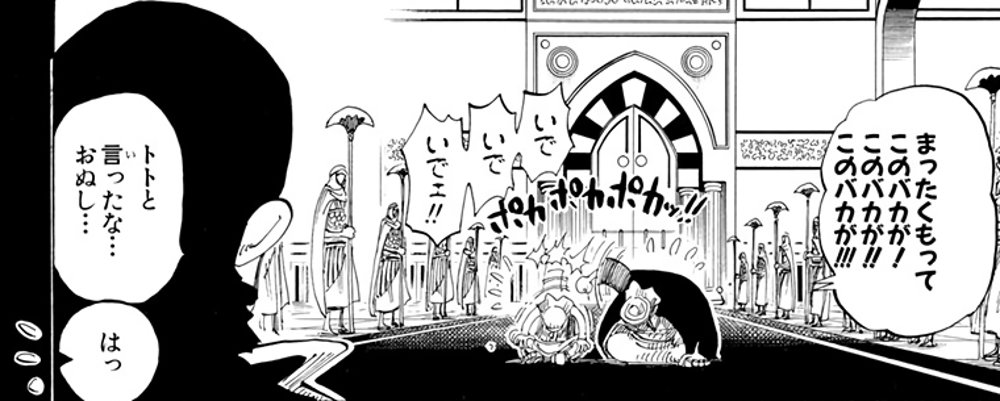
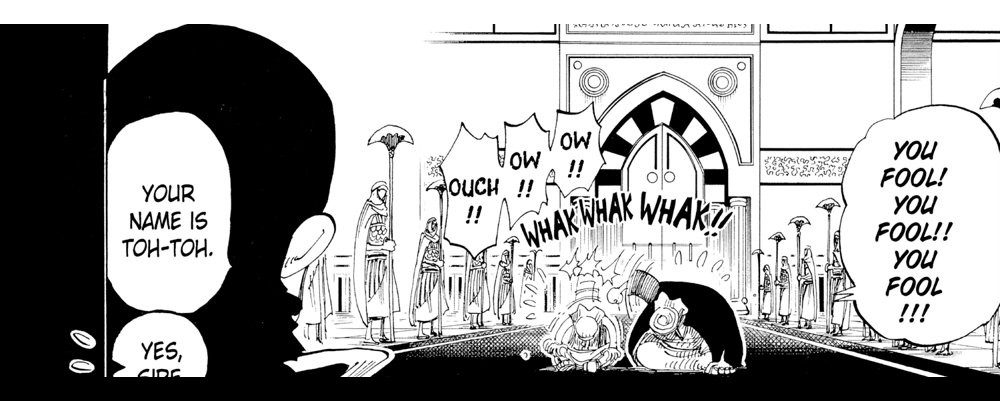
Alabasta, years before Luffy's crew ever sets foot on the sand — a flashback within the arc. A village boy and an accomplice have just been caught inside the palace grounds. Guards make them pay for it: 「いでいでいでェ!!」, "OW!! OW!! OUCH!!", punctuated by three strikes and a chorus from the onlooking court — 「まったくもってこのバカが!このバカが!!このバカが!!!」, "YOU FOOL! YOU FOOL!! YOU FOOL!!!" Then a new silhouette enters the frame: broad-shouldered, unhurried, backlit into pure black against the courtyard light. It is the King of Alabasta, Cobra. The boy has apparently just given a false name. Cobra doesn't raise his voice. He simply confirms what he heard:
「トトと言ったな...おぬし..」
Toto to itta na… onushi…
VIZ's English edition prints: "YOUR NAME IS TOH-TOH." (Vol. 18, p.158.)
Grant the rendering its due: it's clean, it reads instantly, and the scene doesn't need the line to do more than confirm the alias before Cobra pivots to the real business — announcing drought relief for the boy's village, whatever his manners. But listen to what's sitting quietly in the Japanese and nowhere in the English. Cobra doesn't say トトと言ったな…お前… (the ordinary, unmarked "you"). He says おぬし — and that one syllable swap is doing something お前 never could: it tells a Japanese reader, instantly and without a single adjective, that this is a king's voice, not a bureaucrat's. The English reader gets the same information zero syllables' worth of signal.
The Original
おぬし is almost always printed in kana in manga, but its root is 御主. Take it apart:
御 (o-) is the honorific prefix that softens お茶 ("tea") and turns 主人 into ご主人様 ("master of the house"). 主 (nushi / shu) is "master, owner, lord" — the same 主 sitting inside 持ち主 (mochinushi, "owner") and 主人公 (shujinkō, "protagonist," literally the story's own "lord"). Put the two together and おぬし is etymologically something close to "[my] lord" or "your mastership" — a term a retainer once used looking up at a superior.
Centuries of use wore that upward-pointing honorific down to something closer to level ground. This is the same slide that produced 貴様 ("your esteemed self," now a snarl) and てめえ ("before my own hands," a humble "I" that turned around to insult you) — both tracked elsewhere in this corpus. おぬし took the fork those two didn't: it settled into a neutral, faintly formal address, used symmetrically between samurai of comparable rank, and from there became available to any character a writer wants to sound like they arrived from an earlier century — a lord, a knight, a mountain hermit, a sage.
That's what makes おぬし textbook 役割語 (yakuwarigo), linguist Kinsui Satoshi's term for the fixed speech patterns Japanese fiction assigns to character types rather than to any dialect anyone actually speaks. The full "old sage" kit is おぬし ("you") + わし ("I") + じゃ (copula) + a sentence-final のう — instantly recognizable to any anime viewer, spoken by almost nobody outside fiction. Neither Cobra nor Gan Fall, the two speakers in this article, uses the whole kit — no わし, no じゃ. Which is exactly the point: おぬし alone is enough. One pronoun, and the reader knows this speaker is dignified, formal, out of step with modern casualness — before a single other word confirms it. Grammatically the word is inert — it just occupies the "you" slot any ordinary sentence has — so all of its work is register, not syntax. It sits off the JLPT ladder proper; glossaries that bother to list it file it loosely around N2–N1, the shelf for classical and literary holdovers rather than conversational vocabulary. And critically: おぬし is not hostile. Cobra's is stern but paternal; Gan Fall's, as the next section shows, is often outright warm. Marked speech and hostile speech are separate axes — this word proves it.
VIZ's Choice
Six occurrences, image-verified against both editions, spanning two arcs and two speakers:
| Vol. / p. | Speaker → Addressee | Japanese | VIZ English |
|---|---|---|---|
| 18 / 158 | King Cobra → a defiant boy ("Toto") | トトと言ったな…おぬし… | YOUR NAME IS TOH-TOH. |
| 26 / 29 | Gan Fall → the Straw Hats, on first contact | おぬしら青海人か? | ARE YOU BLUE SEA PEOPLE? |
| 26 / 33 | Gan Fall → the Straw Hats, granting a gift | さすれば我輩天よりおぬしらを助けに参上する!! | ...AND I WILL COME DOWN FROM THE HEAVENS TO SAVE YOU! |
| 27 / 30 | Gan Fall → Conis, in hiding | おぬしも共犯となろう…身は危うい…これはサービスだ | AS AN ACCOMPLICE, YOU'RE STILL IN DANGER. REST WHILE YOU CAN. |
| 29 / 203 | Gan Fall → Eneru, in fury | ...!!おぬし… | YOU...!! |
| 32 / 123 | Gan Fall → the Shandia chief | 酋長おぬしが適任であろう | CHIEF, YOU ARE THE ONE MOST SUITED TO THIS. |
Read down that right-hand column and notice what's missing compared to this corpus's other pronoun articles. 因縁 scattered across five different English nouns. おのれ split across "confidence," "swine," "blast you," "fiend." Here there is no scatter, because there is no variation to scatter into — every single line lands on some flavor of the bare word "you." A greeting, a heroic promise, a tender warning, a horrified accusation, and a formal address to a tribal chief — five completely different emotional registers, one identical English pronoun every time. This is the purest possible flattening this series has documented: not a translator choosing imperfectly between several options, but a translator with, structurally, no option at all, because English's "you" doesn't inflect for the speaker's dignity the way Japanese's pronoun set does.
And yet — look sideways at the rest of these characters' lines on the same pages, not just the おぬし clause itself. Cobra, two lines later on the same page: "YOU MAY REMAIN IN ALUBARNA WHILE YOU PONDER YOUR FUTURE!!" — "may" and "ponder" are doing quiet, formal work. Gan Fall, elsewhere in Skypiea: "HEED IT." instead of "listen," "ENTRUST THIS GIRL TO ME" instead of "leave her with me," "BUT YOU MAY HAVE THIS ONE FREE, IN HONOR OF YOUR COURAGE" instead of "here, take it, you earned it." VIZ does have a strategy for these two speakers' overall dignity — it just never touches おぬし itself. The pronoun, the single word doing the most concentrated register-signaling in the sentence, is the one place the translation goes completely silent.
The Gap
No deictic shortcut for age or era. The instant Cobra or Gan Fall says おぬし, a Japanese reader receives a complete character judgment — old-fashioned, dignified, possibly from a bygone regime — with zero extra words spent. English "you" is the single most neutral word the language owns. It cannot front-load a speaker's vintage the way a swapped pronoun can; the information has nowhere to go but the surrounding sentence, and often it simply doesn't go anywhere.
Marked does not mean hostile — and English's nearest tools assume otherwise. This corpus's three other pronoun articles (貴様, てめェ, おのれ) are all about honorifics curdled into insults. おぬし is proof the curdling was never mandatory. But reach for English's one dignified-archaic "you" — "thee/thou" — and you import Early Modern English's Bible-and-Shakespeare baggage wholesale, which is the wrong kind of old for a manga knight addressing teenagers on a pirate ship.
One character's verbal fingerprint disappears across volumes. Gan Fall says おぬし roughly nineteen times over several volumes of Skypiea. In Japanese, that repetition builds a voice — the reader learns to hear "an old-fashioned knight is speaking" before the sentence even finishes. In English, "you" appears with the same frequency Luffy, Nami, and Eneru's "you" does. The fingerprint that should distinguish Gan Fall's every line is present in the Japanese and entirely absent in translation.
The rare compensation stops short of the one word that needed it most. VIZ visibly reaches for "heed," "entrust," "ponder," "in honor of" elsewhere in these characters' dialogue — proof the translator hears the register. But none of that elevated diction ever migrates onto the pronoun itself, the single most repeated, most reliable signal in the Japanese text.
What If
For the headline line specifically, the menu and its prices:
- "Thy name is Toh-Toh, is it not…" — the closest one-word swap; "thy/thou" is the only slot English keeps open for dignified archaic address. Cost: reads biblical or Shakespearean rather than manga-king dignified — the wrong flavor of old.
- "So — your name is Toh-Toh, is it." — a formal tag stands in for the pronoun's weight without importing another century of English wholesale. Cost: subtle enough a skimming reader may never clock it as marked at all.
- "You are called Toh-Toh, then." — the slightly inverted, stiff phrasing gestures at formality. Cost: still just modern diction underneath; nothing here truly signals "archaic."
- Keep VIZ's plain line, but give おぬし-speakers a running tic — a dropped "indeed," a fixed formal cadence — carried consistently across every appearance, the way some translators solve 老人語 (old-man speech) elsewhere. Cost: invents texture this exact sentence doesn't literally contain, and only pays off with discipline sustained across dozens of lines and several volumes.
Take-away
おぬし is proof that "marked speech" and "hostile speech" are different things wearing the same shirt in this corpus. Where 貴様, てめェ, and おのれ all curdled from honorific into insult, おぬし is the sibling that stayed dignified — and English, having no equivalent word held in reserve for exactly this purpose, quietly erases it every time.
Three rules of thumb to carry off this page:
- A pronoun can be the entire characterization. おぬし needs no わし, no じゃ, no dialect spelling to mark a speaker as venerable — the single word is doing all the work. Watch for one-word role-language markers hiding inside otherwise ordinary sentences.
- Marked ≠ hostile. Don't assume every non-default second-person pronoun in Japanese fiction is an insult in progress. Some, like おぬし, spent their whole history staying respectful.
- Repetition is the tell. A single occurrence of an archaic pronoun might be a translator's rounding error. Nineteen occurrences from one character, all rendered identically as "you," is a flattened fingerprint — worth noticing precisely because the pattern is invisible in English.
For this corpus's other three second-person pronouns — the ones that did curdle into insults — see 貴様 and the honorific that curdled into an insult, てめェ, the humble "I" that turned around to insult you, and おのれ, the one word English splits three ways. And for more places where a single Japanese word carries more social information than English can hold, browse the One Piece translation notes index.
Every Japanese and English line quoted above is a byte-exact capture from the cited editions — ONE PIECE Vol. 18 & Vol. 26–32 (Japanese) and One Piece (VIZ Media) at the corresponding panels — via our bilingual page database; see Sources below.