The Moment
Volume 6, the Forest of Death — the survival stage of the Chunin Selection Exam, and it has gone as wrong as it can go. Sakura, bruised and out of fight, is all that stands over her downed teammates when the Sound ninja close in — until Rock Lee plants himself in front of her. Outnumbered and outmatched, Lee reaches for the one card he is forbidden to play, and the page cuts to the day his master dealt it to him. Guy, one finger raised, mid-lecture:
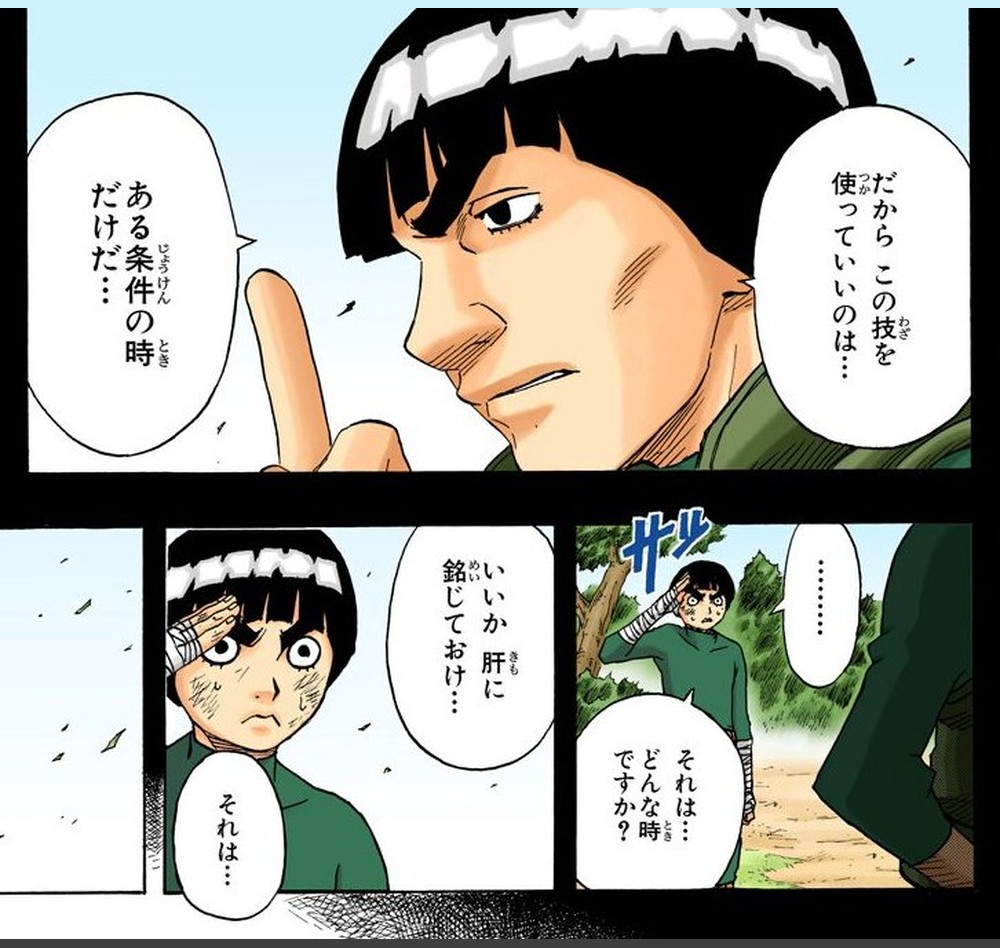
「だからこの技を使っていいのは」「ある条件の時だけだ…」
Dakara kono waza o tsukatte ii no wa… aru jōken no toki dake da…
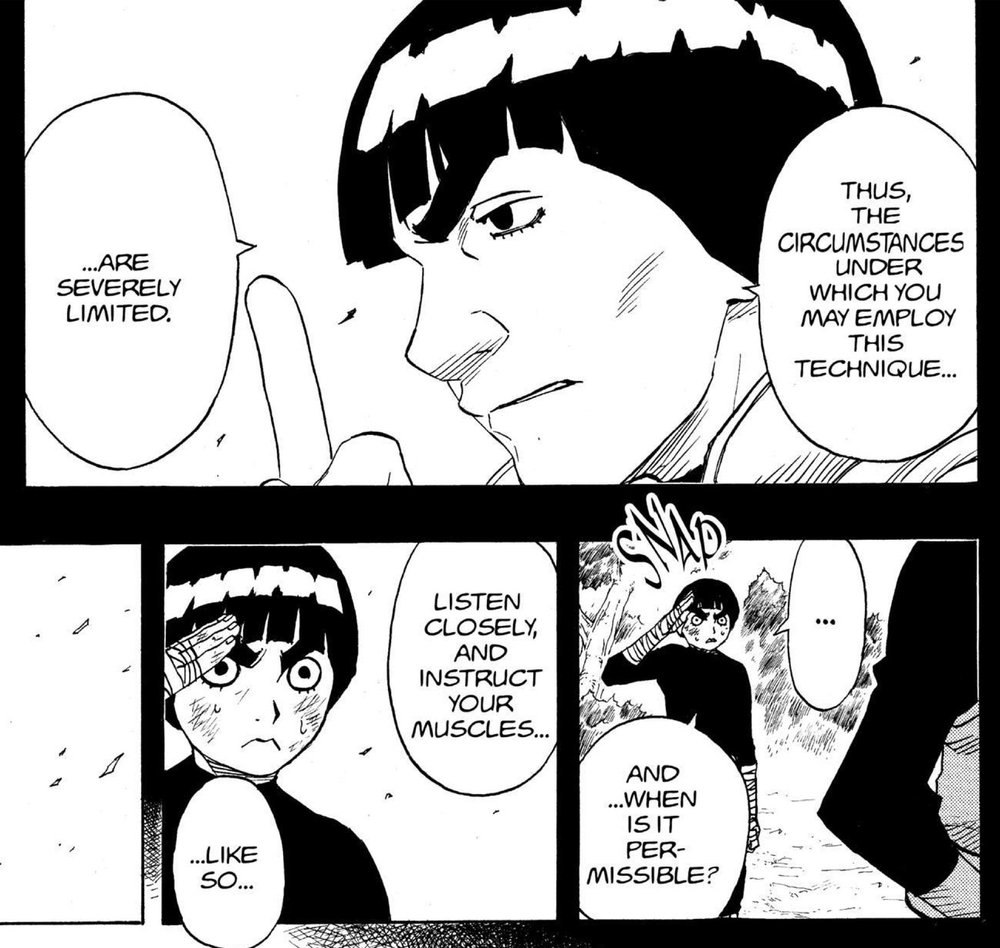
"THUS, THE CIRCUMSTANCES UNDER WHICH YOU MAY EMPLOY THIS TECHNIQUE... ...ARE SEVERELY LIMITED."
Young Lee asks the obvious — 「それは…どんな時ですか?」 ("AND ...WHEN IS IT PERMISSIBLE?") — and Guy leans into the answer with a command first:
「いいか 肝に銘じておけ…」
Ii ka, kimo ni meijite oke…
VIZ's English edition prints: "LISTEN CLOSELY, AND INSTRUCT YOUR MUSCLES..." (Vol. 6, p.139).
Grant the rendering its due: the entire page before this one is a physiology lecture. In VIZ's own English, the technique 「いわば〝捨て身の技〟なのだ」 ("...SO WHEN YOU CALL UPON IT, YOU'RE SACRIFICING A PART OF YOURSELF!") works by 「しかしこの技はチャクラでその脳のリミッターを無理やり外し…」 — "OVERRIDING THAT INTERNAL CRANIAL SAFETY FEATURE" that keeps a human body from tearing its own muscles apart. "Instruct your muscles" keeps the passage in key: brains, limiters, muscle fibers. It even lands near a real English idea — muscle memory, training a rule until the body performs it unbidden.
But that is not what Guy said. Guy said: Listen — engrave this on your liver. And the Japanese page pays the engraving off. Back in the present, Lee unwinds his bandages — 「ガイ先生‥では心おきなくあの技をやります…」 ("MASTER GUY... THE TIME HAS SURELY COME FOR ME TO USE THE FORBIDDEN SKILL YOU TAUGHT ME...") — and on the next page the engraved rule itself detonates over the charging panel: 「大切な人を守る時!!」 — when protecting someone precious!! Whether you hear that as Guy's remembered voice completing the lesson or as Lee firing it back word for word, the Japanese lets the inscription and the act coincide. VIZ, which never asked Lee to memorize anything, has to convert the recall into a present-tense justification: "I'M DEFENDING THE LIFE OF SOMEONE WHO MEANS THE WORLD TO ME!"
The Original
肝に銘じる (kimo ni meijiru) — take it apart and you get a chisel and an organ.
肝 (kimo) is the liver. In the old Sino-Japanese map of the body — the 五臓 (gozō, five viscera) of traditional medicine — the liver is not a filter; it is the seat of nerve, courage, and vital spirit. Everyday Japanese still files those feelings there: 肝が据わる (kimo ga suwaru, "his liver is seated" — unshakable), 肝を冷やす ("chill one's liver" — a scare that reaches your core), 度肝を抜く ("yank out someone's liver" — to flabbergast), 肝試し (kimodameshi, the classic test-of-courage walk through a graveyard), 肝っ玉母さん (the gutsy mother). The organ is so central that 肝心 (kanjin) — literally "liver and heart" (also written 肝腎, "liver and kidneys") — is simply the word for crucial.
銘 (mei) is the metal radical 金 plus 名 "name": a name cast into bronze — an inscription. This is the 銘 of 座右の銘 (zayū no mei, the motto you keep at your right hand), of 感銘 (kanmei, an impression deep enough to be engraved), of 墓碑銘 (a gravestone epitaph), of a sword's 銘 (the smith's name chiseled into the tang). 銘じる is the verb of that character: to inscribe, permanently, in the hardest material available.
So 肝に銘じる is not "remember this." It is chisel this into the organ where your nerve lives — a memory stored not in the head but in the body's core, written in a medium that does not erase.
The grammar seals it. Both occurrences in Naruto end in 〜ておけ: the blunt imperative of ておく, the "do it now and keep it stored for later" aspect. 肝に銘じておけ = engrave it now, so that it is already there on the day you need it. It is the natural grammar of a precept — which is why the phrase's native habitat is exactly what this manga shows: a senior handing a junior a rule to live by. In the polite register, 肝に銘じます is what you say to your boss after a serious mistake: I will engrave it on my liver. As vocabulary, the idiom sits around JLPT N1; the ておけ scaffolding is N4. The distance between those two numbers is the distance between the grammar and the culture.
VIZ's Choice
Both appearances of 肝に銘じる in the volumes we have on file:
| Vol. / p. | Scene | Japanese | VIZ English |
|---|---|---|---|
| 6 / 139 | Guy → Lee, handing down the Lotus rule | いいか肝に銘じておけ… | LISTEN CLOSELY, AND INSTRUCT YOUR MUSCLES... |
| 25 / 82 | Fugaku → Itachi, the night lecture | それをよく肝に銘じておけ | TAKE THAT TO HEART. |
The Volume 25 scene is the idiom's other natural habitat, nineteen volumes away. Night in the Uchiha compound: Itachi's father — the clan head — arms crossed beside the boys' mother, reminds Itachi 「お前は一族と里の中枢を繋ぐパイプ役でもあるのだ…」 ("YOU'RE THE PIPELINE BETWEEN THE CLAN AND THE VILLAGE NERVE CENTER...") and then drives it in: 「それをよく肝に銘じておけ」 — "TAKE THAT TO HEART." — 「そして明日の会合には来い」 ("ATTEND TOMORROW'S MEETING."), while little Sasuke eavesdrops from the doorway.
"Take that to heart" is the shelf answer — the phrase any dictionary offers for 肝に銘じる, and it is genuinely good: curt, paternal, imperative, idiomatic. Which sharpens the Volume 6 question considerably. The standard equivalent existed, and VIZ's own team would later use it. So why did Guy's line come out as a memo to the muscles?
Read charitably, the translator was protecting the scene's coherence: the muscle-limiter lecture dominates the spread, and "instruct your muscles" keeps Guy sounding like the PE-teacher-of-doom he is. And notice the instinct underneath: faced with an idiom that stores an instruction in an organ, the translator kept the instruction in the body — just relocated it to the muscles, the only body part the English page had been talking about. The instinct was right. The address was wrong. Japanese does not file rules in the muscles; it engraves them on the liver — and English, offered the same idiom twice, filed it once under muscle and once under heart, and never once under the organ where Japanese actually keeps it.
The Gap
An organ transplant, performed silently. "Take to heart" is a perfect functional match and a complete anatomical mismatch. English keeps what matters in the chest: you learn by heart, know by heart, take to heart. Japanese keeps its nerve lower and to the right — in the liver, and more broadly in the belly (肝, 腹, 胆). A learner who reads only VIZ meets the right meaning and never learns that the organ was different — which means never learning to read 肝が据わる, 肝を冷やす, or 肝心 when they arrive. The funny thing is that English used to agree: Elizabethan humoral medicine also kept courage in the liver, which is why Shakespeare's cowards are lily-livered — a liver too bloodless to be brave. English moved its filing cabinet four centuries ago; Japanese never did.
The chisel goes missing. 銘 is an inscription in bronze or stone — the medium is the message: this cannot be unwritten. "Take that to heart" absorbs; "instruct your muscles" briefs. Neither engraves. The permanence that makes 肝に銘じろ a once-in-a-lifetime command — you do not 銘じる your grocery list — softens into ordinary advice.
A setup deleted, a payoff orphaned. The Japanese page is built like a mechanism: Guy orders the rule engraved (p.139); two pages later the engraved words come back — 大切な人を守る時!! — at the exact moment they apply. That is 肝に銘じる working as narrative: what was inscribed resurfaces intact. VIZ's Guy never asked for memory, so VIZ's payoff cannot be a recall; it becomes Lee explaining himself in the present tense — "I'M DEFENDING THE LIFE OF SOMEONE WHO MEANS THE WORLD TO ME!" — true, but no longer an echo.
Two mentors, one idiom, no rhyme. Guy handing Lee the Lotus rule and Fugaku handing Itachi the clan's burden are the same social act, performed with the same words: 肝に銘じておけ, senior to junior, precept downward. A Japanese reader hears the two sternest teachers in the series reach for the same chisel. The English reader hears a muscle memo and a heart idiom — two scenes that no longer know about each other.
What If
The menu for Guy's line, with prices attached:
- "Listen well — and engrave this on your heart." — keeps the chisel, moves the organ to English's native address. Cost: still a transplant, and a shade more solemn than a jumpsuited PE teacher.
- "Now burn this into your memory..." — keeps the permanence and the imperative heat. Cost: fire instead of chisel, and the body drops out entirely — the idiom becomes mental.
- "Mark my words — and mark them well..." — natural stern-master English, and mark is, etymologically, an inscription. Cost: the engraving inside "mark" wore smooth centuries ago; nobody feels it anymore.
- "Listen closely — and take it to heart." — VIZ's own Volume 25 solution, applied consistently. Cost: soft where the Japanese is a chisel; but at least the two mentor scenes would rhyme in English the way they rhyme in Japanese.
Every option pays somewhere, because the original does three jobs at once — organ, chisel, precept — and English idiom offers at most two per phrase.
Take-away
Three rules of thumb to carry off this page:
- When you meet 肝, expect nerve, not anatomy. 肝が据わる, 肝を冷やす, 肝試し, 肝心 — the liver is where Japanese keeps its cool, its courage, and its non-negotiables. Read 肝 as "core," and the whole word family unlocks.
- When you meet 銘, something permanent is being written. 座右の銘, 感銘, 墓碑銘, 肝に銘じる — one character, always a chisel. If a Japanese sentence 銘じる-s something, it intends to keep it forever.
- 〜ておけ is the storage imperative. Do it now, have it ready later. It is how commands become precepts — and why both of this article's speakers, a master and a father, reach for exactly that form.
Japanese keeps a surprising amount of its inner life in the torso: the liver that holds your nerve here, the bug in the belly that registers your dislikes in our companion piece, and — for how a boast lives or dies on one Buddhist battlefield-word — the Asura's battlefield Naruto claims to have survived. For a One Piece line where English likewise had to rebuild a body-part idiom from scratch, see 手も足も出ない on the One Piece hub — or browse the Naruto translation notes index.
Every Japanese and English line quoted above is a byte-exact capture from the cited editions — NARUTO―ナルト― Vol. 6 & Vol. 25 (Japanese) and Naruto (VIZ Media) at the corresponding panels — via our bilingual page database; see Sources below.