The Moment
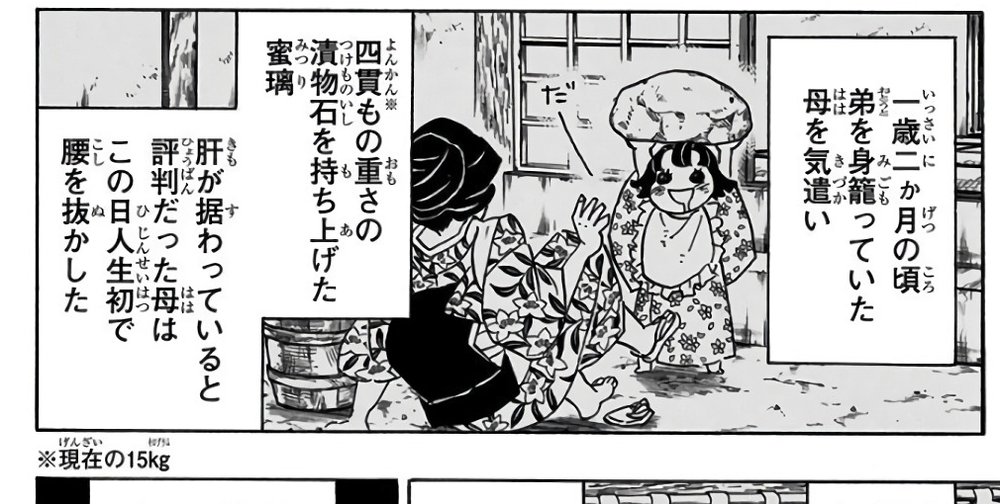
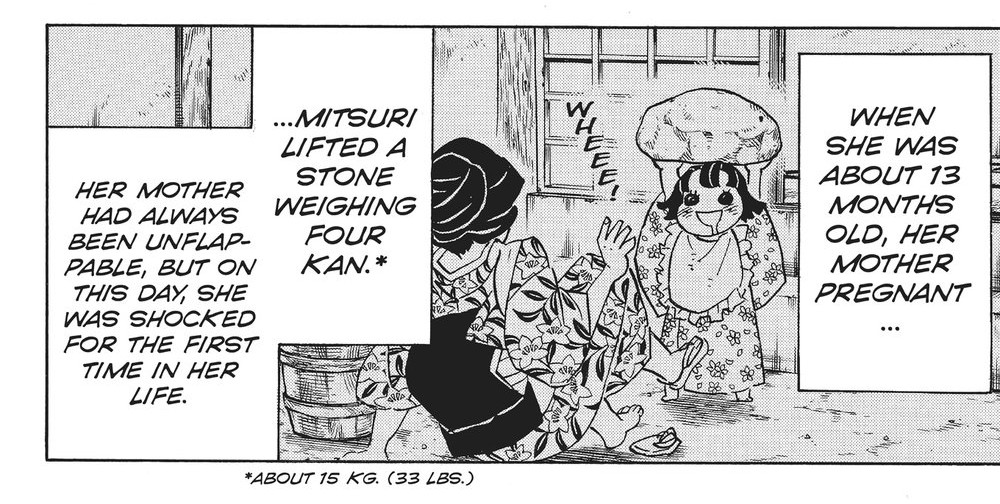
Volume 14, deep in the Swordsmith Village battles, and the story pauses to explain the Love Hashira. The page is laid out like a mock encyclopedia entry, complete with a title — VIZ letters it "THE EIGHTFOLD GIRL" (捌倍娘, hachibai musume, in the Japanese) — and a specification: 「筋肉の密度が常人の八倍ある」 — "HER MUSCLE DENSITY IS EIGHT TIMES THAT OF A NORMAL PERSON." Then comes Exhibit A. Thirteen-month-old Mitsuri Kanroji, worried for her pregnant mother — 「一歳二ヵ月の頃弟を身籠っていた母を気遣い」…「四貫もの重さの漬物石を持ち上げた蜜璃」 — "WHEN SHE WAS ABOUT 13 MONTHS OLD, HER MOTHER PREGNANT... MITSURI LIFTED A STONE WEIGHING FOUR KAN." (VIZ's footnote: about 15 kg, 33 lbs — it is the stone that weighs down the family pickle barrel, and the baby has it on her head.)
The panel shows the toddler mid-parade and, in the foreground, her mother sitting flat on the ground, one arm flung up. The narration explains the seated woman with a sentence built on two body parts:
「肝が据わっていると評判だった母はこの日人生初で腰を抜かした」
Kimo ga suwatte iru to hyōban datta haha wa kono hi jinsei hatsu de koshi o nukashita
VIZ's English edition prints: "HER MOTHER HAD ALWAYS BEEN UNFLAPPABLE, BUT ON THIS DAY, SHE WAS SHOCKED FOR THE FIRST TIME IN HER LIFE." (Vol. 14, p.164).
Grant the rendering its due. "Unflappable" is genuinely good for 肝が据わっている — a person nothing ruffles — and the sentence keeps the narrator's dry biographical cadence. Nothing here is wrong. What's missing is that the Japanese sentence is not about two feelings. It is about two pieces of anatomy — one that stayed put for a lifetime, and one that just failed.
The Original
The line runs two idioms through one mother, and each is a lesson in where Japanese keeps its emotions.
肝 (kimo) is the liver. In the classical Chinese body-map that Japanese inherited, the liver is the organ of boldness — which is why courage-vocabulary in Japanese keeps coming back to it: 肝っ玉 (kimottama, "guts"), 肝が太い ("thick-livered": fearless), 肝試し (kimodameshi, a "liver test" — the classic dare to walk through somewhere haunted), 度肝を抜く (dogimo o nuku, "to yank the liver out": to flabbergast), and 肝に銘じる (kimo ni meijiru, "to engrave on the liver": to take an instruction to heart, permanently).
据わる (suwaru) is "to be set, seated, fixed in place" — written with 据, not the 座 of people sitting down. It is the verb of a machine bolted to its base, of a gaze that locks (目が据わる — the fixed stare of the very drunk or the very dangerous), of a belly that settles into resolve (腹が据わる). So 肝が据わる: the liver is properly seated. Nerve so stable it cannot be knocked off its mount. Note what the idiom claims: not a mood, but a mechanical property.
腰 (koshi) is the hips and lower back — the body's load-bearing pivot, and Japanese physical culture's favorite body part: put your hips into it (腰を入れる), go at something half-hipped (及び腰, timid), fold mid-effort (腰砕け). 抜かす (nukasu) is "to let slip out, to lose." So 腰を抜かす: to lose one's hips — the strength leaves the joint that holds you upright, and you go down where you stand. It is what happens to old men who see ghosts and grandmothers who win lotteries. And Japanese liked the failure enough to fossilize it into a noun: 腰抜け (koshinuke), "the de-hipped" — a person whose hips are presumed permanently out of order. A coward.
Put together, the sentence is a see-saw with a body on each end: the liver that sat famously firm — 評判だった, the neighborhood had rated it — versus the hips that gave out, 人生初で, for the first time in her life. Composure and collapse, measured in the same anatomical currency. Grammatically it is plain past-tense narration any second-year student can parse; the idioms are the toll gates — 腰を抜かす sits around N2 in most lists, and the 肝 family is N1 idiom-drill territory.
VIZ's Choice
The corpus lets us watch what English does to this whole body-lexicon across the series, not just in one panel:
| Vol. / p. | Speaker | Japanese | VIZ English |
|---|---|---|---|
| 1 / 97 | Urokodaki, laying down the law | しかしこれは絶対にあってはならないと肝に銘じておけ | BUT IT IS YOUR SACRED DUTY TO ENSURE THAT THIS NEVER HAPPENS. |
| 4 / 157 | a spider demon, over a fainted Zenitsu | なんという腰抜けだ | WHAT A COWARD! |
| 7 / 14 | Aoi, confessing her fear | 選別でも運良く生き残っただけその後は恐ろしくて戦いに行けなくなった腰抜けなので | I SURVIVED SELECTION DUE TO PURE LUCK. SINCE THEN, I'VE BEEN AFRAID TO GO FIGHT, SO I'M A COWARD. |
| 14 / 164 | narration, on Mitsuri's mother | 肝が据わっていると評判だった母は… | HER MOTHER HAD ALWAYS BEEN UNFLAPPABLE... |
| 14 / 164 | narration, same sentence | …この日人生初で腰を抜かした | ...SHE WAS SHOCKED FOR THE FIRST TIME IN HER LIFE. |
Every row is locally sound. "Coward" is what 腰抜け means; "unflappable" is what 肝が据わる means; Urokodaki's 肝に銘じておけ — engrave this on your liver — even gains a certain gravity as "SACRED DUTY." But read the columns against each other. In Japanese, five lines share two body parts: the liver where nerve sits, the hips that fail when nerve is overwhelmed. The demon sneering at Zenitsu — who has literally fainted and is dangling from a tree, 「失神?」 ("HE JUST PASSED OUT?") — is diagnosing exactly the condition Mitsuri's mother suffers seven volumes later: hips, lost. In English, one becomes a personality judgment ("COWARD") and the other a passing emotion ("SHOCKED"), and no reader could guess they were ever the same joint.
The Gap
The see-saw disappears. The sentence's engineering is one organ set against one joint failed: a liver with a lifetime reputation for staying seated, and hips that quit for the first time ever. That is comedy with a fulcrum — the most stable machine in the village finally breaking down, at the sight of her own baby. "UNFLAPPABLE, BUT... SHOCKED" keeps the contrast but melts the mechanics; what was a physical event on a physical scale becomes a mood swing between adjectives.
The picture loses its caption. 腰を抜かす is not a feeling; it is an event with a posture. Strength exits the hips, and you sit down hard, involuntarily — and that is precisely what Gotouge draws: the mother flat on the ground, arm thrown up, while the baby marches past under a pickling stone. The Japanese caption describes the drawing. The English caption describes an interior state, leaving the English reader to wonder, at least subliminally, why a merely "shocked" woman is sitting on the floor.
A lexicon becomes a scatter. 腰を抜かす, 腰抜け, 肝が据わる, 肝に銘じる — for the Japanese reader these are visibly one system: the trunk of the body as emotional machinery. VIZ, translating each occurrence sensibly on its own page, hands English readers "shocked," "coward," "unflappable," and "sacred duty" — four entries with no family resemblance. The loss is not any single line; it is the grammar of the body that quietly organizes all of them.
What If
The menu for the mother's sentence, and what each item costs:
- "Her mother was famous for her steady nerve, but that day, for the first time in her life, her legs gave out from under her." — keeps the collapse physical and visible, so the caption matches the panel again. Cost: the failure moves to the legs, because English terror lives in knees and legs, never hips.
- "Nothing could rattle her mother, people said — but that day she fell right on her backside for the first time in her life." — preserves 評判 (the neighborhood's verdict) and the pratfall the artwork draws. Cost: "on her backside" plays broader slapstick than the narrator's deadpan.
- "Her mother had the steadiest nerve in the village, but that day her knees buckled for the first time in her life." — answers body with body: buckling knees are English's native shock-anatomy. Cost: a buckle is a wobble; 腰を抜かす is total system failure — she is already on the floor.
- "Her mother was renowned for her iron nerve — and that day, for the first time ever, she collapsed on the spot." — keeps the fall without naming parts. Cost: "collapsed" reads medical rather than comic, and "iron nerve" swaps anatomy for metallurgy.
Note the recurring toll: English can buy back the fall or the steadiness, but no option restores the two idioms' shared anatomy — courage and collapse as conditions of the same torso. That vocabulary simply was never built.
Take-away
肝が据わる and 腰を抜かす are easy idioms hiding a structural difference between the languages: Japanese files composure and panic under body mechanics — organs that sit, joints that fail — while English files them under psychology. A translator can always find a serviceable adjective; what cannot be carried across one line at a time is the map of the body underneath.
Three rules of thumb to carry off this page:
- When a Japanese emotion-word names a body part, take the anatomy seriously: the liver (肝) holds nerve, the belly (腹) holds resolve, the hips (腰) hold you up. The feeling is a report on the part's condition.
- 据わる means "set in place." Learn it once and three idioms unlock together: 肝が据わる (nerve), 腹が据わる (resolve), 目が据わる (that fixed, dangerous stare).
- When an insult looks abstract, check for a fossilized body-failure inside it. 腰抜け "coward" is 腰を抜かす frozen into a noun — the same hips Mitsuri's mother lost, thrown as a taunt.
For more Demon Slayer body idioms English couldn't keep in the body, see the nose that simply works in 鼻が利く and the ringing arms of 腕が鳴る — and for the same failure of anatomy in another sea entirely, One Piece's 手も足も出ない, the hands and feet that won't come out. Or browse the Demon Slayer translation notes index.
Every Japanese and English line quoted above is a byte-exact capture from the cited editions — 鬼滅の刃 Vol. 1–14 (Japanese) and Demon Slayer: Kimetsu no Yaiba (VIZ Media) at the corresponding panels — via our bilingual page database; see Sources below.