The Moment
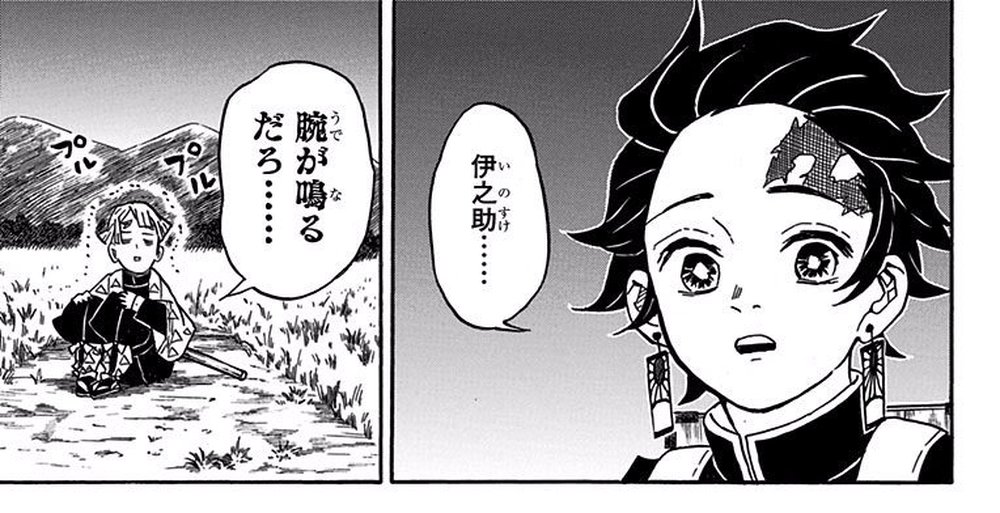
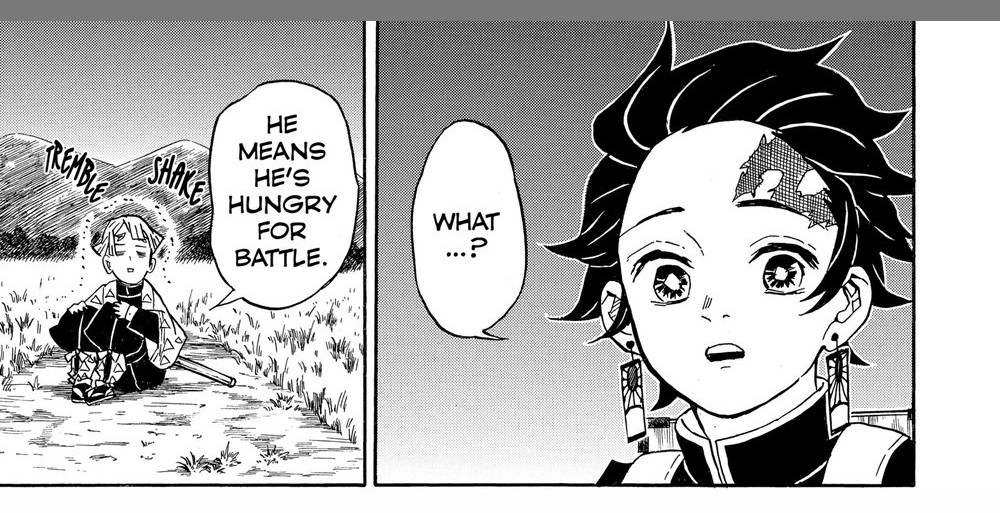
Volume 4, the foot of Natagumo Mountain. The mountain ahead is strung with spiderwebs and bad omens; Zenitsu has folded up in the grass, trembling so hard the panel gives him his own sound effects (プルプル — VIZ letters it TREMBLE, SHAKE). And Inosuke — boar head, twin blades, zero doubt — is already stomping past everyone:
「俺が先に行く!!」 — "ME FIRST!"
「お前はガクガク震えながら後ろをついて来な!!」 — "YOU CAN TREMBLE IN FEAR AND FOLLOW BEHIND!"
And then, filling a whole panel with boar-headed resolve, his battle declaration:
「腹が減るぜ!!」
Hara ga heru ze!!
…which means "I'm getting hungry!!" That is not a battle declaration. Tanjiro turns, wide-eyed, and murmurs his friend's name — 「伊之助……」 — and then, while Zenitsu shakes in the grass beside them, delivers the gentlest possible correction:
「腕が鳴るだろ……」
Ude ga naru daro…
"(The phrase you want is) my arms are ringing…" Inosuke reached for the classic warrior's idiom — skill humming, hands begging for a fight — and came back holding his stomach.
VIZ's English edition prints the exchange like this: Inosuke bellows "I'M HUNGRY!", Tanjiro answers "WHAT ...?", and then, over trembling Zenitsu: "HE MEANS HE'S HUNGRY FOR BATTLE." (Vol. 4, p.56–57).
Grant the rendering its due, because it earns real credit: having translated Inosuke's botched line literally — and 腹が減るぜ does literally mean "I'm hungry" — VIZ found the one English word that could hold the gag together. Hungry stretches from stomachs to ambition, so "I'M HUNGRY!" → "HE MEANS HE'S HUNGRY FOR BATTLE" still lands as a two-beat joke: loud nonsense, quiet repair. Plenty of translations would have simply dropped the beat. This one kept a joke — just not the same joke, and not the idiom.
The Original
腕 (ude) is "arm." But in Japanese, the arm is where skill lives. A craftsman's ability is his 腕前 (udemae); a capable person is 腕利き (udekiki), "an effective arm"; you polish your skill with 腕を磨く (ude o migaku) and test it with 腕試し (udedameshi). Centuries of artisan and swordsman culture sit inside that metonymy: what you can do is stored in your arms.
鳴る (naru) is the intransitive "to ring, to sound" — the verb of bells (鐘が鳴る), thunder (雷が鳴る), ringing ears (耳鳴り), and, yes, growling stomachs (腹が鳴る).
Put them together: 腕が鳴る, "one's arms ring." Skill as a struck bell that hasn't been allowed to sound — I can't sit still; my hands are begging to show what they can do. It is the stock phrase of the eager swordsman in every period drama, which is exactly why Inosuke, all instinct and bravado, reaches for it before charging up a demon-infested mountain. Most JLPT idiom lists shelve it around N2 — but note that everything else in the exchange is beginner-grade grammar. The comedy needs the phrase to be common: every Japanese reader knows the idiom, so every Japanese reader hears the miss.
And what a precisely engineered miss it is. Inosuke's 腹が減る (hara ga heru, "to get hungry") sits two sound-slips from 腕が鳴る (ude ga naru): same [body part] + が + [verb] frame, same rhythm — and the genuine idiom 腹が鳴る ("one's stomach growls") sits exactly halfway between them. He aimed for ringing arms, skidded through growling stomach, and landed on empty stomach. A boy raised by boars, who taught himself human speech, knows the warrior's set phrases approximately — which is funnier, and more endearing, than not knowing them at all.
Then there is Tanjiro's grammar. The だろ in 「腕が鳴るだろ……」 is not the textbook "probably." After a bare quoted phrase, だろ is the straight man's correction marker — short for それを言うなら腕が鳴るだろ, "if that's what you're trying to say, it's ude ga naru." Japanese comedy runs on this structure: the boke blurts the wrong thing at full volume, the tsukkomi lays the right phrase next to it, deadpan. The six-dot ellipsis is the deadpan — no lecture, no exclamation point, just the correct idiom set down with a sigh.
VIZ's Choice
腕が鳴る appears exactly once in the volumes we have on file — so there is no translation scatter to chart. What there is instead is a chain reaction. Here is the full exchange, Japanese against VIZ's print:
| Vol. / p. | Speaker | Japanese | VIZ English |
|---|---|---|---|
| 4 / 56 | Inosuke | 俺が先に行く!! | ME FIRST! |
| 4 / 56 | Inosuke | お前はガクガク震えながら後ろをついて来な!! | YOU CAN TREMBLE IN FEAR AND FOLLOW BEHIND! |
| 4 / 56 | Inosuke | 腹が減るぜ!! | I'M HUNGRY! |
| 4 / 57 | Tanjiro | 伊之助…… | WHAT ...? |
| 4 / 57 | Tanjiro | 腕が鳴るだろ…… | HE MEANS HE'S HUNGRY FOR BATTLE. |
Watch the dominoes. The first decision is on page 56: render 腹が減るぜ literally, as "I'M HUNGRY!" Perfectly defensible — that is what the words say, and the non-sequitur is the point. But that one choice forecloses page 57. Tanjiro cannot quote the correct idiom back, because in English there is no correct idiom two sound-slips away from "I'm hungry." So his fond, weary name-call 「伊之助……」 becomes a generic "WHAT ...?", and his correction becomes an explanation: "HE MEANS HE'S HUNGRY FOR BATTLE." — pivoting on the one English word, hungry, that can stretch from stomach to bloodlust.
It is genuinely clever triage. It is also a category change: the Japanese panel contains an idiom; the English panel contains a paraphrase of one.
The Gap
The idiom never makes landfall. VIZ translated what the correction meant, not what it said, so English readers never meet 腕が鳴る at all — not this time, and (since this is its only appearance in the series we have on file) not ever. The image of skill as a bell, arms ringing because they haven't been allowed to strike, is deleted rather than approximated. A Japanese eight-year-old reading this page banks a set phrase for life; the English reader banks nothing.
A correction becomes a footnote. 「腕が鳴るだろ……」 is a quotation — Tanjiro citing the canonical phrase, the tsukkomi's だろ doing the correcting. "HE MEANS HE'S HUNGRY FOR BATTLE." is a gloss — the sentence a translator writes in the margin, except here it is printed inside Tanjiro's speech bubble, delivered to no one in particular (poor trembling Zenitsu is the only candidate audience). The speech act changes: Tanjiro stops being a straight man repairing his friend's Japanese and becomes an interpreter narrating his friend's psychology.
The near-miss becomes a non-sequitur. In Japanese, Inosuke almost knows the phrase — he grabs the right frame and the wrong organ, which tells you something true and touching about a boy who learned language alone on a mountain. In English, Inosuke just announces "I'M HUNGRY!" apropos of nothing. The joke flattens from "he misfires set phrases" to "he says random things" — a quiet rewrite of the character, one panel wide.
What If
No rendering is free; here is the menu and its prices.
- "…He means his arms are itching for a fight." — borrows English's own body-part idiom (itchy palms, itchy trigger finger) and keeps the repair beat. Cost: itching is an irritation where 鳴る is a bell; the eagerness survives, the music doesn't.
- Fix the setup instead: let Inosuke botch an English idiom — "MY BLOOD'S GROWLING!" — so Tanjiro can genuinely correct: "...Boiling. His blood is boiling." — this is the only route that rebuilds the actual malapropism machinery. Cost: it rewrites Inosuke's printed line, and "blood boiling" tips toward anger rather than joyful eagerness.
- "'Raring to go.' …That's what he means." — keeps the quotation-shape: Tanjiro still cites a fixed phrase rather than explaining a mood. Cost: "raring to go" is beige; no body part, no bell, no swordsman anywhere in it.
- "His arms are humming — he can't wait to use that sword." — smuggles the ringing-arms image into English and glosses it in the same breath. Cost: it commits VIZ's own sin, explanation inside the bubble — just with the metaphor left breathing.
The deeper point: the gag is a malapropism of a set phrase, and English simply has a thinner canon of set phrases for a fool to almost-know. Japanese comedy can rely on every reader carrying a shelf of idioms to hear the near-miss against; the translator either builds a substitute shelf on the spot or explains the joke. VIZ explained.
Take-away
When a translation line begins "He means…", read it twice — you are usually looking at the chalk outline of a joke or an idiom that didn't survive the crossing. Here the victim was 腕が鳴る, the ringing arms of a swordsman who can't wait, and the collateral damage was a beat of characterization: Inosuke the almost-fluent, corrected by Tanjiro the gentle pedant.
Three rules of thumb to carry off this page:
- 腕 in an idiom is rarely an arm. It is skill — 腕前, 腕を磨く, 腕試し, 腕によりをかける. When arms ring, hum, or get polished, Japanese is talking about ability.
- だろ after a bare phrase can be a correction, not a guess. The tsukkomi's それを言うなら〜だろ pattern — "the phrase you want is ___" — turns だろ into a red pen. Deadpan ellipsis is your clue.
- Malapropisms are translation's hardest jokes. They need a set phrase the audience already owns. Watch what your translation does when a character gets an idiom almost right: keep, rebuild, or explain — every choice shows.
For another Demon Slayer line where a blade-sharp Japanese phrase came out of English translation transformed, see the four-character cut of 一刀両断 — or browse the Demon Slayer translation notes index. And for what happens when English meets a whole family of Japanese body-part idioms at once, see our One Piece piece on 手も足も出ない, where hands and feet scatter five ways.
Every Japanese and English line quoted above is a byte-exact capture from the cited editions — 鬼滅の刃 Vol. 4 (Japanese) and Demon Slayer: Kimetsu no Yaiba Vol. 4 (VIZ Media) at the corresponding panels — via our bilingual page database, and every VIZ line was re-confirmed against the printed English page. One housekeeping note: at this spread the two editions align page-for-page (JP p.56–57 ↔ VIZ p.56–57), and the odd-looking pairing of 「伊之助……」 with "WHAT ...?" is not a database misalignment — it is genuinely what VIZ printed in that bubble, part of the restructured gag analyzed above.