The Moment
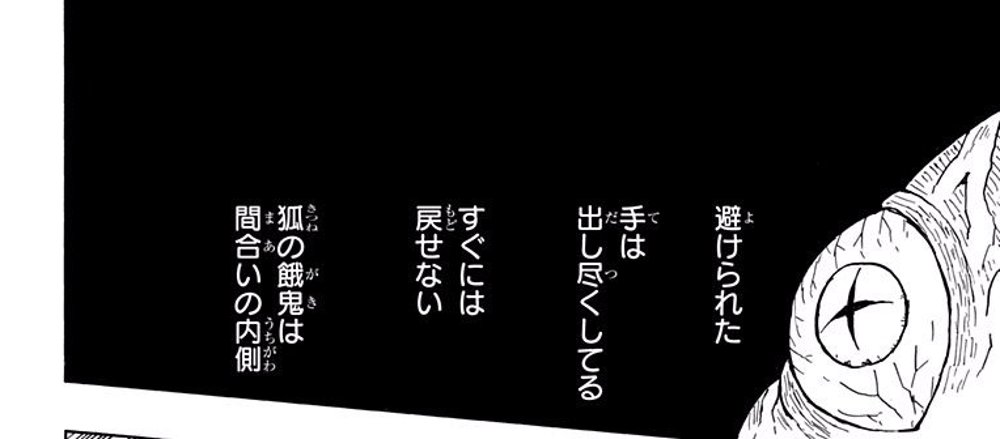
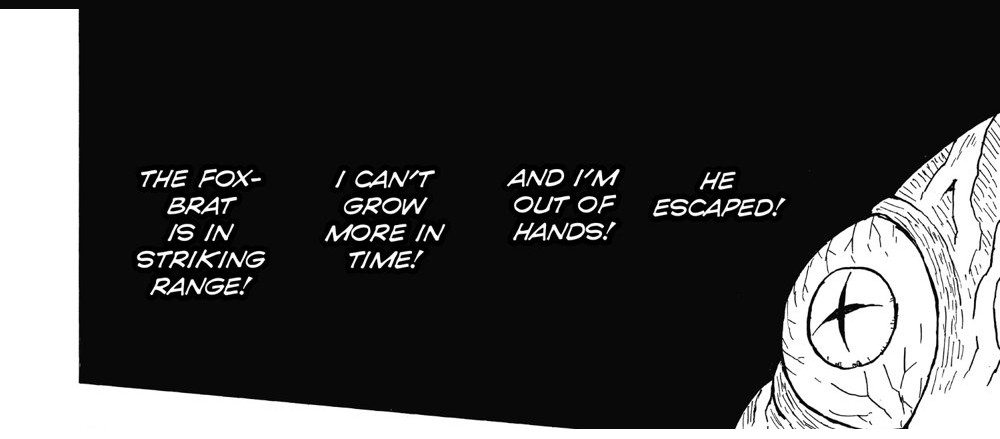
Mount Fujikasane. The Final Selection — the entrance exam that leaves trainee demon slayers alone on a mountain full of real demons for seven nights, survive or don't. Tanjiro is mid-fight against a demon that, the same page confirms, once killed the boy whose fox mask Tanjiro now wears pushed back on his head. The demon is fast, regenerating, and — between swings — doing the clipped mental math of someone timing a killing blow:
「狐の餓鬼は間合いの内側」
Kitsune no gaki wa maai no uchigawa
VIZ's English edition prints: "THE FOX-BRAT IS IN STRIKING RANGE!" (Vol. 1, p.188).
Grant the rendering its due: "fox-brat" is a genuinely good compound. It keeps the two-part shape of the Japanese — modifier, then insult — and lands as one sneer instead of two words stapled together. A few thought-bubbles earlier on the same page, the demon recalls a previous kill: 「アイツでも斬れなかった」, "EVEN THE PEACH-HAIR COULDN'T CUT IT!" — the corpus confirms this is the same page, the same monologue, and "peach-hair" is Sabito, the pink-haired boy who secretly trained Tanjiro and died on this mountain wearing this same mask. The demon isn't reaching for a random insult. It recognizes the mask, and "fox-brat" earns its keep as description.
What "brat" cannot do is carry what's folded into 餓鬼 itself — the word underneath the fox.
The Original
餓鬼 (gaki) splits into 餓 (ga), "starvation, hunger" — the same 餓 as 餓死 (gashi, "death by starvation") — and 鬼 (ki), "demon, ogre, ghost." Together the compound is the standard term for one of the six realms of rebirth in Buddhist cosmology (六道, rokudō): 餓鬼道 (gaki-dō), the realm of the hungry ghosts. Doctrine and temple art agree on the shape of the punishment: souls reborn there for the sin of greed carry bloated stomachs on throats the width of a needle, forever starving in sight of food and water that turns to fire or filth the instant it nears their mouths. It is hunger built into a body as a sentence.
Ordinary Japanese kept the appetite and quietly dropped the afterlife. 餓鬼 became the everyday word for a small, insatiable, badly behaved child — a kid who wants everything and waits for nothing, the way a hungry ghost wants everything and gets nothing forever. Prefix it and the register drops further: 糞餓鬼 (kuso-gaki, "shit-brat") and 馬鹿餓鬼 (baka-gaki, "idiot-brat") stack a scatological or foolish intensifier onto the noun — three of our seven corpus lines carry that 糞.
The headline sentence wraps the word in the barest grammar Japanese owns: no verb at all, just [PERSON] は間合いの内側, "[person is] inside striking range" — a fighter's internal shorthand, with 間合い (maai) the martial-arts term for fighting distance, precise enough to appear in kendo manuals. 狐 (kitsune, "fox") is bolted on as a spotter's tag, not a metaphor for cunning: Tanjiro fights this entire arc in Sabito's fox mask, and the demon — which killed Sabito here — knows exactly whose mask it's looking at.
VIZ's Choice
Every appearance of 餓鬼 in the volumes we have on file, with who's speaking and to whom:
| Vol. / p. | Speaker → target | Japanese | VIZ English |
|---|---|---|---|
| 1 / 188 | The Final Selection demon, of Tanjiro | 狐の餓鬼は間合いの内側 | THE FOX-BRAT IS IN STRIKING RANGE! |
| 6 / 166 | Haganezuka, of Inosuke | ぶっ殺してやるこの糞餓鬼!! | I'M GONNA KILL YOU, YOU THANKLESS BRAT! |
| 10 / 49 | Daki, of Nezuko | 逃がさないわよ醜い糞餓鬼!! | YOU CAN'T GET AWAY, YOU UGLY BRAT! |
| 14 / 88 | Gyutaro, of Tanjiro | その口の利き方が舐めていると言ってるんだ糞餓鬼め | EVEN YOUR TONE IS AN INSULT, YOU BRAT. |
| 14 / 99 | Daki, of Muichiro | 口を閉じてろ馬鹿餓鬼が!! | SHUT YOUR INSOLENT MOUTH, YOU STUPID BRAT! |
| 14 / 125 | Daki, of Tanjiro (off-panel) | あの餓鬼やっと姿を見せた | THAT BRAT FINALLY SHOWED HIMSELF! |
| 21 / 107 (VIZ p.108)* | Kanroji, mid-battle | 忌々しい餓鬼め…!! | CURSE THAT BRAT!! |
Seven for seven: every occurrence lands on BRAT. Where our 因縁 piece found translation scatter — one Japanese word, five different English guesses — this is the opposite finding: total, unbroken convergence. And the speaker list is the real story. Five of the seven are demons: the unnamed Final Selection demon, Gyutaro once, and Daki three separate times — at Nezuko, at the Mist Hashira Muichiro Tokito (the deadpan "はいはい… 結構いるね" he offers just before she snaps 口を閉じてろ馬鹿餓鬼が!! is pure Muichiro, unbothered even mid-threat), and at Tanjiro himself in the panel before her death. The other two break the pattern in opposite directions: Haganezuka the swordsmith is fully human, screaming ぶっ殺してやるこの糞餓鬼!! at Inosuke in a comic bonus strip after Inosuke breaks his blade — 餓鬼 doing ordinary delinquent-adjacent duty, no demons involved. And the Vol. 21 line comes from Kanroji Mitsuri, the Love Hashira, mid-collapse of Muzan's crumbling castle in the manga's final battle, her line captured only as narration-adjacent dialogue with no clean pairs-index partner — the surrounding panels point toward Muzan himself, whose body by that stage of the fight is degenerating into monstrous, infant-shaped mutations, though the corpus alone can't nail the addressee with certainty.
*A pagination note on that last row: our bilingual database pairs Japanese page 107 with a blank English slot — Volume 21's VIZ edition runs one page ahead of the Japanese at this stretch of the book, so "CURSE THAT BRAT!!" actually sits on the printed VIZ p.108, not p.107. We confirmed the line by reading both page images directly; see notes below.
The Gap
The realm disappears. 餓鬼 names a specific cosmological punishment — endless craving met with endless denial. "Brat" names nothing but bad behavior. This isn't softening; it's deletion. An English reader closes the volume never having learned that a Buddhist hell for the greedy is folded into a word seven different characters use as a slur.
The irony inverts, or just vanishes. Demon Slayer's demons are cursed with an unstoppable hunger for human flesh that immortality never satisfies — a horror-manga 餓鬼道 with fangs. Five of our seven insults are demons using humanity's word for insatiable greed to demean the mortals hunting them. Whether Gotouge intends the echo or not, the word choice is available to a Japanese reader who knows 餓鬼道; "BRAT" — appetite-free, doctrine-free — closes that door entirely.
The crudeness never curses. 糞餓鬼 and 馬鹿餓鬼 are dirtier than bare 餓鬼: 糞 is scatological, roughly "shit-." Three of seven Japanese lines carry it. Zero of seven English lines reach for a curse word — "THANKLESS," "UGLY," and "STUPID" are all PG-rated adjectives standing in for a rude prefix.
One word flattens six voices. A swordsmith's comic tantrum, a serial killer's contempt, a dying Hashira's fury, and a monster's tactical aside are all doing different work with 餓鬼 — different volume, different cruelty, different stakes. VIZ's unbroken "BRAT" makes them all sound like the same register of insult, when the Japanese runs from playground taunt to killing threat on the strength of one added kanji.
What If
The menu and its prices, starting with the headline line:
- "THE FOX-GHOST IS IN RANGE!" — keeps the compound shape and gestures at the ghost/demon sense inside 鬼. Cost: reads like a description of an actual yōkai, not an insult at a human boy, and the "insatiable child" sense disappears.
- "THAT STARVED LITTLE WRETCH..." — "starved" reaches for the hunger 餓鬼 buries; "wretch" keeps the contempt. Cost: sounds archaic beside a demon's clipped combat thought.
- "YOU DAMNED BRAT!!" (for 糞餓鬼) — lets 糞's crudeness land as an actual curse. Cost: swaps in Christian afterlife vocabulary for Buddhist — a different theology, not none at all.
- Keep "BRAT," but graduate it: "BRAT" for bare 餓鬼, "YOU FILTHY BRAT" for 糞餓鬼, "YOU IDIOT BRAT" for 馬鹿餓鬼. Cost: still never touches the hungry-ghost doctrine underneath, but at least restores the register ladder that a single flat choice sands off.
Take-away
餓鬼 is a Buddhist hell worn down into a schoolyard word so thoroughly that most Japanese speakers use it without a flicker of the six realms — but Demon Slayer keeps handing the word to demons, whose own condition is the hungry-ghost realm with a face on it, and that placement is doing quiet work the English can't inherit.
Three rules of thumb to carry off this page:
- 餓鬼 always has a realm folded inside it. When a demon uses the word, ask whether the insult is also, accidentally, a confession.
- 糞 and 馬鹿 are a crudeness dial, not decoration. Losing them isn't imprecision so much as flattening a whole register ladder into one setting.
- When translation converges instead of scatters — everyone getting the same English word — ask what had to be sanded off to make that consistency possible. Here, it's an entire cosmology stacked under one syllable.
For more Buddhist vocabulary hiding in plain sight across this series: a funeral prayer rendered as an epitaph in 成仏してください and the Epitaph That Points the Wrong Way, a monk's one untranslated prayer turned into a curse in 南無三 and the One Prayer VIZ Chose to Translate, an execution ground buried inside an everyday idiom in 土壇場 and the Execution Ground English Only Hits by Accident, and the rudest way to tell someone to die properly in 往生しやがれ and the Buddhist Send-Off VIZ Flattened to "Die" — or browse the full Demon Slayer translation notes index.
Every Japanese and English line quoted above is a byte-exact capture from the cited editions — 鬼滅の刃 Vol. 1, 6, 10, 14 & 21 (Japanese) and Demon Slayer: Kimetsu no Yaiba (VIZ Media) at the corresponding panels — via our bilingual page database; see Sources below. One pagination note: the Vol. 21 line sits on VIZ p.108, one page ahead of the Japanese edition's p.107, and was confirmed by reading both printed pages directly rather than trusting the machine alignment.