The Moment
The Chūnin Exam preliminaries, held on a tiled arena floor beneath the stands where the rest of the year's genin — Naruto among them, baffled and shouting 「なんであんなに2人とも熱くなってんだってばよ!?」, “WHAT ARE THEY GETTING SO INTENSE ABOUT?!” — watch the first one-on-one match of the round. Facing off are Sakura Haruno and Ino Yamanaka, and the manga pauses the fight before it starts to explain exactly what's at stake.
Years earlier, in a field of cosmos flowers, a much younger Sakura sat crying, teased for her wide forehead, until Ino noticed and asked what was wrong. Sakura lied — sand in her eyes — and later admitted the truth in her own head:
「いの...私はずっとすっとあの時くれたアナタの言葉を信じてやってきた...」
Ino… watashi wa zutto zutto ano toki kureta anata no kotoba o shinjite yattekita…
VIZ: “INO... THAT DAY, YOU HELPED ME TO BELIEVE IN MYSELF, AND I'VE HUNG ON TO THAT EVER SINCE...” Ino tied her own red ribbon around Sakura's forehead that day, insisting she keep it — 「そのリボンはあげたのよー!」, “THAT WAS A GIFT! YOU'RE SUPPOSED TO KEEP IT!” — and told her a shinobi's headband belongs across the forehead, not hidden behind bangs. Sakura kept the ribbon for years. Now, standing across the same arena floor from the friend who gave it to her, she has come to return it, and to declare she's no longer the girl trailing behind Ino. Ino's answer is short:
「分かったわ...サクラ...」
Wakatta wa… Sakura…
“I GET IT... ...SAKURA.”
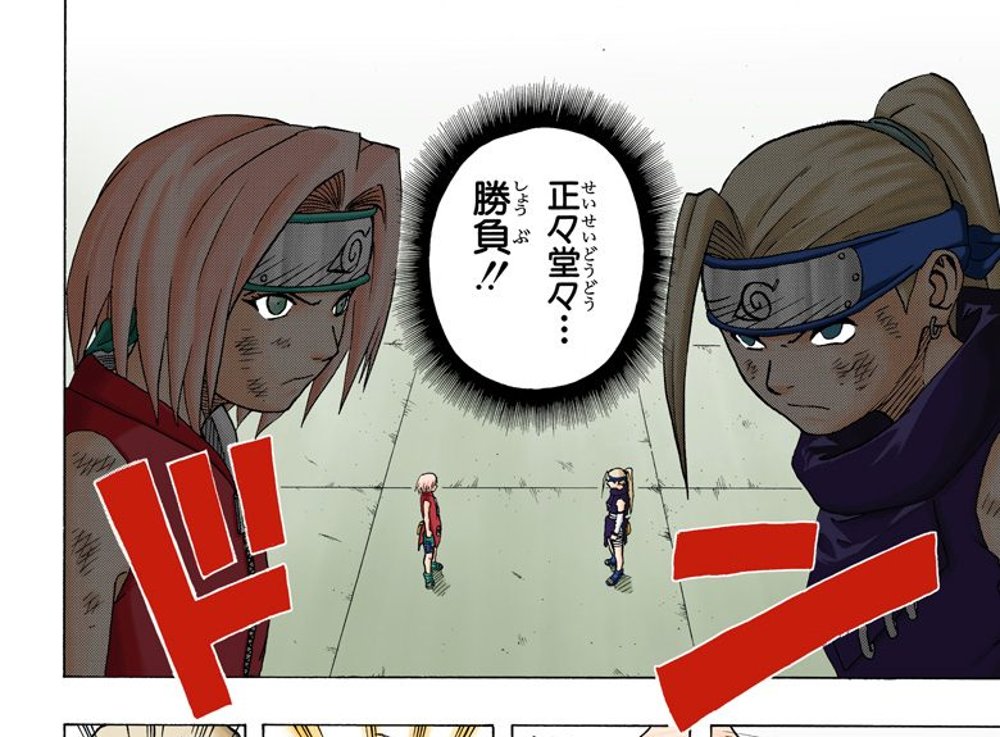
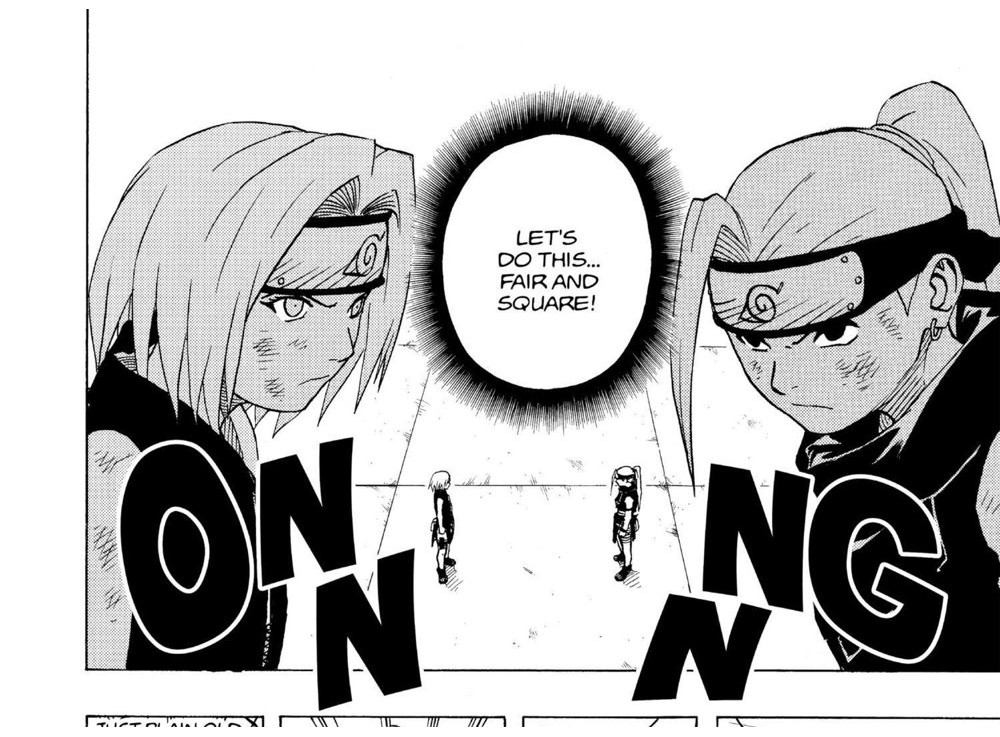
Then, both girls squared up on the tiles, Ino calls the terms of the match:
「正々堂々...勝負!!」
Seisei-dōdō… shōbu!!
VIZ's English edition prints: “LET'S DO THIS... FAIR AND SQUARE!” (Vol. 8, p.162).
Grant the rendering its due, because in this article that praise is the actual finding, not a formality. “Fair and square” is not a rough approximation reaching for the spirit of 正々堂々 — it is English's own doubled pair of near-synonyms, built to do almost exactly what the Japanese compound does: state, with emphatic redundancy, that nothing underhanded is about to happen. The two phrases even fall into the same two-beat shape in this exact panel: an opener, then the idiom, then the fight. It is worth pausing on this before the rest of the article turns skeptical, because most entries in this project's corpus don't get to.
The Original
正々堂々 welds two already-doubled words into a single four-character adverb, and both halves are worth taking apart.
正 (sei) is “correct, right, upright” — the character in 正しい (tadashii, “correct”). Reduplicated into 正々 (seisei), it means not merely correct but correct through and through, without a shred of trickery.
堂 (dō) is literally “hall” — the character in 講堂 (a lecture hall) or 議事堂 (the Diet building) — but by extension “imposing, dignified, unashamed.” Reduplicated into 堂々 (dōdō), it's the everyday word for standing tall without flinching (堂々とした態度, “a dignified bearing”).
Both doublings are marked on the page by the same small character: 々, the kurikaeshi (“repetition”) iteration sign. It isn't a word in its own right — it's a piece of orthography that tells the reader “repeat the previous kanji,” and Japanese reaches for it constantly: 人々 (hitobito, “people, every person”), 山々 (yamayama, “mountain range upon mountain range”), 時々 (tokidoki, “from time to time”). Stack two such doublings together — 正々 plus 堂々 — and you get a single adverb: openly, fairly, standing tall, nothing hidden.
The phrase's oldest recorded ancestor isn't even Japanese. Sun Tzu's Art of War advises a general: 無邀正正之旗、勿撃堂堂之陣 — do not intercept a banner flying 正正 (in perfect order); do not attack a formation standing 堂堂 (imposingly disciplined). That's military caution, a warning about an enemy so well-ordered that a head-on attack against it is folly. Japanese absorbed the phrase and flipped its use — from a warning about an opponent too disciplined to safely attack, into a badge of honor claimed for one's own conduct. 正々堂々と戦う, “to fight fair and square,” is the phrase a kendo instructor, a sumo referee, or (as here) a genin about to spar with her best friend all reach for.
Grammatically, the bare four-character phrase does real work as a stand-alone declaration — no verb needed — which is exactly why Ino can shout it as its own beat, then drop the one-syllable noun 勝負 (“a match, a contest”) after the ellipsis like a challenge flag. As vocabulary, JLPT guides usually shelve 正々堂々 at N2; its individual kanji are elementary, but the yojijukugo form and the classical-Chinese pedigree underneath it push the compound up a register.
VIZ's Choice
The Naruto corpus we have on file carries exactly one occurrence of 正々堂々 — this one. But this same expression turns up twice more in a companion article on this hub network, covering Demon Slayer's Akaza, and the contrast across all three is the real payoff of reading them side by side:
| Work / Vol. / p. | Speaker | Japanese | VIZ English (page-verified) |
|---|---|---|---|
| Naruto Vol. 8 / p.162 | Ino, to Sakura, mid-battle-cry | 正々堂々…勝負!! | LET'S DO THIS... FAIR AND SQUARE! |
| Demon Slayer Vol. 18 / p.103→104 | Akaza, dying, internal monologue | 正々堂々 | IT WAS A BOLD... ...AND SPLENDID TECHNIQUE. |
| Demon Slayer Vol. 18 / p.33→34 | Akaza, mid-battle, internal monologue | 正々堂々真正面から打ち砕かれた | HE CAME AT ME HEAD-ON AND COMPLETELY DEMOLISHED... (正々堂々 dropped) |
One occurrence out of three renders the idiom as “fair and square.” The other two, from the same publisher, the same translator's toolkit, do something else entirely: Akaza's own dying verdict on the technique that killed him becomes “bold,” trading a claim about his killer's integrity for a claim about his killer's nerve; one chapter earlier, the word is cut outright, its meaning folded (optimistically) into the surviving 真正面から, “head-on.”
A methodological note belongs here, because it's directly relevant to why this comparison is trustworthy rather than a guess. This project's bilingual corpus auto-pairs the Demon Slayer p.103 line with the English candidate “IT WAS FAIR AND SQUARE.” — the same plausible, dictionary-clean guess a machine aligner would make for any 正々堂々. It is wrong. The real printed VIZ page, verified directly against the page image, reads “IT WAS A BOLD... ...AND SPLENDID TECHNIQUE.” The Naruto occurrence in this article was checked the same way, independently, against both the Japanese and English page images — and here the corpus pairing holds up exactly as printed. Two nearly identical four-character phrases, two different verdicts on whether the machine-aligned guess can be trusted; the only way to know is to open the page.
So why does the idiom land for Ino and miss for Akaza? Register is the likeliest answer. Ino's line is shouted dialogue, punchy shonen battle-cry material, exactly the register “fair and square” was built for in English. Akaza's lines are hushed narration boxes — a centuries-old swordsman grading his own death in solitary, formal reflection — and “bold... and splendid technique” simply scans better in that quieter, more literary cadence than the punchier “fair and square” would have. The translator isn't being inconsistent so much as making a fresh call every time, because 正々堂々 was never treated as a fixed formula requiring one fixed English answer. It's a translator's choice made new in each scene — which is precisely why owning the right-shaped English phrase is no guarantee it survives to the panel that needs it most.
The Gap
Success here doesn't predict success elsewhere — not even within the same idiom. The clearest lesson of the table above is that “English happens to have a matching doubled phrase” and “that phrase gets used” are two separate facts. Ino gets it. Akaza, dying, arguably needs it more — his entire warped code of honor rests on that one word — and doesn't get it at all.
The doubling mechanism is invisible even when the outcome is right. “Fair and square” pairs two different words (fair, square) for emphasis — the same trick as “safe and sound” or “null and void.” 正々堂々 pairs one root with itself, twice, marked visibly by 々. The rhyme these two idioms share is real; the grammar producing it is not the same operation, and nothing on the English page tells a reader that Japanese is doing something its own language can't.
Two claims collapse into one idiom's worth of meaning. 正々 (scrupulous rightness) and 堂々 (undaunted bearing) are independently doubled words making two separate claims — one about honesty, one about composure and standing tall under pressure. “Fair and square” reads as a single frozen unit to an English ear; there's no way to notice that “square” is quietly doing the work of an entirely separate word about bearing, not merely honesty.
The military ancestry evaporates. 正々堂々 descends from Sun Tzu's description of a formation too disciplined to safely attack — a claim about invincible order. English “square” most likely descends from a carpenter's tool guaranteeing a true right angle — an image about precision, not martial grandeur. The two idioms meet in the same place today by entirely different roads, and none of the classical-Chinese battlefield weight makes the crossing.
What If
- “COME AT ME — FAIR AND SQUARE!” — turns the declaration into a direct command, closer to how the two-beat Japanese lands as a dare. Cost: adds a verb the Japanese doesn't have, softening the bare noun-phrase bluntness of 正々堂々…勝負!! into something more conversational.
- “OPENLY. HONORABLY. LET'S FIGHT!” — splits 正々 and 堂々 into two separate English beats, mirroring the compound's own two-part construction. Cost: sounds like a formal oath rather than a genin's battle cry; loses the tight, punchy rhythm of the four-character original.
- “NO TRICKS. JUST US.” — a leaner, more contemporary paraphrase of the “nothing hidden” half of 正々堂々, in language a modern teenager might actually say. Cost: drops the ceremonial, classical-register weight entirely — reads flat where 正々堂々 is formal.
- Keep VIZ's idiom, tighten the shape: “FAIR AND SQUARE — LET'S GO!” — hugs closer to 正々堂々…勝負!!'s own order, idiom first, challenge second. Cost: “let's go” undersells 勝負's weight as a formal declaration of contest, more casual than the Japanese noun it replaces.
Notice what none of these options need to solve: unlike almost every other article in this project, no alternative here has to invent English vocabulary from nothing. The raw material — “fair and square” — was already sitting on the shelf. The only question was ever whether to reach for it.
Take-away
正々堂々 is proof that a Japanese four-character idiom and its nearest English phrase can share not just a meaning but a shape — two doubled halves on one side, two paired synonyms on the other — and still not be the same trick. Ino's challenge to Sakura is the rare case in this project where VIZ's reflex reach for “fair and square” happens to be exactly right. It is not a rule. Three volumes and one publisher later, the same four characters carry a dying demon's entire moral universe, and the phrase is nowhere on the page.
Three rules of thumb to carry off this page:
- A structural match is not a guarantee. English owning a phrase shaped like the Japanese — doubled, paired, rhythmically twinned — tells you nothing about whether a translator will reach for it in any given panel. Check the panel, not the dictionary entry.
- 正々堂々 is two doublings, not one. 正々 (fairness) and 堂々 (bearing) are each doing separate work; a translation that keeps only one half of that — as “bold” keeps only bearing, dropping fairness — has kept half the compliment.
- 々 marks a real grammatical operation. Whenever you meet it — in 正々堂々, in 人々, in 山々 — you're looking at a root repeating itself, not two words that happen to rhyme. English's nearest cousins, binomial pairs like “fair and square,” get a similar rhythm from a completely different mechanism.
This isn't the only place a Naruto yojijukugo carries more than its English replacement keeps: see the four-character verdict VIZ cut to one word in 問答無用, the Confucian doctrine flattened into “justify” in 大義名分, and the whole story packed into 一部始終 — or browse the full Naruto translation notes index. For the one time this exact idiom meets a translator who reaches the other way — dropping it or swapping it for “bold” in a dying demon's own verdict on his killer — see this hub network's companion piece on Demon Slayer's own 正々堂々, from Akaza's death in Volume 18.
Every Japanese and English line quoted above from the Naruto scenes is a byte-exact capture from NARUTO―ナルト― Vol. 8 (Japanese edition) and Naruto Vol. 8 (VIZ Media) at the corresponding panels, via our bilingual page database; see Sources and References below. The two Demon Slayer comparison lines in VIZ's Choice were independently verified against 鬼滅の刃 Vol. 18 (Japanese edition) and Demon Slayer: Kimetsu no Yaiba Vol. 18 (VIZ Media) page images, since the corpus's own automatic pairing for one of them does not match the real printed panel; the corpus's exact bytes are preserved in References.