The Moment
Skypiea, the sky island — and the self-declared god Enel has spent the last several pages demonstrating, almost bored, that nothing Zoro throws at him lands. He shrugs off point-blank fire (「パズーカの業火をかき消した...!!」 — "HE STOPPED THE BAZOOKA FLAME?!"), tells Zoro that his entire reserve of strength is 「無に等しい」 next to his own — "NOTHING COMPARED TO MINE!!" — and promises to teach Zoro's body 「神の定義」, VIZ's "THE KAMI'S RULES." Then, mid-beating, he pauses to explain the theology behind it:
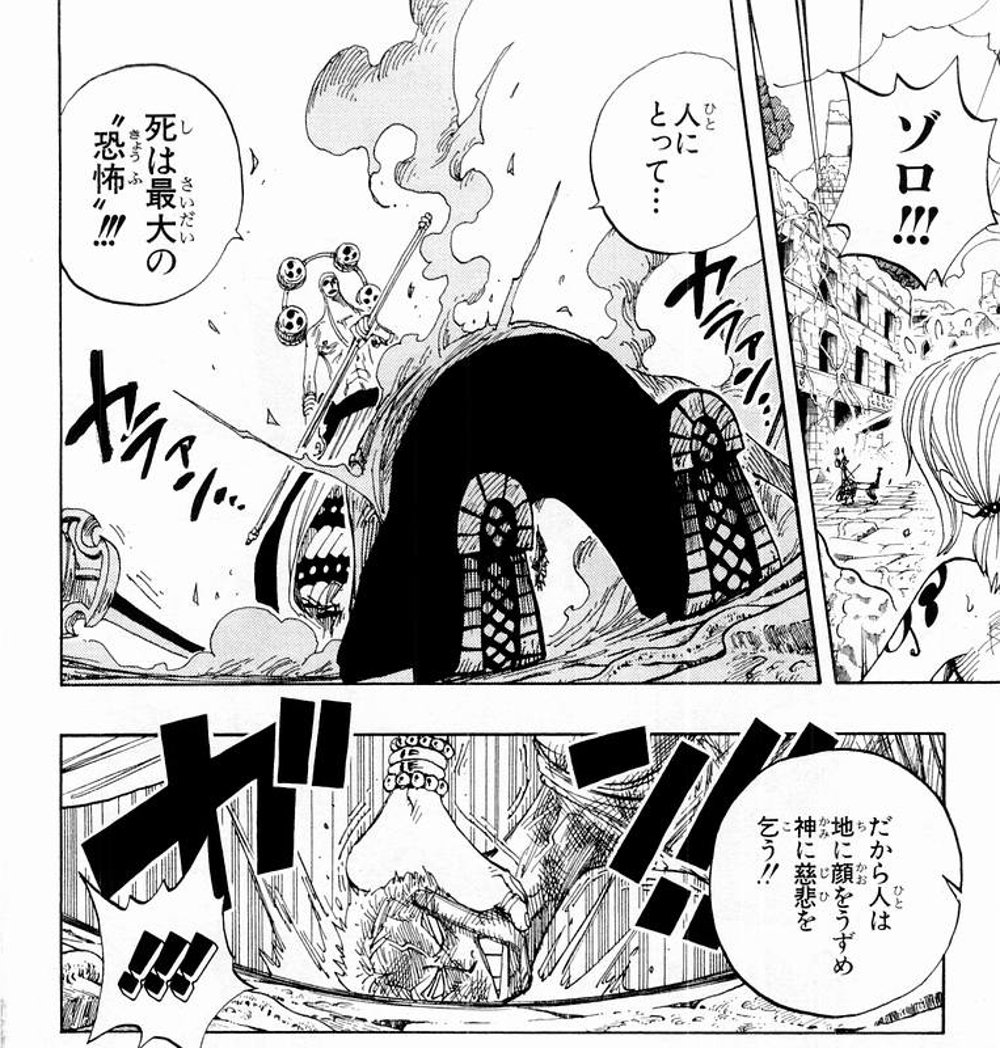
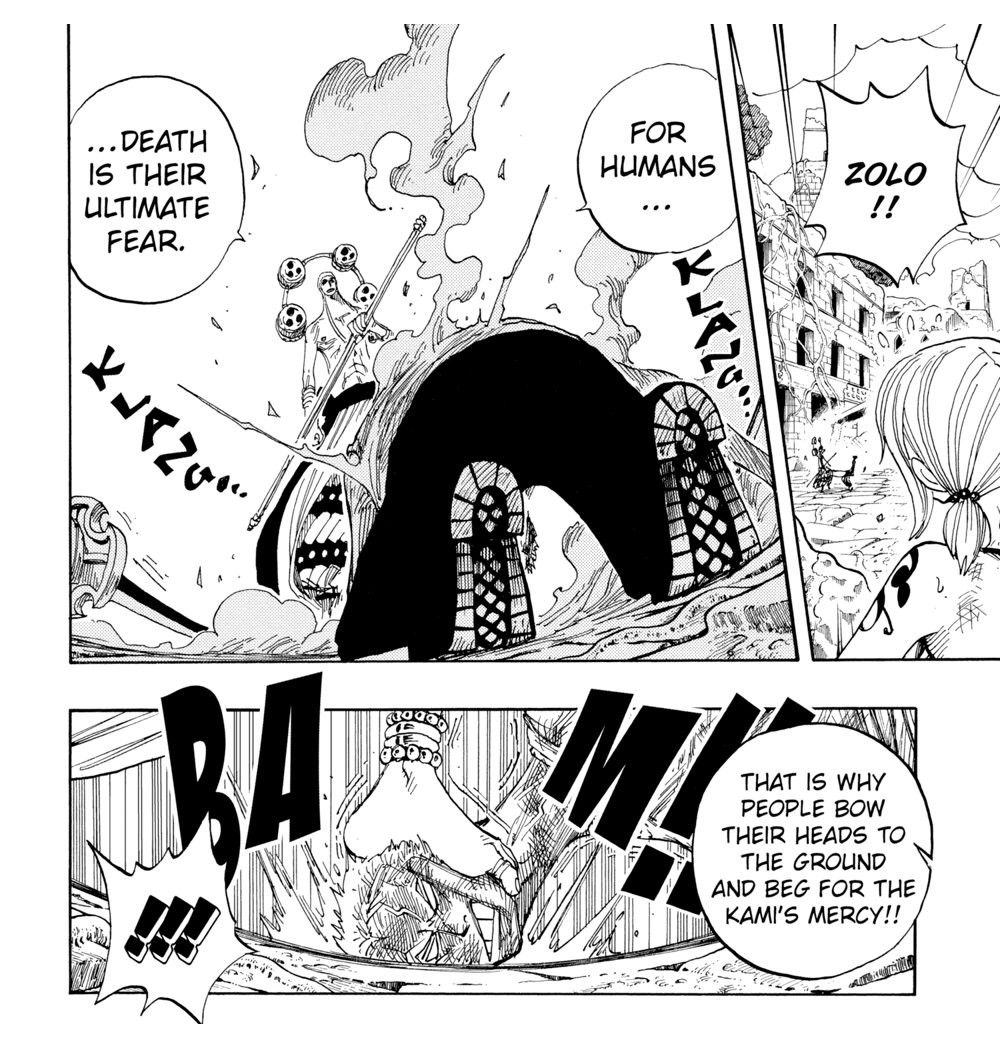
「人にっとって...死は最大の“恐怖”!!!」
Hito ni totte… shi wa saidai no "kyōfu"!!!
VIZ: "FOR HUMANS... DEATH IS THEIR ULTIMATE FEAR."
And then the line this article is built around:
「だから人は地に顔をうずめ神に慈悲を乞う!!」
Dakara hito wa chi ni kao o uzume kami ni jihi o kō!!
VIZ's English edition: "THAT IS WHY PEOPLE BOW THEIR HEADS TO THE GROUND AND BEG FOR THE KAMI'S MERCY!!" (Vol. 29, p.222).
Grant the rendering its due first: it's a tight, punchy line that correctly keeps 神 as "kami" instead of flattening it into a generic "God," and "MERCY" is exactly the word an English-speaking reader expects a beggar to ask a deity for. Nothing here is a mistranslation. But look closely at what 地に顔をうずめ actually pictures — not a bow, a burial: mortals press their own faces into the dirt — and then listen to what they're asking for once they're down there. 慈悲 is not one Buddhist virtue. It is two, welded together, and "mercy" only has a seat for one of them.
The Original
Take 慈悲 (jihi) apart, because Buddhist dictionaries insist on treating the two halves as separate jobs, not synonyms of one warm feeling.
慈 (ji) renders the Sanskrit maitrī — loving-kindness, the active wish to give others happiness. It's the same 慈 in 慈しむ (itsukushimu, "to cherish tenderly") and 慈愛 (jiai, a mother's compassionate love). This half of the word doesn't wait for suffering to exist first; it's generosity offered on its own terms.
悲 (hi) renders the Sanskrit karuṇā — compassion born specifically from perceiving suffering, the wish to end it. It's the 悲 in 悲しい (kanashii, "sad") and 悲しむ (kanashimu, "to grieve"). This half is reactive: it needs pain in the room before it can do its work.
Put the two together and Buddhist glossaries hand you a tidy four-character definition: 与楽抜苦 (yoraku-bakku) — 与楽 "bestow joy," 抜苦 "uproot suffering." 慈悲 names two acts, not one emotion. It sits inside the 四無量心 (shi-muryōshin), the Four Immeasurable Minds a Buddhist practitioner cultivates toward all beings without exception: 慈 and 悲, alongside 喜 (muditā, sympathetic joy at others' happiness) and 捨 (upekkhā, equanimity).
The grammar of the line itself needs none of that machinery to parse: [PERSON に 慈悲を乞う], "to beg PERSON for jihi." What does the work is 乞う (kou), a formal, almost liturgical verb for "to beg, entreat" — a register above the everyday 頼む (tanomu, "to ask [a favor]"). Grammar-simple, vocabulary-heavy: 慈悲 is JLPT N1, and the concept behind it — a compassion built from two distinct verbs, not a mood — is bigger than any single level tag.
VIZ's Choice
Both appearances of 慈悲 in the volumes we have on file, side by side with the official English:
| Vol. / p. | Japanese | VIZ English |
|---|---|---|
| 29 / 222 | だから人は地に顔をうずめ神に慈悲を乞う!! | THAT IS WHY PEOPLE BOW THEIR HEADS TO THE GROUND AND BEG FOR THE KAMI'S MERCY!! |
| 34 / 39 | えぇ!!?なんて慈悲深い.....!! | HUH!? SO MERCIFUL!! |
Where our earlier pieces on 因縁 and 往生際 found scatter — one Japanese phrase, five different English guesses — 慈悲 does the opposite. It converges. Two appearances, two completely different scenes, and "mercy"/"merciful" both times. In Vol. 34, on Foxy Pirates territory, one crewman has just growled 「情けは無用だ...奪うもんは奪って貰うぜ!!」 — "WE DON'T NEED YOUR PITY--JUST TAKE WHAT YOU WANT!!" — refusing charity, only for Luffy to let them keep their sail and redraw the mark himself. Another crewman gasps 「えぇ!!?なんて慈悲深い.....!!」 — "HUH!? SO MERCIFUL!!" — genuine, startled gratitude at an unearned kindness. Notice, in passing, that VIZ actually does distinguish 情け (nasake, secular "pity") from 慈悲 (jihi) on that same page — "pity" for the first, "merciful" for the second — a small, real piece of translator care worth crediting.
But set the two 慈悲 scenes side by side and the convergence is the finding. Whether the word describes Luffy's spontaneous generosity to strangers or Enel's self-serving demand that terrified subjects grovel for what he alone controls, English reaches for the identical vocabulary both times. Japanese uses one word for both scenes too — but it's a word built to mean two different actions at once, so a Japanese reader can feel that Luffy's 慈悲深い is mostly 慈 (freely given) while Enel's 慈悲 is mostly 悲-shaped extortion (suffering he created and alone can lift). "Mercy" can't make that distinction. Consistency isn't the same as accuracy.
The Gap
"Mercy" only survives the courtroom half of 慈悲. Mercy is what a judge or a king chooses to withhold — the punishment you deserved but didn't get. It is reactive by definition: no offense, no mercy needed. 慈, the joy-giving half of 慈悲, isn't reactive at all — it's unconditional generosity that doesn't require anyone to have done anything to deserve it first. Enel's line asks mortals to beg for exactly that reactive, courtroom half; "mercy" fits him disturbingly well. But the word itself carries the other, unconditional half too — and that's the half a false god's usage quietly steals, because he only ever offers the withholding, never the giving.
The compound's structure disappears. A reader meets "BEG FOR THE KAMI'S MERCY" and has no way to know the Japanese word underneath is built from two kanji doing two jobs — bestow joy, remove suffering — the same way 因縁 welds a direct cause to a surrounding condition. English supplies one noun where Japanese supplies a small doctrine.
The borrowed robes go unnoticed. 慈悲's natural habitat is sutras and bodhisattva epithets — 大慈大悲, "great compassion," belongs to Kannon, who hears suffering and answers it without limit. Enel, a man with a lightning Devil Fruit and a god complex, is trying on that vocabulary as a costume: what follows his "mercy" line — 「仕方のない事さ...生物は恐怖の前にひれ伏すようにできている...本能というものだ」, "IT CAN'T BE HELPED... CREATURES ARE MADE TO BOW DOWN IN THE FACE OF TERROR... THAT'S INSTINCT" — reframes the whole transaction as biology, not virtue. A bodhisattva's 慈悲 is a vow, freely renewed; Enel's is a shrug over an animal reflex he engineered. "Mercy" alone can't signal that the word has been lifted from a temple and repurposed as tyranny's vocabulary — you need to already know where 慈悲 usually lives to feel the theft.
What If
No rendering is free; here is the menu and its prices.
- "...and beg the god for compassion." — warmer than "mercy," leans toward karuṇā. Cost: still one undifferentiated noun; 与楽/抜苦 vanish just the same.
- "...and beg the god to spare them and comfort them." — spells out both halves in plain verbs. Cost: a single word becomes a clause; the line's punch is gone.
- "...and beg the god for his grace." — "grace" captures the unconditional-gift sense "mercy" lacks. Cost: swaps in a Christian theology for a Buddhist one — a different borrowed religion, not a neutral fix.
- Keep "MERCY," restore the prostration: "GROVEL, FOREHEADS TO THE DIRT, AND BEG THE KAMI FOR MERCY." — recovers the physical violence of 地に顔をうずめ. Cost: 慈悲's internal split is still invisible; only the posture comes back.
Every option pays because English built "mercy" around a courtroom, and 慈悲 was built around a shrine. Translating between the two buildings always leaves something on the floor.
Take-away
When a self-styled god in One Piece asks for 慈悲, he's asking for something with two working parts — joy freely given, suffering actively lifted — and claiming the authority of a bodhisattva while offering neither in good faith. English's "mercy" is a single, reactive virtue: the harm withheld, never the joy bestowed. The word survives the transfer; half its engine doesn't.
Three rules of thumb to carry off this page:
- When you meet 慈悲, listen for both halves — 慈 (give joy) and 悲 (remove suffering) — even when English can only afford one word for the pair.
- Watch for 慈悲 anywhere someone borrows a bodhisattva's authority — 大慈大悲 is Kannon's title, and any character who reaches for it (sincerely or not) is making a theological claim, not just a kind gesture.
- Don't mistake translation consistency for translation completeness: "mercy" showing up reliably every time doesn't mean nothing was lost — it can just mean English only had the one word to lose it to.
For Enel's other borrowed Buddhist vocabulary — the taunt that tells his enemies they don't know how to die — see 往生際が悪い and the Buddhist Death Buried in a Villain's Taunt. And for more lines where the words survive translation and the fingerprint doesn't, browse the One Piece translation notes index.
Every Japanese and English line quoted above is a byte-exact capture from the cited editions — ONE PIECE Vol. 29 & Vol. 34 (Japanese) and One Piece (VIZ Media) at the corresponding panels — via our bilingual page database; see Sources below.