The Moment
Skypiea, the city in the clouds. Enel, the self-declared god of this sky island, has just told the Straw Hats to clear out before he destroys the country wholesale. Nico Robin, refusing to be herded off like everyone else, pushes back:
「それをもし断ったら...?」
VIZ: "AND WHAT IF WE REFUSE?"
Off to the side, Nami calls out, worried: 「ロビン...!!」 — "ROBIN!" Enel's answer comes instantly, and it is not a negotiation:
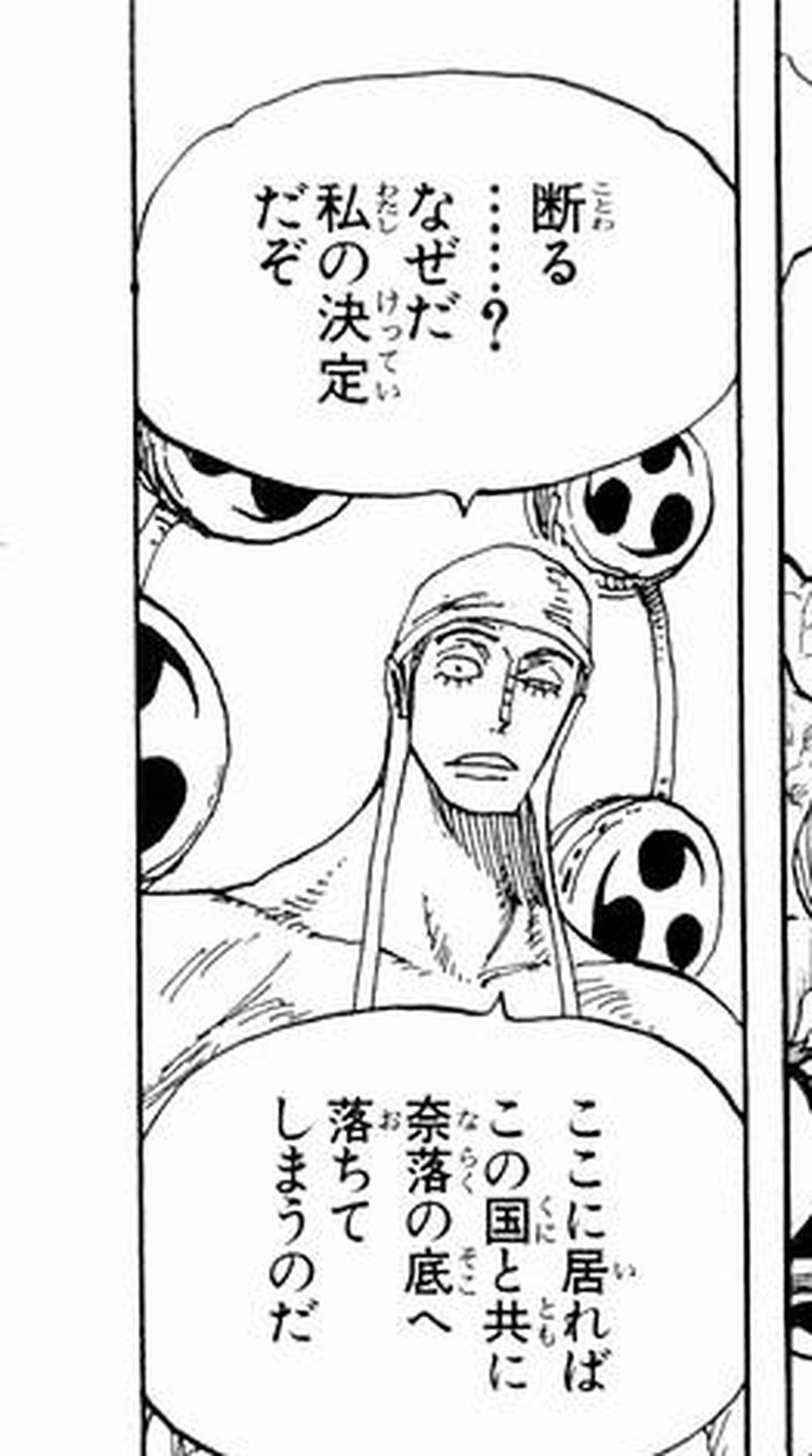
「断る...?なぜだ私の決定だぞ」
Kotowaru…? Naze da watashi no kettei da zo
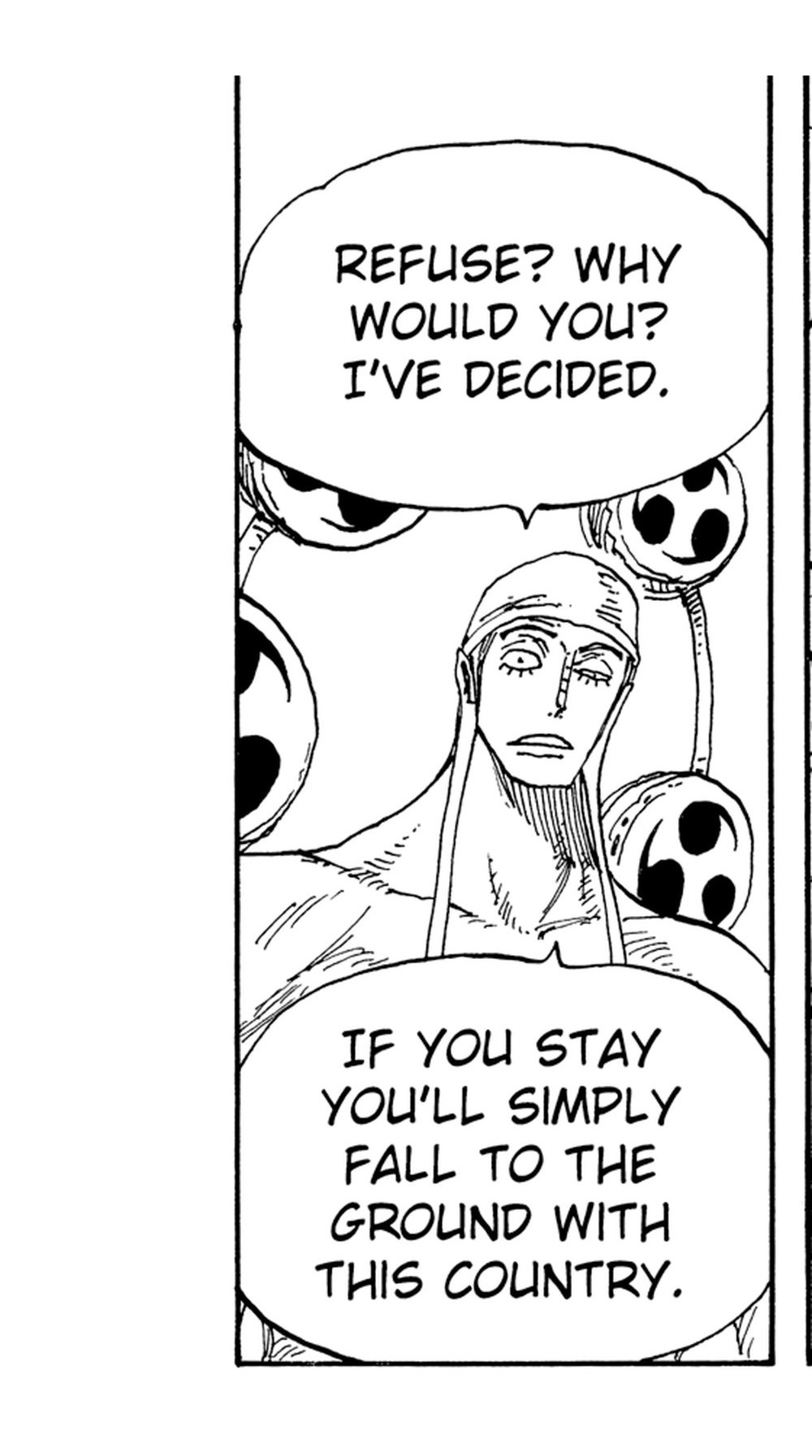
VIZ: "REFUSE? WHY WOULD YOU? I'VE DECIDED."
Then he explains, matter-of-factly, exactly why refusal isn't really an option:
「ここに居ればこの国と共に奈落の底へ落ちてしまうのだ」
Koko ni ireba kono kuni to tomo ni naraku no soko e ochite shimau no da
VIZ's English edition: "IF YOU STAY YOU'LL SIMPLY FALL TO THE GROUND WITH THIS COUNTRY." (Vol. 29, p.208.)
Give the line its due before taking it apart: it's clear, it's ominous, and — this is the twist that makes 奈落 worth an entire article — it is also, on the level of plain physics, completely true. Skypiea is a country floating in the sky; Enel intends to bring it down. "Fall to the ground" isn't a mistranslation. Robin herself concedes the same physical point a beat later: 「確かに...あなたの能力ならそれもできるのでしょうけど」 — "IT'S TRUE YOUR POWERS COULD MAKE THAT HAPPEN..." But listen again to the word Enel actually reached for. He didn't say 地面 (jimen, "the ground") or 下 (shita, "down below"). He said 奈落. And 奈落 isn't scenery. It's hell.
The Original
Most of the Buddhist compounds in this series of articles — 因縁, 慈悲, 冥土 — are built the same way: two meaningful characters welded together for their sense. 奈落 (naraku) is built the opposite way, and that's the whole story.
奈 (na) is nearly a dead character in modern Japanese. It carries no real independent meaning here; it survives mainly as a phonetic placeholder, the same 奈 that spells the place name 奈良 (Nara) — itself probably an old sound-borrowing too, not a "meaningful" compound. 落 (raku), by contrast, is very much alive: it means "to fall, to drop," the same 落 as 落下 (rakka, "a fall") and 落ちる (ochiru, "to fall"). Put them together and 奈+落 simply reproduce the syllables na-ra(ku) of the Sanskrit word they're carrying into Japanese: naraka, hell.
This technique has a name: 音写 (onsha), "writing by sound" — choosing kanji purely for their pronunciation and letting the meaning ride along for free (or not at all), the same method that gave Japanese loanwords like 卒塔婆 (sotoba, from stūpa). The happy accident here is that 落 also happens to mean "fall" — so the sound-borrowing echoes the doctrine anyway, since beings whose accumulated bad karma sends them to hell are traditionally described as falling into it.
Now set 奈落 next to its sibling, 地獄 (jigoku) — "hell" in the sense every learner meets first. 地獄 breaks into 地 ("earth, ground") and 獄 ("prison"): a plain semantic translation — 意訳 (iyaku) — of the same Sanskrit naraka, built from characters chosen because they mean "an underground prison," not because they sound like the original word at all. (Our companion pieces on Demon Slayer's and Naruto's own 地獄 lines dig into that word's eight-tiered cosmology in detail — same coordinate system, different franchise, same word.) One Sanskrit concept, two Japanese words, two opposite translation strategies: 奈落 borrowed the sound; 地獄 borrowed the sense. They describe the identical Buddhist hell, arrived at by completely different roads.
And because 落 means "fall" on its own, the idiom in this very line — 奈落の底へ落ちる — quietly repeats itself: the same 落 that spells "fall" inside 奈落 reappears a few syllables later as the ordinary verb 落ちる. Native readers barely register the echo, but it doubles down on the falling all the same. As for level: 奈落 isn't on any standard JLPT list at all. Treat it as advanced, literary vocabulary — a word recognized instantly from set phrases and ghost stories, rarely produced spontaneously in conversation.
VIZ's Choice
This is the only appearance of 奈落 in the volumes we have on file — no scatter to chart, no table of five different guesses. That makes the single choice worth sitting with rather than skating past.
Faced with 奈落の底へ落ちてしまうのだ, the translator had, roughly, three roads available: keep the hell ("fall to hell," "plunge into the abyss"), keep the idiom's ordinary meaning of ruin ("you'll go down with this country"), or keep the literal physics ("fall to the ground"). VIZ chose the third — and it's a defensible choice on its own terms. Skypiea's fall is not a metaphor waiting to happen; it is the actual plot of the next several chapters. A translator who wrote "YOU'LL FALL INTO HELL" here risks a reader assuming Enel is threatening something supernatural, when what he's describing is gravity.
But notice what that choice costs against the two companion words already published on this hub. In 因縁, English scattered one Japanese concept across five different renderings. In 慈悲, English converged two different scenes onto one word, "mercy." Here, with only one data point, the pattern is neither scatter nor convergence — it's erasure. 奈落 shows up exactly once in this corpus, and the one English sentence built from it contains no trace of hell, abyss, underworld, or pit. The word that gives kabuki its trapdoors and Japanese its go-to idiom for hitting rock bottom left no residue at all.
The Gap
English is forced to choose between the literal and the figurative, and the Japanese refuses to. 奈落の底へ落ちる in Enel's mouth is simultaneously the standard idiom for total ruin and a literal description of what's about to happen to a floating island — the pun is the point. VIZ's "FALL TO THE GROUND" preserves only the literal half; nothing signals to an English reader that the sentence is also doing idiomatic double duty.
The geometry inverts. 奈落 names a bottomless pit — depth without a floor, the whole reason 奈落の底 ("the bottom of naraku") is a meaningful phrase to say at all. "Ground" names the opposite: the thing you land on, solid and finite. The Japanese threatens an endless fall into hell; the English promises a landing.
The register drops. Enel has spent this entire scene talking like a god issuing a verdict — 私の決定だぞ, のだ, clipped and absolute. 奈落 belongs to that same elevated, quasi-liturgical register. "Fall to the ground" is plain, almost clinical English, the sentence a physics teacher might use rather than a self-declared deity pronouncing a sentence.
What If
No option here is free; here's the menu and its prices.
- "Stay, and this country will drag you down to hell with it." — restores the Buddhist hell and the "total ruin" idiom in one word. Cost: loses the literal, physical "falling from the sky" half of the pun that VIZ's version actually nailed.
- "If you stay, you'll plunge into the abyss along with this country." — "abyss" keeps 奈落's bottomless-pit geometry. Cost: reads as pure metaphor; nothing signals the literal fall coming a few chapters later.
- "Stay here, and you'll go down with this country — all the way down." — gestures at bottomlessness while keeping both readings alive. Cost: wordier and softer than Enel's clipped のだ.
- "IF YOU STAY, YOU'LL FALL TO HELL WITH THIS COUNTRY." — a single word swapped into VIZ's own sentence restores the theology without sacrificing the literal-fall reading. Cost: "hell" is blunter and less specific than 奈落's bottomless-pit imagery, and it can't match the register of the more formal 奈落の底.
The lesson underneath all four: a pun built to work as both physics and theology can survive translation into English vocabulary, or English register, or English's literal/figurative split — but rarely all three at once.
Take-away
奈落 is a reminder that not every Buddhist word in Japanese arrived in translation — some arrived as pure sound, phonetic characters standing in for a foreign syllable, with their "meaning" riding along as a bonus rather than the point. Enel's line uses that borrowed hell to describe an entirely literal fall from the sky, and English, forced to pick one reading, picks the one that isn't about hell at all.
Three rules of thumb to carry off this page:
- 奈落 and 地獄 name the same hell by two different methods. 奈落 borrowed naraka's sound (音写); 地獄 borrowed its sense (意訳). When you meet either, ask which road it took — the same question is worth asking of Demon Slayer's and Naruto's own 地獄 lines, which chase the eight-tiered version of this same underworld through ten different English words.
- 落 is doing double duty. Inside 奈落 it's a phonetic syllable; a few words later, in 落ちる, it's the ordinary verb "to fall." The repetition is easy to miss and impossible to translate cleanly.
- Watch for words built to work twice. When a Japanese line reads as both literal description and standing idiom at once, expect English to keep only one — and expect the choice to depend on which reading the plot needs next.
For the same borrowed hell arriving by a different door, see the souvenir Buggy withholds in 冥土の土産 — 冥土 names the same afterlife journey without naming hell specifically. And for the karmic tie that gets the opposite treatment — one Japanese word, five different English guesses instead of one English guess with nothing in it — see 因縁 and the bond English can't hold. Enel's own taunts turn up again in 往生際が悪い and the Buddhist death buried in a villain's insult, or browse the full One Piece translation notes index.
Every Japanese and English line quoted above is a byte-exact capture from the cited editions — ONE PIECE Vol. 29 (Japanese) and One Piece Vol. 29 (VIZ Media) at the corresponding panels — via our bilingual page database; see Sources below.