The Moment
Swordsmith Village. Upper Rank Four, Hantengu, has spent this entire fight doing what he always does when cornered: splitting a fresh, fully powered demon off his own body for every strong emotion — rage, joy, grief, fear — while the true Hantengu, cowardly and small enough to hide inside a closed fist, keeps clear of the actual fighting. A narration box a few pages earlier names the pattern outright, tracking in Tanjiro's own head how this demon has clawed his way out of tight spots 'many times' this way, growing stronger 'the more we press him' — and the thought curdles into a question the demon is about to weaponize: why does it feel like we're the villains?
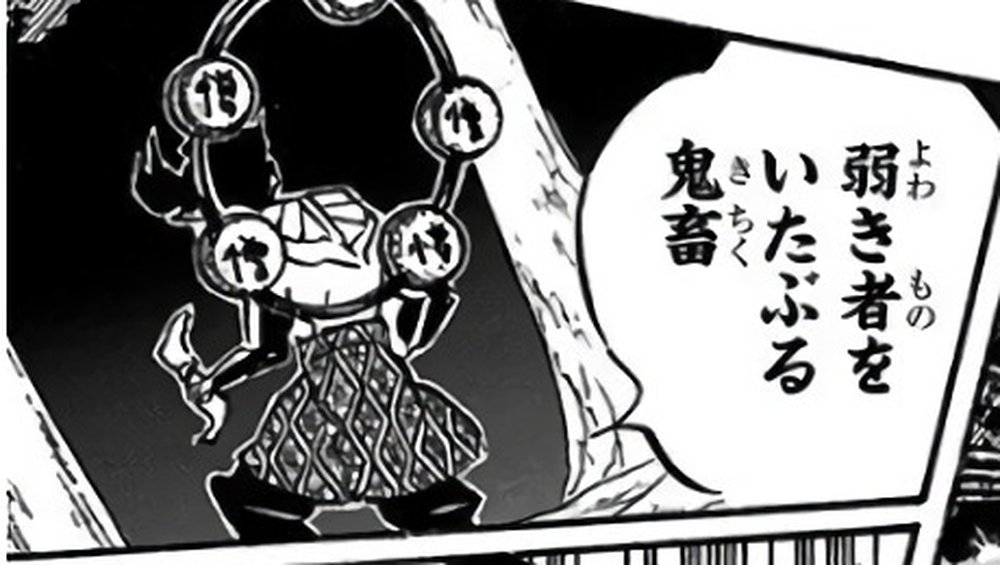
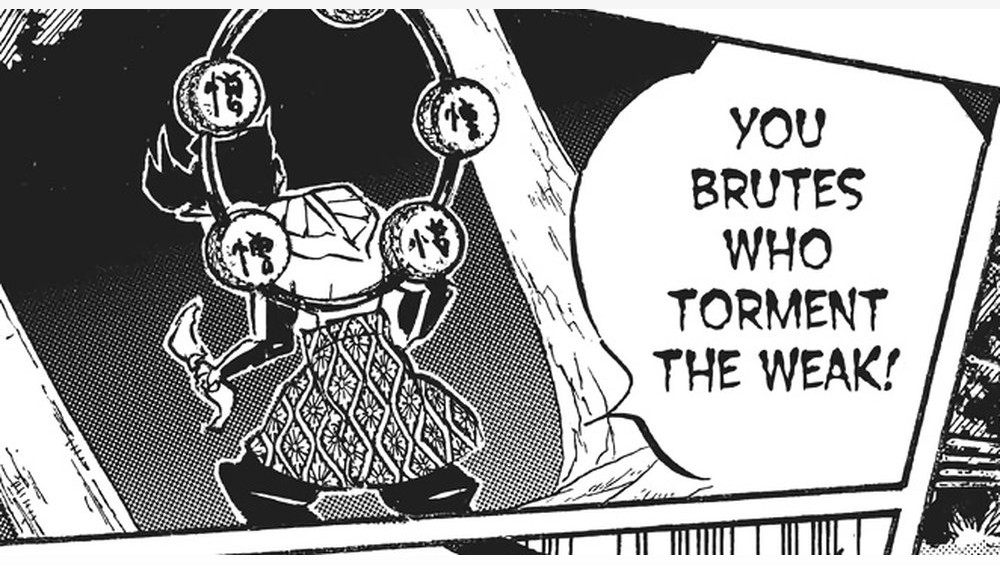
Tanjiro has just landed a hit on that tiny true body. Bleeding from the foot, the miniature Hantengu — a knot of limbs strung between prayer-bead faces — turns the fight into a trial, and casts the slayers as the guilty party:
「弱き者をいたぶる鬼畜」
Yowaki mono o itaburu kichiku
VIZ's English edition prints: "YOU BRUTES WHO TORMENT THE WEAK!" (Vol. 14, p.13).
Give the line its due: "brutes" is doing real work here. It's punchy, it's exactly the size of the speech bubble VIZ's letterer had to fill, and "torment the weak" correctly carries the accusation — cruelty aimed at a victim who supposedly can't fight back. As courtroom theater, in a single panel, it lands.
But listen to what's compressed inside the Japanese noun VIZ folds into "brutes": 鬼畜, kichiku — and Hantengu is, categorically, one half of his own insult.
The Original
Take the compound apart. 鬼 (oni) means "demon, ogre, devil" — and it is the same 鬼 that opens the manga's own Japanese title, 鬼滅の刃 (Kimetsu no Yaiba, "Blade of Demon Destruction"), and names every monster Tanjiro has fought since chapter one. 畜 (chiku) is the bound root of 畜生 (chikushō), "livestock; beast" — the Animal Realm of the six-fold wheel of rebirth Buddhist cosmology sorts every unenlightened soul through: 天 (heaven), 人 (human), 修羅 (asura, endless warfare), 畜生 (animal), 餓鬼 (hungry ghost), 地獄 (hell).
鬼 itself never shows up as one of those six realm-names on its own — but it is the folk face of two of them at once. Oni stand guard as hell's tormentors in temple painting and centuries of setsuwa literature, and 鬼 supplies the literal kanji sitting inside 餓鬼 (gaki), the hungry-ghost realm (the subject of a companion piece on this site — see Take-away below). So 鬼畜 reads, literally, demon and beast — and doctrinally, it doesn't just call someone cruel. It drags them through two of the lowest rungs of the 三悪道 (san'akudō), the "three evil paths" reserved for hell, hunger, and animal ignorance: past ordinary human failing, straight into subhuman territory, twice over.
Grammatically the word is a bare noun. It can stand alone as a shouted epithet ("you kichiku!"), or modify another noun with の, as in this article's second occurrence, 鬼畜の所業 — literally "a demon-and-beast's line of work." No verb conjugation, no register cushioning: just the noun, dropped like a verdict.
VIZ's Choice
Every appearance of 鬼畜 in the volume we have on file, both from the same scene, both from the same speaker:
| Vol. / p. | Speaker | Japanese | VIZ English |
|---|---|---|---|
| 14 / 13 | Hantengu, true form (tiny body) | 弱き者をいたぶる鬼畜 | YOU BRUTES WHO TORMENT THE WEAK! |
| 14 / 24 | Hantengu, pressing the accusation via one of his emotion-clones | これはもう鬼畜の所業だ | A FIENDISH DEED. |
Where our 餓鬼 piece found total convergence across seven speakers and five volumes, this is a tighter, stranger pattern: the same demon, doubling down on the same accusation eleven pages apart, and VIZ answers with two different but equally well-chosen English phrases — "brutes," a noun aimed at people, and "a fiendish deed," a noun aimed at the act itself. Both are accurate registers. Both are the correct emotional temperature: righteous, wounded, absolute. Neither one is the same word twice, which — read generously — is good localization instinct, varying the English the way a real speaker varies emphasis under interrogation. But because neither rendering touches the compound's architecture, the two lines don't rhyme in English the way they rhyme in Japanese: a reader of the translation has no way to know the demon reached for the exact same charged word both times, building his case brick by identical brick.
The Gap
The double-realm fusion collapses to a single note of "monstrous." "Brutes" and "fiendish" both land in the same general lane — cruel, inhuman, bad — but 鬼畜 is doing something more specific than intensity: it names two Buddhist rebirths at once, hell's demon-guards through 鬼 and the animal realm through 畜. English has adjectives for "very cruel"; it doesn't have a compound that demotes someone through two named cosmological categories in four syllables.
The reflexive irony disappears entirely. A reader who doesn't recognize 鬼 as "the word this whole manga's villains are named for" cannot see what a Japanese reader sees instantly: a demon, calling humans "demon-and-beast," in a series about hunting demons. "Brutes" carries no trace of oni. The joke — if it is a joke, and Gotouge's Hantengu is written with enough self-serving cunning that it plausibly is one, even unconsciously — cannot survive translation into a word with no demon inside it.
The propaganda charge goes silent. 鬼畜's loudest twentieth-century outing is 鬼畜米英, the wartime slogan that branded an entire enemy nation as devils. That history doesn't make it into a manga panel, but it's part of why the word lands as hard as it does on a Japanese page — the reader's ear has heard this exact compound used to dehumanize before. "Brutes" is a strong word. It has never named a war.
The manipulation loses its precision. The narration a page earlier all but tells the reader this accusation is a tactic, not a genuine grievance. "Brutes" reads as pure sincerity — a victim's cry. 鬼畜, read with the doctrinal irony intact, reads as something closer to a confession mistaken for an accusation.
What If
The menu and its prices, for the headline line:
- "YOU DEMON-BEASTS WHO TORMENT THE WEAK!" — keeps both halves of the compound visible on the page. Cost: confusing from a literal demon's mouth; a reader might parse it as self-description rather than insult.
- "YOU INHUMAN FIENDS!" — "inhuman" reaches for the beast half, "fiend" for the demon half. Cost: the specific two-realm architecture is gone; it reads as generic intensified cruelty.
- "YOU MONSTERS, PREYING ON THE WEAK!" — keeps the venom and the news-headline register 鬼畜 genuinely carries in real Japanese. Cost: "monster" is a softer, vaguer word than 鬼畜's deliberate cosmological precision.
- Keep "BRUTES," but let the irony surface elsewhere — a glossary note, a translator's aside — flagging that the speaker is, structurally, half of his own insult. Cost: doesn't fix the line itself, only recovers what a careful reader can notice unassisted.
Take-away
鬼畜 works because it refuses to just mean "cruel" — it names exactly which two rungs of the wheel of rebirth the target has fallen to, and Demon Slayer hands the word to a demon accusing humans of being it. English's best options all have to choose between clarity and cosmology; none get both.
Three rules of thumb to carry off this page:
- When 鬼 shows up inside a compound insult, ask whether the title of the work is also implicated. In a story built entirely around 鬼, every appearance of that kanji is doing double duty.
- 鬼畜 is not casual vocabulary. If a translation renders it as lightly as "jerk" or "creep," something has gone wrong — this word sits at the top of Japanese's register for describing atrocity.
- Watch for accusations that reveal more about the accuser than the accused. 鬼畜, said by a demon, is the clearest possible case of a word turning into unintentional self-portraiture.
For the hungry-ghost realm hiding inside every demon's favorite playground insult, see 餓鬼 and the Hungry-Ghost Hell Behind Every "Brat"; for the hell 鬼 traditionally guards, see 地獄 and the Eight Buddhist Underworlds English Flattens to One. The animal-realm half of this word has its own life across the family of jpn.fan sites too: One Piece's Skypiea arc turns 畜生 into a very different kind of insult, aimed at an actual animal rather than a demon in disguise — a companion piece worth reading side by side with this one. Browse the full Demon Slayer translation notes index for more.
Every Japanese and English line quoted above is a byte-exact capture from the cited editions — 鬼滅の刃 Vol. 14 (Japanese) and Demon Slayer: Kimetsu no Yaiba Vol. 14 (VIZ Media) at the corresponding panels — via our bilingual page database; see Sources below.