The Moment
Volume 10. Konoha has just weathered Orochimaru's assault on the Chunin Exams, and suspicion has settled on an unlikely face: Kabuto Yakushi, the soft-voiced medic-nin who has been a little too convenient a coincidence one time too many. Kakashi corners him in a courtyard, cuts off his deflections — 「黙って質問にだけ答えろ」 ("JUST SHUT UP AND ANSWER MY QUESTIONS.") — and gets to the point:
「大蛇丸と繋がってるのか?」
Orochimaru to tsunagatteru no ka?
VIZ: "...IN LEAGUE WITH OROCHIMARU?" (Vol. 10, p.141.)
Kabuto doesn't flinch. He smiles instead, and answers a direct accusation with something between a legal argument and a dare:
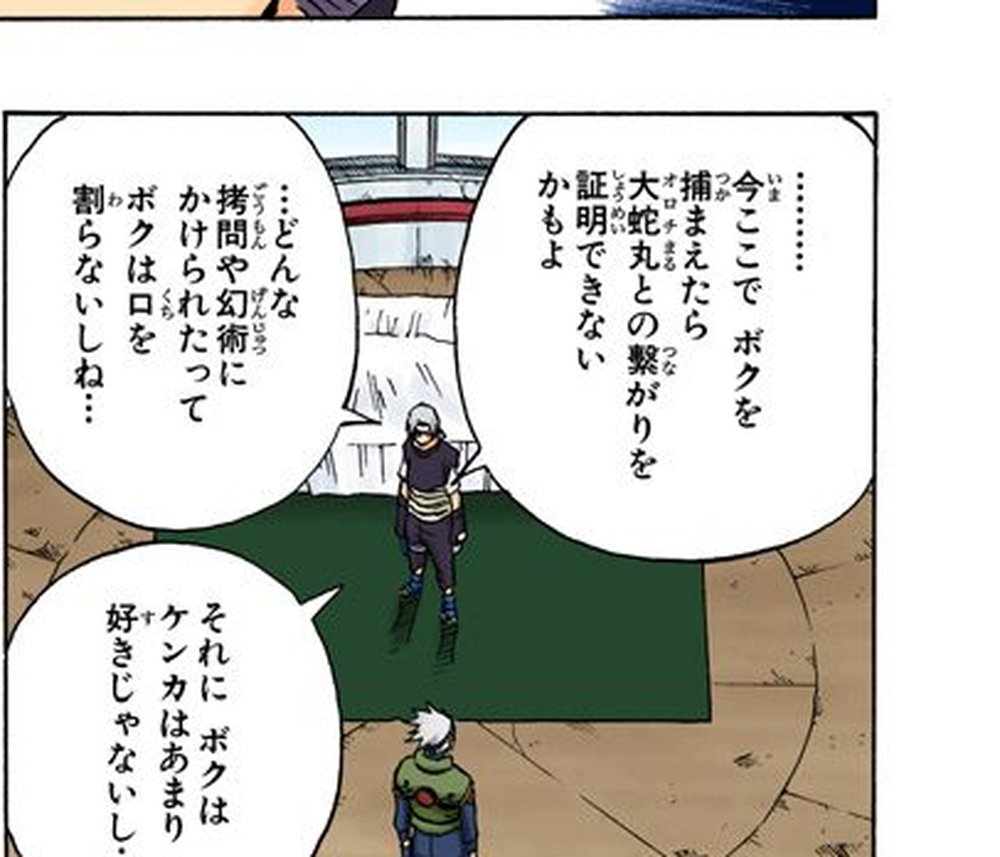
「...どんな拷問や幻術にかけられたってボクは口を割らないしね...」
…Donna gōmon ya genjutsu ni kakeraretatte boku wa kuchi o waranai shi ne…
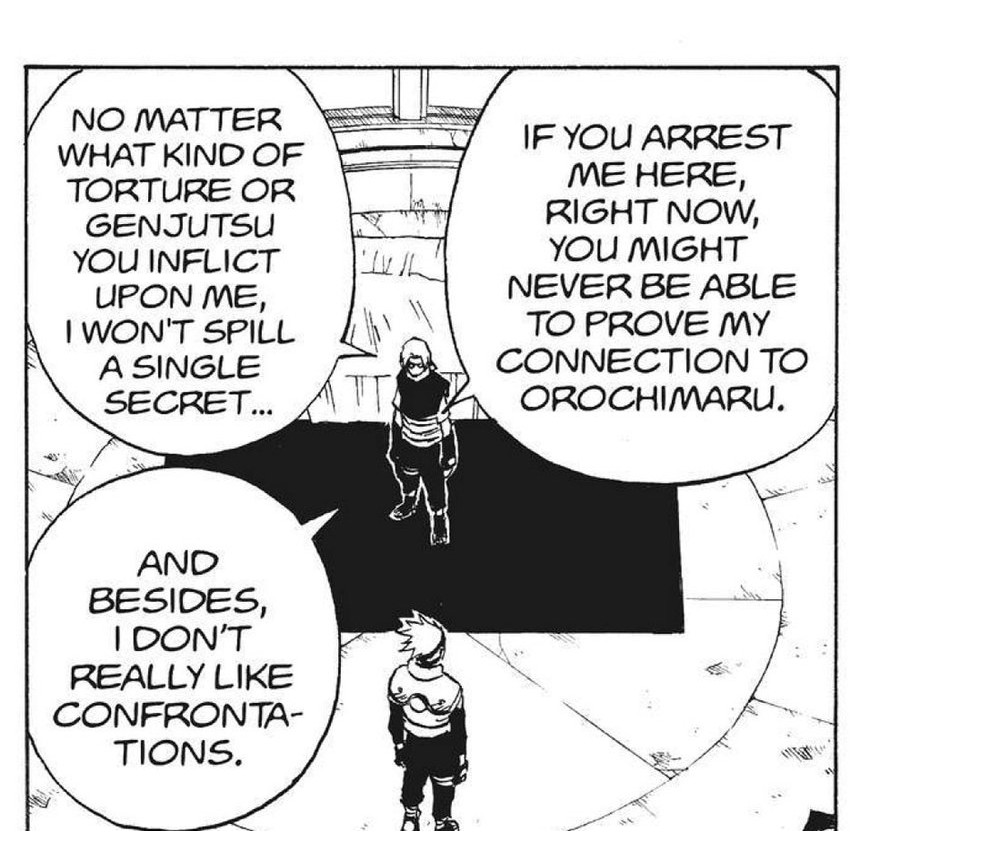
VIZ's English edition prints: "NO MATTER WHAT KIND OF TORTURE OR GENJUTSU YOU INFLICT UPON ME, I WON'T SPILL A SINGLE SECRET..." (Vol. 10, p.141).
Grant the rendering its due first: it's a clean, chilling threat, delivered with exactly the right calm by a boy who looks like he shelves library books for a living. Kakashi has nothing he can make stick, and lets him go with a parting shot — 「お前..わがままなガキだねどーも...」, "YOU... YOU'RE JUST A SELFISH LITTLE BRAT, AREN'T YOU...?" — while Kabuto walks off having given away exactly nothing.
But look closely at the one word doing the threatening. 口を割る (kuchi o waru) does not mean "to spill a secret." It means to crack a mouth open — the same verb Japanese uses for breaking glass, cracking an egg, splitting a plate down the middle. Kabuto isn't promising that nothing will leak out of him. He's telling Kakashi, quite specifically, that Kakashi can try to break him open and it won't work.
The Original
Take 口を割る apart, because the anatomy is doing more work than the English lets on.
口 (kuchi) is simply "mouth" — no surprises there. The verb is where the meaning lives: 割る (waru), "to split; to crack; to break by force." This is the exact verb of ガラスを割る ("to break a window"), 卵を割る ("to crack an egg"), 皿を割る ("to break a plate"). It is a verb for hard, brittle, sealed things — things that don't bend or tear, they give way all at once. Japanese has other, calmer verbs sitting right next to it that a translator might reach for instead — 話す (hanasu, plain "to speak"), 白状する (hakujō suru, "to make a clean confession") — and the writer chose none of them. The writer chose the verb for breaking a plate, and pointed it at a mouth.
That is the whole idiom in one image: a stubborn silence is a hard shell wrapped around the truth, and to get someone talking is to physically crack that shell — not persuade it, not coax it, break it. 拷問 (gōmon, "torture") and 幻術 (genjutsu, an illusion-technique specific to the Naruto-verse) are exactly the tools you'd expect to be listed as candidates for doing the cracking; the sentence is built to take them.
The idiom has a cousin worth knowing, because it proves the violence in 割る is load-bearing rather than decorative: 腹を割って話す (hara o watte hanasu), "to split one's stomach open and talk." Same verb, different organ, opposite mood — this one means candid, heart-to-heart honesty, freely given rather than forced out. Japanese consistently imagines truth-telling, whether coerced or voluntary, as something sealed inside the body that has to be cracked open to get out. English's closest cousin, "open up," keeps the container image but drops every trace of force — you can open up gently. You cannot 割る gently; the verb doesn't have a gear for that.
Grammatically, Kabuto's line runs on a concessive construction: どんな…にかけられたって ("no matter what kind of X gets thrown at me") is a casual contraction of …にかけられたとしても, and the whole clause is a boast built as a hypothetical Kakashi can't test. The closing しね stacks a listing-particle し ("and what's more...") onto the soft tag ね — Kabuto isn't just refusing, he's rattling off refusal as one item in a longer list of reasons Kakashi should give up, which is exactly what he does in the lines that follow. As vocabulary, 割る itself is elementary (N4/N5); the idiom 口を割る, because its meaning can't be assembled from its parts by a beginner, is generally grouped with N2 set phrases.
VIZ's Choice
Both appearances of 口を割る in the volumes we have on file, side by side with the official English:
| Vol. / p. | Speaker & context | Japanese | VIZ English |
|---|---|---|---|
| 10 / 141 | Kabuto Yakushi, refusing to break under Kakashi's interrogation | ...どんな拷問や幻術にかけられたってボクは口を割らないしね... | NO MATTER WHAT KIND OF TORTURE OR GENJUTSU YOU INFLICT UPON ME, I WON'T SPILL A SINGLE SECRET... |
| 39 / 74 | Kakashi Hatake, briefing Naruto and Sakura on Akatsuki's resistance to capture | 奴らはそう簡単に口を割るような連中じゃないし... | THEY'RE NOT A LOOSE-LIPPED BUNCH, THAT'S FOR SURE... |
The idiom appears exactly twice, and the two scenes mirror each other cleanly: in Volume 10, a suspect boasts that his own mouth won't crack; in Volume 39, an interrogator's report notes that a whole organization's mouths don't crack easily either. Same verb, same body part, first person becoming a professional third-person assessment.
And VIZ, working the two scenes thirty volumes apart, reaches for two completely different English pictures — neither of which is the Japanese picture. "I WON'T SPILL A SINGLE SECRET" turns the mouth into a container that leaks. "THEY'RE NOT A LOOSE-LIPPED BUNCH" turns it into a fastening that's either tight or slack. Spilling and looseness are both perfectly natural English ways to talk about people revealing secrets — which is exactly the problem. English's whole vocabulary for this concept is built on liquid and slackness. Japanese's is built on breakage. The two occurrences don't converge on a shared English phrase the way, say, a recurring compound like 修羅場 might scatter across five different renderings — instead they converge on the same failure, twice, because English simply doesn't keep a "crack a sealed thing" verb in its confession vocabulary the way Japanese does.
The Gap
Force becomes leakage. "I WON'T SPILL A SINGLE SECRET" replaces 割る's externally applied violence — someone or something cracking a shell — with spilling, a passive, almost accidental image: things spill on their own, they aren't spilled by an interrogator's effort. The entire reason Kabuto's line names torture and genjutsu as candidate methods is that 割る demands an agent doing the cracking. English's verb needs no one holding the hammer.
An event becomes a trait. 口を割る names a change of state — sealed, then cracked, at a specific moment under specific pressure. "Loose-lipped" names a standing condition — the kind of person someone has always been. That is nearly the opposite compliment: it's the profile of someone whose mouth was never properly shut in the first place, which is much closer to 口が軽い ("a light mouth") than to the idiom actually used. Kakashi's tactical read — these operatives will hold up under questioning — comes out sounding like a comment on their personalities rather than their training.
The snap disappears into degrees. 割る is binary. A plate is whole, and then, after one decisive instant, it is in pieces — there is no such thing as a plate that is 30% broken. That all-or-nothing quality is precisely what makes an interrogation scene tense: resistance holds, holds, holds, and then it's simply gone. "Spill" and "loose-lipped" both tolerate degrees — a little spills, someone is somewhat loose-lipped — so the translation quietly turns a fracture into a leak rate, and the drama of the held line goes with it.
What If
No rendering is free; here is the menu and its prices.
- "No matter what torture or genjutsu you throw at me, I won't crack." — "crack" is modern English's nearest cousin to 割る's snap-not-leak image, and "crack under interrogation" is already an established idiom. Cost: standing alone, "crack" can read thinner than the vivid mouth-as-shell picture the Japanese draws.
- "You won't pry this out of me, no matter what." — "pry" keeps the force-against-something-sealed image active and agentive. Cost: the sealed thing loses its anatomical address; it could be a lid, a safe, anything — the mouth itself disappears from the sentence.
- "They're not the type to crack." (for Kakashi's Volume 39 line) — restores the state-change image "loose-lipped" traded away, while keeping the clipped, professional register of a field briefing. Cost: "crack" reads a shade more casual than the surrounding tactical diction.
- "I won't let them break me open." — keeps 割る's violence in full. Cost: shifts the target from the mouth specifically to the whole self, so the idiom's precise body-part focus — this is about speech, not survival generally — gets lost.
The common tax across all four: English can buy back the force, or the binary snap, or the body part, but rarely all three in one clean phrase, because English's confession vocabulary was never built around the image of something hard being cracked.
Take-away
口を割る asks English to do something its interrogation vocabulary was never built for: picture a mouth as a locked, hard-shelled thing that must be physically broken rather than gently opened or accidentally emptied. VIZ reaches for spilling in one scene and looseness in the other — both fluent, both wrong about where the force is coming from.
Three rules of thumb to carry off this page:
- When 割る shows up on a body part, look for the container it implies. A mouth, a stomach, a chest — 割る treats each as something sealed that resists opening, whether the scene wants confession (口を割る) or candor (腹を割って話す).
- Distinguish 口が堅い, 口が軽い, and 口を割る. A hard mouth resists; a light mouth was never shut; and cracking is the specific event that turns the first kind of person into the second, however briefly.
- Watch for state-change verbs flattening into trait-adjectives in translation. "Crack" is an event with a before and after; "loose-lipped" is a description with no clock attached. When English swaps one for the other, ask what moment of drama just quietly disappeared.
For another body idiom that carries more literal violence in Japanese than its English panel lets on, see the sister analysis of a different kind of paralysis — hands and feet that won't move — in One Piece: 手も足も出ない. Or browse the Naruto translation notes index for more.
Every Japanese and English line quoted above is a byte-exact capture from the cited editions — NARUTO―ナルト― Vol. 10 & 39 (Japanese) and Naruto (VIZ Media) at the corresponding panels — via our bilingual page database; see Sources below.