The Moment
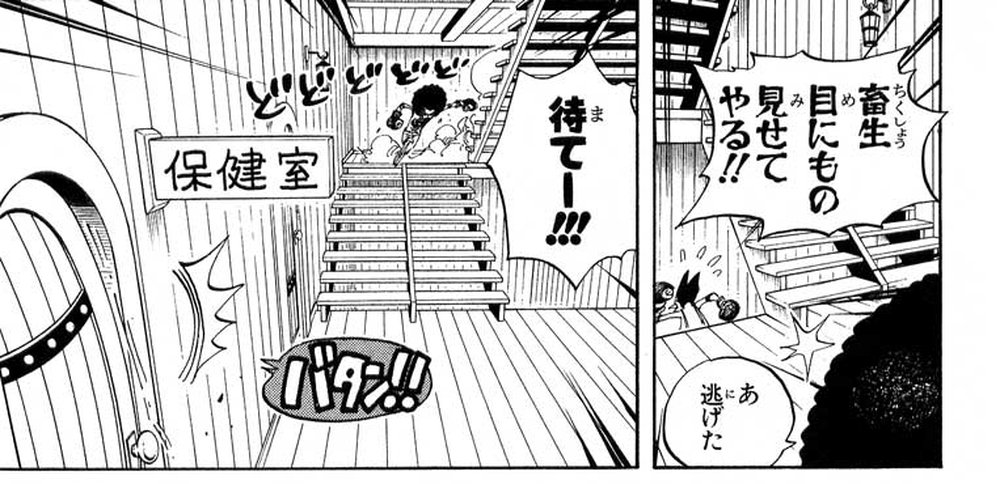
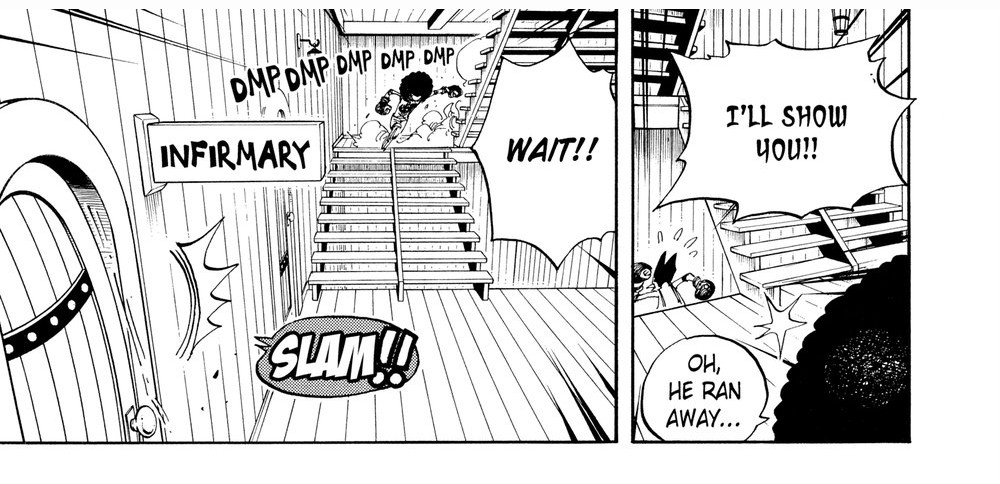
Round three of the Davy Back Fight — the "Combat," a one-on-one duel aboard Foxy's own ship, boss versus boss: Foxy the Silver Fox against Luffy, who is fighting this round in a magnificent afro. And the duel currently looks like this: Foxy sprinting away down the stairs of his own vessel at full speed, Luffy pounding after him yelling 「待てー!!!」 ("WAIT!!"), and Foxy hurling one line back over his shoulder as he goes:
「畜生 目にもの見せてやる!!」
Chikushō, me ni mono misete yaru!!
VIZ's English edition prints: "I'LL SHOW YOU!!" (Vol. 33, p.201).
A beat later Luffy pulls up short — 「あ逃げた」, "OH, HE RAN AWAY..." — while Foxy slams himself into the ship's infirmary, from which he will shortly re-emerge disguised, not at all convincingly, as a nurse.
Give VIZ its due: "I'LL SHOW YOU!!" is genuine, snarling defiance; it fits the bubble, fits the sprint, and any English reader hears a villain refusing to accept how this chase looks. But the Japanese line is a very specific piece of stock villainy, and the English one is not. 畜生 (chikushō) — literally "beast," functionally "damn it!" — has evaporated. And 目にもの見せる, one of Japanese's great fixed threats, has been replaced by an English idiom that points in a different direction entirely.
The Original
The idiom comes apart into four innocent pieces:
- 目 (me) — "eye."
- に (ni) — the locative particle: "to, into."
- もの (mono, 物) — "a thing."
- 見せる (miseru) — "to show," the causative partner of 見る "to see."
Literally: "I'll show a thing to your eyes" — I will force your eyes to witness something. What something? The idiom never says. And that is the whole engine: dictionaries gloss 目にもの見せる as ひどい目にあわせて思い知らせる — "put someone through something terrible so they learn their lesson the hard way." Every native speaker fills in the blank the same way. The unnamed もの is pain, humiliation, defeat — all the more menacing for going unnamed, the way a closed box is scarier than an open one.
Japanese loves this move. The fleeing delinquent's 覚えてろ! ("remember this!" — remember what, exactly?) and the gangster's ただじゃおかない ("I won't leave this as-is") run on the same fuel: the threat that declines to describe itself.
Foxy's line then bolts on two aggressor's flourishes. 畜生 (chikushō) is the expletive — literally "beast/brute," the Buddhist word for the animal realm, long since worn down into Japanese's all-purpose "damn it!" And 〜てやる (-te yaru) is the do-it-AT-you benefactive: grammatically the form for doing someone a favor, aimed downward, so that in a threat it means the favor you're about to do them is a beating.
One trap for learners: in this idiom, 目 is the literal eye — the organ that will be made to watch. In its close cousin ひどい目に遭う ("to have a terrible time of it"), the same kanji has shifted to mean "an experience." Same character, two different jobs, both employed in the vocabulary of suffering. As vocabulary, 目にもの見せる sits around JLPT N1 — yet every piece of it is N5, which is exactly why a learner can read straight through the threat without seeing it.
VIZ's Choice
The idiom appears twice in Vol. 33, forty-six pages apart, both times in Foxy Pirate mouths. Side by side:
| Vol. / p. | Speaker | Japanese | VIZ English |
|---|---|---|---|
| 33 / 151 | a Foxy pirate, rallying the boss | オヤビン!!三回戦のコンバットで目にもの見せてやりましょうぜ!! | BOSS! SHOW THEM YOUR STUFF IN THE THIRD-ROUND BATTLE!! |
| 33 / 197 | Foxy, mid-flight | 畜生目にもの見せてやる!! | I'LL SHOW YOU!! |
Two appearances, two completely different solutions — and, notice, both of them built on English show. That is no accident: 見せる really is "show," so the translator each time kept the verb and let the idiom go. What scattered is everything the verb was carrying.
On p.197, "I'LL SHOW YOU!!" keeps the defiance but swaps the target. On p.151, "SHOW THEM YOUR STUFF" keeps the energy but swaps the object — and quietly rewrites the grammar too: 見せてやりましょうぜ is the let's-volitional plus rough ぜ, the crew enlisting themselves in the payback ("let's make 'em pay, boss!"), where VIZ's imperative hands the whole job to Foxy alone. Each choice is locally defensible; the crew's line really is a pep rally, and Foxy's really is defiance. But the English reader meets the same fixed idiom twice and is never once told a threat was made.
The Gap
The victim disappears. English's "I'll show you!" is a vow of self-vindication: I'll prove you wrong, I'll prove I can. Its target is the doubter's opinion; the person who suffers, if anyone, is the speaker's own reputation, redeemed. 目にもの見せてやる is a vow of retribution whose target is the listener's body — your eyes will be made to see something you'll regret. Foxy isn't promising to prove himself. He's promising, while running away, to hurt Luffy. The comedy of the panel — menace and cowardice in one breath, the classic 捨て台詞 (sute-zerifu, the parting threat you toss behind you as you flee) — needs the threat to be a threat.
A revenge oath becomes a talent show. "SHOW THEM YOUR STUFF" reads as "display your skills" — your stuff is your talent. The Japanese crew member is not asking the boss to perform; he is promising, on behalf of five hundred pirates, that the people who humiliated the boss will be made to suffer for it in round three. The scene still works in English — but as a different scene.
The curse gets clean. 畜生 is a real expletive, and VIZ simply drops it. Small loss, but it is the word that marks Foxy's line as a snarl rather than a announcement — and its Buddhist pedigree (the "beast realm" of rebirth) is one more little example of how much of Japanese's rough vocabulary is worn-down theology.
The unnamed もの loses its slot. English threats want their object named — "teach you a lesson," "make you pay" — and the one English idiom that keeps the object coyly vague, "I'll show you a thing or two," has drifted into meaning a demonstration of superior skill. The Japanese machine — menace by omission — has no standing English equivalent, so every translation either names the pain or loses it.
What If
For Foxy's line, the menu and its prices:
- "Damn you... I'll make you pay!!" — restores the expletive and aims the threat back at Luffy. Cost: "pay" is a debt metaphor; the forced-witnessing image is gone.
- "I'll show you a thing or two!!" — astonishingly close to the literal Japanese: show, plus a deliberately unnamed thing. And the slightly fusty, blustering ring suits Foxy perfectly. Cost: modern ears hear "I'll demonstrate my skill," so the punishment still leaks away — but as a compromise it is hard to beat.
- "You'll regret this, damn you!!" — the fleeing villain's parting threat, future pain promised and undescribed. Cost: generic; any villain in any language owns this line.
- For the crew's line: "Boss!! Let's teach 'em a lesson in the third-round Combat!!" — restores the payback and the crew-inclusive let's. Cost: loses the bouncy pep-rally surface that "SHOW THEM YOUR STUFF" honestly captures.
Every option pays somewhere, because English keeps offering two shelves — prove myself or punish you — and 目にもの見せる sits on the second while sounding, word for word, like the first.
Take-away
Three rules of thumb to carry off this page:
- When you meet 目にもの見せる, translate it in your head as a threat of consequences — "make you pay," never "show my stuff." The verb is show; the meaning is punish.
- Watch for Japanese threats that refuse to name the pain — 覚えてろ, ただじゃおかない, 目にもの見せる. The omission is not vagueness; it is the menace.
- Keep the two jobs of 目 separate: the literal eye of 目にもの見せる and the "experience" of 痛い目・ひどい目に遭う. When 目 shows up in the vocabulary of suffering, ask which one is on duty.
And a footnote from the same page as the crew's rally: when the sobbing-boss theatrics drag on, Sanji cuts them off with 「茶番はいいから次いけよ」 — "ENOUGH OF THIS RIDICULOUS FARCE. ON TO THE NEXT GAME." That word, 茶番 — the tea-server's farce, has a pitfall article of its own. For more of the body doing idiomatic work, see 手も足も出ない — hands and feet that won't come out and 腑に落ちない — the answer that won't drop into your gut — or browse the One Piece translation notes index.
Every Japanese and English line quoted above is a byte-exact capture from the cited editions — ONE PIECE Vol. 33 (Japanese) and One Piece Vol. 33 (VIZ Media) at the corresponding panels — via our bilingual page database; see Sources below.