The Moment
Konoha is burning. What the story calls 木ノ葉崩し — "Operation Destroy Konoha" — has just collapsed, and on a rooftop above the wreckage the man who built the Hidden Leaf Village is casting the last jutsu he will ever cast. The Third Hokage, Sarutobi, has invoked the Reaper Death Seal (死神封印, Shiki Fūjin) — a technique that trades the caster's own soul for the power to seal something out of existence — and what it seals away is Orochimaru's arms, taking with them his ability to mold jutsu by hand. Orochimaru's first response is fury at the theft: 「この老いぼれが!私の腕を返せ!!」 ("YOU USELESS OLD MAN! GIVE ME BACK MY ARMS!!"). Sarutobi's answer is not triumph. It's an epitaph, delivered mid-ritual, to the student he is about to die killing:
「愚かなるかな...大蛇丸」 「...我が弟子よいずれあの世で会おう」 「共に逝けぬのは残念じゃが...」
VIZ: "NOW WHO IS THE FOOL, OROCHIMARU?" / "...MY DEAR DISCIPLE, LET US MEET AGAIN ONE DAY IN THE AFTERLIFE." / "IT'S A SHAME I CAN'T TAKE YOU WITH ME, BUT..."
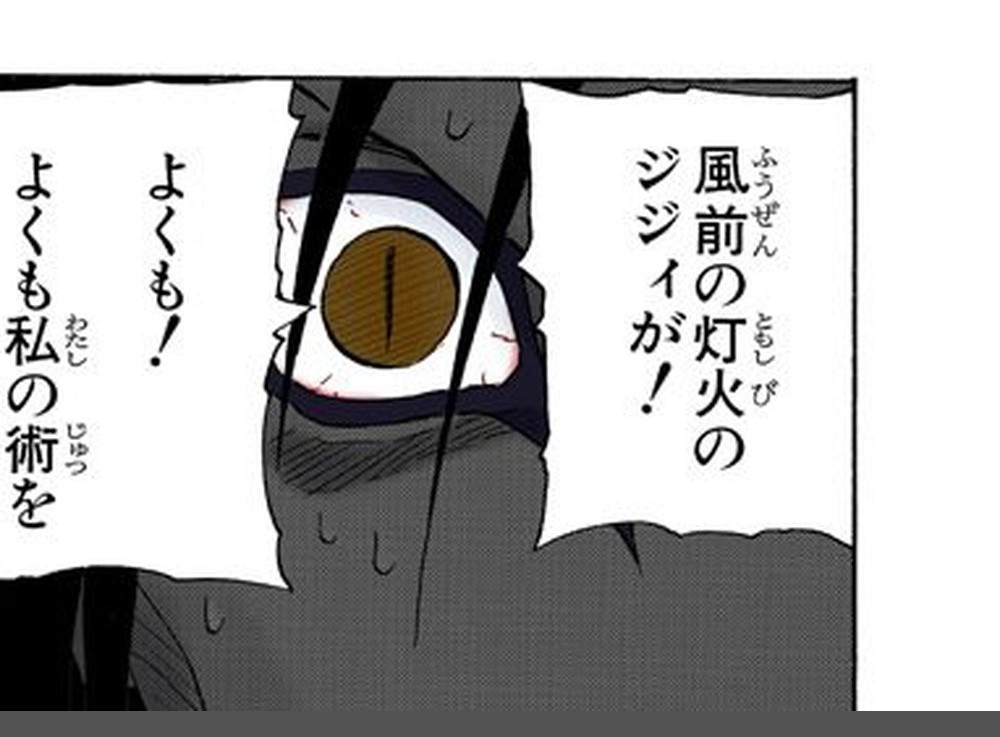
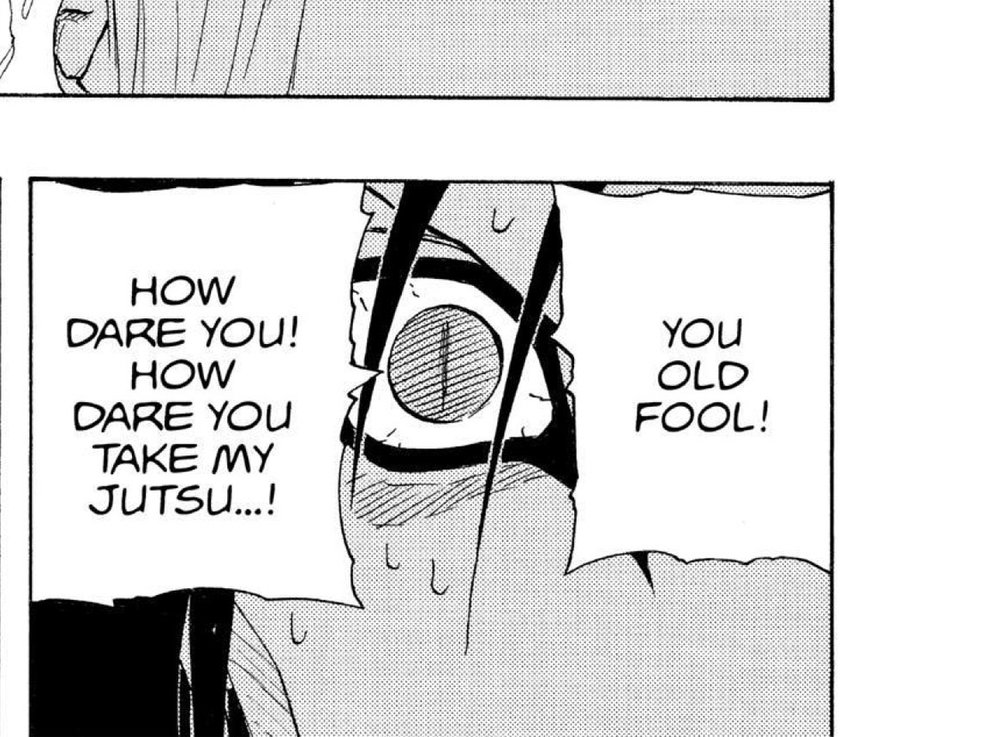
The next panel is nothing but Orochimaru's eye — a slit pupil filling the frame, one long speech bubble wrapping around it — and he screams back the line this article is about:
「風前の灯火のジジィが!よくも!よくも私の術を...!」
Fūzen no tomoshibi no jijii ga! Yokumo! Yokumo watashi no jutsu o…!
VIZ's English edition, re-lettered to read left to right across the same art, prints: "HOW DARE YOU! HOW DARE YOU TAKE MY JUTSU...!" / "YOU OLD FOOL!" (Naruto Vol. 16, p.43).
Grant the rendering its due first: splitting the outburst across two bubbles to fit English reading order, without redrawing a single line of Orochimaru's eye, is clean relettering work, and "YOU OLD FOOL!" is a punchy four syllables for a panel this size. But listen to what Orochimaru is actually saying. He doesn't call Sarutobi foolish. He calls him a flame standing in the wind — 風前の灯火 (fūzen no tomoshibi) — the single Japanese image for a life one gust from going dark. And Sarutobi, in that exact panel, is dying.
The Original
Take the idiom apart in its printed form, 風前の灯火, because the manga's furigana hands you the whole pronunciation for free.
風前 (fūzen) — 風 "wind" + 前 "in front of, before" — is simply "before the wind," the position of something standing exposed with nothing to block the gusts.
灯火 (tomoshibi) — 灯 "lamp, light" + 火 "fire" — is a lit flame. The dictionary headword for this idiom is usually the shorter 風前の灯, with the single kanji 灯 alone carrying the reading tomoshibi; the manga spells the fuller two-kanji 灯火, and the printed furigana confirms it's read exactly the same way, ともしび. Same idiom, dressed in its longer clothes.
String the pieces together with the possessive の and you get a single, complete picture: a lamp-flame standing in the open wind. No candle-holder, no shelter, nothing between the fire and the gust that will end it. That image is Japanese's go-to figure for anything — a life, a regime, a family fortune — that could be extinguished at literally any moment. It shows up in classical war chronicles describing a doomed garrison, in modern news copy about a company one bad quarter from bankruptcy, and, here, in a battle manga, aimed at a man whose life is a heartbeat from over.
Notice what the sentence does not have: a verb. 風前の灯火のジジィが! is grammatically just [NOUN1 の NOUN2], "a 風前の灯火 old man," thrown as a bare vocative — no です, no だ, nothing conjugated at all. The noun phrase alone is the whole insult, which is exactly what lets the closing が turn it into a slap (more on that below). As vocabulary, 風前の灯 sits around N1: every kanji inside it is elementary on its own (風・前・火 are N5, 灯 closer to N2), but the fixed idiom and the abstraction it demands — reading a single static image as a whole claim about mortality — is advanced-learner territory, the kind of phrase you meet in literature and editorials long before you meet it in conversation.
VIZ's Choice
This expression surfaces exactly once across the corpus of pages checked for this article, so there's no scatter to chart — only one decision to weigh, and it's worth weighing carefully, because it isn't a case of English lacking the tools.
VIZ had, at minimum, three paths open. It could have kept the image outright — English owns "a candle in the wind" as a working idiom for exactly this meaning, no invention required. It could have kept the shape of the metaphor without the exact idiom — "flickering," "guttering," "about to go out" are all ordinary English verbs for a dying flame. Or it could drop the metaphor and translate the function — an insult about imminent death, phrased as an insult about imminent death, even without a lamp anywhere in the sentence ("YOU'RE ALREADY HALF DEAD, OLD MAN!" would have done that much).
VIZ took none of these. It reached instead for "FOOL" — a word that isn't in 風前の灯火 at all, drawn instead from the other line on the page, where Sarutobi calls Orochimaru foolish two panels earlier (愚かなるかな, "NOW WHO IS THE FOOL, OROCHIMARU?"). The choice reads, in English, like a comeback in a schoolyard argument — no, YOU'RE the fool — because "fool" is now sitting in both characters' mouths. In Japanese, the two lines don't rhyme at all: Sarutobi's word is 愚か (foolish); Orochimaru's is 風前の灯火 (a dying flame). They're not trading the same insult back and forth. They're saying two completely different things about each other, and English quietly makes them symmetrical.
The Gap
The image is deleted, not translated. 風前の灯火 is a candle, a wind, and the instant before the dark — three concrete pictures compressed into one adjective ("old") and one noun ("fool"). Nothing visual crosses over. A reader who has never seen a flame guttering in open air gets nothing from "YOU OLD FOOL!" that a reader who has seen a thousand of them would also get.
The meaning doesn't thin — it inverts. 風前の灯 never once calls anyone stupid; it describes a state (about to be extinguished), not a judgment (foolish). "FOOL" imports a claim the Japanese line never makes, and erases the one claim it does make.
The dramatic irony — the entire reason Orochimaru reaches for this idiom instead of any other insult in the language — vanishes. Sarutobi is dying in the very panel where the line is spoken. 風前の灯火 names that fact even as it mocks him for it: it is simultaneously an insult and an accurate diagnosis. "YOU OLD FOOL!" could be shouted at any old man anywhere in this manga; it has no idea Sarutobi is expiring as it's said.
English accidentally writes a rhyme that isn't there. Two beats earlier on the same page, Sarutobi tells Orochimaru 「愚かなるかな...大蛇丸」, rendered "NOW WHO IS THE FOOL, OROCHIMARU?" Orochimaru's retort then lands, in English, as "YOU OLD FOOL!" — a tidy tit-for-tat volley about who's the bigger fool that simply does not exist in the Japanese, where Orochimaru's line never touches 愚か at all. English readers get a squabble over foolishness. Japanese readers get a man being told, correctly, that he is dying.
What If
No option here is free — every one trades something specific away.
- "YOU FLAME ABOUT TO GO OUT, OLD MAN!" — keeps the image and the insult in one motion. Cost: clunky for a single gasped exclamation, and "old man" is far too polite for ジジィ's contempt.
- "A CANDLE IN THE WIND, THAT'S ALL YOU ARE, OLD MAN!" — reaches for English's own idiom of the identical shape, the one sitting unused on the shelf. Cost: too long for a panel built around one furious glare; the register drifts toward wistful where the Japanese is venomous.
- "YOU'RE ALREADY GUTTERING OUT, OLD GHOST!" — keeps the flame-verb and adds the mortality outright. Cost: "ghost" is an invention with no Japanese behind it, and "guttering" is a slightly bookish word to be screaming mid-battle.
- "YOU FLICKERING OLD WRECK!" — keeps VIZ's compression and bite while nodding at the candle. Cost: "flickering" only gestures at the image instead of naming it, and "wreck" swaps out ジジィ's very specific "old man" contempt for something vaguer.
Notice the shared problem: every option that keeps the flame image runs long, and every option short enough for the panel drops the flame. That tension — a wide, classical picture squeezed into a one-beat scream — is the real translation problem here, and it's one 風前の灯 poses every time it shows up in a fight instead of a eulogy.
Take-away
風前の灯(火) is Japanese's picture for a life about to go out — a candle with nothing standing between it and the wind. When a villain reaches for it mid-battle instead of a plain insult, the idiom is doing double duty: mockery and diagnosis in the same breath. Flatten it to "fool," and the diagnosis disappears along with the picture.
Three rules of thumb to carry off this page:
- When a Japanese insult describes a state rather than a trait, don't upgrade it to a judgment. "About to go out" and "foolish" are different accusations; English has room for both without collapsing one into the other.
- Check what a translated word is echoing on the same page before trusting it. VIZ's "fool" here isn't a translation of 風前の灯火 at all — it's borrowed vocabulary from a different line, three panels earlier, and the borrowing changes what the exchange means.
- Before assuming English has "no equivalent" for a Japanese image, check the shelf. "A candle in the wind" was sitting right there, unused, the entire time.
For another villain's line where a vivid image gets swapped for a flat sneer, see 尻ぬぐい and the crusty put-down VIZ traded for "yeah right!"; for another case of an animal image quietly evicted from an idiom, see 腹の虫 and the tiny tenant English evicts. Or browse the full Naruto translation notes index.
Every Japanese and English line quoted above is a byte-exact capture from the cited editions — NARUTO―ナルト― Vol. 16 (Japanese, color digital) and Naruto (VIZ Media) at the corresponding panel — via our bilingual page database; see Sources below.