The Moment
The Land of Waves arc, Volume 3. Momochi Zabuza is a man with a banner: one volume earlier, taking this job, he introduced himself with it — 「このオレ様を誰だと思ってる…霧隠れの鬼人と呼ばれたこの桃地再不斬をな!」, "REMEMBER WHOM YOU'RE TALKING TO! I AM MOMOCHI ZABUZA, THE DEMON, OF THE NINJAS WHO HIDE IN THE MIST!" (Vol. 2, p.67). Now the Demon is flat on his back in a treetop hideout, freshly thrashed by Kakashi, unable even to speak.
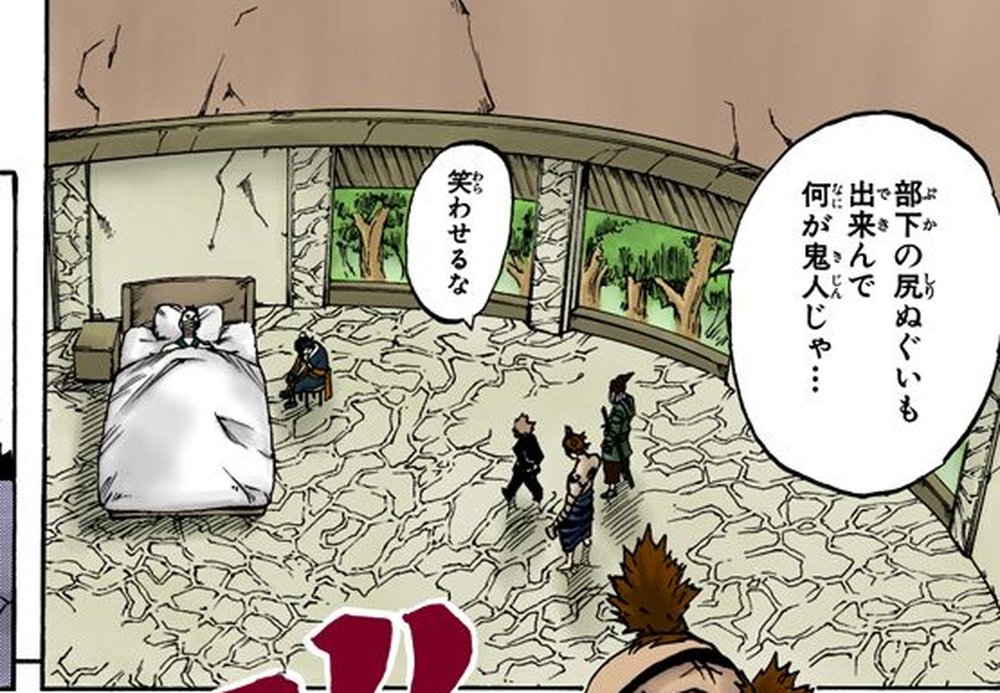
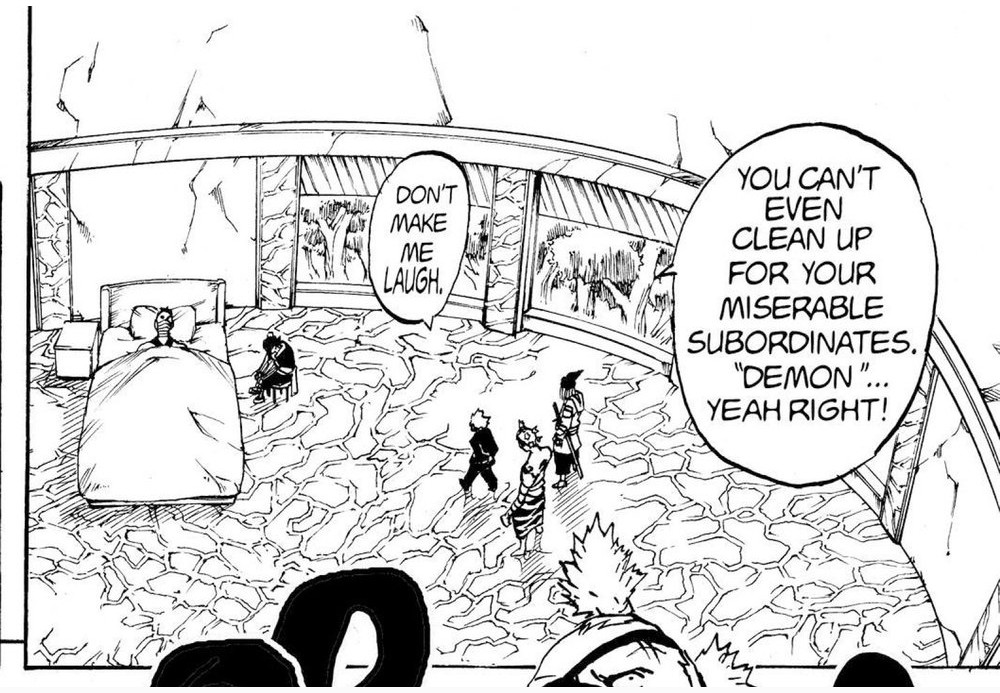
The door creaks open. In walk two hired swords — caption boxes introduce ZOURI and WARAJI, "samurai bodyguard[s] in the service of Gatô" — and between them, a very short, very rich old man in a black suit: Gatō, the shipping magnate who is bankrolling the whole affair. He starts sneering before he is through the door: 「あんたまでやられて帰ってくるとは」 — "I'M SURPRISED YOU HAVE THE NERVE TO SHOW YOUR FACE AROUND HERE AFTER TAKING A BEATING LIKE THAT." — 「霧の国の忍者はよほどのヘボと見える!!」 — "NINJA FROM THE LAND OF THE MIST WOULD APPEAR TO BE VASTLY OVERRATED." And then, crossing the stone floor toward the bed, he files his formal complaint:
「部下の尻ぬぐいも出来んで何が鬼人じゃ…」
Buka no shirinugui mo dekinde nani ga kijin ja…
VIZ's English edition prints: "YOU CAN'T EVEN CLEAN UP FOR YOUR MISERABLE SUBORDINATES. "DEMON"... YEAH RIGHT!" (Vol. 3, p.20). The next bubble lands the boot: 「笑わせるな」 — "DON'T MAKE ME LAUGH."
Grant the rendering its due. "Clean up for your subordinates" genuinely carries the idiom's cargo — a mess that was theirs, handled in their stead — and the scare quotes around "DEMON" catch exactly what 何が…じゃ is doing: revoking a title to its holder's face. The scene plays on: Gatō reaches for the helpless Zabuza (「黙っていることは無いだろ…」 — "NOTHING TO SAY FOR YOURSELF?"), and the boy at the bedside catches his arm and nearly breaks it — 「汚い手で再不斬さんにさわるな…」, "DON'T DEFILE LORD ZABUZA WITH YOUR TOUCH." (Vol. 3, p.21).
But hold the two versions of the insult side by side. The Japanese is an old man's verdict, delivered in an old man's grammar, about a very specific chore. The English is the same verdict delivered by a teenager at a mall. And the chore itself — the word this article is about — has been through the wash.
The Original
Take 尻拭い (shirinugui) apart; it is not a polite word wearing overalls, it is a chore with a smell.
尻 (shiri) is the backside — the buttocks, and by extension the tail end of anything: 目尻 (mejiri, the outer corner of the eye), 帳尻 (chōjiri, the bottom line of the ledger), 尻込み (shirigomi, to balk — literally to back your rear away from a task).
拭い (nugui) is the noun form of 拭う (nuguu), "to wipe" — the same 拭 you carry in 手拭い (tenugui), the classic cotton hand-wiping cloth.
Put together, 尻拭い is wiping a backside that is not your own — the image is cleaning up after a small child. As an idiom it means handling the aftermath of someone else's blunder: their debts, their scandal, their botched job. It is entirely standard Japanese — newspapers use it for banks absorbing a subsidiary's losses, office workers groan about 前任者の尻拭い, cleaning up a predecessor's mess — but the literal picture never fully deodorizes, and that residue is the word's whole power. Its neutral cousin 後始末 (atoshimatsu, "settling what comes after") describes the same labor with no smell at all; its vulgar cousin ケツを拭く (ketsu o fuku) says the anatomy out loud. 尻拭い sits in the middle: printable, respectable, and still faintly humiliating — aftermath work performed in somebody else's stead, unthanked, with a grudge built in. As vocabulary it is solid JLPT N1 material; the grammar around it here is simple.
And the bookkeeping of the insult is precise. Zabuza's 部下 (buka, subordinates) are the 鬼兄弟 — the Demon Brothers — who botched their ambush of the bridge-builder in Volume 1. When Gatō took the contract to Zabuza, the client side of the room was already fretting about exactly this: 「敵もかなりの忍を雇ったようじゃし…そのうえ鬼兄弟の暗殺失敗で警戒を強めているとなると…」 — "THE ENEMY HAS HIRED NINJAS OF TREMENDOUS SKILL! AND BESIDES... NOW THAT THE DEMON BROTHERS HAVE TRIED AND FAILED, THEY'LL BE ON GUARD AGAINST FURTHER ATTEMPTS." (Vol. 2, p.67). Zabuza took the cleanup job personally — and got beaten too. So the line closes like a ledger: the Demon of the Hidden Mist was reduced to wiping up after demons, and couldn't even manage that. 何が鬼人じゃ.
That final flourish is a set formula worth stealing: 何が+X+だ/じゃ — "what's all this 'X' about?" — the construction Japanese uses to revoke a title, a boast, or a brand name to its owner's face. And the じゃ is not random: copula じゃ for だ, the negative ん in 出来んで, the contemptuous 〜おって Gatō uses later (強がりおって — "still talking tough") are the stock dialect of fiction's mean old men — 役割語, role language, the off-the-shelf voice Japanese fiction issues to crusty elders and money-fat villains. Gatō speaks it in every scene he has. It is half his characterization: the youngest thing about him is his bank balance.
VIZ's Choice
尻拭い appears exactly once in the volumes we have on file, so watch VIZ's single choice closely — phrase by phrase.
"CLEAN UP FOR YOUR ... SUBORDINATES" keeps the idiom's skeleton. Even the slightly odd "for" (idiomatic English says "clean up after") accidentally points the right way: 尻拭い is substitution labor, done on behalf of the one who made the mess. What's gone is the anatomy. English owns the same image — every English speaker has heard an exasperated "I'm not here to wipe your—" — but that register is off-limits in a teen-rated graphic novel, so the diaper pail becomes a mop bucket.
"MISERABLE" is a phantom. The Japanese hangs no adjective on 部下 — the Demon Brothers are not being insulted, their failure is simply the mess — so every ounce of scorn lands on one man: the boss who couldn't finish the cleanup. VIZ's adjective sprays contempt sideways and blurs that org-chart logic.
""DEMON"... YEAH RIGHT!" gets the mechanism right — the scare quotes are 何が…じゃ, a title held up and revoked — and the voice wrong. "YEAH RIGHT!" is nineties American teen slang; 何が鬼人じゃ is a crusty grandee's sneer. The insult survives; the sixty-year-old delivering it does not.
And the word inside the crosshairs has its own translation history, because the arc keeps passing Zabuza's banner from hand to hand:
| Vol. / p. | Speaker | Japanese | VIZ English |
|---|---|---|---|
| 2 / 67 | Zabuza, taking the job | このオレ様を誰だと思ってる…霧隠れの鬼人と呼ばれたこの桃地再不斬をな! | REMEMBER WHOM YOU'RE TALKING TO! I AM MOMOCHI ZABUZA, THE DEMON, OF THE NINJAS WHO HIDE IN THE MIST! |
| 3 / 20 | Gatō, over the sickbed | 部下の尻ぬぐいも出来んで何が鬼人じゃ… | YOU CAN'T EVEN CLEAN UP FOR YOUR MISERABLE SUBORDINATES. "DEMON"... YEAH RIGHT! |
| 4 / 87 | Gatō, on the bridge | 霧隠れの鬼人が聞いてあきれるわ 私から言わせりゃあなんだ…/小鬼ちゃん…ってとこだなァ | CALLING YOURSELF THE DEMON OF KIRIGAKURE IS JUST PLAIN FALSE ADVERTISING! / MORE LIKE A BABY DEMON, IF THAT. |
| 4 / 99 | Zabuza, dying, dragging Gatō down | 大したことねェ…霧隠れの鬼人も…死んで地獄なら本物の鬼になれるぜ… | EVEN AN OGRE IN NAME ONLY... A WASHOUT FROM KIRIGAKURE VILLAGE... CAN BECOME A REAL DEMON IN HOW HE MEETS HIS DEATH. |
Read the right-hand column top to bottom: DEMON, "DEMON," DEMON OF KIRIGAKURE, OGRE. Three volumes of consistency, and then — at the exact panel where the Japanese pays the thread off — the word changes. In the Japanese, Zabuza's dying line runs the same 鬼人 one last time: "even the famed kijin of the Hidden Mist didn't amount to much… but die like this, and in hell I can become a real demon (本物の鬼)." Title versus substance, carried by one word and one 本物の. VIZ builds the contrast lexically instead — an "ogre in name only" versus "a real demon" — which is elegant in isolation, and credit where due: the line lands, and the follow-up 「楽しみにしとけ!小鬼ちゃんかどうか地獄でたっぷり確かめさせてやるよォ!!!」 — "ONCE WE'RE IN HELL, I CAN TAKE MY TIME, AND SHOW YOU OVER... AND OVER... WHO IS, OR IS NOT, "A BABY DEMON"!" — throws Gatō's bridge insult back at him beautifully. But the banner Zabuza raised in Volume 2, the one Gatō spat on over the sickbed, was "THE DEMON." At the moment he reclaims it, English hands him an ogre.
The Gap
The stench is laundered. 尻拭い puts the great Demon in rubber gloves at a changing table; "CLEAN UP FOR" puts him in a staff meeting. The idiom's information survives — someone else's mess, handled in their stead — but the humiliation was in the anatomy, and the anatomy is exactly what a T-rated page cannot print. The insult grades down from visceral to managerial.
A phantom adjective smears the scorn. Adding "MISERABLE" feels like free intensification, but it re-aims the line. Japanese: your failure was not finishing their cleanup — one target, hierarchical, precise. English: your subordinates are wretched too — two targets, diffuse. Gatō is a businessman delivering a performance review from hell; the added sneer at the staff muddies his balance sheet.
The old man's formula becomes teen slang. 出来んで…何が…じゃ is role language — the stock crusty-elder dialect that tells a Japanese reader "old, imperious, contemptuous" before they've parsed a word of content. "YEAH RIGHT!" swaps that voice for a completely different stock character. English has no じゃ, but it has period furniture — "some 'Demon' you are," "'Demon,' my foot" — and this bubble bought none of it.
The epithet thread snaps at the payoff. 鬼人 is claimed (Vol. 2), revoked (this line), miniaturized to 小鬼ちゃん (Vol. 4, p.87), and reclaimed in death as 本物の鬼 (Vol. 4, p.99). Four beats, one word. VIZ keeps "DEMON" for three beats and switches to "OGRE" on the fourth — so the English reader hears a new insult where the Japanese reader hears the same banner, finally earned.
What If
No rendering is free; here is the menu and its prices.
- "YOU CAN'T EVEN WIPE UP YOUR OWN MEN'S MESSES. SOME 'DEMON' YOU ARE..." — keeps the wiping, keeps a single target, and "some X you are" is English's own title-revoking formula. Cost: the backside retreats to a hint, and "wipe up" reads more kitchen than nursery.
- "'THE DEMON OF THE MIST,' MY FOOT — YOU COULDN'T EVEN MOP UP AFTER YOUR OWN UNDERLINGS." — "my foot" is genuinely dated, so the old man stays old. Cost: quaint to the point of parody for younger readers, and the idiom trades a backside for a foot.
- "REDUCED TO PLAYING NURSEMAID FOR YOUR FLUNKIES — AND FAILING AT THAT. AND THEY CALL YOU A DEMON?" — restores the bodily-caretaker humiliation in printable form. Cost: "nursemaid" is a metaphor the Japanese only implies, and the line runs long for a bubble.
- Keep VIZ's frame, drop the additions: "YOU CAN'T EVEN CLEAN UP AFTER YOUR OWN SUBORDINATES. SOME 'DEMON'..." — Cost: still deodorized; but the scorn stays on one man, the idiomatic "after" replaces the odd "for," and no phantom adjective sneaks in.
The deeper point: 尻拭い was never untranslatable — English has the mess, the wiping, even the anatomy. What English couldn't deliver on this page was all three at a rating Shonen Jump ships with. The translator's real constraint was the parental advisory, not the dictionary.
Take-away
尻拭い is aftermath-labor with a grudge: somebody else made the mess, you are holding the cloth, and the word makes sure everyone can smell why you resent it. Gatō weaponizes it upward — the fearsome title on one side of the sentence, the diaper chore on the other — and the collision is the insult.
Three rules of thumb to carry off this page:
- When you meet 尻拭い, translate the direction of the mess. Someone else made it; the subject is stuck with it. "Clean up after," "mop up someone's mess," "carry the can" — never "help out."
- 何が+X+だ/じゃ is a formula, not a question. It revokes titles: "some X you are," "X, my foot." Translate the revocation, not the interrogative.
- じゃ・〜ん・〜おって is a costume. When a fiction elder talks this way, the dialect is characterization — find the speaker an English voice the same age, or he walks out of the translation forty years younger.
For more Naruto idioms that keep their feelings in the body, see the patience-sack Tobi's temper bursts out of in 堪忍袋 and the belly-bug that does Kakashi's grumbling in 腹の虫 — or browse the Naruto translation notes index.
Every Japanese and English line quoted above is a byte-exact capture from the cited editions — NARUTO―ナルト― Vol. 2–4 (Japanese) and Naruto (VIZ Media) at the corresponding panels — via our bilingual page database; see Sources below.