The Moment
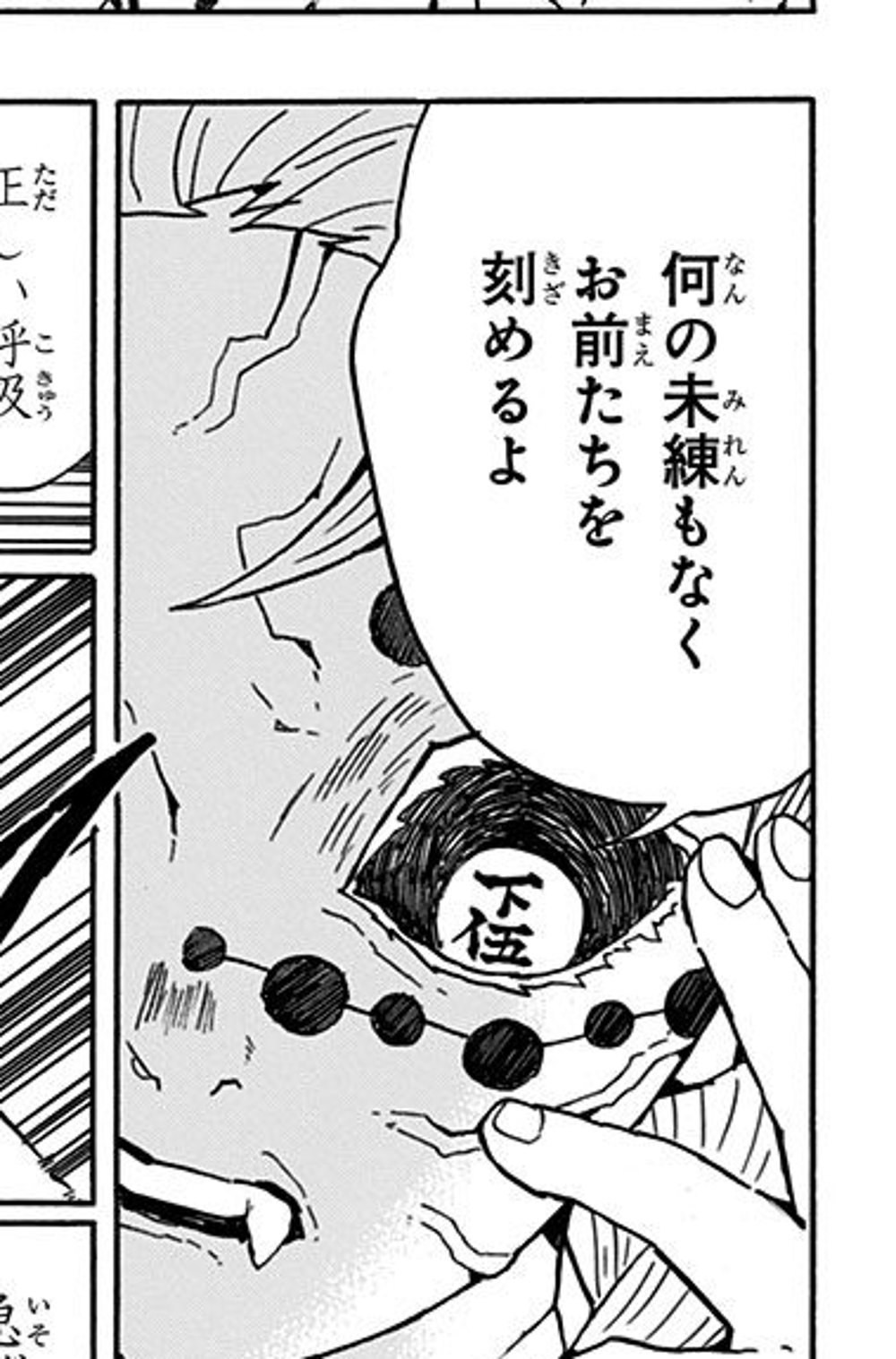
Mount Natagumo — Spider Mountain, the domain Rui built out of captured demons and mind-controlling thread, arranged into a "family" that answers to him as father. By the time this panel arrives, Tanjiro has already tried to end the fight once: Rui severed his own head with his own thread rather than let the boy's blade land, and mocked him afterward for celebrating a "pitiful fantasy" of victory. Then something happens that hasn't happened to Rui in longer than he can remember. Nezuko — newly awakened to her own Blood Demon Art — catches fire, and the flames burn nothing else in the clearing except Rui and the controlling thread wrapped around Tanjiro's throat. Rui works through it out loud, thought by thought: そもそも何でお前は燃えてないのかな ("why, exactly, aren't you burning"), 妹の力なのか知らないが苛々させてくれてありがとう (whether it was your sister's power or not, thanks for making me this angry), 僕と僕の糸だけ燃えたよね (only me and my thread burned, huh) — and then, to the collapsed Tanjiro and the transformed Nezuko both:
「何の未練もなくお前たちを刻めるよ」
Nan no miren mo naku, omae-tachi o kizameru yo.
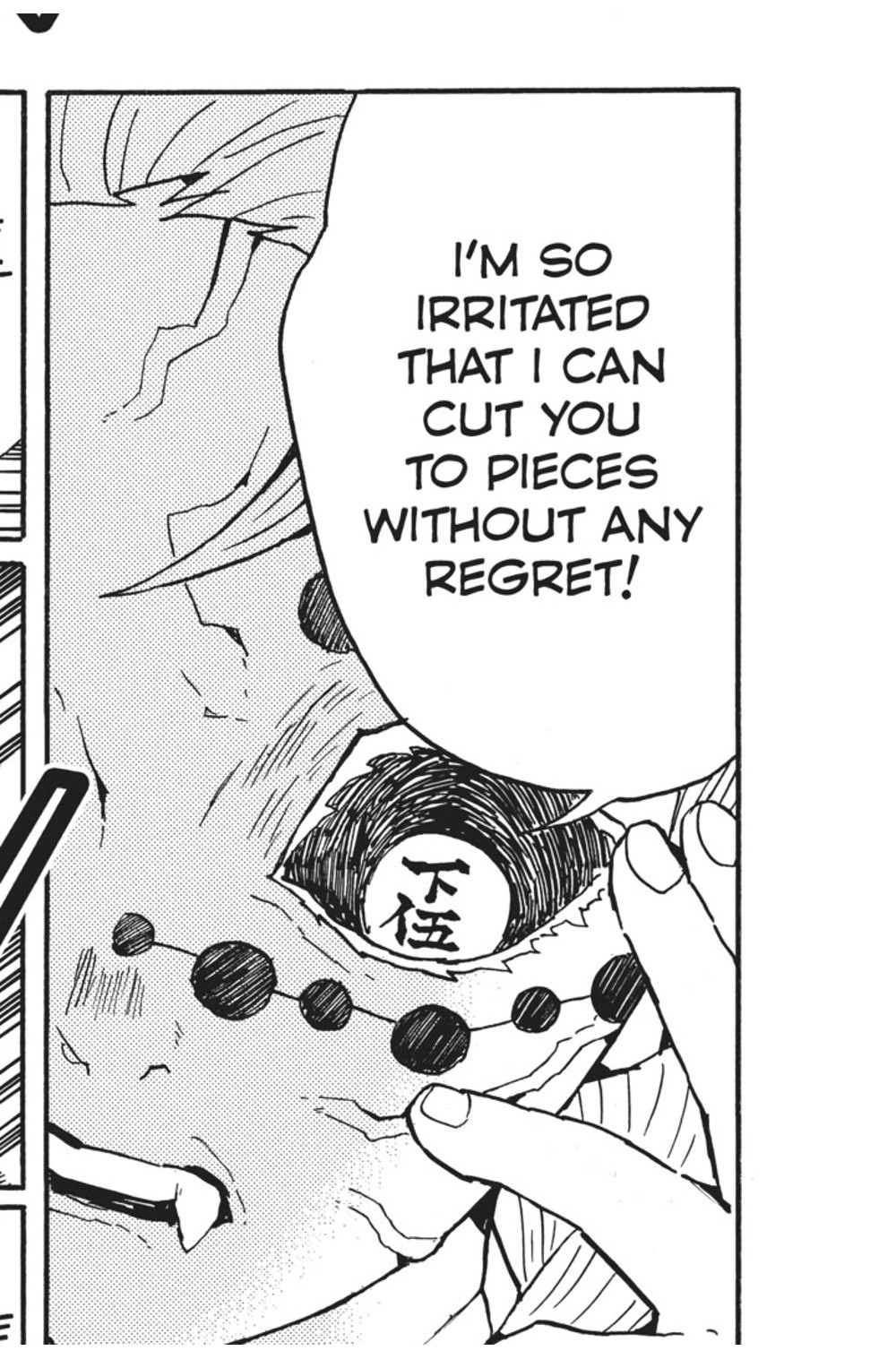
Our own bilingual database recorded an English line for this bubble: "WHAT AN UNPLEASANT FEELING!" It is not VIZ's line for this panel. It's a real line from this same scene — just the wrong bubble, an artifact of a page-numbering drift between the Japanese and English editions of this volume that we trace out fully below. Reading VIZ's actual printed page settles what belongs here: "I'M SO IRRITATED THAT I CAN CUT YOU TO PIECES WITHOUT ANY REGRET!" (Vol. 5, p.155).
Grant that line its due before anything else: it's a good line. "So irritated" earns the exclamation point that's been building since the top of the page, "cut you to pieces" is a clean, ugly threat, and "regret" is a completely reasonable, idiomatic English word for what 未練 usually gestures at in casual conversation. Nobody reading only the English page feels shortchanged by this sentence.
What they can't hear is that 未練 was never really about being sorry.
The Original
Break the compound down. 未 (mi) means "not yet" — the same 未 that opens 未来 (mirai, "future," literally "not-yet-arrived") and 未定 (mitei, "undecided," literally "not-yet-fixed"). 練 (ren) means "to temper, to refine, to knead, to drill" — the same 練 in 訓練 (kunren, "training") and 鍛錬 (tanren, "forging," what a smith does to a blade and what a martial artist or ascetic does to the self through repetition). Put the two together with almost brutal literalism and 未練 reads as "not-yet-tempered."
That is not decoration. Japanese reference dictionaries record the word's oldest sense as close to technical: 仏道の修行がまだ足りないこと — a practitioner's Buddhist discipline not yet sufficient, a will not yet forged hard enough to let go of the world. It borrows the vocabulary a swordsmith uses on steel and points it at a soul: something still soft where it needs to be hard, still attached where it needs to release. Centuries of ordinary use kept the clinging and quietly dropped the forge — 未練 drifted into the everyday word for lingering attachment, reluctance to give something up: heartbreak you can't set down, a dream you won't stop rehearsing, an ex you keep almost texting.
The line itself frames the noun inside 何の…もなく, an emphatic double negative — "with no ~ of any kind, without so much as a scrap of ~." Bolted onto that is 刻める, the potential form of 刻む (kizamu, "to carve, to notch, to mince finely"): able to carve. 何の未練もなくお前たちを刻めるよ, read all the way through, is "with not one scrap of attachment left in me, I am able to carve you both up." The grammar is nothing special — a demon stating a capability, the way a swordsman might say 斬れる ("I can cut"). All the weight sits in the noun.
VIZ's Choice
未練 appears exactly once in the Demon Slayer volumes in our corpus — a genuine single occurrence, no scatter table to build here. But this occurrence came with a problem the usual "quote the corpus, open the page, confirm" workflow doesn't normally hit this hard, and it's worth walking through, because the fix is also the finding.
The corpus paired our line — JP Vol. 5, p.154, pair index 3 — with the English string "WHAT AN UNPLEASANT FEELING!" On its face that's a strange match: nothing about "an unpleasant feeling" answers "with no miren at all, I can carve you up." Rather than trust the pairing, per this site's standing rule, we opened both printed pages directly — and found the Japanese and English editions of Volume 5 running one page apart at this stretch of the book. JP p.153's dialogue (Rui growling that he hasn't been this angry in a long time, vowing to kill "you and your sister" both) is what actually sits on EN p.154. JP p.154 — our page, with the miren line — sits on EN p.155. JP p.155 (Rui's Blood Demon Art, "Murderous Eye Basket") sits on EN p.156. The offset holds steady across every page we checked in this stretch, a full page ahead in the English edition — and it isn't limited to this scene: this site's companion piece on 地獄 and the Eight Buddhist Underworlds English Flattens to One independently caught the identical +1 drift a few dozen pages later in the same volume, at Rui's death scene on JP p.178 / EN p.179. "WHAT AN UNPLEASANT FEELING!" is real VIZ dialogue — it's just the true translation of a different Japanese line one page upstream (part of the "I haven't been this angry" beat), pulled one panel out of place by the same page-numbering seam.
With the seam accounted for, VIZ's actual choice for our headline line is the one this article has been quoting: "I'M SO IRRITATED THAT I CAN CUT YOU TO PIECES WITHOUT ANY REGRET!" A single occurrence, a single translator's decision, and — credit due — a decision that lands as a line. The only quiet cost is the one this whole piece is about: of everything 未練 could have offered an English translator (attachment, unfinished business, a reason to hesitate), "regret" is the reading that happens to erase the exact plot function the word is about to serve.
The Gap
"Regret" looks backward; 未練 reaches forward. "I won't regret this" promises something about how Rui will feel after — remorse, or the absence of it, for an action already taken. 未練 doesn't describe an aftermath; it describes a hindrance — the attachment that would stay a hand before it swings. "With no miren at all" means "nothing is holding me back," a claim about what isn't stopping him. VIZ's "regret" quietly moves that claim from before the kill to after it.
The doctrinal charge goes with it. Every other stop on this site's tour of Demon Slayer's death vocabulary — 成仏, 往生, 地獄 — describes one stage of the same machine: a soul either sheds its worldly attachment and passes on, or it doesn't, and stays. 未練 is the technical name for the thing that jams that machine. A demon reaching for this specific word to describe his own combat resolve isn't just talking tough — inside the series' own cosmology, he's making a testable claim about his soul. "Regret" is a mood. It promises nothing about what happens to Rui next.
The line is a boast the book is already disproving. Read forty pages further and Rui — decapitated, dying — doesn't dissolve into the vengeful demon his boast promised. He remembers being a sickly, unloved little boy; he begs forgiveness from parents he half-abandoned by dying young and being replaced in his own head by a "family" built out of kidnapped, thread-bound strangers; and he is answered, not punished — his real mother and father's spirits tell him they will go with him anywhere, even to hell. This is the single most miren-soaked death in the volume: a demon who could not stop clinging to a fiction rather than grieve what he'd actually lost. "With no miren at all, I can cut you to pieces" is the loudest false claim Rui makes in the entire arc. "Regret" can't hear the promise being broken, because "regret" was never the promise.
What If
The menu and its prices:
- "I'm so worked up I could carve you both up without a single attachment left in me!" — keeps 未練 as attachment rather than remorse, closer to the doctrinal target. Cost: "attachment" reads clinical, more therapy session than battlefield snarl.
- "There's nothing left in me to hold this blade back!" — dramatizes what miren's absence does rather than naming the word, letting the hindrance-sense through indirectly. Cost: loses the specific claim that an emotional tie to the target is being denied; reads as generic bloodlust instead.
- "I can cut you down and there won't be one loose thread left in me!" — leans into Rui's own signature weapon (thread) to gesture at "nothing left dangling" — i.e., no miren. Cost: clever, but invented wordplay the original doesn't attempt; risks reading as the translator's joke rather than the demon's threat.
- Keep VIZ's shape, swap the one word: "I'M SO IRRITATED THAT I CAN CUT YOU TO PIECES WITHOUT A SINGLE ATTACHMENT LEFT!" — Cost: longer and harder to letter into the same bubble, but the doctrinal claim — and the foreshadowing — survives the trip.
Take-away
未練 looks, from the outside, like one more word for "regret" — and in ninety-nine everyday sentences out of a hundred, that gloss will serve you fine. The hundredth sentence is this one: a demon staking his whole self-image on having none of it, in a series that is about to spend an entire death scene proving him wrong.
Three rules of thumb to carry off this page:
- 未練 names a hindrance, not a feeling about the past. Before reaching for "regret," ask whether the sentence is really describing something holding a person back, rather than something they feel sorry about afterward. The two are not the same claim.
- When a demon uses this series' death vocabulary about themselves, take it as foreshadowing. 未練, 成仏, 往生, 地獄 aren't mood words here — they're the technical terms of an afterlife with rules, and a character invoking one is making a claim the story can hold them to.
- 未練 is the missing ingredient in every "successful" death this series shows you. Wherever a demon passes on peacefully, check what they let go of first — and wherever one doesn't, 未練 is usually the reason, spoken or not.
未練 is the exact residue of 煩悩 (bonnō) — the Buddhist term for worldly craving — that keeps a soul from a clean parting; see the One Piece hub for the bilingual pun built entirely out of a 108-count of bonnō. For the destination a soul reaches only once its miren is gone, see 成仏してください and the epitaph that points the wrong way and 往生しやがれ and the Buddhist send-off VIZ flattened to "die"; for the place a lingering soul is threatened with instead, see 地獄 and the eight Buddhist underworlds English flattens to one and 三途の川 and the three crossings English rounds down to one; and for the hungry-ghost realm hiding inside a different demon's insult, see 餓鬼 and the hungry-ghost hell behind every "brat". Or browse the full Demon Slayer translation notes index.
The Japanese line quoted above is a byte-exact capture from the cited edition — 鬼滅の刃 Vol. 5 (Japanese) — via our bilingual page database; see Sources below. One correction: our database pairs this line's English side to the string "WHAT AN UNPLEASANT FEELING!", recorded against the same page number (154). That string is real VIZ dialogue, but not for this bubble — Volume 5's English and Japanese editions run one page apart at this point in the book (confirmed against a second, independent pagination correction on this same volume in our 地獄 piece), and VIZ's true rendering of 何の未練もなくお前たちを刻めるよ prints one page later, on Vol. 5 p.155, as quoted and analyzed throughout this piece. Both editions' pages were read directly to confirm. rawCaptureEn above preserves the database's original string for traceability, not because it is what VIZ printed for this line.