The Moment
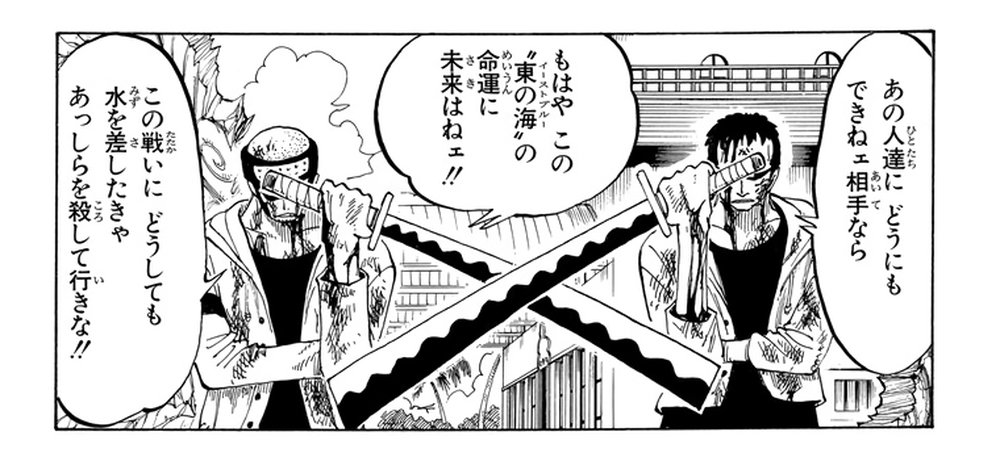
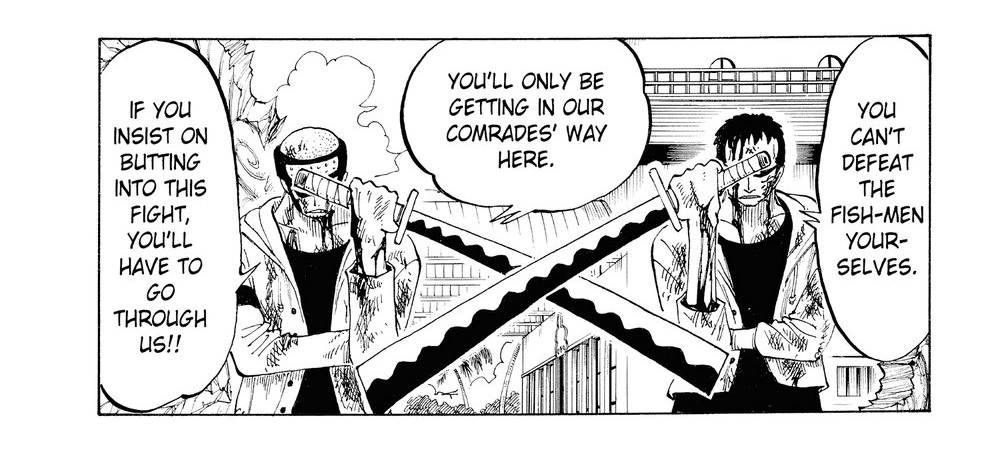
Cocoyasi Village, and the fight everyone has been waiting the whole arc for is finally happening: Luffy against Arlong. The village's own fishermen — ordinary men who have spent years paying protection money under Arlong's boot — want in. A crowd of them surges forward, weapons raised, ready to throw themselves at Arlong's crew alongside the Straw Hats. Two of Genzo's men plant themselves in the crowd's path, swords crossed in an X, and give the villagers their answer:
「この戦いにどうしても水を差したきゃあっしらを殺して行きな!!」
Kono tatakai ni dōshitemo mizu o sashitakya asshira o koroshite ikina!!
VIZ's English edition prints: "IF YOU INSIST ON BUTTING INTO THIS FIGHT, YOU'LL HAVE TO GO THROUGH US!!" (Vol. 10, p.14).
Grant the rendering its due: this is a strong line. "Go through us" is exactly the kind of blunt, physical promise the moment needs, and it matches the working-class snarl of あっしら beat for beat. The only thing missing is what the Japanese is actually picturing — not a body blocking a door, but a splash of cold water landing on something that's been building up heat. 水を差したきゃ, "if you want to pour water on this," imagines the fight itself as a pot at a rolling boil, and the villagers as the well-meaning cook about to ruin it.
The Original
水 (mizu) is "water." 差す (sasu) is a verb that resists a single English gloss — its unifying sense is inserting something into a receiving space: 傘を差す is "to put up an umbrella" (inserting it open above you), 目薬を差す is "to put in eyedrops." Paired with water, 差す gives you the plainest action imaginable: to add water to something.
The idiom's home address is the kitchen. 差し水 (sashimizu) is the technique — practiced in households across Japan — of splashing a cup of cold water into a pot of boiling udon or soba the instant it threatens to foam up and over the rim. It's a small, physical, universally recognized reflex: the pot is too hot, so you cool it, and the boil-over never happens. From that literal splash, the idiom generalized outward. Any situation that has built up heat — a fight, an argument, a rising mood, someone's freshly kindled enthusiasm — can have someone 水を差す it: arrive uninvited and take the heat back out, whether or not anyone asked them to.
Grammatically, the headline line is doing something small and colloquial: 差したきゃ contracts 差したい ("want to pour") plus the conditional ければ down into -たきゃ, so 水を差したきゃ reads "if you want to pour water [on this]." As vocabulary, 差す alone is elementary (roughly N4); the idiomatic collocation 水を差す, where "adding water" specifically means "ruining something," sits closer to N2 — the level where a set phrase stops being decodable from its parts and has to simply be known.
VIZ's Choice
Every appearance of 水を差す in the volumes on file, JP beside the official English:
| Vol. / p. | Japanese | VIZ English |
|---|---|---|
| 10 / 14 | この戦いにどうしても水を差したきゃあっしらを殺して行きな!! | IF YOU INSIST ON BUTTING INTO THIS FIGHT, YOU'LL HAVE TO GO THROUGH US!! |
| 10 / 57 | 彼らの戦いに水を差す結果になっては意味がない | ...AND THE RUBBER BOY AND HIS FRIENDS WILL HAVE FOUGHT FOR NOTHING. |
| 10 / 150 | (…誰かがこの戦いに)水を差してるってことになる!!! | (SO IF THAT BRAT IS STILL ALIVE, THEN SOMEONE…) MUST BE HELPING HIM!!! |
| 10 / 151 | 水を差す!? | SO!? |
| 21 / 142 | 意気込みに水を差す様だが... | I HATE TO DISAPPOINT YOU... |
Five appearances, five different English exits, and not one of them a temperature or a liquid. Look at what each solution keeps and drops.
At p.14, "butting into" keeps the interference half of the meaning and drops the water outright — a defensible, common move. At p.57, village chief Genzo is refusing to let a crowd of amateurs join Sanji's underwater rescue: 彼らの戦いに水を差す結果になっては意味がない, "if it results in dampening their fight, there's no point [going]." VIZ restructures the whole clause around consequence instead of action — "...AND THE RUBBER BOY AND HIS FRIENDS WILL HAVE FOUGHT FOR NOTHING" — trading Genzo's cause ("we'd be the ones spoiling it") for its downstream effect ("their effort becomes worthless"). Reasonable, but the water is gone and so is Genzo as the potential spoiler.
p.150 is the strangest case, and worth pausing on, because the polarity flips outright. Arlong, mid-battle, reasons aloud that devil fruit users should drown underwater — so if a certain someone is still alive down there, 誰かがこの戦いに水を差してるってことになる: "then someone must be dampening/interfering with this fight." From Arlong's antagonistic point of view, keeping his opponent alive is sabotage — a violation of the natural order he's counting on. VIZ's "MUST BE HELPING HIM!!!" describes the exact same event from the opposite emotional angle: not interference with Arlong's plan, but aid to the drowning man. Same fact, same underwater rescue, and English quietly swaps the antagonist's frame for the narrator's — losing the fact that Arlong experiences this as a foul.
p.151 is the most extreme flattening of the five. In the confusion of that fight, one line reduces to a bare 水を差す!? — "[Am I] interfering!?" — thrown back defiantly, and VIZ compresses it to "SO!?" By any measure, this is close to total loss: not just the water, but nearly the entire proposition, kept alive only by the exclamation-question mark and the panel art around it.
And p.142 shows the idiom doing its other job — not meddling in an event, but deflating a mood. Zoro, facing Mr. 1 (Daz Bones) in Alabasta, opens with 意気込みに水を差す様だが…, "I seem to be pouring water on your enthusiasm, but…" — talking over Mr. 1's own boast mid-sentence, cutting off a villain who's still in the middle of bragging that no swordsman has ever scratched him. VIZ's "I HATE TO DISAPPOINT YOU..." is genuinely excellent English — dry, understated, perfectly Zoro — and it's the cleanest semantic match of the five. It just isn't wet.
The Gap
The water evaporates, every single time. Five renderings, zero mentions of liquid, pouring, or cooling. "Butting into," "fought for nothing," "helping," "SO!?," "disappoint" — Oda kept returning to one concrete kitchen image, and an English reader would never guess it was there even once.
English already owns the exact idiom, and VIZ never reaches for it. "To pour/throw cold water on" is not an invention for this article — it's a live, common English idiom, arguably closer to 水を差す in image and register than any single word VIZ chose. Five opportunities passed, five times the bucket sat untouched on the shelf.
One metaphor, two unrelated English word-families. 水を差す covers both meddling in an event (p.14, p.150, p.151) and deflating someone's mood or momentum (p.57, p.142) as a single continuous idea — heat either way, water either way. "Butt into" and "disappoint" don't sound like relatives in English, so nothing signals to the reader that Oda is reusing one idiom across a village standoff and a duel taunt alike.
Antagonistic framing can invert into neutral framing. At p.150, Arlong experiencing a rescue as interference with his plan becomes, in English, a flat narrative statement that someone is "helping him" — accurate to the event, but silent on how the villain himself is furious about it.
What If
The headline line's menu, and its prices:
- "If you're so set on throwing cold water on this fight, you'll have to kill us first!!" — plugs in English's own cousin idiom; the water survives and the threat still lands. Cost: "cold water" reads slightly more polished than あっしら's rough dockworker voice.
- "If you want to douse this fight, you'll have to go through us!!" — keeps VIZ's excellent "go through us," trades "butting into" for a liquid verb. Cost: "douse" pulls English ears toward dousing a fire, not quite 差す's noodle-pot image.
- "Feel like dampening this fight? Kill us first!!" — "dampen" is the mildest, most idiomatic English cousin available. Cost: sounds almost bureaucratic set against a death threat.
- Keep VIZ's line, add the water back: "IF YOU INSIST ON POURING COLD WATER ON THIS FIGHT, YOU'LL HAVE TO GO THROUGH US!!" — minimal edit, keeps everything that already works. Cost: three extra words in a bubble that was already full.
Take-away
水を差す pictures a fight, a mood, or a plan as a pot at a full boil, and anyone who interrupts it — for better or worse — as the hand with the water cup. English owns a phrase built for exactly this image, "pour/throw cold water on," and across five real appearances in these volumes, the official translation never once picks it up. The interruption always survives translation. The kitchen behind it never does.
Three rules of thumb to carry off this page:
- When 差す follows a noun, ask what's being inserted where. 水を差す (add water, i.e., spoil), 傘を差す (put up an umbrella), 目薬を差す (put in eyedrops) — one verb, one physical gesture, wildly different objects.
- 水を差す is one idiom wearing two hats: meddling in an ongoing event, and deflating someone's mood. English will reach for different words for each — don't let that fool you into thinking Japanese sees two different ideas.
- A villain's "interference" can read as a hero's "help" in translation — the same fact, told from the opposite character's point of view. Watch antagonist-voiced lines especially closely; the polarity of a verb can survive while its speaker's grievance quietly disappears.
This idiom's mirror image, where Oda reaches for heat instead of cooling, is 火に油を注ぐ — "to pour oil on a fire" — the subject of the sister article on the idiom VIZ left on the table: water dampens, oil inflames, and English owns matching idioms for both that its official translations pass over at almost the same rate. For another 水-rooted idiom from these volumes, see the impermanence buried in 水の泡 — or browse the full One Piece translation notes index.
Every Japanese and English line quoted above is a byte-exact capture from the cited editions — ONE PIECE Vol. 10 & Vol. 21 (Japanese) and One Piece (VIZ Media) at the corresponding panels — via our bilingual page database; see Sources below.