The Moment
Two pages earlier, Igaram — Vivi's loyal captain of the guard — put on her clothes, told the crew 「無事に.....祖国で会いましょう」 ("MAY WE MEET AGAIN IN OUR HOMELAND"), and sailed off alone as a decoy, drawing every Baroque Works agent in the harbor after the wrong princess. It worked. It also looked, for one panel, like it had cost him his life: 「バカな...!!!もう追手が...!!?」 ("IT CAN'T BE!!! THEY GOT TO HIM ALREADY!!?"), and Luffy, grim, pays the only tribute a pirate captain has on hand — 「立派だった!!!」, "HE WAS ADMIRABLE!!!" (Vol. 13, p.102).
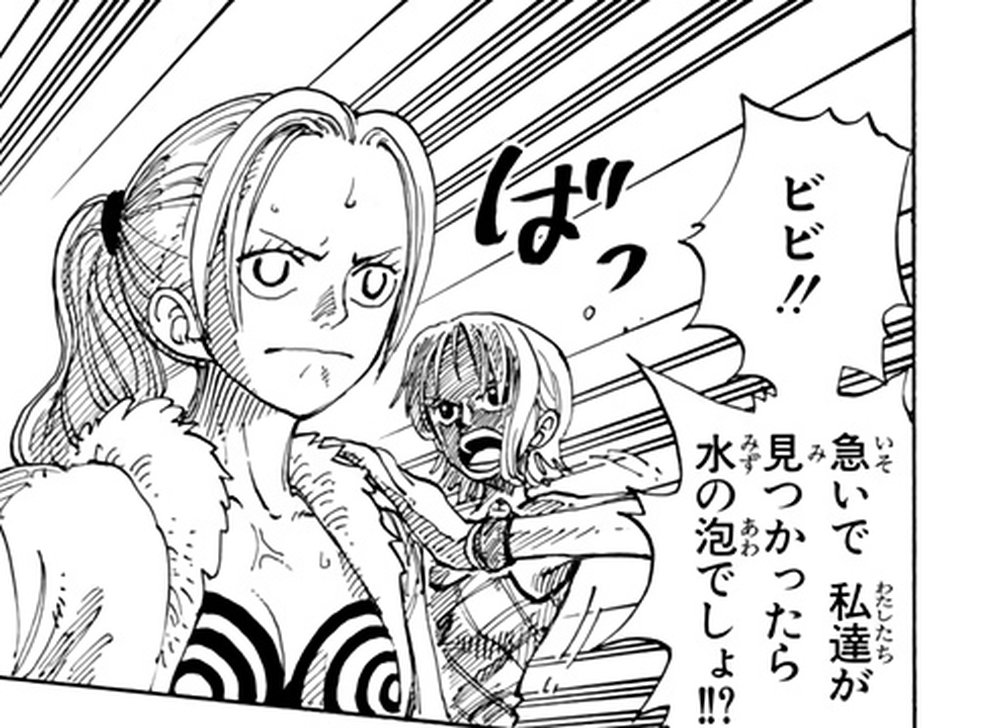
So when the page turns and Nami — the real Vivi slumped against her back, disguise blown, nowhere left to hide it — snaps into motion, every word is carrying the weight of what Igaram just bought them:
「ビビ!!急いで私達が見つかったら水の泡でしょ!!?」
Bibi!! Isoide, watashitachi ga mitsukattara mizu no awa deshō!!?
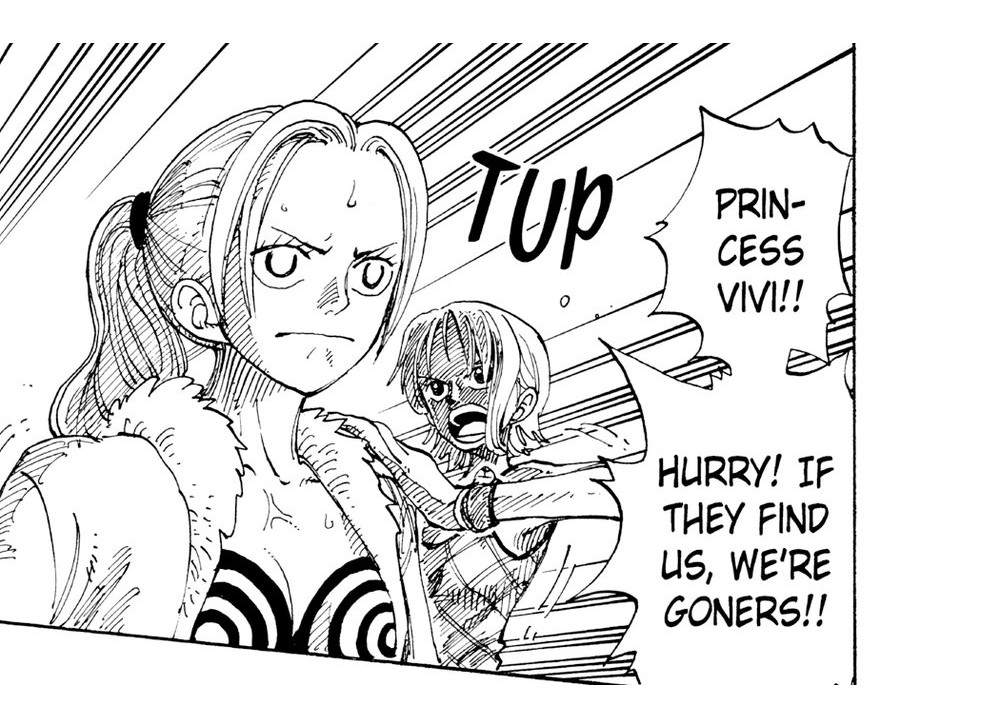
VIZ's English edition prints: "PRINCESS VIVI!! HURRY! IF THEY FIND US, WE'RE GONERS!!" (Vol. 13, p.103).
Grant the rendering its due: it is fast, it is exactly the length of a shouted warning, and "we're goners" tells an English reader in two words that discovery means disaster. Given the size of the speech bubble and the beat's forward momentum, that's a real accomplishment. But notice what disaster it names. "Goners" says we would die. The Japanese says something narrower and, in context, sadder: this — all of it, Igaram's sacrifice included — would be for nothing. Nami isn't only afraid of getting caught. She's afraid of getting caught after a man just staked his life on the idea that they wouldn't.
The Original
水の泡 breaks into three plain pieces: 水 (mizu, "water"), の (the possessive "of"), 泡 (awa, "bubble, foam"). Put together: the water's bubble. Look once at the kanji 泡 and it explains itself — 氵, the three-drop water radical, next to 包 (hō), "to wrap, envelop." A bubble is exactly that: a pocket of nothing, wrapped in water, sitting on a surface for as long as surface tension allows and not one instant longer.
As a set idiom, 水の泡になる and its blunter cousin 水の泡だ take that picture and put it to work: hopes, plans, months of effort — all of it can "become bubbles on the water," meaning it forms, briefly looks like something, and then is simply gone, with nothing left to show it was ever there. This is the idiom's whole argument in one image, and it is why 水の泡 always describes a total loss rather than a partial setback — a bubble doesn't deflate by half.
The same kanji has a second, older life. Read 泡 together with 沫 — another droplet-and-foam character — and you get 泡沫 (utakata), the classical, literary word for the identical bubble. Where 水の泡 is a complaint you might hear at a bus stop, 泡沫 is the word Japanese reaches for when the bubble needs to carry philosophy rather than gossip — and nowhere more famously than the opening of Kamo no Chōmei's 13th-century essay the Hōjōki:
「ゆく河の流れは絶えずして、しかももとの水にあらず。よどみに浮かぶうたかたは、かつ消えかつ結びて、久しくとどまりたる例なし。」
"The river flows on without ceasing, yet the water is never the same water. The bubbles floating in its still pools, now vanishing, now forming, never stay long."
That sentence is the founding statement of mujō (無常), impermanence, in Japanese letters — and 水の泡 is its low-stakes, everyday descendant, the same bubble stripped out of the essay and sent to do duty complaining about a ruined afternoon. Grammatically the idiom is nothing exotic: [X が水の泡になる/だ], "X becomes/is bubbles-on-water." As vocabulary, 泡 sits around JLPT N2 — ordinary enough to appear in a news broadcast, old enough to open one of the most quoted paragraphs in the language.
VIZ's Choice
Every appearance of 水の泡 in the volumes we have on file:
| Vol. / p. | Japanese | VIZ English |
|---|---|---|
| 13 / 103 | 急いで私達が見つかったら水の泡でしょ!!? | HURRY! IF THEY FIND US, WE'RE GONERS!! |
| 23 / 24 (EN p.29) | 全ては水の泡だ!!! | ...WAS IN VAIN!! |
| 27 / 33 (EN p.31) | すまんな...アレで全ては水の泡だ... | FORGIVE ME... FOR ALL MY EFFORTS, I ACCOMPLISHED NOTHING. |
Three appearances, three unrelated English sentences, and not one drop of water among them. That's the pattern this whole site keeps finding in Japanese idiom-vocabulary: the image is the first casualty, every single time, because English simply has no fixed container for "bubble = wasted effort" to pour into.
And each choice is locally sound. In Vol. 23, Crocodile — having just buried Luffy under a sandstorm of his own Sables technique — roars 全ては水の泡だ!!! at a beaten-looking enemy: "...WAS IN VAIN!!" is tight, propulsive, and correctly reads the line as a taunt about defeat, not a lament. In Vol. 27, the deposed sky-god Gan Fall — drinking alone, confessing to a Shandian child that his decades of peacemaking amounted to nothing once Eneru stole his throne — gets the gentlest and least literal of the three: "FOR ALL MY EFFORTS, I ACCOMPLISHED NOTHING" trades the bubble for a full clause, and the clause is arguably more devastating in English than a bubble metaphor would have been from an old man's mouth. None of the three translators is wrong. None of them is translating the same word the same way twice, either.
The Gap
The bubble never survives the border. "Goners," "in vain," "accomplished nothing" — three renderings, zero water. English readers get the outcome (something failed totally) but never the mechanism Japanese readers are shown: a fragile, momentary thing forming and popping, gone before it can leave a mark. The failure is preserved; the shape of the failure is not.
"Burst bubble" is the false friend hiding in plain sight. English does have a bubble idiom for loss — but "my bubble burst" means a hope or belief turned out to be unrealistic and collapsed under its own weight. It's disillusionment: I was wrong to believe that. 水の泡 never says the effort was foolish to begin with; it says the effort was real and got erased anyway, often by someone else's action (getting caught, getting beaten, getting overthrown). The one English idiom built on the same image is, quietly, arguing the opposite case.
The Vol. 13 line loses its addressee. "WE'RE GONERS" makes the threat about Nami and Vivi's survival. The Japanese, landing two pages after Igaram's sacrifice, is at least as much about his effort — whether the decoy he just staked his life on will have meant anything. "Goners" answers "what happens to us if we're caught?" The idiom is also quietly asking "what happens to what he just did?" English keeps the first question and drops the second.
The Buddhist undertone goes completely silent. Because 泡/utakata is the specific image anchoring Japanese literature's most famous meditation on impermanence, 水の泡 carries a faint charge no English failure-word supplies: not just this went wrong, but this was, by its nature, never going to hold. "In vain" and "accomplished nothing" are verdicts. 水の泡 is closer to a small, bitter piece of philosophy.
What If
Every option below trades something away; here is the bill for each.
- "...gone, like foam on the water!!" (Vol. 23, Crocodile) — keeps the image and still fits a one-panel gloat. Cost: softer and slower than "in vain"; a little of the taunt's speed is lost.
- "...all of it, popped like a bubble..." (Vol. 27, Gan Fall) — keeps the water image and the deflated, valedictory tone of an old man owning his failure. Cost: "popped" imports a childish lightness his confession doesn't want.
- "If they catch us, it's all bubbles!!" (Vol. 13, Nami) — keeps the idiom intact, including the sense that a plan — Igaram's plan — is what's at stake, not only their lives. Cost: reads as invented slang to anyone meeting the idiom for the first time.
- "Gone, like foam that never touched the shore." — a fully literary paraphrase that states the mujō undertone outright. Cost: far too ornate for a shouted warning; it belongs in narration, not a speech bubble under attack.
The deeper lesson: pick the water image, and you buy back the picture at the cost of speed and plainness. Pick the plain English failure-word, and you buy back speed at the cost of the picture. No option gets both — which is exactly why VIZ picked a different loser three different times.
Take-away
水の泡 asks English to hold two things at once that English keeps as separate drawers: this failed completely and this failure has the shape of a bubble popping — sudden, total, leaving nothing behind. Translators reliably rescue the first and let the second go, because there's no ready-made English container for it and a speech bubble has no room to build one from scratch.
Three rules of thumb to carry off this page:
- 水の泡 always means total, traceless loss — not a setback, not a partial failure. A bubble doesn't deflate by half; if the idiom is in play, whatever it describes is entirely gone.
- "Burst bubble" is a false friend, not a translation. English's own bubble idiom means disillusionment (a false hope popping), not effort erased after the fact. Don't let the shared image fool you into treating them as equivalents.
- Trace 泡 back to 泡沫 (utakata) whenever the stakes feel bigger than the sentence. The same kanji, read differently, opens one of Japanese literature's oldest statements on impermanence — and every casual 水の泡だ is standing, faintly, in that shadow.
Skypiea alone supplies two more scenes where a Buddhist-tinged word gets flattened into secular English on its way into print: Enel's taunt in the Buddhist death buried in 往生際が悪い, and a priest's verdict in 自業自得 turned into battle advice. Browse more of these swaps at the One Piece translation notes index.
Every Japanese and English line quoted above is a byte-exact capture from the cited editions — ONE PIECE Vol. 13, 23 & 27 (Japanese) and One Piece (VIZ Media) at the corresponding panels — via our bilingual page database; see Sources below.