The Moment
Alabasta is coming apart. King Cobra has just been told that Igaram — the loyal captain who spent the whole voyage home shielding Princess Vivi — is dead. Grief turns straight into orders:
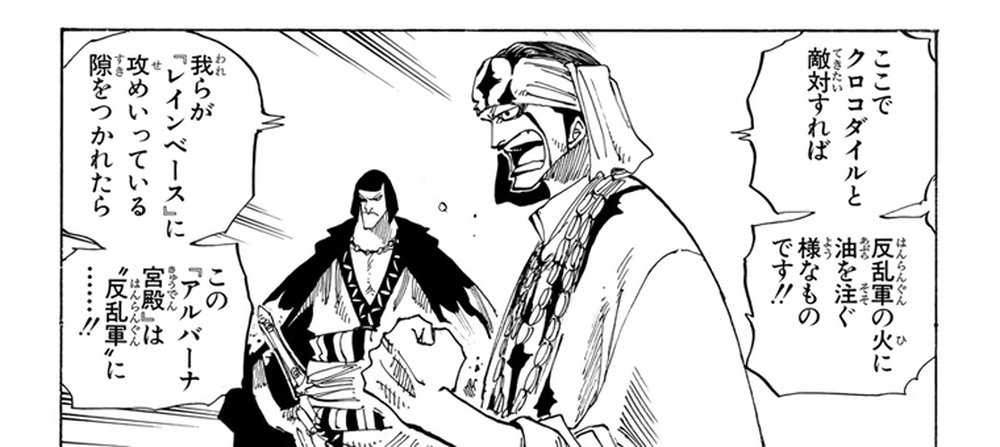
「ビビの覚悟とイガラムの死を無駄にはさせん!!!」「討って出るぞ!!!クロコダイルの居る『レインベース』へ!!」
"VIVI AND IGARAM'S SACRIFICES SHALL NOT BE IN VAIN!" "MARCH ON TO RAINBASE! CROCODILE MUST BE STOPPED!!"
A king about to throw his own army at the enemy stronghold, in person, out of grief. His two royal-guard captains — Chaka the Jackal and Pell the Falcon — move to stop him. Chaka goes first, with logistics: Rainbase is too far, the people's hearts already lean toward Crocodile. Then Pell steps forward with the argument that actually lands, the one built to be quoted rather than merely heard:
「ここでクロコダイルと敵対すれば 反乱軍の火に油を注ぐ様なものです!!」
Koko de Kurokodairu to tekitai sureba, hanrangun no hi ni abura o sosogu yō na mono desu!!
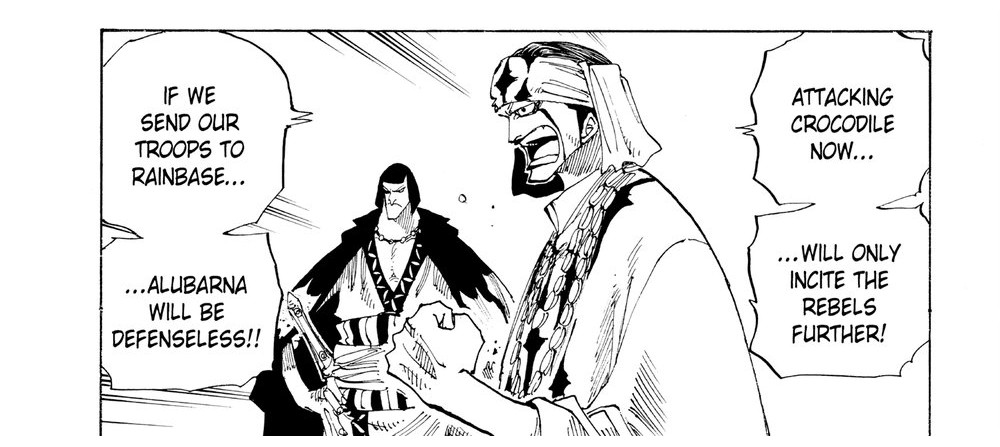
VIZ's English edition prints, split across the same two bubbles: "ATTACKING CROCODILE NOW... ...WILL ONLY INCITE THE REBELS FURTHER!" (Vol. 19, p.22).
Grant the rendering its due: it gets the logic exactly right. The king's plan will not calm the rebellion, it will feed it — that causal claim survives the trip into English intact, phrased with real force, and the line break even falls in roughly the right place. Nobody reading only the English edition would come away with the wrong idea about what happens next in Alabasta. But listen to what carries that idea in each language. The Japanese doesn't just state the outcome — it reaches for a picture everyone in the room already knows: 火に油を注ぐ, pouring oil on a fire. The English states the outcome and stops there.
The Original
Take the sentence apart piece by piece, because every piece is doing work.
反乱軍 (hanran-gun) — 反乱 "revolt, rebellion" plus 軍 "army, troops": the rebel forces massing against the crown. 火 (hi), "fire," takes に, the locative particle marking onto. 油 (abura), "oil" — not fuel in general, oil specifically — takes を, marking it as the thing being poured. And the verb, 注ぐ (sosogu), "to pour," is the same verb you'd use pouring tea, or, figuratively, pouring your whole heart into something (心血を注ぐ, kekketsu o sosogu). Stack the clause: 反乱軍の火に油を注ぐ — "pouring oil onto the rebel army's fire."
Then comes the part that matters most and disappears first in translation: 様なものです (yō na mono desu), "[it] is a thing resembling…" — the explicit simile frame of ~のようだ, bolted onto a whole clause rather than a single noun. Pell is not saying this will incite the rebels. He is saying this resembles pouring oil on a fire — reaching past his own authority to a saying everyone in the throne room already believes, the way you'd invoke a proverb to a king rather than just contradict him.
Every individual word here is beginner vocabulary — 火, 油, and 注ぐ are all words a first-year learner already owns. What makes 火に油を注ぐ a genuine idiom, typically shelved around JLPT N2, is entirely the fused, non-literal reading: recognizing that this isn't a sentence about liquids and flame at all, it's a fixed proverb about worsening an already-volatile situation. The grammar is simple. The recognition is the hard part.
VIZ's Choice
This idiom surfaces exactly once in the volumes on file — no scatter table to draw here, and that singularity is itself worth sitting with. VIZ had one shot at 火に油を注ぐ in this corpus, one panel, one deadline, and the choice made in that single panel is the whole data set.
And it's worth being precise about what the choice actually cost. This was not a case where the idiomatic option was clunky, over-long, or culturally opaque to an English reader. "...WOULD ONLY ADD FUEL TO THE REBELS' FIRE!" fits the same bubble, carries the same force, and lands the exclamation in the same place as the line VIZ actually printed. "Add fuel to the fire" is not an obscure literary reach for an English reader — it is one of the most common idioms in the language, exactly as common in English as 火に油を注ぐ is in Japanese. There was no untranslatable residue here, no concept without a Western equivalent, no pun with only one working half. Just a live idiom on one side of the page and a flat paraphrase on the other, for reasons the text itself doesn't reveal — most plausibly the same house habit visible elsewhere in this series (see 因縁, see 手も足も出ない): a reflex toward plain clarity that fires even when the colorful, equally clear option was sitting right there, free.
The Gap
A free equivalent, unclaimed. This is the rare pitfall in the series that isn't about English lacking something. English has "add fuel to the fire" and the rarer "pour oil on the flames," both built on the identical mechanism — a flammable liquid, an existing fire, a bad situation made worse by the addition. The image, the grammar shape (verb phrase describing an action), and the rhetorical function (a rebuke dressed as folk wisdom) all transfer at close to zero cost. VIZ had no excuse of untranslatability available and reached past the match anyway.
The simile marker vanishes. ような…です tells the reader, explicitly, that Pell is invoking a comparison — quoting received wisdom, not just voicing an opinion under pressure. "WILL ONLY INCITE THE REBELS FURTHER" reports the outcome directly, in Pell's own analytical voice. The king (and the reader) loses the sense that Pell is standing on the accumulated weight of a saying everyone already trusts, rather than simply arguing his own case harder.
The picture disappears. 火 and 油 are things a panel can draw — flame, oil, the instant they touch. "Incite" is an abstraction with no image behind it at all, in a medium built entirely around images.
Two advisors, one voice. Chaka's warning just before this is procedural — distance, an undefended capital. Pell's was written to sound different: proverbial, weightier, reaching outside the tactical moment for older authority. Flattening 火に油を注ぐ into a plain forecast erases that contrast, leaving both guards sounding like the same tactical-briefing voice instead of two men arguing the same conclusion from two different temperaments.
What If
- "...WOULD ONLY ADD FUEL TO THE REBELS' FIRE!" — the nearest idiomatic English cognate, near-identical image and force, almost no extra length. Cost: "fuel" is generic where 油 specifies oil — a small, honest concession, not an invention.
- "...IS LIKE POURING OIL ON THE FIRE OF THE REBELLION!" — keeps the oil specifically, and keeps the ような "is like" simile frame that VIZ's line drops entirely. Cost: a few characters longer, a tighter fit in a narrow bubble.
- "...WOULD BE POURING OIL ON THE FLAMES OF REVOLT!" — reaches for English's rarer, older oil-idiom, matching the Japanese image almost word for word. Cost: reads slightly more literary to modern ears than "add fuel to the fire."
- "...WOULD ONLY FAN THE FLAMES OF REBELLION!" — trades "pouring" for "fanning," a different mechanism, but keeps a live fire-idiom in play. Cost: the specific, vivid act of pouring oil is gone.
Each of these costs something small and honest — a syllable, a slightly older register, a swapped verb. None of them costs the metaphor itself. That's the whole point of this article: for once, the price of fidelity here was nearly nothing.
Take-away
Most of the pitfalls in this series exist because English genuinely lacks a word or a concept Japanese has — a Buddhist compound, a doubled meaning, a pun with only one working half. 火に油を注ぐ is the exception that proves the rule matters: here English had the identical idiom, ready to go, and the translation reached past it for a flat paraphrase anyway.
Three rules of thumb to carry off this page:
- When a Japanese idiom maps closely onto an English one, don't assume the translation took the free win — check. "Add fuel to the fire" for 火に油を注ぐ shows that even a gift-wrapped equivalent can be left on the table.
- Watch for ような…です (or ~のようだ) doing simile work on a whole clause, not just a noun — it's Japanese explicitly flagging "I am quoting a comparison here," a texture worth preserving with "it would be like X-ing" rather than collapsing to a flat statement.
- 油 shows up across more idioms than you'd expect (油を売る "to loaf," 油断 "carelessness") — always check whether it's doing figurative work before reading it as literal oil.
For a case with the mirror-image problem — the same Japanese idiom rendered five different ways instead of flattened once — see 手も足も出ない and the body-idiom English keeps rewording. And for another moment where a proverb gets swapped for plain tactical English, see 自業自得 and the Buddhist verdict turned into battle advice — or browse the One Piece translation notes index.
Every Japanese and English line quoted above is a byte-exact capture from the cited editions — ONE PIECE Vol. 19 (Japanese) and One Piece Vol. 19 (VIZ Media) at the corresponding panel — via our bilingual page database; see Sources below.