The Moment
The Straw Hats have just climbed the beanstalk to the sky and been swallowed whole for their trouble — a giant serpent, the same creature the deposed sky-knight Gan Fall (VIZ spells it "Ganfor") will later greet by name, Nola, has closed its jaws around the crew mid-arrival. Luffy, characteristically, needs the situation spelled out for him. Gan Fall sizes up the trouble first: 「お前らヘビに食われたのか…!!」, "...GETTING EATEN BY A SNAKE!!" — and then, with the deadpan of an old soldier who has seen worse, adds 「何とおぬし船長であったか…!世も末である」, "SO YOU'RE THE CAPTAIN. THESE MUST BE DESPERATE TIMES." Chased by a fresh round of disbelief from the rest of the crew, Nami cuts through the noise once more, explaining not just where they are but why:
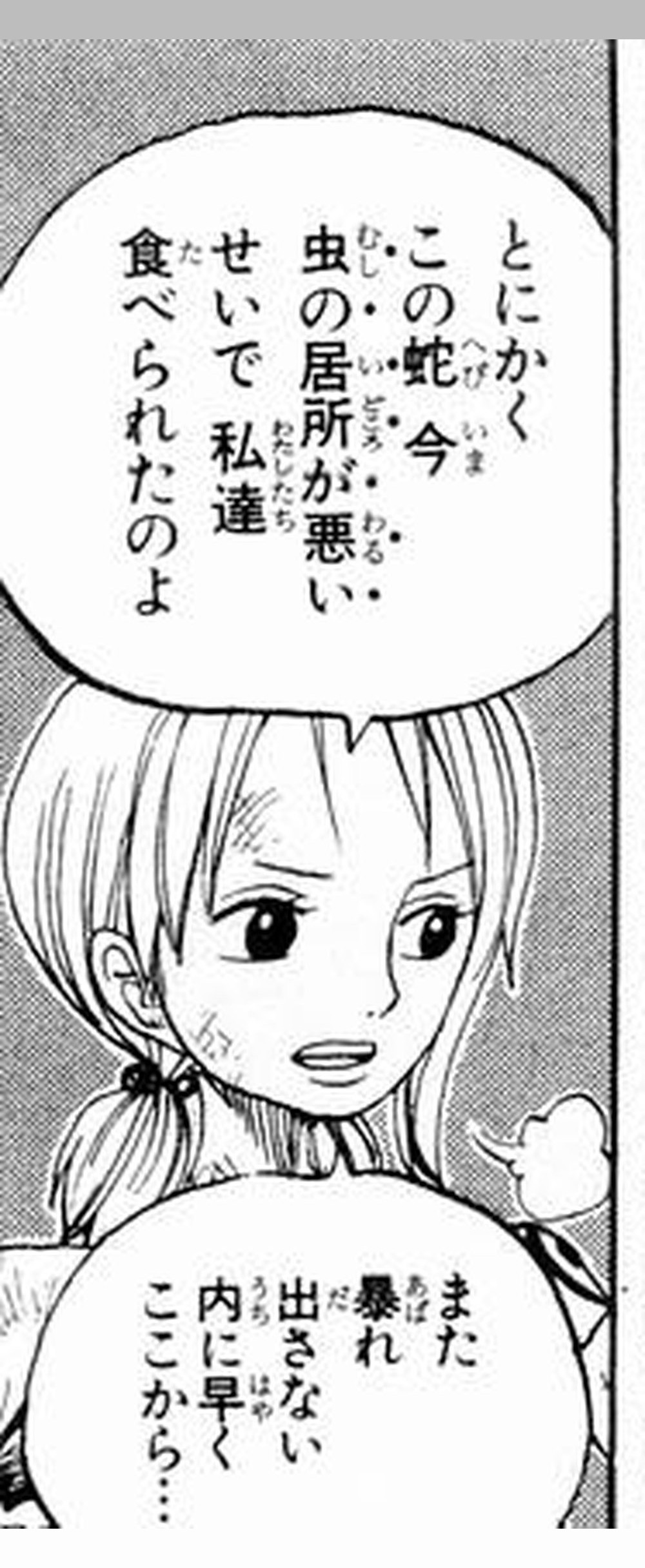
「とにかくこの蛇今…虫の居所が悪いせいで私達食べられたのよ」
Tonikaku kono hebi ima… mushi no idokoro ga warui sei de watashitachi taberareta no yo.
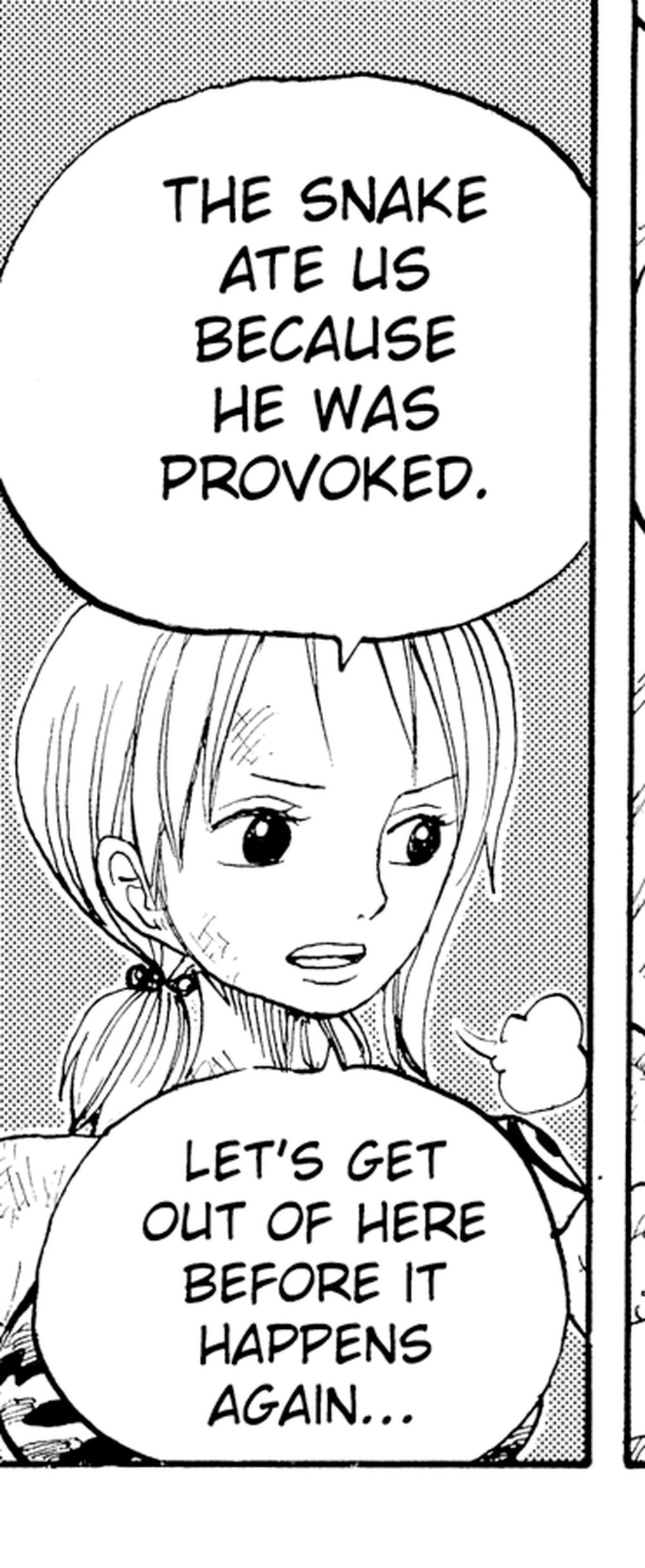
VIZ's English edition prints: "THE SNAKE ATE US BECAUSE HE WAS PROVOKED." (Vol. 29, p.131.)
Grant the rendering its due first: it's clean, it reads instantly, and it keeps Nami's brisk, no-nonsense delivery — she isn't panicking, she's briefing. "Provoked" even gestures at roughly the right neighborhood of meaning: something is off with the snake, and nobody in the room is really at fault for it. But look at what VIZ had to invent to get an English reader there. Nowhere in Nami's line does she say anything provoked the snake. She says something stranger: that a bug living inside it is currently sitting in the wrong spot.
The Original
Take the idiom apart piece by piece.
虫 (mushi) is the ordinary word for bug, worm, insect — the kanji itself a pictograph of a crawling creature, one of the first hundred kanji any learner meets. Nothing exotic yet.
居所 (idokoro) is where it gets interesting: 居 "to be, to reside" plus 所 "place" — a completely real, completely bureaucratic Japanese noun meaning "whereabouts, one's current address." It's the word Japanese legal documents reach for when someone lacks a fixed residence: 住所又は居所 ("domicile or whereabouts"). It shows up on missing-person notices and court paperwork, anywhere the state needs to know where you currently are, as distinct from 住所, your official permanent address.
Put the two together and 虫の居所 files a change-of-address form for the insect: the current whereabouts of the bug. Add が悪い, the plainest possible "is bad" — N5 grammar, the first adjective sentence any learner produces — and the whole idiom lands with a completely straight face on something absurd: the bug's registered address is bad today.
That absurdity is the point, but it wasn't invented for comic effect. It rides on a genuine, centuries-old body of folk medicine that populated the human interior with small creatures — mushi — blamed for whatever the body did without asking permission first: growling with hunger, boiling with anger, sending unaccountable hunches. The tradition has an actual illustrated record: the 針聞書 (Harikikigaki), a 1568 medical scroll now a minor museum celebrity for its catalogue of googly-eyed body-bugs, one drawn for practically every ailment. In this folklore the bug isn't fixed in one organ — it can relocate — and the idiom assumes exactly that: wherever it happens to be sitting on a given day decides whether its host is easygoing or impossible to deal with. No outside trigger required. Just bad luck in real estate.
Grammatically the whole thing is beginner-level — [Xの居所] plus [〜が悪い] — which is exactly why 虫の居所が悪い sits at JLPT N1 on vocabulary lists despite using no hard grammar at all: the difficulty is entirely in knowing which everyday words have been drafted into folklore. The register is completely unmarked, ordinary spoken Japanese; Nami's せいで ("because of, due to the fault of") supplies a faint note of aggrieved, matter-of-fact cause, and her closing のよ is her habitual assertive register — she's stating a fact of nature, not offering an opinion, to a captain slow on the uptake.
VIZ's Choice
虫の居所が悪い appears exactly once in the volumes we have on file, so there's no scatter table to read here — one bubble, one decision, worth sitting with on its own.
VIZ chose "HE WAS PROVOKED," and the choice is a clean piece of craftsmanship under real constraint: the bubble has to explain, in a handful of words, why a giant snake ate the entire cast, in language a fast-reading English audience will accept without a footnote. "Provoked" delivers exactly that — instant, unremarkable, done. It even lands in roughly the same emotional neighborhood as the Japanese: nobody is really to blame, the snake just wasn't itself.
But notice the machinery VIZ had to swap in to get an English reader there. Japanese explains the snake's behavior with an involuntary internal state — the bug's address is bad, full stop, no cause needed. English can't leave a mood unexplained without sounding like a plot hole, so "provoked" supplies a cause the original doesn't have: something must have happened to set the snake off. That's not a small adjustment. It relocates the entire explanation from inside the snake to outside it — from folklore to event, from involuntary temperament to reactive anger. The result reads perfectly in English. It just isn't answering the question Nami actually asked and answered.
The Gap
Agency runs backward. 虫の居所が悪い assigns the cause to an involuntary resident that needs no trigger; the snake had a bad day in there, that's all. "HE WAS PROVOKED" installs an external cause and, quietly, an implied provoker — as if someone out there shares the blame for the crew nearly becoming lunch. The Japanese line accuses no one. The English line, structurally, does.
The address disappears. 居所 is a real bureaucratic noun for "current whereabouts," and the idiom's dry humor depends on filing that word against an insect. Losing 居所 doesn't just lose a word — it loses the specific joke of treating a temper-organ like it has a mailing address, which is the whole reason this idiom sounds droll rather than mystical in Japanese.
The family goes unlabeled. This same resident shows up across Japanese as 腹の虫 (hungry, furious), 虫の知らせ (a premonition), 虫が好かない (instinctive dislike), 疳の虫 (a child's tantrum) — one creature working several jobs. English answers each idiom on its own terms, with its own unrelated vocabulary, so a reader who has already met the belly-bug in this site's Naruto coverage of Kakashi's hungry genin has no way of knowing they've just met its cousin, several volumes and one animal removed.
What If
No option here is free; here's the menu and its costs.
- "His bug just picked a bad spot to sit today — that's why we got eaten." — keeps the literal image and the causeless, no-fault logic intact. Cost: baffling on first read; "his bug" sounds like nonsense without the folklore standing behind it.
- "The snake wasn't provoked — it just woke up on the wrong side." — borrows English's nearest cousin, a blameless bad mood needing no cause. Cost: imports Western furniture (a bed) into a folk-anatomy joke about an insect, and severs the resemblance to 腹の虫 and its family elsewhere on this site.
- "The snake was just in one of its moods — that's why it ate us." — plain, natural, keeps せいで's shrugging tone. Cost: the bug is gone without a trace; nothing marks this as kin to any other 虫 idiom a reader might meet later.
- Keep VIZ's shape, smuggle the tenant back in: "THE SNAKE'S INNER BUG WAS SITTING WRONG TODAY — THAT'S WHY IT ATE US." — Cost: too long for the bubble, and "inner bug" needs the reader's trust that this is folklore, not whimsy invented on the spot.
Every option trades the same two things against each other: keep the literal bug and risk sounding invented, or keep the shrugging tone and lose the creature that makes the idiom what it is.
Take-away
Three rules of thumb to carry off this page:
- When a mood needs no explanation, look for a 虫. Japanese routinely blames involuntary states — hunger, fury, hunches, crankiness, tantrums — on a resident bug rather than an event. English always wants a trigger; Japanese is often fine without one.
- 居所 is a real word before it's a joke. It means "current whereabouts" in ordinary bureaucratic Japanese (住所又は居所 on legal forms) long before anyone drafts it to describe an insect's mood. Spotting the borrowed bureaucracy is half of catching the idiom's dry humor.
- Collect the 虫 family as one creature, not six phrases. 腹の虫, 虫の知らせ, 虫が好かない, 疳の虫, and 虫の居所が悪い all share a tenant. Meet it growling for lunch in one book, and you'll recognize it sulking in a bad mood in another.
This idiom is in good company on this site: for the same resident heard growling with hunger and seething with anger, see this site's Naruto coverage of Kakashi teasing his starving genin with 腹の虫 — the belly-bug's more famous appearance. Closer to home, for two more places Japanese locates a feeling inside an organ English would rather leave abstract, see the liver that carries courage in 肝っ玉 and the viscera that has to physically accept an explanation in 腑に落ちない. Or browse the One Piece translation notes index.
Every Japanese and English line quoted above is a byte-exact capture from the cited editions — ONE PIECE Vol. 29 (Japanese) and One Piece Vol. 29 (VIZ Media) at the corresponding panels — via our bilingual page database; see Sources below.