The Moment
Volume 15. The Hashira have gathered after the Swordsmith Village battle, and Amane Ubuyashiki has just explained the Demon Slayer Mark — the power-up two of their number have already manifested. Then she lowers the price of it onto the room, in a sentence VIZ leaves hanging off the edge of the page: "THOSE WHO DO MANIFEST THE MARK... ...WITHOUT EXCEPTION WILL ALL—" (Vol. 15, p.94). A beat panel: crows on a roof ridge. Nobody finishes the sentence. Nobody has to.
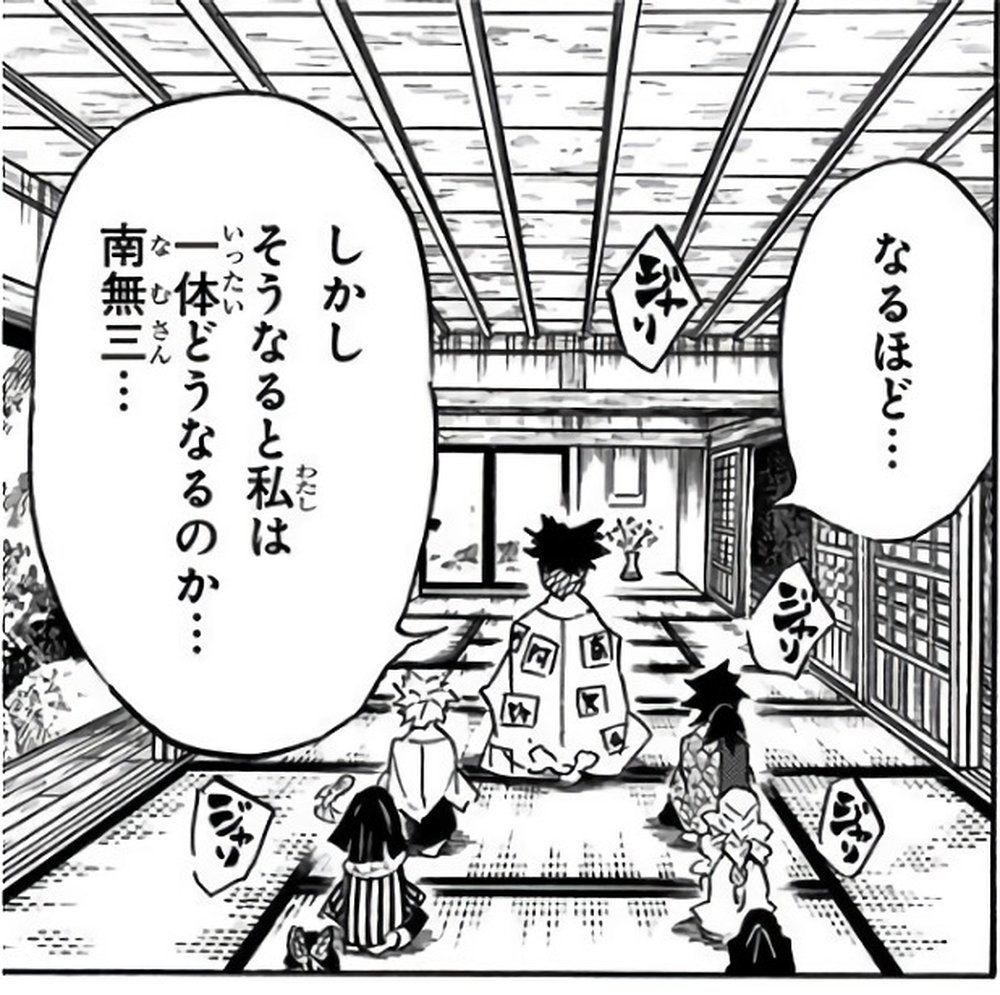
And then the room's gentlest giant — Gyomei Himejima, the Stone Hashira, the blind lay monk whose haori is printed edge to edge with the characters 南無阿弥陀仏 — rises and simply walks out, murmuring to himself:
「なるほど…」「しかしそうなると私は一体どうなるのか…南無三…」
Naruhodo… Shikashi sō naru to watashi wa ittai dō naru no ka… Namusan…
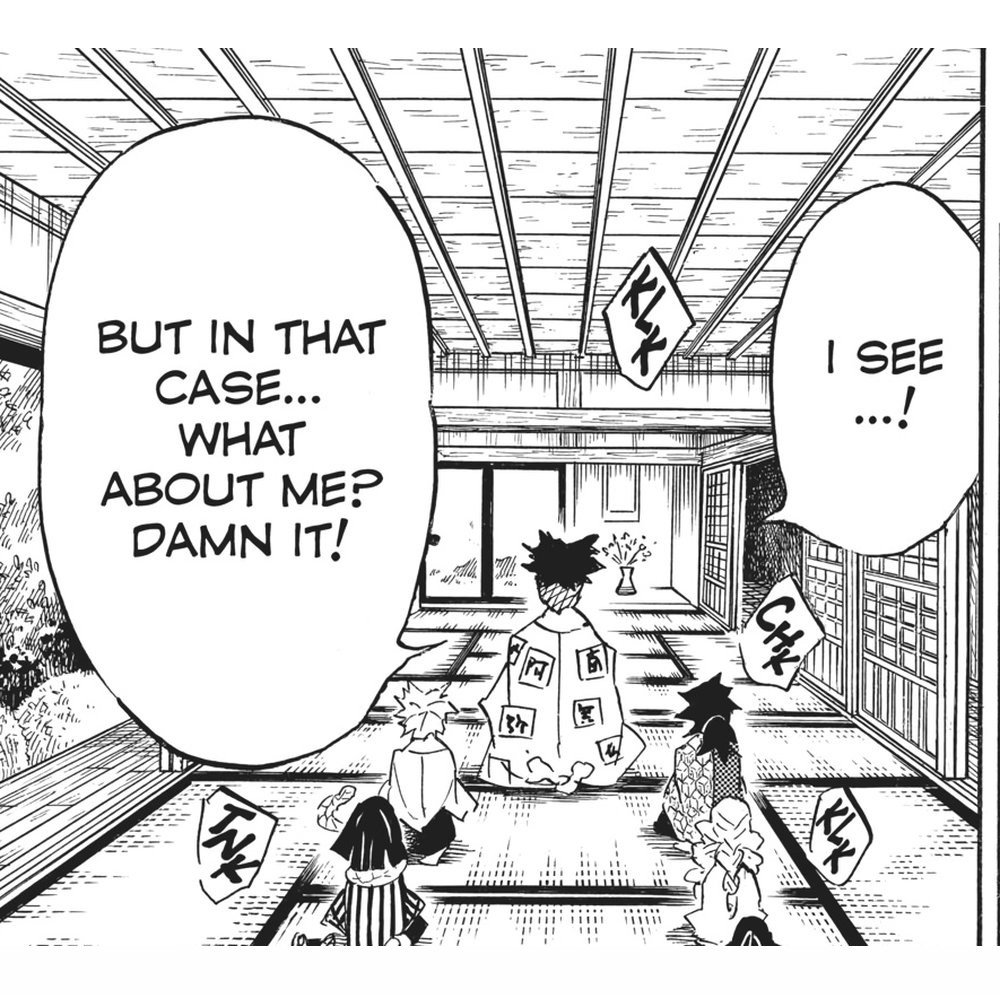
VIZ's English edition prints: "I SEE...!" / "BUT IN THAT CASE... WHAT ABOUT ME? DAMN IT!" (Vol. 15, p.95).
The scene collapses into comedy on cue — Muichiro stands with a flat "SINCE LADY AMANE HAS LEFT, I'LL EXCUSE MYSELF.", Sanemi erupts (「おい待てェ失礼すんじゃねぇ」 — "HEY, WAIT! DON'T BE RUDE!"), and Giyu, magnificently, declares "I'M NOT INVOLVED." Grant VIZ's line its due inside that chaos: "DAMN IT!" is abrupt, funny, and perfectly timed. The beat where the most serene man in the Corps thinks only of himself and bolts survives completely.
But look at what the word was. 南無三 (namusan) is not a curse. It is a prayer — the same prayer this character is never allowed to stop saying — and this is the only time in these volumes that VIZ translates it.
The Original
Start with the two characters doing the work: 南無 (namu). They mean nothing. That is the point — 南 "south" and 無 "nothing" are pure sound-spelling (ateji) for Sanskrit namas: "I bow to, I take refuge in," the same root that lives in namaste. When Buddhism crossed into China and then Japan, its formulas came as sound first, meaning second; 南無 is a fossilized bow, in phonetic kanji.
Bolt a sacred name onto it and you get an invocation:
- 南無阿弥陀仏 (Namu Amida Butsu) — "I take refuge in Amida Buddha." 阿弥陀 transliterates Amitābha; only 仏, "Buddha," is meaning-bearing kanji. This six-character formula is the heart of Pure Land Buddhism: recite the Name, and Amida receives you into the Pure Land at death.
- 念仏 (nenbutsu) — 念 "recite mindfully" + 仏 "Buddha": the act of reciting it. When Genya tells Tanjiro 「俺の場合は念仏唱える」 ("I chant the nenbutsu"), this is the practice he means.
- 南無三 (namusan) — our word. It clips 南無三宝 (namu sanbō), "homage to the Three Treasures": the Buddha, the Dharma, and the Sangha, the tripod every Buddhist takes refuge in. And then the centuries went to work on it. By the Edo period, 南無三 was what a kabuki hero shouts when the ambush springs — a whole act of taking refuge worn down into three syllables of "oh no." It is a prayer the way "goodness gracious" is a prayer: the theology has gone quiet, but it is still there, printed in the letters.
So the sentence Himejima murmurs on his way out — 私 (watashi), the room's one polite self-pronoun; 一体どうなるのか, "what on earth becomes of me…" — ends in a word that is simultaneously a period-drama "yikes" and, in this particular mouth, one more bead on the string. Because Gotouge has built Himejima so that he cannot speak outside his faith: prayer beads, palms together, perpetual tears, and that haori spelling out 南無阿弥陀仏 across his shoulders. Even his panic prays.
VIZ's Choice
Here is every appearance of the 南無/念仏 family in the volumes we have on file, side by side with the official English:
| Vol. / p. | Speaker & scene | Japanese | VIZ English |
|---|---|---|---|
| 6 / 81 | Himejima, weeping over the pinned Tanjiro at his first appearance | 南無阿弥陀仏… | NAMU AMIDA BUTSU... |
| 8 / 107 | Himejima, as news of Rengoku's death reaches the Hashira | 南無阿弥陀仏… | NAMU AMIDA BUTSU... |
| 15 / 95 | Himejima, leaving the Hashira meeting | しかしそうなると私は一体どうなるのか…南無三… | BUT IN THAT CASE... WHAT ABOUT ME? DAMN IT! |
| 16 / 11 | Tanjiro, mid-waterfall, noticing Inosuke's chant has stopped | ん?念仏が聞こえなくなった | HM? I DON'T HEAR THE NENBUTSU CHANT ANYMORE! |
| 16 / 23 | Genya, explaining his concentration ritual | 俺の場合は念仏唱える | I CHANT THE NENBUTSU. |
| 16 / 23 | The boys, on Himejima's habit | そうそう南無南無言ってるだろ | RIGHT, RIGHT. HE SAYS "NAMU NAMU." |
| 16 / 34 | Himejima, chanting over a soaked — and alive — Tanjiro | 南無阿弥陀仏南無阿弥陀仏… | NAMU AMIDA BUTSU, NAMU AMIDA BUTSU... |
| 16 / 104 | Himejima, the chant becoming a battle cry as he swings | 南無/阿弥陀仏 | NAMU... / ...AMIDA BUTSU! |
Read the right-hand column and a policy emerges, and it is a good policy: the prayer is treated as untranslatable sacred matter. VIZ transcribes 南無阿弥陀仏 letter for letter, keeps 念仏 as the loanword "the nenbutsu" (adding "chant" once, as a quiet gloss), even preserves the boys' teasing 南無南無 as "NAMU NAMU." Across eleven pages the English reader is being taught, patiently, to recognize the sound of this man's faith — so well that the gags land untranslated: Tanjiro hears the funeral formula chanted over his own dripping head and yelps 「えっ俺死んじゃった…?」 — "HUH?! DID I DIE?!" (Vol. 16, p.34) — and at the climax someone shouts "NOW, HIMEJIMA!!" and the chant itself splits across two bubbles as the flail comes down: "NAMU... ...AMIDA BUTSU!" (Vol. 16, p.104). The prayer works as characterization, comedy, and war cry, all without a word of translation.
Then 南無三 walks in — the hardest case, the one where the prayer has half-become an emotion — and the policy snaps. "DAMN IT!"
The Gap
The one word that got translated is the one that got converted. 往生しろ became "rest in pieces" in One Piece; here the trade is starker, because it breaks a pattern the translation itself built. Eleven renderings teach the reader that namu-words are sacred and foreign; the twelfth renders a namu-word as native profanity. The English reader cannot hear that "DAMN IT!" and "NAMU AMIDA BUTSU" begin with the same syllables — that Himejima's outburst is his faith, compressed, not his faith abandoned.
"Damn" points the wrong way. 南無 asks for refuge: I bow, receive me. "Damn" consigns to hell: let it be condemned. They are theological opposites — a plea for shelter and a sentence of exile — and the swap runs in the same direction as Demon Slayer's other graveside conversion, 成仏してください becoming "please find peace": Buddhist words that point somewhere replaced by English words that lock a door.
The character note dissolves. The Japanese gag is precise: a man with no secular register hits a moment of pure self-interest, and even that comes out liturgical. He panics in prayer. The English gag is broader: a solemn giant swears like anybody's uncle. Still funny — but now Himejima has a secular register after all, and the single most disciplined voice in the Corps briefly sounds like Zenitsu. The consistency that made "NAMU NAMU" a loving joke two volumes later has a hole in it, and the hole is exactly where his humanity showed.
What If
The menu, with prices:
- "MERCIFUL BUDDHA..." — keeps the panic inside the faith, instantly readable. Cost: invented liturgy; it sounds like a screenwriter's monk, not a fossil phrase real Japanese actually shouts.
- "HEAVEN HELP ME..." — an English prayer worn down to an interjection: precisely the register of 南無三, dated and a little comic in a modern mouth. Cost: "heaven" is generically theistic; the act of taking refuge blurs.
- "NAMU SAN...!" — extend VIZ's own transcription policy to its final case and let the reader's trained ear do the work. Cost: unglossed, it is noise at the exact moment the line needs to read as "what about me?!"; the art must carry the dismay alone.
- "LORD HAVE MERCY..." — the closest living English cousin: liturgy used as exclamation, archaic, faintly funny, and still audibly a plea for shelter rather than a condemnation. Cost: openly Christian — it converts the monk on the spot, which is the same trade "DAMN IT!" made, just facing the altar instead of the pit.
Notice the shape of the problem: English has plenty of worn-down prayers, but they all belong to the wrong religion, and its all-purpose secular exclamation is a curse. The translator had to choose between the wrong faith and no faith. VIZ chose no faith — and lost the fingerprint.
Take-away
Three rules of thumb to carry off this page:
- 南無 is sound, not meaning. When you meet 南無X — 南無阿弥陀仏, 南無妙法蓮華経, 南無三 — read it as "homage to X / I take refuge in X," and ignore what 南 and 無 usually mean. It is Sanskrit wearing kanji.
- Prayers wear down into interjections in every language. Before translating one, ask how far down it has worn — and match the register first (南無三 ≈ "heaven help me," not "damn it"), because the direction of the theology travels with the word even after the speaker stops noticing it.
- When a translation leaves a word untranslated, that is a policy — watch its exceptions. VIZ's NAMU AMIDA BUTSU / "the nenbutsu" / NAMU NAMU is a carefully built glossary; the one deviation, "DAMN IT!," is where the meaning leaked out. Exceptions are where translations confess.
For more of Demon Slayer's Buddhist death-vocabulary, see the send-off buried in 成仏してください and Inosuke's backwards 往生しやがれ — and for the same 往生 problem an ocean away, the One Piece piece on 往生しろ and the tombstone pun VIZ reached for. Or browse the Demon Slayer translation notes index.
Every Japanese and English line quoted above is a byte-exact capture from the cited editions — 鬼滅の刃 Vol. 6–16 (Japanese) and Demon Slayer: Kimetsu no Yaiba (VIZ Media) at the corresponding panels — via our bilingual page database; see Sources below.