The Moment
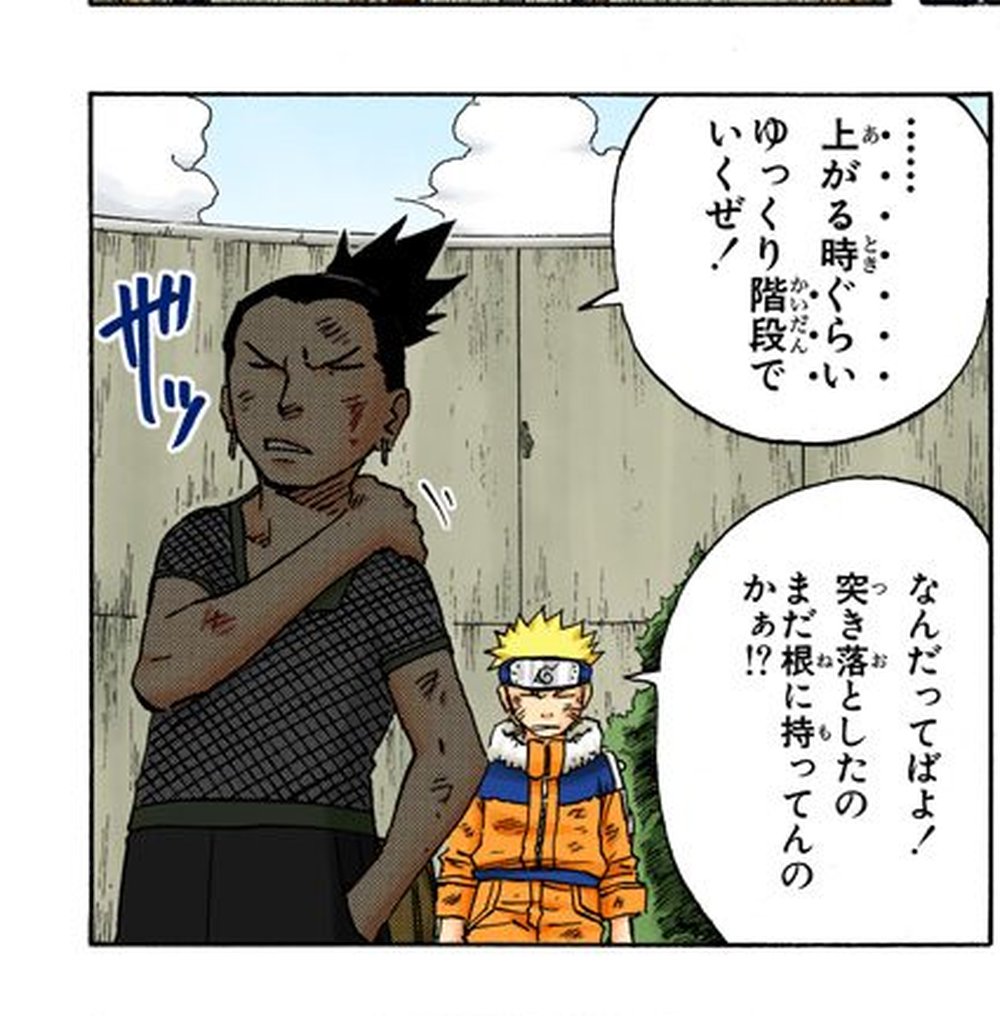
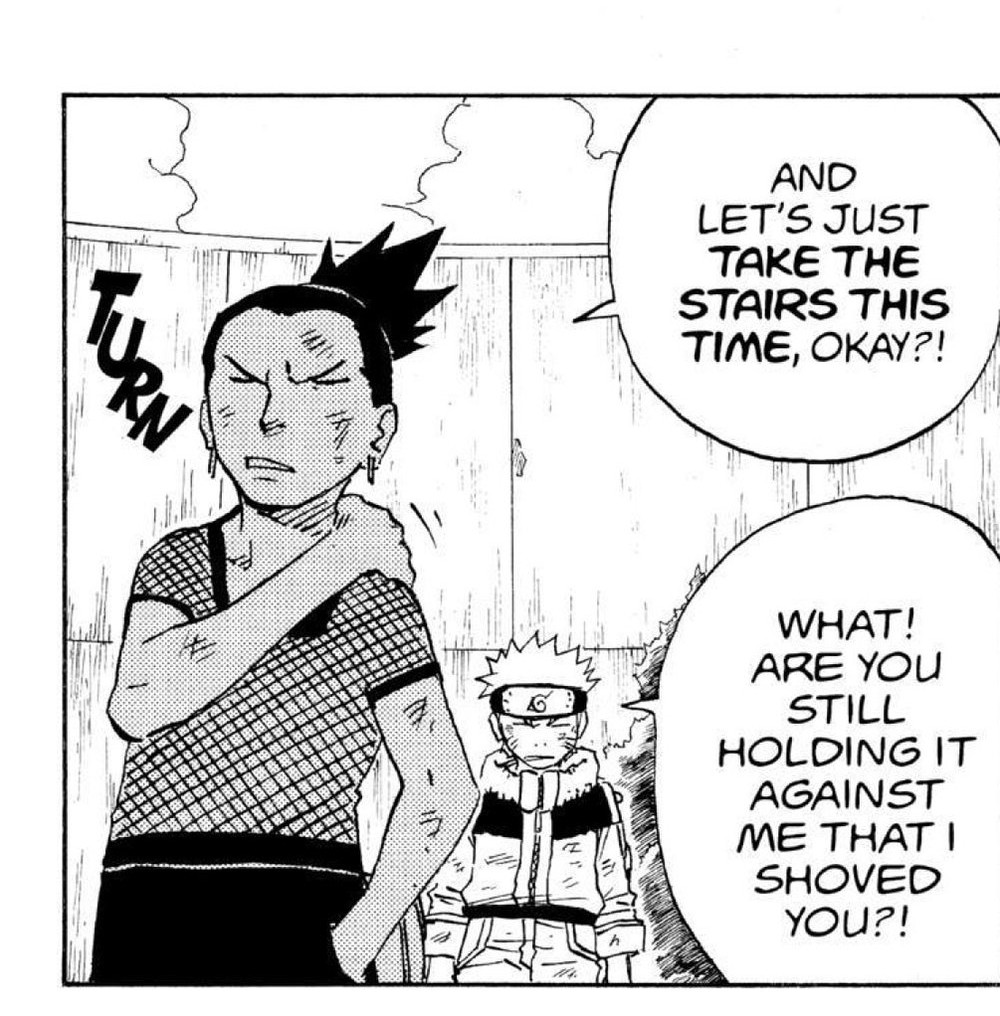
Volume 13. The pages just before this one are pure grief — Sakura sobbing over Rock Lee's broken body after his crushing loss to Gaara in the Chunin Exam preliminaries. Then the story cuts away for a breath: a wide shot of the tower's outer wall, someone off-panel calling down to Gaara to come inside, and Naruto's group heading back to the spectator floor. An adult overseeing them — mesh shirt, a fresh scratch across one shoulder — turns sharply (「ザッ」, the snap of a turn) and lays down a rule with visible irritation:
「......あ..上がる時ぐらいゆっくり階段でいくぜ!」
…a… agaru toki gurai yukkuri kaidan de iku ze!
"AND LET'S JUST TAKE THE STAIRS THIS TIME, OKAY?!" The implication sits right there in "this time": something already happened on these stairs. Naruto, small and indignant beside her, isn't about to let the dig pass:
「なんだってばよ!突き落としたのまだ根に持ってんのかぁ!?」
Nan da tteba yo! Tsukiotoshita no mada ne ni motten no kaa!?
VIZ's English edition prints: "WHAT! ARE YOU STILL HOLDING IT AGAINST ME THAT I SHOVED YOU?!" (Vol. 13, p.37).
Grant it its due first. This is a clean, idiomatic, instantly readable line — exactly what an English-speaking kid would blurt out in the same spot, delivered with the right amount of outrage and not a single wasted word. "Holding it against" is, in fact, the single closest fixed English idiom to 根に持つ in both meaning and register: no bookish "grudge," no clunky paraphrase, no lost momentum in a fast two-panel exchange. If the assignment were simply "convey that Naruto shoved her and she's still annoyed," this line does the job about as well as English can. The loss here is quieter than a mistranslation. It's a metaphor swapped for its nearest neighbor, so smoothly that an English-only reader would never suspect anything botanical was ever growing under the Japanese sentence.
The Original
根に持つ splits into three plain pieces: 根 (ne), "root" — the underground part of a plant, the same 根 sitting inside 根っこ (nekko, the colloquial word for "root") and 大根 (daikon, "big root," the radish everyone has grated over their fish) — plus に, the locative particle that marks where something sits, plus 持つ (motsu), "to hold, to carry, to possess." Literally: "to hold [it] at the root."
Notice what the grammar is doing: it treats the grievance as a location, not an object. You don't hold a grudge the way you hold a rock in your hand, closed fingers, open fingers, gone. You let something settle into the root system of your feelings — and once it's there, trimming the visible stem (an apology, an explanation, the sheer passage of time) doesn't kill it, because the root is still in the ground, ready to send up a new shoot the next time the subject comes up. That's the entire difference this article is chasing: a grip releases; a root has to be dug out.
Naruto's actual sentence is even more compressed than the dictionary form. Casual Japanese drops the object particle constantly, so 突き落としたの(を)まだ根に持ってんの really reads as "(the fact that) I shoved you down — are you still holding that at the root?" — with の nominalizing the whole shoving incident into a single noun-shaped thing, the object planted at the root. The same underground logic keeps resurfacing elsewhere in the language: 根強い (nezuyoi, "deep-rooted, tenacious," said of stubborn beliefs or lasting popularity), 根絶 (konzetsu, "to eradicate at the root," because pulling up the visible weed by its leaves is never enough), and the reassuring negative 根に持たない (ne ni motanai) — "I won't hold this against you," the promise that no root gets planted in the first place.
VIZ's Choice
This expression surfaces exactly once in the volumes on file — no scatter across five scenes, no table of competing solutions to weigh against each other, just one sentence and one choice to examine on its own terms.
And the choice is a good one, as far as it goes. "HOLDING IT AGAINST ME" is the one fixed English idiom that shares 根に持つ's exact shape: a state (not an action) of continuing to blame someone for a past wrong, activated by "still," delivered with the same rhetorical-question shock as the Japanese かぁ!?. VIZ even preserves the setup that makes the line make sense — the previous bubble, "AND LET'S JUST TAKE THE STAIRS THIS TIME, OKAY?!", keeps the implied backstory (something happened on stairs before) fully intact, so the English reader isn't confused about what's being held against whom. Structurally, nothing is lost: cause, effect, and comic timing all survive the trip.
What doesn't survive is underneath the structure. "Hold" is English's default verb for any sustained negative feeling — you hold a grudge, hold a grievance, hold something against someone, hold a candle for an old flame — and it's such a flexible, bleached-out verb that it carries almost no picture of its own anymore. 根に持つ, by contrast, is doing something much more specific: it's making a claim about how a grudge behaves, not just that one exists. The translator's job here wasn't really "translate this idiom" so much as "pick the smoothest available English idiom for the same social situation" — and English's idiom shelf for grudges is entirely grip-shaped. There was no vine-shaped alternative sitting there to reach for.
The Gap
"Holding" is a grip; 根に持つ is a growth. English's whole idiom family for lingering resentment — hold a grudge, hold it against someone, carry a grudge — treats the feeling as an object kept in the hands: static, chosen, releasable the instant you decide to let go. 根に持つ pictures something rooted in soil instead: it grows on its own, resprouts after being cut back, and can't simply be dropped the way an object can — it has to be dug out, root and all. Naruto's teasing かぁ!? assumes the grudge is alive and still growing, not merely gripped in someone's fist for eleven-odd chapters.
A false-friend coincidence, not a shared metaphor. English does have root-language for grievances — "the root of the problem," "deep-seated resentment" — but none of it made it into this line; VIZ reached for the container idiom instead. The irony runs deeper than a missed opportunity: "grudge" itself descends from Old French grouchier / groucher, "to grumble, murmur" — an auditory root, the internal mutter of complaint, not a botanical one. Two languages independently reached for the same emotional territory through two entirely different senses — English through sound, Japanese through soil — and the one English phrase that shares Japanese's actual image, "root of the problem," was sitting right there on the shelf, unused.
The antonym goes missing. Japanese answers 根に持つ with a built-in opposite, 水に流す — forgiveness pictured as a grievance floating away downstream instead of digging in. That pairing hands Japanese speakers a single, shared physical vocabulary for the entire emotional cycle: a wrong either takes root, or it washes away. "Hold it against me" has no comparably vivid opposite in everyday English — "let it go" is close in meaning but shares no image with "hold" at all — so the reader loses not just this one idiom, but the whole folk taxonomy it belongs to.
What If
The menu, and what each option costs:
- "Are you still holding a grudge about me shoving you?!" — the most literal option, keeps "grudge" explicit on the page. Cost: "grudge" reads heavier and more deliberate than Naruto's teasing かぁ!?, and the root image is still nowhere in sight.
- "You're still sore about that shove?!" — quick and casual, a strong match for Naruto's rapid-fire delivery. Cost: "sore" suggests something fleeting and surface-level, the opposite of a grievance that regrows on its own.
- "Don't tell me that's STILL eating at you?!" — at least keeps an active, organic process instead of a static grip. Cost: "eating at" is a decay/predator metaphor, not a growth one — it borrows from a different Japanese idiom's territory (気に病む) rather than this one's.
- "You've been nursing that grudge this whole time?!" — "nursing" happens to rhyme with 根に持つ's botanical logic: something nursed is tended, not merely clenched. Cost: "nursing a grudge" is real English, but more literary and slow-paced than a shonen exclamation needs.
No option on this list threads every needle — keeps Naruto's speed, keeps the botanical image, and stays instantly readable in a speech bubble — because English simply never built a fast, punchy idiom around a growing grudge. Every fix trades one of those three away.
Take-away
根に持つ shows how a translation can be entirely correct about what happened — someone was shoved, someone's still annoyed about it — and still lose the shape of the feeling, because English and Japanese picture the same emotion through unrelated senses: a grip versus a root, a grumble versus a garden.
Three rules of thumb to carry off this page:
- When you meet 根に持つ, picture soil, not a fist. The grudge isn't being carried; it's been allowed to grow, which is exactly why it keeps coming back on its own.
- 根 is a whole vocabulary of stubbornness. 根強い, 根絶, 根気, 根も葉もない — collect them together and you have Japanese's entire toolkit for describing what won't go away.
- Watch for an idiom's built-in opposite. 根に持つ answers to 水に流す the way "hold a grudge" answers to nothing in particular in English — and losing the pair, not just the phrase, is often the bigger translation cost.
For another place where Naruto's trademark ってばよ carries more than the English text lets on, see the chapter title that kept quoting itself in 油断大敵, or browse the full Naruto translation notes index.
Every Japanese and English line quoted above is a byte-exact capture from the cited editions — NARUTO―ナルト― Vol. 13 (Japanese, colored digital edition) and Naruto Vol. 13 (VIZ Media) at the corresponding panel — via our bilingual page database; see Sources below.