The Moment
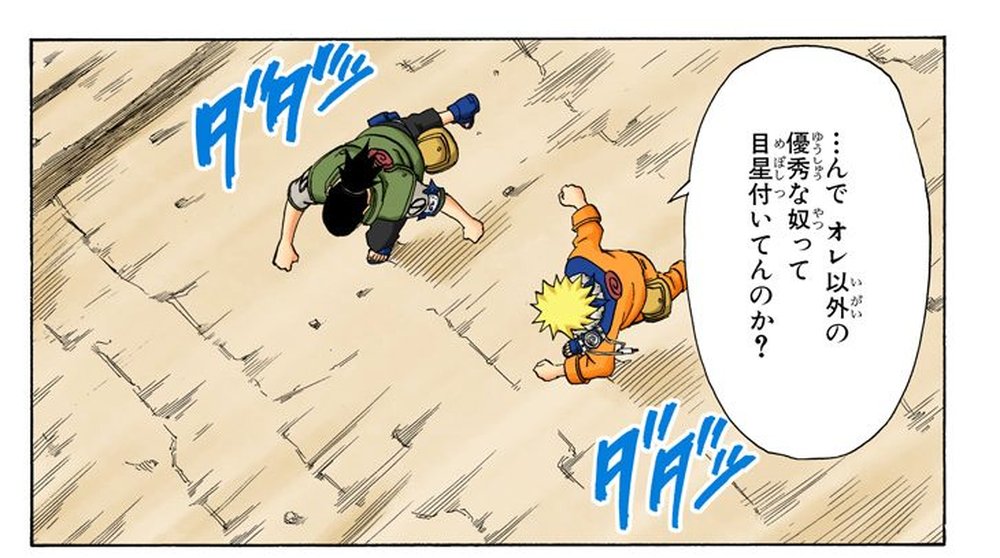
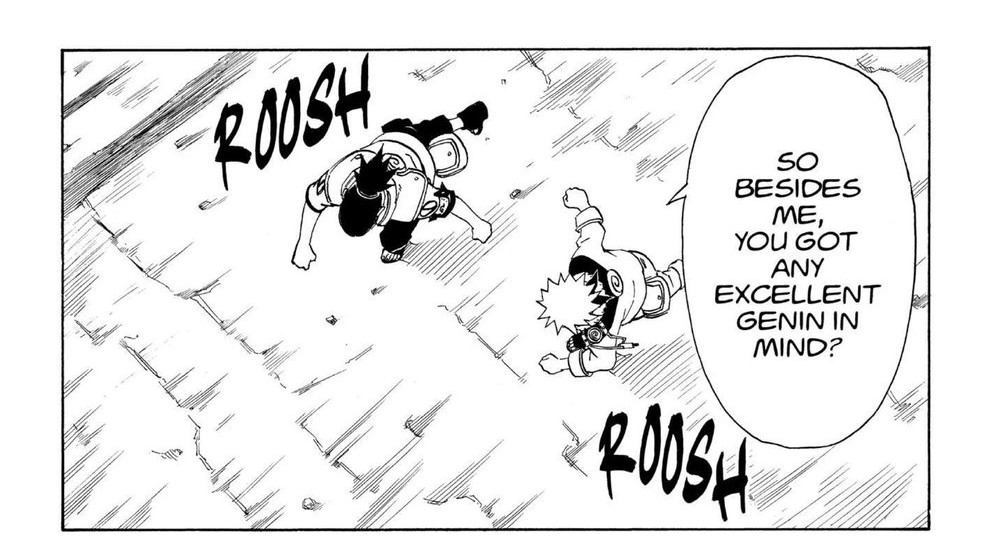
The Hidden Leaf Village, right after the Kazekage — Gaara — has been taken by the Akatsuki. Tsunade has authorized an emergency rescue squad, and the job of assembling it on short notice has landed on Shikamaru Nara. He's already sprinting from house to house recruiting teammates before the reader even catches up with him — muttering, a page earlier, 「めんどくせー...けど知ってる奴のことだけに放っとけねーしな」, "what a drag... but I can't just ignore it, not when it's someone I know." Naruto, still pulling his jacket on, tears out after him. Two panels later the pair are running full-tilt across a rooftop, and Naruto — impatient, a little competitive, clearly worried about who else is coming — throws out the question that's been on his mind since he woke up:
「...んでオレ以外の優秀な奴って目星付いてんのか?」
…Nde, ore igai no yūshū na yatsu tte meboshi tsuiten no ka?
VIZ's English edition prints: "SO BESIDES ME, YOU GOT ANY EXCELLENT GENIN IN MIND?" (Vol. 21, p.41).
Grant the rendering its due: it's fast, natural, and exactly the kind of thing an impatient friend blurts out mid-sprint. "Got any... in mind" is genuinely idiomatic English for exactly this situation. But look at what disappears along the way. 目星付いてんのか isn't a generic "do you have someone in mind" — it's built on 目星 (meboshi), 目 "eye" plus 星 "star," the picture of physically marking a target with your gaze before you've confirmed it's the right one. Naruto isn't just asking whether Shikamaru has thought about it. He's asking whether Shikamaru has already picked out, eye fixed on it, a candidate he hasn't yet proven correct.
The Original
目星 splits into two ordinary-looking kanji doing a very specific job together. 目 (me) is "eye" — N5, the same 目 that opens 目次 ("table of contents," literally "eye-order") and 目立つ ("to stand out," literally "to stand in the eye"). 星 (hoshi, voiced to boshi here) is "star" — N4, the everyday 星 of 星空 ("starry sky") and 火星 ("Mars"). But the 星 inside 目星 was never a celestial object. It's a target-mark: the small dot an eye fixes on the way an archer's eye fixes on the black center-dot of a 的 (mato, an archery target) — the identical repurposed 星 that gives 図星 (zuboshi) its name, the bullseye-dot at the heart of a sibling idiom this hub already covered, in Sanji's taunt at Mr. 2 Bon Kurei (the bullseye VIZ actually kept, published on the One Piece side of this project).
The two words are a matched pair built on one shared picture, aimed at two different moments in the same act of guessing. 図星 is the star already struck — a hidden truth guessed exactly right, confirmed the instant someone admits 図星だ, "that's exactly it." 目星 is the star merely fixed upon — a candidate singled out, a guess formed, with no confirmation attached yet. Aim, then hit; 目星, then 図星. 目星を付ける (meboshi o tsukeru), literally "to attach an eye-star [to something]," is the idiom built on the aiming half of that pair: to form a working guess, to single out a likely suspect, direction, or lead, before anyone knows whether it's right.
The grammar in Naruto's line takes that idiom and contracts it down to rapid-fire speech. 目星が付いている — "an eye-star is [already] attached" — drops its が and squeezes 付いている into 付いてん, landing as 目星付いてんのか: a bare yes/no question, "is there a guess already formed?" Nothing exotic in the structure; all the weight sits in the two-kanji noun doing the work.
VIZ's Choice
Every appearance of 目星 on file across the volumes in the corpus, speaker included:
| Vol. / p. | Speaker | Japanese | VIZ English |
|---|---|---|---|
| 21 / 41 | Naruto Uzumaki, running beside Shikamaru Nara | ...んでオレ以外の優秀な奴って目星付いてんのか? | SO BESIDES ME, YOU GOT ANY EXCELLENT GENIN IN MIND? |
| 28 / 58 | Kakashi Hatake, questioning Jiraiya over dango about the Akatsuki | 目星は? | WHAT DO THEY SEEK? |
Two occurrences, two completely different English solutions — and neither keeps the eye or the star. Naruto's line becomes "have... in mind," a phrase about mental possession with no aiming left in it. Kakashi's line becomes something else again: pressing Jiraiya for an explanation of why the Akatsuki has suddenly gone public with its movements, Kakashi tacks on a clipped follow-up — 目星は?, literally "as for [your] eye-star?" — and VIZ answers with "WHAT DO THEY SEEK?"
That second choice is worth sitting with, because it doesn't just drop the image — it moves the sentence's subject. 目星は? is elliptical enough to lean on context for its missing verb, but its natural reading keeps the question aimed at Jiraiya's own guess: "Do you have a lead [on why]?" VIZ's rescue instead asks about the Akatsuki's actual goal, a fact about them rather than a state of Jiraiya's mind. Jiraiya's own reply a beat later — 「そこまではワシにも分からん」, "THAT I STILL DON'T KNOW" — makes more sense as an answer to "do you have a guess?" than to "what do they seek?", since the second question is exactly the one thing Jiraiya, by his own admission, cannot answer either way. The English is smooth and dramatically serviceable; it just isn't quite answering the question the Japanese asked.
The Gap
The physical act of aiming collapses into a mental state. 目星を付ける stages guessing as something you do with your eye — fix a mark, the way an archer sights a target before releasing. "Have... in mind" and "seek" are both purely cognitive; nobody's eye does anything in either translation. The idiom's whole reason for existing — that Japanese pictures forming a guess as physically marking a target — never reaches the English reader.
The "not yet confirmed" half of the word goes unmarked. 目星 is definitionally provisional: it's the guess before the hit, the half of the aim-and-strike pair that hasn't yet earned the word 図星. "Have... in mind" carries no such built-in uncertainty — it's equally natural whether the speaker is guessing or already sure. English can say "I have someone in mind" about a locked-in decision as easily as a hunch; Japanese's 目星 never can.
The subject of the question quietly moves. 目星は? asks what Jiraiya has fixed his eye on — his lead, his candidate answer. "WHAT DO THEY SEEK?" asks what the Akatsuki actually wants — a claim about the organization, not about Jiraiya's state of mind. It's a small grammatical shift with a real consequence: the follow-up line, Jiraiya's own confession that he doesn't know, fits the Japanese question more naturally than the English one.
The sibling relationship with 図星 is invisible in translation. A reader who has met VIZ's "BULL'S-EYE." for 図星 elsewhere in this hub's corpus has no way to notice, from "have... in mind" alone, that the two idioms share a kanji, a target-metaphor, and opposite moments in the same act of guessing. In Japanese the pair rhymes on sight; in English the rhyme is gone before either word is spoken.
What If
- "So besides me, have you marked anyone else?" — keeps a verb-image close to 目星を付ける's own "attach a mark." Cost: "marked" reads faintly clinical or predatory next to Naruto's breezy tone.
- "Got your sights on anyone besides me?" — imports an aiming image of its own, casual register intact. Cost: "sights" evokes a gun scope, not an archer's eye — right family of metaphor, wrong weapon.
- "Besides me, who've you got pegged?" — "pegged" keeps the sense of a provisional, unconfirmed pick. Cost: the visual eye/target image is gone, traded for a carpentry metaphor.
- For Kakashi's line: "Any leads?" — keeps the clipped register and, crucially, keeps the question aimed at Jiraiya's own guess rather than Akatsuki's goal. Cost: no image of eye or target survives; "leads" is detective-novel vocabulary standing in for a physical metaphor.
Every option here trades the same thing away: an English verb that keeps some kind of aiming image ("sights," "marked") never quite matches the specific eye-and-star picture of 目星, and an English verb that keeps the provisional sense ("pegged," "leads") drops the image entirely. Nothing on the shelf does both at once, because English doesn't have a household idiom for "a target your eye has settled on but your hand hasn't struck yet."
Take-away
目星 and 図星 are a matched set: the same 星-as-target-mark, one word for the aim, one for the hit. English's "have... in mind" solves the aim half by forgetting there was ever a target, and "seek" solves it by asking about the target's own wishes instead of the guesser's eye. Both are fluent. Neither remembers that somewhere in the sentence, someone was picturing a mark and fixing their eye on it.
Three rules of thumb to carry off this page:
- When you meet 目星, ask whether the guess has been confirmed yet. If it hasn't, you're on the aiming side of the pair; if a character then says 図星, the arrow has landed — a two-idiom story, told in two words, across however many pages separate them.
- Watch for 星 doing target-duty, not star-duty, whenever it turns up outside the night sky. 図星, 目星, and 星取り (sumo's win-loss "star" record) all use 星 for a marked point, not a celestial body — a small but recurring metaphor family worth collecting.
- A clipped noun-plus-は question (目星は?) leans hard on context for its missing verb — and English, which has to supply a full sentence, can accidentally answer a different question than the one that was actually asked.
This pairs naturally with another moment where this hub tracked what a character's own eyes are doing: Naruto's partner sizing him up in the Forest of Death with 顔色, reading a friend's face for a color the Japanese line never names. Both idioms trust the eye to do work English hands off to a flat statement instead. For more of what Naruto's translators quietly relocate, browse the Naruto translation notes index.
Every Japanese and English line quoted above is a byte-exact capture from the cited editions — NARUTO―ナルト― Vol. 8, 21 & 28 (Japanese) and Naruto (VIZ Media) at the corresponding panels — via our bilingual page database; see Sources below.