The Moment
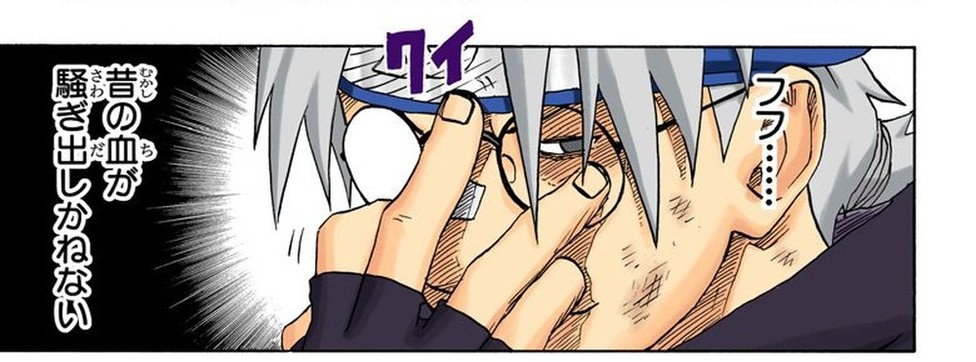
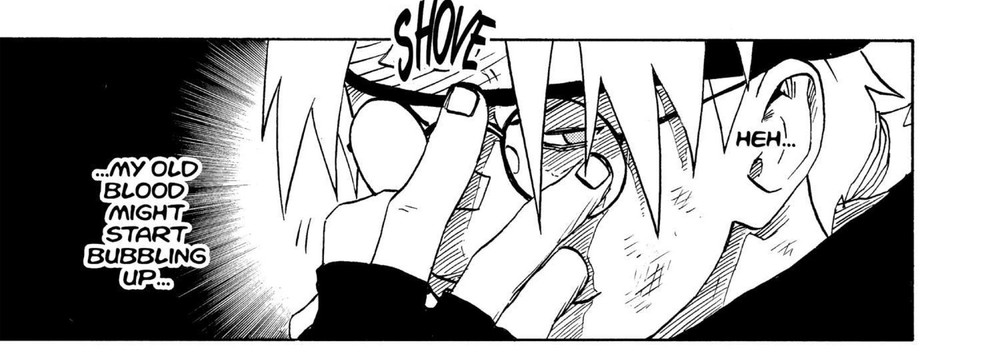
Kabuto Yakushi has just backed away from the arena floor during the Chunin Exam preliminaries — Konoha's genin hopefuls thinned round after round, Sasuke and Naruto barely out of their own matches — and for once nobody is watching him perform. Alone, he indulges a private monologue that starts almost sentimental: 「...ナルトくんサスケくん...もう少し君達と遊びたかったんですがね...」 ("...NARUTO, SASUKE... I WOULD HAVE LIKED TO HANG OUT WITH YOU A WHILE LONGER..."), then hardens into something colder — a reminder, to himself, of the job he actually has: 「これでも一応スパイなんでね...」 ("FUN'S FUN, BUT TECHNICALLY I'M A SPY HERE..."). He shoves his glasses up his nose, and admits the real risk of staying in the fight any longer:
「昔の血が騒ぎ出しかねない」
Mukashi no chi ga sawagidashikanenai
VIZ's English edition prints: "...MY OLD BLOOD MIGHT START BUBBLING UP..." (Vol. 8, p.51).
Grant the rendering its due first: it is a genuinely careful piece of translation. VIZ keeps "blood" as the subject of the sentence — most English idioms about excitement don't — and "bubbling up" finds a plausible liquid-in-motion image for a verb (騒ぐ) with no single-word English equivalent. Read on, though, and 「"本当の顔"をここでさらすわけにはいかない...」 — "AND NOW IS HARDLY THE TIME TO BLOW MY COVER" — makes the stakes explicit: Kabuto isn't worried about a mood. He's worried about his "real face" (本当の顔) showing through the genial, bespectacled med-nin performance he has spent years building. "My old blood might start bubbling up" is Kabuto warning himself that the fighter he used to be is still in there — and that it does not answer to him the way a mood would.
The Original
Take the idiom apart at the kanji.
血 (chi), "blood," is one of Japanese's oldest surviving pictographs: 皿, a ritual dish, holding 丶, a drop — a drop of sacrificial blood in a vessel, straight out of the blood-oath ceremonies that gave Japanese 血判 (けっぱん, a bloody thumbprint sealing a vow) and 血盟 (a blood pact). Even stripped of ritual, 血 in ordinary Japanese still means more than the liquid: it is lineage, temperament, the part of you decided before you were born — 血は争えない ("blood cannot be argued with," blood will tell), 血筋 (bloodline).
騒ぐ (sawagu), "to make noise, to riot, to kick up a commotion," is built from 馬 (horse) beside 蚤 (flea). The traditional gloss for the compound is exactly the scene it draws: a horse maddened by a flea bite, thrashing and noisy, its body no longer answering to anything but the itch. From that image, Chinese and then Japanese generalized 騒 outward — a rowdy crowd 騒ぐ, a scandal that 世間を騒がせる ("sets the world abuzz"), a room of children 騒ぐ — but the animal is still standing in the character's root: 騒ぐ is what a body does when something inside it has stopped taking orders.
Put the two together and the grammar does something English sentences rarely do: 血 sits in the subject slot, 騒ぐ is the whole predicate. Not "I get excited" (a person, verbed) but "[my] blood riots" (the blood, verbed) — the speaker's own body given its own intransitive verb, doing the rioting on its own account.
Kabuto's actual line stacks two more layers onto that bare idiom. 出す tacked onto a verb's masu-stem (騒ぐ → 騒ぎ + 出す → 騒ぎ出す) is the inchoative auxiliary, "to start Ving" — so his blood isn't merely restless, it is on the verge of starting to riot. And かねない, built from 兼ねる ("to be unable to," as in 言いかねる, "can't bring myself to say") negated into potential, is the textbook N2 grammar point for an unwelcome possibility you cannot rule out — closer to "there's a real risk that..." than to a simple "might." 騒ぎ出しかねない is not idle worry; it is a calculated risk assessment, delivered by a character whose whole personality runs on calculated risk assessment. As vocabulary, 血が騒ぐ itself sits around JLPT N2 — common enough for sports commentary and adventure fiction, not so common it needs glossing for a native reader — while かねない is core N2 grammar in its own right.
VIZ's Choice
血が騒ぐ surfaces twice in the volumes we have on file, spoken by two very different characters about two different bloods:
| Vol. / p. | Speaker | Japanese | VIZ English |
|---|---|---|---|
| 8 / 51 | Kabuto Yakushi (to himself) | 昔の血が騒ぎ出しかねない | ...MY OLD BLOOD MIGHT START BUBBLING UP... |
| 11 / 23 | Kimimaro (about Gaara) | 満月には..あいつの血が騒ぐ... | WHEN THE FULL MOON IS OUT... ITS BLOOD STIRS UP... |
Elsewhere in the corpus, an ailing Kimimaro squares off with Gaara one-on-one — sizing him up, deciding whether the fight is worth the cost — and delivers his own diagnosis of Gaara's danger: not sand jutsu, not raw strength, but a body that changes with the calendar. "WHEN THE FULL MOON IS OUT... ITS BLOOD STIRS UP..." is the closing line of the page, said as Gaara stands at a distance, and it does exactly what Kabuto's line does three volumes earlier — assigns a person's true, dangerous nature to their blood rather than to their will.
Set the two English lines side by side and VIZ's restraint is notable: both keep "blood" as a literal noun, both keep something like an intransitive verb ("bubbling up," "stirs up") rather than reaching for an unrelated English idiom the way translators often do with hard-to-place phrases. This is unusually literal-adjacent as manga translation goes — most of the idioms this hub has covered scatter across four or five unrelated English words per occurrence. 血が騒ぐ gets to keep its own image almost intact, twice.
But look at what still moves. "Bubbling up" is a kitchen image — a pot approaching a simmer, contained, almost domestic. "Stirs up" sits closer to the Japanese structurally (intransitive, no named stirrer) but reads flatter, more clinical, the diction of a diagnosis rather than a threat. Kabuto's line, wrapped in the hedge-and-risk grammar of かねない, is a controlled man auditing his own composure; Kimimaro's line, bare declarative 騒ぐ with no かねない in sight, is a blunt fact stated about someone else. VIZ's two translations track that register gap reasonably well — one line reads nervous, one reads flat — but neither English sentence can reproduce the single shared verb doing double duty in Japanese, the echo a Japanese reader gets from meeting 血が騒ぐ twice that an English reader, seeing "bubbling" and "stirs" three volumes apart, has no way to notice at all.
One more asymmetry sits underneath the possessive. Kabuto's blood is his own — 昔の血 ("blood of the past"), his own dormant self. Kimimaro's line is about someone else's blood — あいつの血, "that guy's blood," using あいつ, the blunt, faintly contemptuous pronoun for a third person. VIZ renders あいつ as "its," not "his" — a small, deliberate edit that shifts the referent from Gaara-the-boy toward something less than a boy, closer to the tailed beast the line is really describing. The Japanese pronoun leaves that slippage between person and monster genuinely ambiguous; the English translation resolves it, quietly, in one syllable.
The Gap
English has no bare "blood riots" construction, and even the closest attempt tames the riot. "Gets my blood up" keeps a human grammatical subject (something else does the getting). "My blood is pumping" describes a bodily process, not a willful uprising. "Stirs the blood" needs a stirrer. VIZ's "MY OLD BLOOD MIGHT START BUBBLING UP" gets closer than any of these — blood is finally the one doing something — but "bubbling" is a simmer, contained and almost cozy, where 騒ぐ is a riot: the same verb used for a mob, a scandal, a room of shouting children. The English blood behaves; the Japanese blood does not.
The pronoun ambiguity in あいつの血 collapses into a single reading. Japanese leaves it genuinely unclear whether "that guy's blood" means Gaara's own blood or the sealed beast's — the whole point of Kimimaro's line is that the two have become hard to tell apart. "ITS blood" answers a question the Japanese was content to leave open.
血継限界 sits one idiom away, and English can't hear it. Naruto's entire hereditary-jutsu system is named 血継限界 (kekkei genkai) — "bloodline limit," techniques passed down by blood, the Byakugan and the Sharingan among them. Every time this series uses 血 for someone's suppressed true nature, a Japanese reader is one short hop from the vocabulary that runs the whole magic system. VIZ's usual rendering keeps the word "blood" too ("Bloodline Limit"), but nothing wires the two English phrases together the way the shared kanji quietly does in Japanese — "my old blood might start bubbling up" and "bloodline limit" don't rhyme in English even though 血 sits inside both of them in the original.
The register gap between the two speakers goes unmarked by vocabulary alone. Kabuto reaches for かねない, hedged, cautious, a spy auditing his own risk; Kimimaro states 騒ぐ flat, no hedge, a blunt read on an opponent. Japanese signals that difference in the grammar wrapped around the idiom. English signals it, if at all, only in which verb VIZ happened to pick that day — "might start bubbling" versus "stirs up" — a distinction a reader has no way to know was intentional.
What If
For Kabuto's headline line, the menu and its prices:
- "...MY OLD BLOOD MIGHT START ACTING UP AGAIN..." — keeps blood as the grammatical subject and gestures at an old, recurring problem. Cost: "acting up" is the register of a bad knee or a cranky toddler, not a killer's instincts; the danger reads as mischief.
- "...THE OLD BLOODLUST IN ME MIGHT START HOWLING..." — "howling" recovers 騒ぐ's noise and its animal undertone at once. Cost: "bloodlust" over-specifies what Kabuto's line only implies, and "blood" stops being the grammatical subject — it becomes the howling thing's address, not the thing itself.
- "...THAT OLD RIOT IN MY BLOOD MIGHT KICK OFF AGAIN..." — restores 騒ぐ's crowd-and-commotion sense directly. Cost: "kick off" leans British-English in a way that won't read naturally everywhere, and turning "riot" into a noun makes blood its container rather than its rioter.
- Keep VIZ's "BUBBLING UP," but let the noise back in: "...MY OLD BLOOD MIGHT START KICKING UP A RACKET AGAIN..." — Cost: "racket" is more colloquial than anything else in Kabuto's carefully composed line, and the sentence outgrows a manga bubble.
Every option has to choose between keeping blood as the subject (faithful to the grammar, harder to make sound natural) or keeping the noise of 騒ぐ (faithful to the verb, usually at the cost of the grammar). VIZ picked the grammar. That is very likely the right call for a manga bubble — but it means the riot, twice in this corpus, arrives in English as a simmer.
Take-away
血が騒ぐ isn't hard to gloss — "gets excited," "blood's up," any of a dozen English phrases land the general idea. What the gloss drops is the direction of control: in Japanese, the blood is doing something to the person, not for them.
Three rules of thumb to carry off this page:
- When 血 shows up outside a hospital scene, check whether it means the liquid or the lineage — 血が騒ぐ, 血は争えない, 血筋 all use "blood" for inherited, involuntary nature, the part of a person decided before they were.
- Watch for verbs that treat a body part as its own grammatical agent — 騒ぐ here, 鳴く in the belly-worm idiom this hub has already covered — and read the intransitive construction itself as the point: Japanese is telling you the self isn't in charge.
- In this particular series, remember that 血 is never just an idiom. The same kanji anchors 血継限界, the hereditary-technique system running under half the cast — so every "blood" idiom is standing one step from the series' own magic words.
For more of Naruto's body-idiom cluster, see a hand dyed rather than dirtied in 手を染める, a burn nobody chose to carry in 手を焼く, and the worm living in every growling stomach in 腹の虫 — or browse the Naruto translation notes index. For a colder use of the same 血, where blood stands for basic human feeling rather than instinct, see the One Piece hub's 血も涙もない.
Every Japanese and English line quoted above is a byte-exact capture from the cited editions — NARUTO Vol. 8 & 11 (Japanese) and Naruto Vol. 8 & 11 (VIZ Media) at the corresponding panels — via our bilingual page database; see Sources below.